Pyrausta

Tradition: Greek mythology, Italian Mythology, Roman Mythology
Alternative Names: Pyrallis, Pyrigonos
Category: Insect, Dragon


The Myth

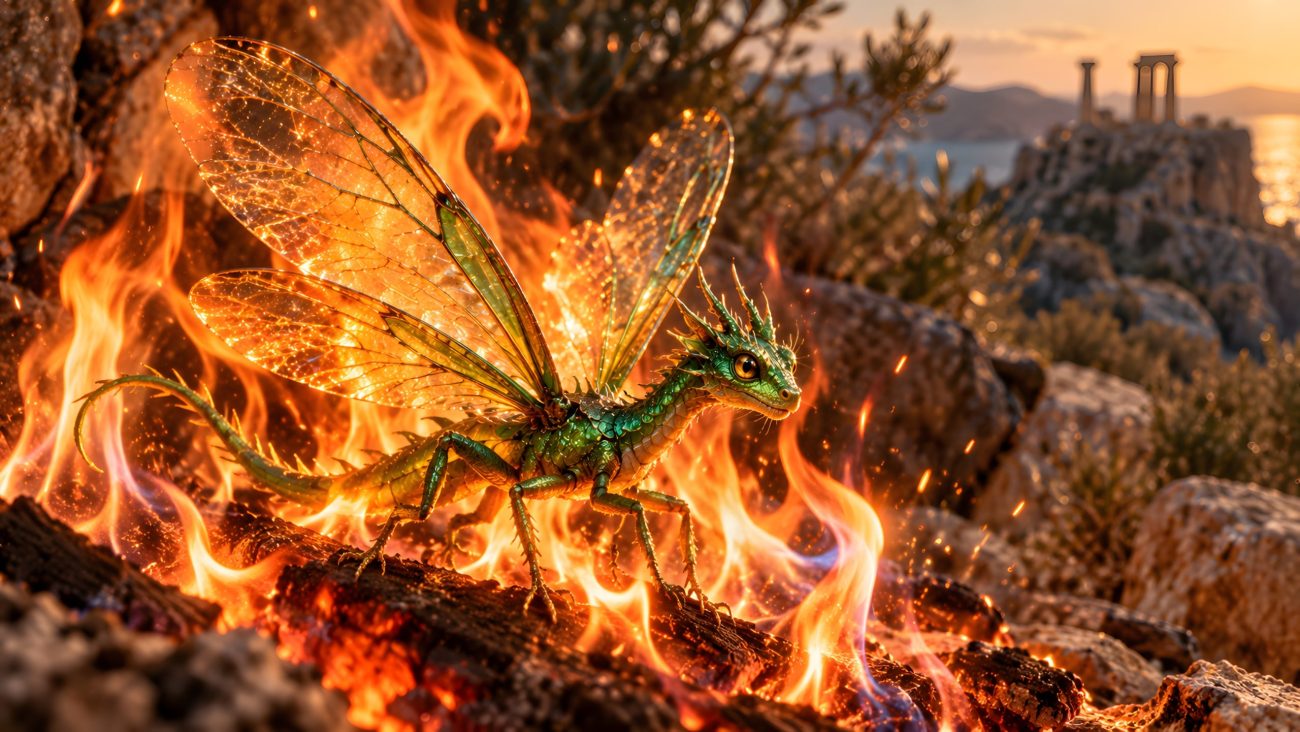
Pyrausta is a tiny, four-legged winged creature said to live within fire. It possesses the delicate, filmy wings of an insect while displaying features associated with a miniature dragon, giving it a strange nature somewhere between the two. Its body is covered in scales and it may possess horns and crests, yet even the largest males are small enough to fit within the palm of a human hand.

The creature is associated with Cyprus and was described in ancient accounts as living directly within flames, much like the legendary salamander. Fire is essential to its existence: while it remains among the flames it survives, but if it ventures too far from the fire it dies. Its entire existence is therefore bound to the heat in which it dwells.

Pyrausta is known by several names. The Greeks called it pyrallis, while pyrigonos was another Greek name for the creature. The name Pyrausta has traditionally been associated with its fiery nature.

Its appearance combines the characteristics of an insect and a tiny dragon. Although dragon-like in its scales, horns, and crests, its diminutive size and wings give it the unmistakable character of an insect. Its coloration can vary enormously, ranging across many possible colors and patterns. Some may be solid-colored, spotted, striped, faded, brilliantly vivid, glowing, flashing, or metallic, while others may have rough, smooth, or slick-scaled surfaces. Some forms can possess subdued coloration suitable for camouflage, while others are conspicuously bright.

Ancient accounts of the Pyrausta’s existence are associated particularly with Pliny the Elder’s Natural History. Later interpretations have suggested that the creature may have been inspired by a real fire-associated insect, with Melanophila acuminata proposed as a possible identification. The Pyrausta nevertheless belongs to the world of legendary creatures, where its extraordinary relationship with fire transformed a small insect into a supernatural being.


Sources

“Pyrausta.” Wikipedia: The Free Encyclopedia. Wikimedia Foundation. Accessed October 3, 2026. https://en.wikipedia.org/wiki/Pyrausta

“Pyrausta.” Warriors of Myth Wiki. Fandom. Accessed October 3, 2026. https://warriorsofmyth.fandom.com/wiki/Pyrausta


Wani

Tradition: Japanese mythology
Alternative Names: Wani
Category: Dragon


The Myth

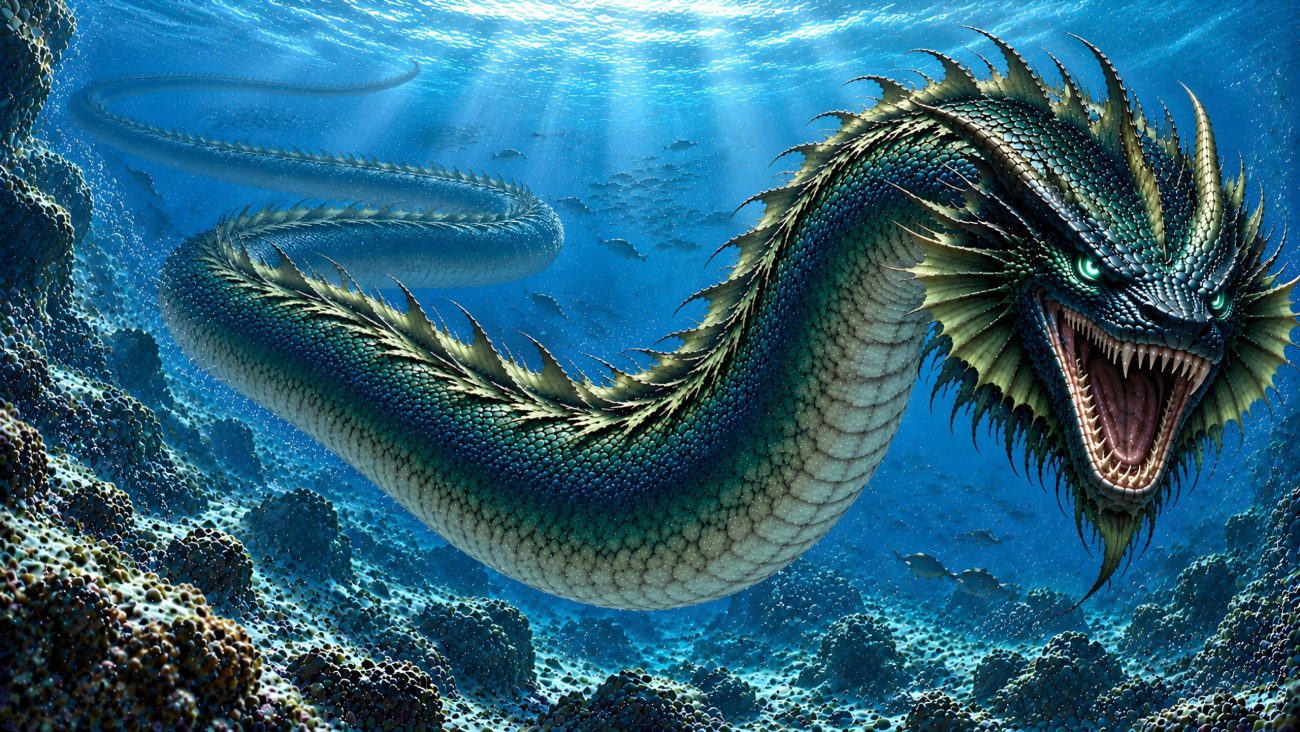
Wani are enormous sea monsters said to dwell in the depths of oceans, seas, and lakes. They possess long, serpentine bodies and fins and can breathe both air and water. Although monstrous in their natural form, wani are capable of transforming themselves into humans, and stories even tell of wani and human beings falling in love.

Wani are regarded as rulers of the oceans and gods of the sea. Far beneath the surface they dwell in magnificent coral palaces, where they maintain a society that mirrors the political world of humans. Their underwater kingdoms contain kings and queens, princes and princesses, courtiers, servants, and other ranks. Among them, Watatsumi, also known as Ryūjin, is the greatest of the sea dragons. He rules the ocean from the magnificent Ryūgū-jō and possesses the tide jewels kanju and manju, with which he controls the ebb and flow of the sea.

The wani appear in some of Japan’s earliest written mythology, particularly the Kojiki and Nihon shoki, although their stories are believed to preserve traditions considerably older than these texts. Their ultimate origins are uncertain, and similarities have been noted between the wani and other great aquatic beings such as the Chinese long and the Indian naga.

The word wani originally appeared in the Kojiki written phonetically using man’yōgana. It was later written with the character 鰐. The word came to encompass sharks and other dangerous sea creatures encountered by sailors and fishermen, perhaps reflecting the way real marine predators could become identified with the enormous serpents of mythology. Over time its meaning expanded to include crocodiles and eventually became associated specifically with crocodiles. Today, wani and the kanji 鰐 normally mean “crocodile,” even though the older mythology describes a very different kind of creature.

One of the greatest stories involving the wani concerns Toyotama-hime, the daughter of Watatsumi. She encountered Hoori, a human hero and grandson of Amaterasu, after he descended into the realm beneath the sea. Hoori had accidentally lost his brother Hoderi’s fishing hook and, unable to find it, eventually discovered the palace of the Dragon King. There he asked Watatsumi for help recovering the lost hook.

With the Dragon King’s assistance, Hoori eventually found the hook. During his stay in the underwater palace, however, he fell in love with Watatsumi’s daughter, Toyotama-hime. The two married and lived together beneath the sea for three years.

Eventually Hoori grew homesick and longed to return to the world above. He and Toyotama-hime therefore returned to the surface together, bringing Hoderi’s lost hook with them. Once back on land, Toyotama-hime became pregnant and prepared to give birth.

She warned Hoori not to look upon her during childbirth. In order to bear the child, she explained, she had to abandon her human appearance and assume her true form. But Hoori could not overcome his curiosity. He secretly looked at his wife as she gave birth and was horrified to discover that the woman he loved had become an enormous wani, cradling their newborn son.

Toyotama-hime was devastated by his betrayal and ashamed that he had witnessed her true nature. Unable to forgive him, she fled back into the sea and never again saw Hoori or the child she had given birth to.

Her sister Tamayori took responsibility for raising the abandoned child. He grew to adulthood and eventually married Tamayori. Their son was Jimmu, who became the first emperor of Japan. Through Toyotama-hime and her wani lineage, the ancient sea-dragon tradition thus became intertwined with the legendary ancestry of Japan’s imperial line.


Sources

“Wani.” Yokai.com: The Japanese Yokai Encyclopedia. Accessed October 3, 2026. https://yokai.com/wani/


Zhulong

Tradition: Chinese mythology
Alternative Names: Zhuyin, Torch Dragon, Torch Shade, Chuolong, Zhuolong
Category: Dragon


The Myth

Zhulong, the Torch Dragon, is a gigantic scarlet dragon deity with a human face and a serpent-like body. His enormous body was said to stretch for a thousand leagues, and some traditions describe him with strange vertical eyes that appear as a straight seam when closed. He dwells in the far north, in remote mountains where the sun itself does not reach, and possesses a supernatural torch-like radiance capable of illuminating the darkness.

Zhulong’s most extraordinary power is his control over light and darkness. When he opens his eyes, daylight appears across the world; when he closes them, night falls. His very presence therefore becomes part of the rhythm of day and night. His breath has a similarly cosmic effect. When he blows, winter arrives, while his call brings summer. If he truly breathes, tremendous gales arise, and the wind and rain themselves are said to answer his command.

The ancient traditions place Zhulong in different remote mountains. At Mount Bell, the deity called Torch Shade lives upon the lower slopes, illuminating the surrounding darkness with his supernatural power. He neither eats nor drinks, and in the account he does not normally breathe or sleep. His immense body lies beyond the ordinary human world, associated with the distant regions where darkness dominates.

At Mount Brillianttail, Zhulong appears as a scarlet god-human with a human face and serpent’s body. His strange eyes stand vertically upon his face. When they close, darkness covers the world; when they open, light returns. He is described as shining his torch across the “ninefold darkness,” illuminating the regions untouched by ordinary sunlight. The wind and rain are also under his command, making the dragon not merely a source of light but a cosmic power governing the elements.

An old tradition preserved by Guo Pu explains why the Torch Dragon is necessary. The sky was believed to be incomplete in the northwest, leaving that region without the normal balance of yin and yang. A dragon therefore carried a torch in its mouth to illuminate the heavens. Zhulong’s light becomes a supernatural answer to the places where the sun cannot reach.

The Songs of Chu preserves the same mystery surrounding the Torch Dragon. Its Heavenly Questions asks where the sun does not shine and how the Torch Dragon illuminates that hidden region. Elsewhere, the Torch Dragon is associated with the frozen northern mountains, appearing as a blazing red presence in the darkness.

The Huainanzi places the Torch Dragon even farther beyond the reach of sunlight. He dwells north of Wild Goose Gate and hides within Abandoned Wings Mountain, a place where he never sees the sun. Here his body is described differently: he has a human face and a dragon’s body but no feet. Despite the variations in his physical form, his association with the remote northern darkness and supernatural illumination remains constant.

A later tradition preserves a related image of a gigantic dragon carrying a torch through the darkness of the far north. In this account, the dragon travels to a mountain that neither the sun nor moon illuminates and holds a torch in its jaws, lighting the mountain completely. Strange luminous plants grow there, their glowing stalks serving as torches in the darkness.

Zhulong is therefore far more than a conventional dragon. He is a cosmic being whose body and actions are woven into the structure of the world itself. His opening eyes bring daylight, his closing eyes bring night, his breath summons the seasons and winds, and his torch penetrates the darkness where the sun cannot reach.


Sources

“Zhulong (mythology).” Wikipedia: The Free Encyclopedia. Wikimedia Foundation. Accessed October 3, 2026. https://en.wikipedia.org/wiki/Zhulong_(mythology)


Zmeu

Tradition: Romanian mythology
Alternative Names: Zmei, Zmeoaică, Zmeoaice
Category: Dragon


The Myth

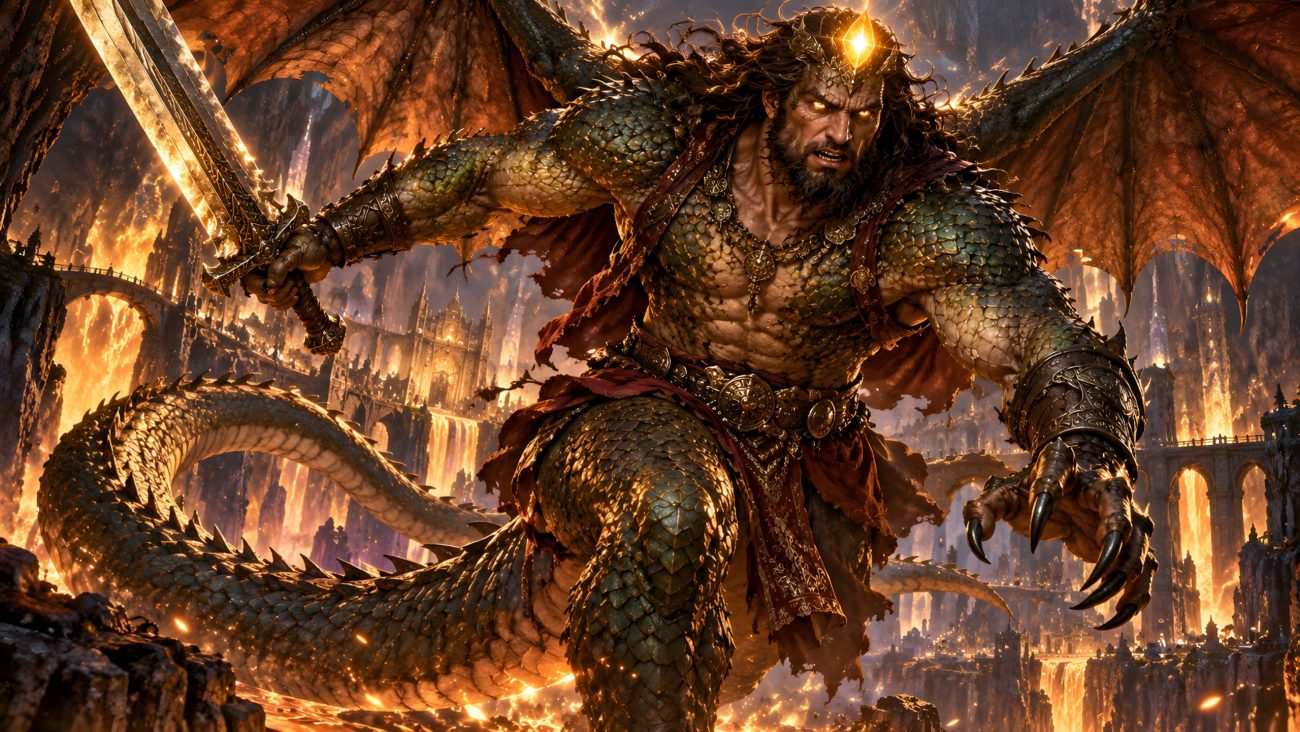
The Zmeu is a strange and formidable creature, neither fully dragon nor fully human. It is often imagined as a humanoid being with arms and legs, a human-like face, and a large, thick body. Some descriptions give it a body covered in scales, a serpent’s tail, and bat-like wings, while others describe a man’s head upon a bird-like body ending in a serpent’s tail. It can speak, ride a horse, wield weapons, create magical objects, and move through the world much like a monstrous human warrior. Some traditions instead portray the Zmeu as an enormous man-eating giant with a rocky tail, while others reduce it to a somewhat larger and heavier human figure.

The creature can also take more overtly supernatural forms. Some Zmei fly through the sky breathing fire, while others can change their shape. They may appear as a living trail of flame or something resembling fireworks moving through the night sky. In certain stories, the Zmeu possesses a magical precious stone fixed to its head, shining with a brilliance like the sun. Other tales reduce the creature to a king of serpents, while popular tradition sometimes confuses the Zmeu with the Balaur, another Romanian dragon. The supernatural creatures ridden by the Șolomonarii are likewise identified as either Zmei or Balauri depending on the tradition.

The Zmeu is one of the great adversaries of Romanian fairy-tale heroes. It commonly dwells in the other world, celălalt tărâm, sometimes beneath the earth in a dark and supernatural kingdom. From there it enters the human world to steal treasures, abduct women, or impose its destructive power upon mankind. Its enormous strength, ability to fly and shapeshift, and mastery of magical objects make it a formidable enemy, but its powers ultimately fail against the courage and martial skill of the heroic Făt-Frumos.

The Zmeu is especially associated with greed and selfishness. It steals things of immense value, forcing a heroic prince to journey into danger and recover what has been taken. In the ballad of Greuceanu, the creature commits one of its greatest acts of theft: it steals the sun and the moon from the sky, plunging humanity into darkness. Greuceanu must confront the supernatural forces responsible and restore light to the world.

In Prâslea the Brave and the Golden Apples, the Zmeu repeatedly steals the king’s precious golden apples. Prâslea follows the trail of the theft into the supernatural realm, pursuing the creature into its dark domain. In some forms of the tale, the Zmeu can even transform into a bird while stealing the apples, linking the Romanian story to a wider family of European tales in which a magical bird carries away a king’s precious treasure.

The Zmeu is also a kidnapper of young women. It frequently carries a beautiful maiden away to its otherworldly fortress, intending to make her his wife. The heroic Făt-Frumos then enters the Zmeu’s realm, confronts the monster, and kills it, freeing the captive woman. She subsequently becomes the hero’s bride-to-be. The Zmeu can therefore stand between the hero and both the treasure and the woman he must rescue, making the confrontation a struggle against the creature’s greed, violence, and desire to possess what belongs to the human world.

The creature’s courtship can take an even more sinister form. Sometimes a Zmeu appears not as a monstrous warrior but as a flame entering the chamber of a young girl or widow. Once inside, the flame transforms into a man and attempts to seduce her. Its ability to cross from supernatural fire into human form makes the Zmeu a particularly uncanny presence: it can arrive as something apparently impossible, only to become a human-looking lover once it reaches its victim.

The Zmeu is almost invariably overcome by the courage of a young prince or wandering knight. Its supernatural strength and magical abilities cannot compensate for the hero’s determination and martial skill. Whether it has stolen the sun and moon, carried away golden apples, or abducted a maiden into its underground kingdom, the creature ultimately becomes the monster standing between Făt-Frumos and the restoration of order.

The female Zmeu is known as the Zmeoaică, and the plural forms are Zmei and Zmeoaice. Together, the Zmei occupy a broad place in Romanian folklore, sometimes resembling dragons, giants, ogres, devils, vampires, or monstrous serpent-kings. Yet their distinctly human qualities—walking on two legs, speaking, riding horses, making weapons, taking lovers, and ruling supernatural kingdoms—set them apart from the purely animal-like dragon.


Sources

“Zmeu.” Wikipedia: The Free Encyclopedia. Wikimedia Foundation. Accessed October 3, 2026. https://en.wikipedia.org/wiki/Zmeu


Zmei

Tradition: Russian Mythology
Alternative Names: Zmey, Zmeya, Zmiy, Zmeyevich
Category: Dragon


The Myth

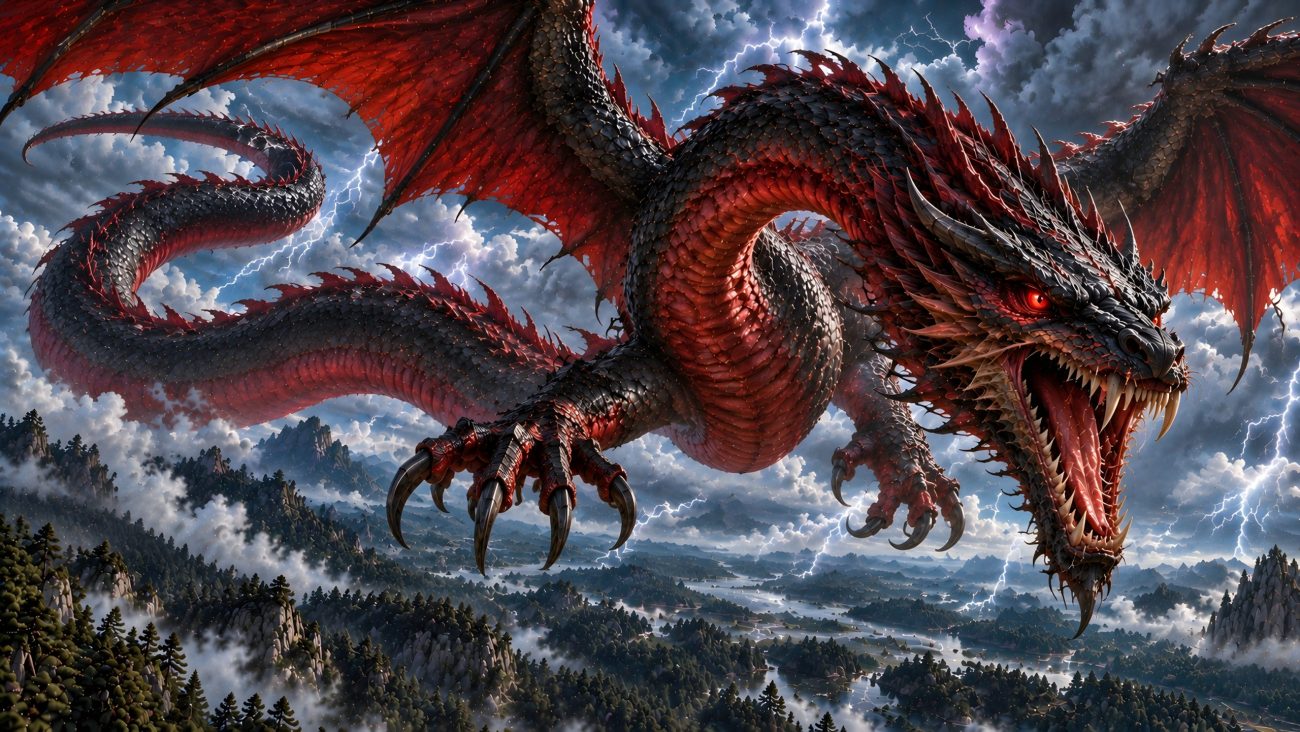
The Zmei is a flying dragon-serpent of Russian folklore, although its appearance can vary considerably. Later descriptions portray it covered in green or red scales with iron claws, while many Zmei are monstrous creatures with multiple heads. They may possess three, six, nine, or twelve heads, and some are capable of breathing fire. The name itself simply means “serpent,” but when used for a dragon it generally implies a flying serpent. Female dragons are called Zmeya, and while male dragons are more common in prose folktales, female dragons appear frequently in epic poetry.

The Zmei is not always purely beast-like. It can move between the forms of serpent, dragon, and human, sometimes appearing as a handsome young man capable of enchanting or seducing women. In the tale of The Milk of Wild Beasts, a Zmei takes the form of a beautiful youth and becomes involved with the family of Ivan Tsarevich. The creature’s shapeshifting can become extraordinarily elaborate: it may disguise itself as ordinary household objects such as a broom, a mop, or an oven fork, attempting to remain hidden from those searching for it. Ivan’s loyal animals, however, are able to recognize the supernatural intruder. In The Crystal Mountain, a Zmei even assumes the form of a golden goat.

The most terrifying Zmei are those with many heads. In Ivan the Peasant’s Son and the Little Man the Size of a Finger, dragons with three, six, nine, and twelve heads appear in succession, each becoming a greater challenge for the hero. The twelve-headed dragon is so difficult to destroy that even after Ivan cuts away almost all of its heads, the final head requires the strength of six men supplied by the Tsar.

Closely related creatures appear in the form of the Chudo-Iudo, monstrous humanlike beings who ride horses and possess several heads. Their heads can even grow back after being cut off, making them extraordinarily difficult to kill. Their supernatural nature blurs the boundary between human warrior and dragon, a characteristic that appears throughout Zmei folklore.

The Zmei can also take on a more human character. The famous Tugarin Zmeyevich is a serpent-like hero and monster who can ride a horse as a human warrior would. He confronts the bogatyr Alyosha Popovich and is eventually slain. Tugarin possesses the enormous appetite associated with a dragon, even swallowing an entire swan and spitting out its bones. He is also described with wings, although some songs rationalize these as artificial paper wings attached to his horse. His character combines the appearance and powers of a dragon with the behavior of a human warrior and pagan adversary.

Another celebrated Zmei is Zmei Gorynych, the “Serpent Gorynych,” a distinctly dragon-like creature associated with water, fire, and numerous heads. He may possess anywhere from three to twelve heads and is capable of breathing fire. Yet even Gorynych is not always a purely monstrous beast and can appear in human form. In Russian heroic tradition, Zmei Gorynych and similar Zmei frequently become adversaries of the bogatyri, including heroes such as Dobrynya Nikitich.

The epic ballad Dobrynya and the Zmei tells of a dragon dwelling around the Puchai River and the caves of the Saracen Mountains. The creature raises its young there and keeps captives within its lair. Possessing the power of flight, it can travel great distances, and one such Zmei flies all the way to Kiev to abduct a princess. Dobrynya eventually confronts and destroys the creature.

The Zmei’s ability to appear as a human also gives it a darker role as a supernatural lover. In The Milk of Wild Beasts, a Zmei takes the form of a handsome young man and seduces the sister of Ivan Tsarevich. She then pretends to be ill and sends Ivan on a dangerous quest to obtain the milk of a wolf, a bear, and a lioness. When Ivan is eventually separated from his magical animal companions, the Zmei reveals its true nature and prepares to devour him. A closely related tale replaces the princess with Ivan’s unfaithful wife and features Zmei Zmeyevich, the “Serpent, Son of Serpent.”

The Zmei can also appear in tales as the lover of the sorceress Marinka. Zmei Gorynych or Tugarin Zmeyevich enters the story as her supernatural lover, although their roles are brief and they are swiftly killed. In some traditions, Zmei Zmeyevich even appears as a tsar, showing how far the creature can move between the forms of monster, warrior, lover, and ruler.

Among the most famous enemies of the Zmei are the Russian bogatyri, whose battles with these creatures turn the dragon-serpent into a symbol of the supernatural adversary standing against the heroic warrior. Across Russian wonder tales and epic poetry, the Zmei therefore occupies an unusual space: it may be an enormous many-headed dragon, a flying serpent, a fire-breathing beast, a seductive young man, or a nearly human warrior bearing the blood and nature of a serpent.


Sources

“Zmei (Russian folklore).” Wikipedia: The Free Encyclopedia. Wikimedia Foundation. Accessed October 3, 2026. https://en.wikipedia.org/wiki/Zmei_(Russian_folklore)
Yinglong

Tradition: Japanese mythology, Chinese mythology
Alternative Names: Yinglong, Winged Dragon, Flying Dragon
Category: Dragon


The Myth

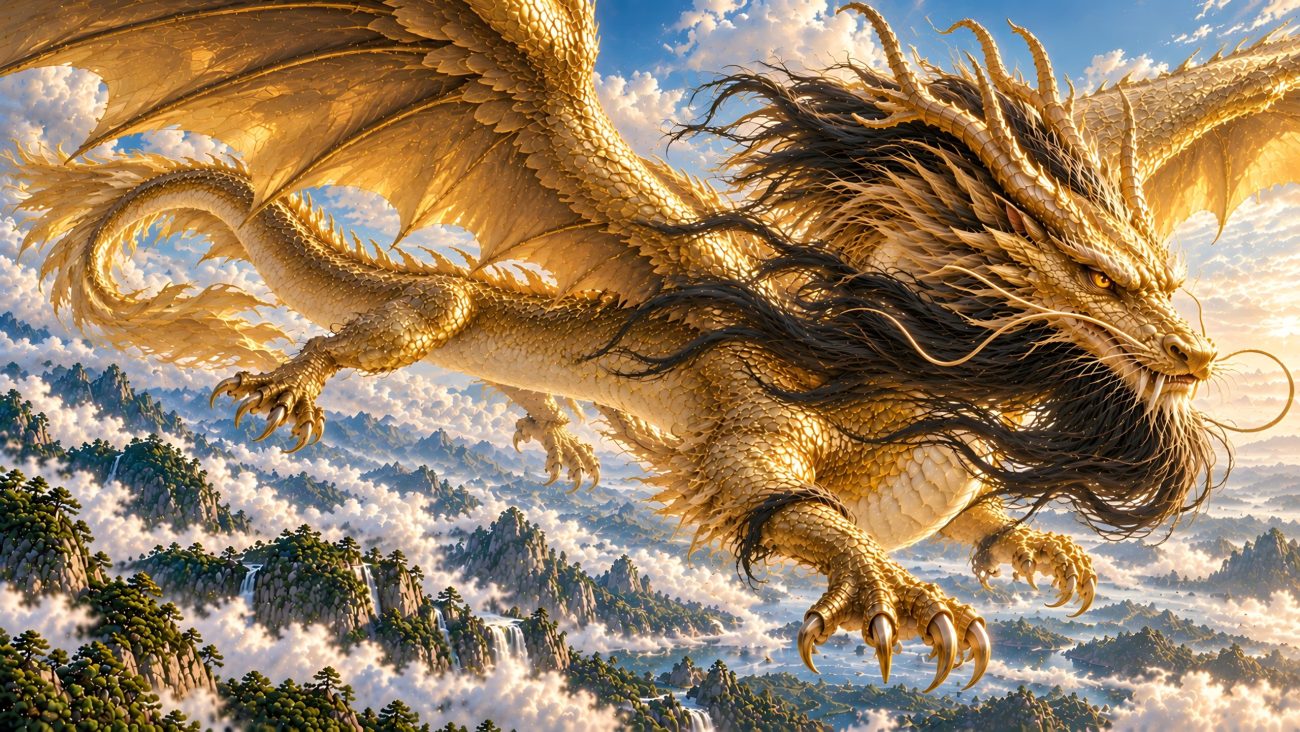
Yinglong is a winged dragon, distinguished from other dragons by its great wings. It is generally depicted with a dragon’s body and wings, although some representations give it the head of a dragon and the body of a bird. Its wings and tail feathers may even resemble the fins of a fish, giving the creature an unusual combination of dragon, bird, and aquatic features.

According to the Sancai Tuhui, Yinglong dwells on Gongqiu Mountain. The winged dragon also appears in several great stories of ancient Chinese mythology, where it becomes involved with the Yellow Emperor, Chiyou, Nuwa, and Yu.

During the great war between the Yellow Emperor and Chiyou, the Yellow Emperor commanded Yinglong to attack the fields of Ganyi. The dragon’s powers were therefore brought directly into the struggles of the ancient divine rulers.

Yinglong was later subdued by Nuwa, who made the powerful dragon serve as the beast that pulled her vehicle. Yu, meanwhile, encountered Yinglong during his legendary efforts to control the great floods. As Yu worked to bring the waters under control, Yinglong used its tail to draw characters upon the ground, marking out the paths by which the waters could be guided. In this role the dragon became a guardian of the waters and an aid in one of the greatest acts of flood control in Chinese mythology. This account was later transmitted directly into Japan through the Wakan Sansai Zue.

The Shanhaijing, in its Dadong Huangjing, places Yinglong at the southern end of the world. There the dragon is said to have become unable to return to Heaven because it had killed Chiyou and Kuafu. Its presence upon the earth was consequently associated with drought, and Yinglong was said to bring drought across the land. Yet the dragon also possessed a strange connection with rain: if people imitated the form of Yinglong, heavy rain was said to follow.

The Huainanzi presents Yinglong within a different kind of cosmic lesson. It describes the soaring serpent moving through mist and Yinglong rising upon clouds, alongside other creatures whose abilities become effective when they encounter the environment suited to them. The passage emphasizes that every being has its own particular strengths and must fulfill its proper role.

The image of Yinglong continued into the artistic traditions of China and Japan. Dragons possessing the same characteristic wings are sometimes called “Flying Dragons” in paintings and decorative sculpture. At Nikkō Tōshōgū Shrine, for example, two such Flying Dragons are carved soaring above waves in the Water Pavilion.

These winged dragons are frequently shown together with waves and flowing water. Their imagery came to be associated with protection against fire, while their connection with water gave them an auspicious character. The tradition also became linked with the legend of the carp climbing the Dragon Gate waterfall and transforming into a dragon, making the dragon and the Dragon Gate motif symbols of transformation and good fortune.


Sources

Takahashi, Toshihiro. “応竜 [おうりゅう] (Yìnglóng).” 新版TYZ 妖怪図鑑 (New TYZ Yokai Encyclopedia). October 21, 2024. https://tyz-yokai.blog.jp/archives/1082948842.html


Enryū

Tradition: Japanese mythology, Chinese mythology
Alternative Names: Yanlong, Salt Dragon, Shio Ryū
Category: Dragon


The Myth

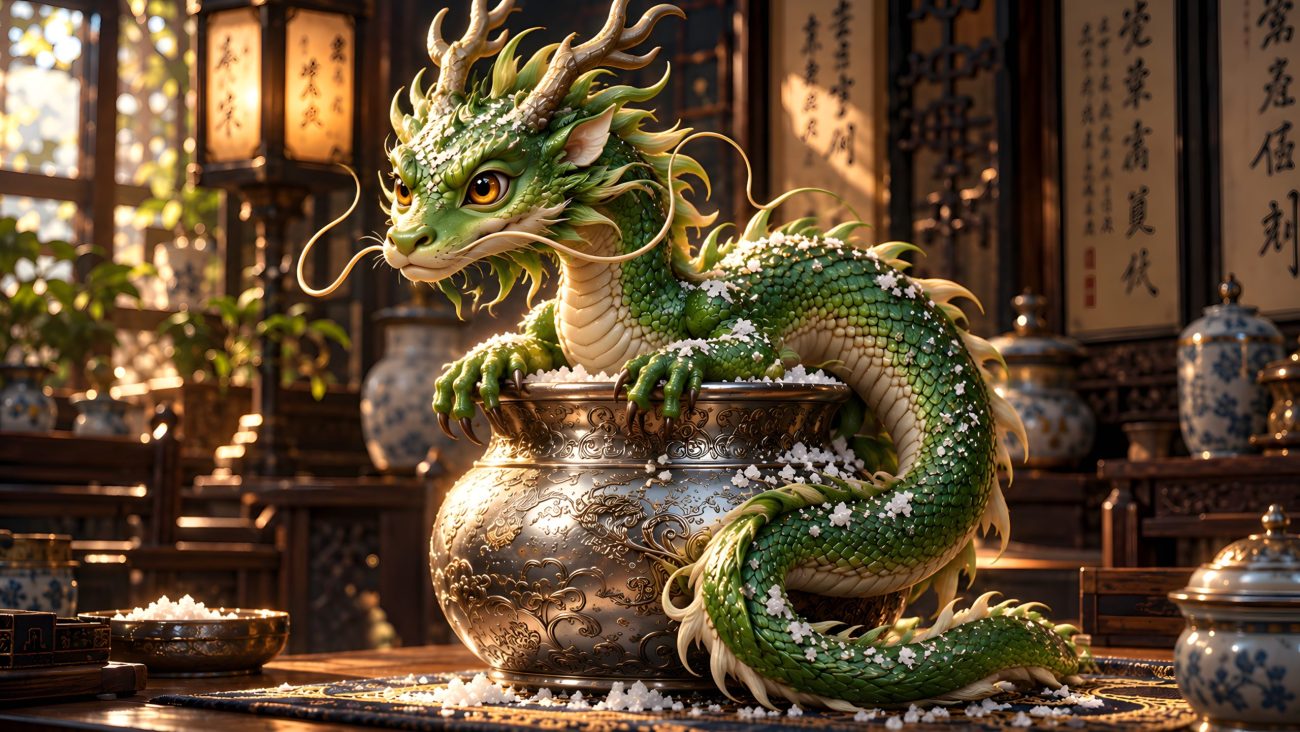
Enryū, the Salt Dragon, was a strange little dragon believed to produce a valuable substance used in tonics. Unlike the enormous dragons of storms and rivers, the Salt Dragon was described as a creature only about one foot long. Its body was covered in scales from which salt could mysteriously emerge.

According to the Compendium of Materia Medica, quoting the Records of Spring Shore, the creature was obtained during the Northern Song dynasty in the reign of Emperor Huizong. Xiao Zhu encountered a Salt Dragon while defeating the Nanman and brought the strange creature into his possession.

The dragon was kept in a silver tub with a jade bowl inside. It was fed salt taken from seawater, and after consuming the salt, more salt would seep from between its scales. The substance produced by the living dragon was regarded as medicinal. Taken together with warm wine, it was believed to increase yang energy and strengthen vitality.

Cai Jing, also called Cai Yuandu in the Records of Spring Shore, was said to have possessed one of these dragons. His Salt Dragon eventually died, however, in a rather peculiar manner. Cai attempted to obtain salt directly by licking the creature’s body. The dragon’s carcass was subsequently preserved by salting it. Even in death it retained value, since a tonic could still be extracted from the preserved body, although its effectiveness was believed to gradually diminish.

The Japanese commentary Bencao Gangmu Keimō repeated the account of the Salt Dragon but admitted that its nature was “not detailed,” offering little additional information about the creature.

The Salt Dragon later appeared in Japanese writings as well. Yanagi Rikyo’s Hitori Ne retold the story of Cai Yuanqing and his Salt Dragon from the Harunogi Kibun. The author remarked that such creatures were rarely discussed because the country in which they were supposedly found was no longer frequently visited, and therefore recorded the strange story for posterity. The same account was subsequently quoted in Keisai Eisen’s Makura Bunko.

The creature also became a subject for Japanese artists. The Illustrated Compendium of Chinese Characters depicts a Salt Dragon peering from a silver jar while reaching toward salt offered to it on a spoon by a boy. Uoya Hokkei created another well-known image of the creature, showing a Salt Dragon receiving salt from a woman. The accompanying humorous poem compares the salt caught between the dragon’s scales to light snow resting upon the swaying branches of a willow.

Thus the Salt Dragon was imagined as a peculiar living source of salt: a tiny dragon that consumed seawater salt, produced more through its scales, and could itself become an ingredient in mysterious medicines even after death.


Sources

Takahashi, Toshihiro. “延竜 [えんりゅう] (Enryū).” 新版TYZ 妖怪図鑑 (New TYZ Yokai Encyclopedia). October 21, 2024. https://tyz-yokai.blog.jp/archives/1083002104.html


Velue

Tradition: French Mythology
Alternative Names: Velue, Peluda, “The Shaggy One,” “The Hairy One”
Category: Dragon, Turtle


The Myth

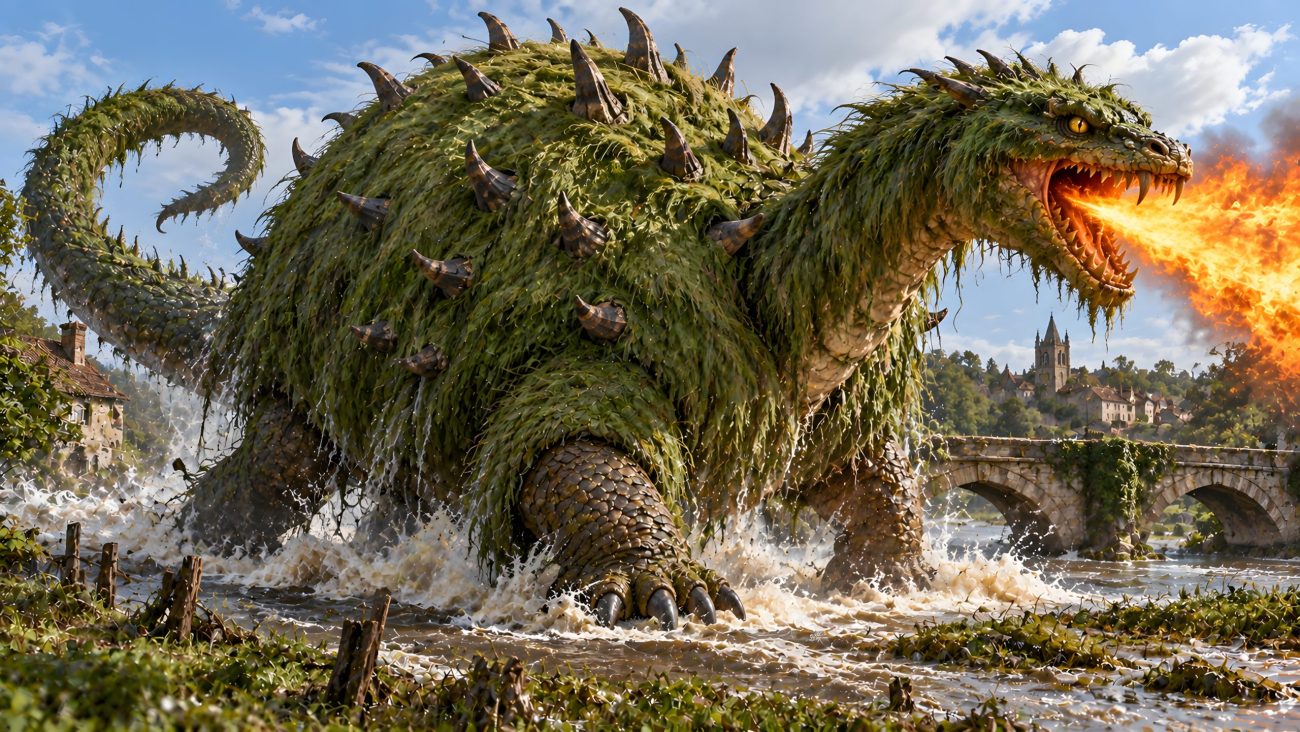
The Velue, whose name means “the shaggy one” or “the hairy one,” was a monstrous dragon said to haunt the Huisne River near La Ferté-Bernard in the Sarthe. Its body was enormous and egg-shaped, roughly the size of a large ox, and covered entirely in shaggy green fur. Sharp spikes protruded from its hairy hide, while its head resembled that of a terrifying serpent. Its immense legs were compared to those of a tortoise, and behind it dragged a powerful serpentine tail capable of killing a man or beast with a single sweep.

The Velue was said to have survived the biblical Flood after being overlooked by Noah. Having escaped the destruction of the world, the creature supposedly carried a grudge against creation and devoted the rest of its existence to destruction and spite.

It breathed fire and laid waste to farms, fields, and crops around the Huisne. Flocks of sheep disappeared down its enormous jaws, with their shepherds sometimes following them as the dragon’s dessert. Walls and moats offered little protection. The Velue was bold enough to enter the streets of the old city itself, terrifying the inhabitants and spreading destruction wherever it went.

Whenever people tried to drive it away, the monster retreated into the Huisne. Its gigantic body displaced so much water that the river overflowed its banks, flooding the surrounding countryside and ruining the fields. The dragon could therefore destroy the land whether it was upon the riverbank or beneath the water.

Women and children were said to be among the Velue’s favorite prey, and it possessed a particular appetite for agnelles, the “she-lambs” of the land—the beautiful and virtuous young women of La Ferté-Bernard. This taste eventually brought about its downfall.

After the Velue seized a young maiden and devoured her, her fiancé set out in pursuit of the monster. He followed its trail to its lair beneath an ivy-covered bridge over the Huisne. There he confronted the beast and struck at its vulnerable tail with his weapon. The blow killed the Velue instantly, bringing an end to the creature that had terrorized the countryside. Its death was celebrated throughout the region.

The story belongs to the tradition of French local dragons such as the Tarasque. Its surviving form is relatively recent: its foundations appear to reach back to the fifteenth century, while the tale was revived and considerably expanded during the nineteenth century. It never developed the major festivals or fixed iconographic traditions associated with some better-known French dragons, although a terracotta fountain sculpture dating from the seventeenth or eighteenth century, discovered in a ditch along the road to La Chapelle-Saint-Rémy, is considered the oldest surviving depiction associated with the Velue.

The association between the Velue and the word agnelles may itself preserve an older local joke. During the sixteenth century, La Ferté-Bernard sided with the Catholic League during the wars of Henri IV. Its governor, Dragues de Comnène, claimed descent from eastern kings and was known for his cunning. During a siege commanded by René de Bouillé, he sent soldiers out of the city disguised as women. The deception nearly succeeded when some of the besiegers approached the apparent damsels gallantly, only to discover that they were walking into an ambush. René de Bouillé’s forces eventually drove the disguised soldiers away, and the incident delighted Henri IV. It gave rise to jokes about the “agnelles de la Ferté“—the “she-lambs of La Ferté”—of whom, as the saying went, only two were needed to strangle a wolf.

The creature is sometimes called Peluda, but this name is a later Spanish rendering of the French Velue. Its popularity as a name for the monster owes much to Jorge Luis Borges, and it is not an original Occitan name for the dragon.


Sources

“Velue.” A Book of Creatures. January 18, 2019. https://abookofcreatures.com/2019/01/18/velue/


Sybaris

Tradition: Greek mythology
Alternative Names: Sybaris, Lamia
Category: Dragon


The Myth

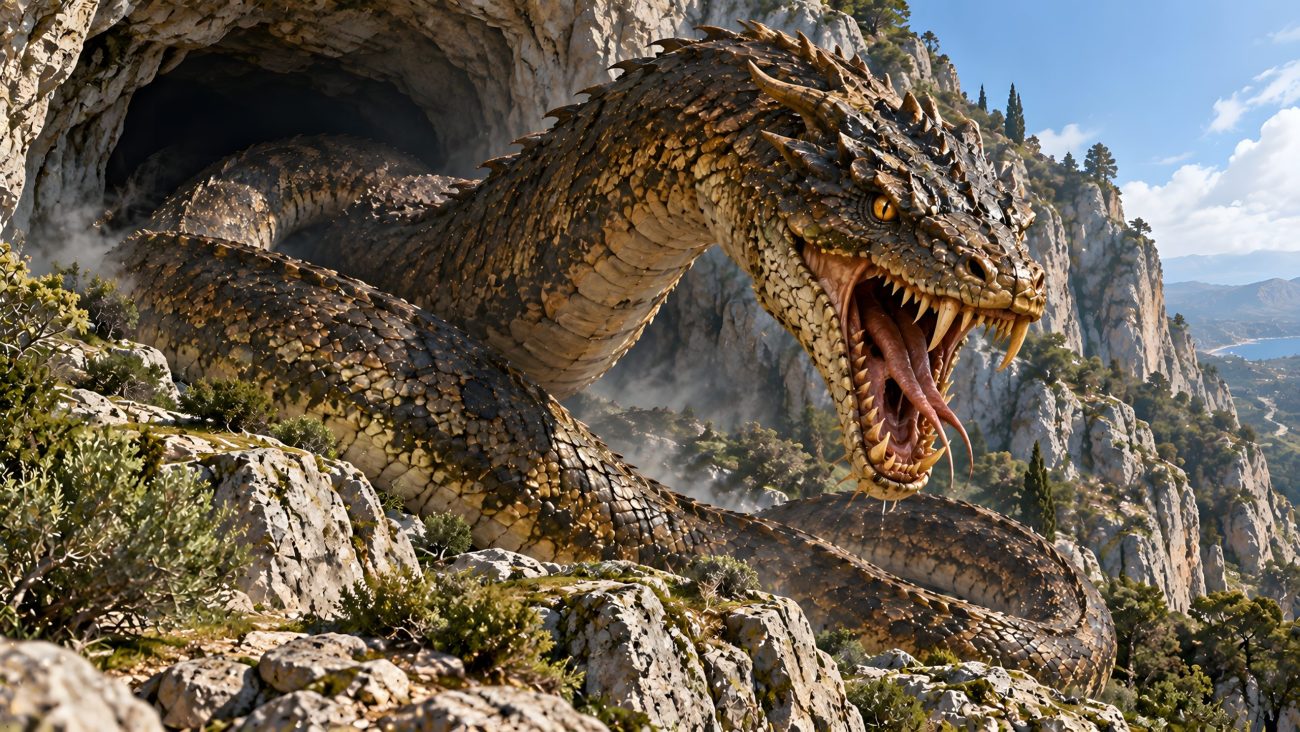
Sybaris, also called Lamia, was a gigantic and monstrous beast that lived in a vast cave on Mount Cirphis near Krisa in Greece. Although the surviving myth gives no precise description of her body, later interpretations have imagined the creature as a dragon or an anguiped, a monstrous being combining human and serpent-like features.

Every day Sybaris emerged from her mountain cave and descended upon the surrounding country, devouring both livestock and human beings. Her constant attacks became such a terror that the people of the region eventually sought help from the Oracle of Delphi, asking how they might put an end to the monster’s depredations.

Apollo’s oracle gave them a terrible answer: a young man had to be offered to the beast. The sacrifice chosen was Alcyoneus, a handsome young man, the son of Diomos and Meganeira.

As Alcyoneus was being prepared for the sacrifice, the young hero Eurybatus happened to pass through the region. Eurybatus was the son of Euphemos and a descendant of the river god Axios. Through divine inspiration he was overcome with love for Alcyoneus and could not allow the young man to be given to the monster.

Eurybatus therefore took Alcyoneus’ place as the victim and confronted Sybaris himself. Instead of allowing the beast to devour him, he seized the monster and hurled her from the mountainside. Sybaris crashed against the rocks below and was killed.

Where the monster struck the earth, a spring suddenly burst forth from the ground. The people of the region named the spring Sybaris in memory of the slain beast, and the name was eventually connected with the city of Sybaris in southern Italy, which was founded by the Locrians.

Thus the monstrous Sybaris, whose daily hunger had terrorized the people of Mount Cirphis, ultimately gave her name to a spring and, through it, to a distant city.


Sources

“Sybaris (mythology).” Wikipedia: The Free Encyclopedia. Wikimedia Foundation. Accessed October 3, 2026. https://en.wikipedia.org/wiki/Sybaris_(mythology)


Sugaar

Tradition: Basque mythology, Spanish Mythology
Alternative Names: Sugar, Sugoi, Suarra, Maju
Category: Dragon, Deity


The Myth

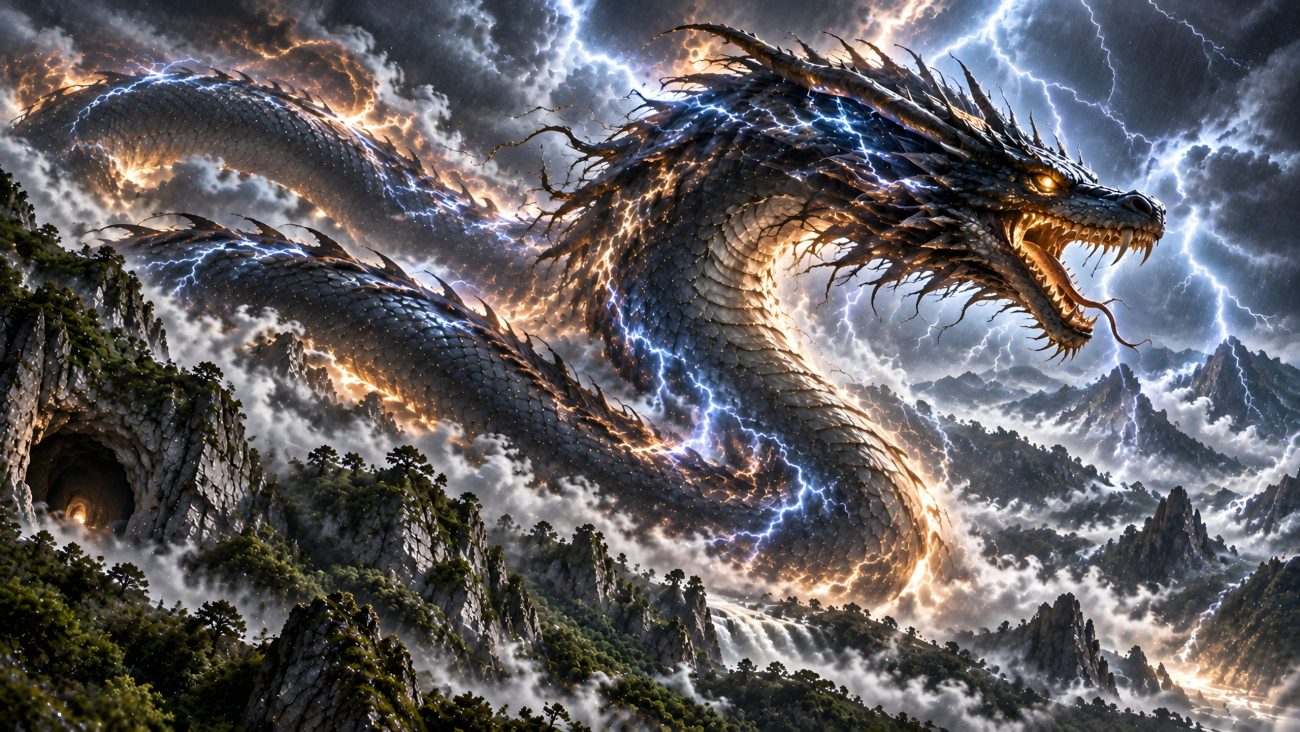
Sugaar is a powerful male serpent or dragon deity of Basque mythology, associated with storms, thunder, rain, and lightning. He may appear as pure fire or lightning, but his usual form is that of a great serpent or dragon. He is the male counterpart of the goddess Mari and is considered an ancient pre-Christian figure, with traditions surrounding him predating those concerning Herensuge.

Sugaar lives among mountains and caves, with one of his homes said to lie in the Aralar mountain range. His most famous dwelling is the cave of Baltzola, where he appears in a tale concerning two brothers from Dima.

Sugaar is Mari’s consort and is said to visit her at Mount Anboto every Friday. Their meetings are understood in different ways: Sugaar may be imagined tending Mari’s hair, while other traditions describe the two joining together and producing the great thunderstorms that sweep across the land. Their union also carries a deeper natural meaning, with Sugaar representing the rain that fertilizes the earth associated with Mari.

Yet Sugaar is not always a divine and benevolent figure. In Betelu he is regarded as an evil spirit, while in Ataun he serves as a frightening bogeyman figure. His nature therefore moves between that of an ancient storm deity and a dangerous supernatural being feared by ordinary people.

One of the most striking stories about Sugaar begins when two young brothers from Dima discover him inside the cave of Baltzola. The younger brother attacks the strange creature, cutting its tail with a stone. His elder brother disapproves of the violence, and the two leave the cave.

Years pass before the elder brother encounters a mysterious man who leads him back to the same cave at Baltzola. There the stranger gives him a box filled with gold and a red belt, instructing him to take the belt to his younger brother.

When the brothers are reunited, the younger brother refuses to wear the belt. Instead, he ties it around a chestnut tree. The moment the belt touches the tree, the tree bursts violently into flames.

The brothers suddenly understand who the mysterious stranger must have been. The man who had given them the gold and the red belt was Sugaar himself, returning years after the brothers had wounded him in his cave.


Sources

“Sugaar.” Wikipedia: The Free Encyclopedia. Wikimedia Foundation. Accessed October 3, 2026. https://en.wikipedia.org/wiki/Sugaar