Kranokolaptes

Tradition: Greek Mythology, Egyptian Mythology
Alternative Names: Head Striker
Category: Insect


The Myth

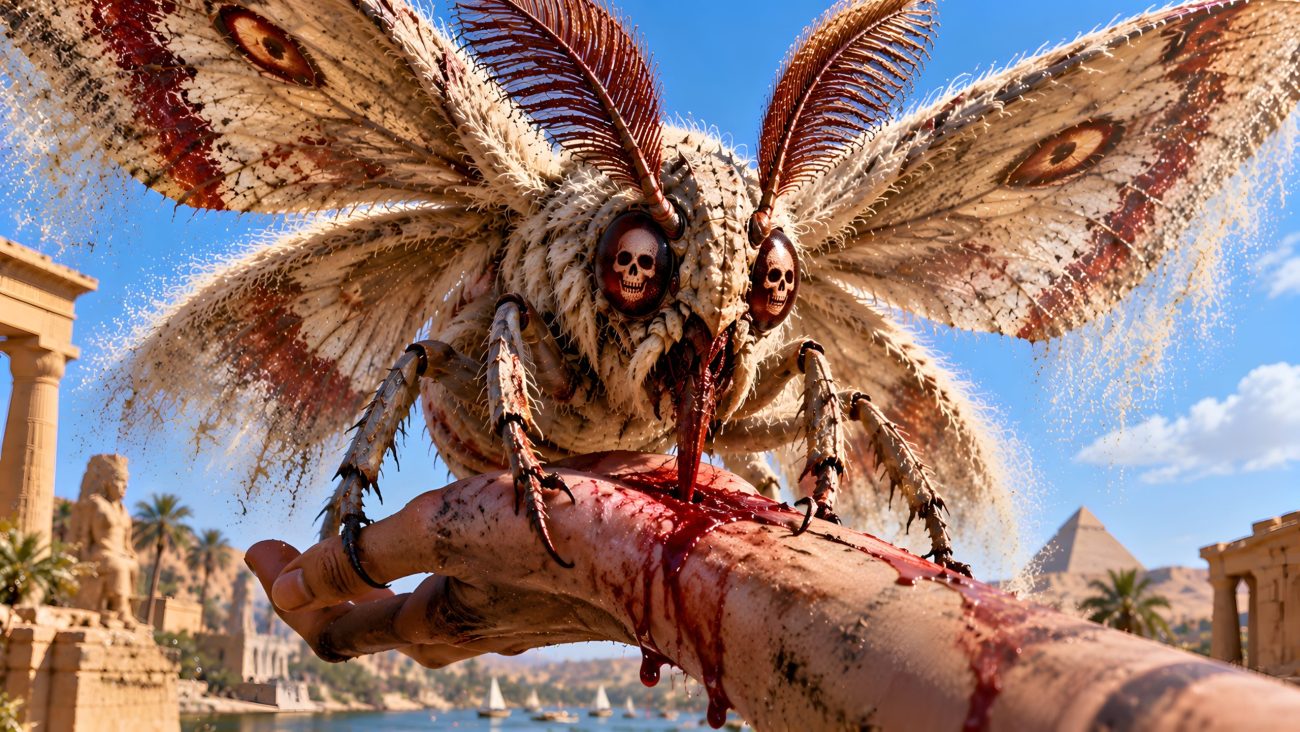
The Kranokolaptes is a deadly insect from ancient accounts of Egypt, described as resembling a moth with four soft, downy wings covered in a felt-like texture. Its wings leave behind a trail of ashy dust, while its body is thick and heavy, with a fat abdomen and a hard head that constantly nods. Beneath its head lies a deadly stinger, which the creature uses to attack humans.

The Kranokolaptes strikes at the head and neck, and its sting is said to cause instant death. Victims can survive only if treated with the creature’s own antidote: a Kranokolaptes drowned in oil. The insect is associated with the persea tree, where it develops, possibly a species of Mimusops.

Although the ancient writer Nicander classified the Kranokolaptes among spiders, its description bears little resemblance to an arachnid. Another ancient account describes it as green, though this may have resulted from a misreading of Nicander’s original description. Its deadly bite may explain why it was grouped alongside dangerous spiders despite its moth-like appearance.

Modern interpretations have suggested that the Kranokolaptes legend may have been inspired by large hawkmoths, whose thick bodies and prominent mouthparts resemble aspects of the creature. The vampire moth Calyptra thalictri offers another possible comparison because it can pierce skin to drink blood and rocks its head as it does so. However, its bite causes swelling and irritation rather than the instantaneous death attributed to the mythical Kranokolaptes.


Sources

“Kranokolaptes.” A Book of Creatures, December 12, 2016. https://abookofcreatures.com/2016/12/12/kranokolaptes/
Gold-Digging Ants

Tradition: Greek Mythology, Indian Mythology
Alternative Names: Indian Gold-Digging Ants; Myrmekes
Category: Insect


The Myth

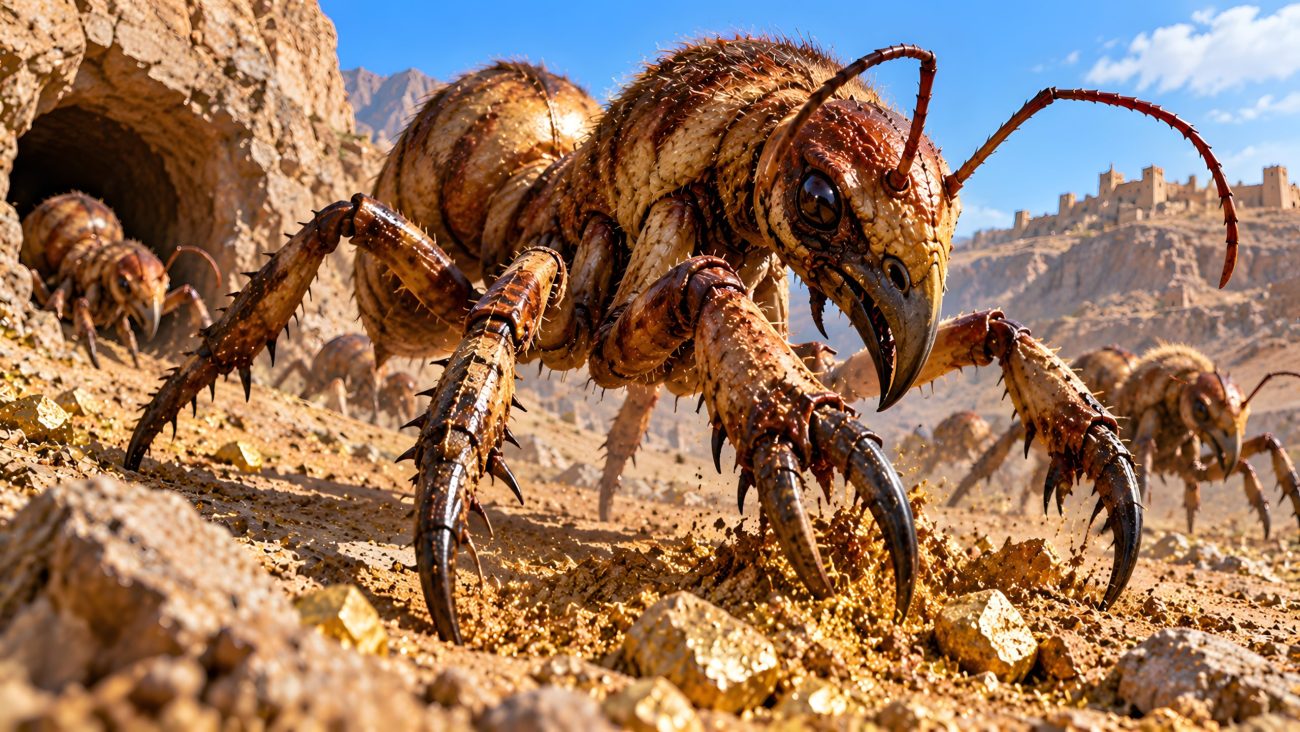
Gold-digging ants are enormous, powerful creatures said to inhabit gold-rich deserts in distant lands. Herodotus placed them in the sandy deserts of the Dards in India, within the Persian Empire, while later accounts, including the Ortus Sanitatis, relocated them to Ethiopia. Despite the differences in their supposed homeland, the stories describe creatures that dig up precious gold and fiercely defend their territory.

These creatures are smaller than dogs but larger than foxes. Pliny compared their size to that of an Ethiopian wolf and described their colour as resembling a cat. Skins attributed to the ants and presented before Alexander the Great were said to resemble panther skins. In the Ortus Sanitatis, however, the gold-digging ant looks unlike any ordinary ant or familiar animal. It has a rounded, bird-like head and four legs equipped with long talons. Whatever their appearance, the creatures are described as exceptionally swift, strong, and dangerous.

Gold-digging ants excavate their nests in areas rich in gold dust. As they dig underground, they bring sand containing the precious metal to the surface. This makes their nests tempting targets for treasure seekers, but the ants guard their riches aggressively. Anyone who attempts to steal their gold risks being caught and torn apart by the creatures.

Treasure hunters use camel caravans to raid the nests during hot summer mornings, when the ants remain underground. They rapidly collect the gold-bearing sand and load it into bags before the creatures detect their presence. However, the ants soon catch the scent of the intruders and rush to the surface. The camels must have a substantial head start, because the pursuing creatures are said to be fast enough to catch them and dismember them if they fail to escape.

The true identity of the gold-digging ants remains uncertain. Various explanations have suggested that they were not insects at all, but mammals whose digging habits and ferocity inspired the stories. Proposed candidates include hyenas, whose Persian name may have resembled the Greek word for ant, and Siberian foxes, which are known for digging and fierce behaviour. Another theory identifies the creatures as Himalayan marmots, whose extensive burrowing could bring gold-bearing material to the surface. According to this explanation, the Greek word murmex, meaning ant, may have contributed to confusion between ants and marmots.


Sources

“Gold-Digging Ant.” A Book of Creatures, August 22, 2016. https://abookofcreatures.com/2016/08/22/gold-digging-ant/


Indus Worm

Tradition: Greek Mythology, Indian Mythology
Alternative Names: Worms of the Indus
Category: Insect


The Myth

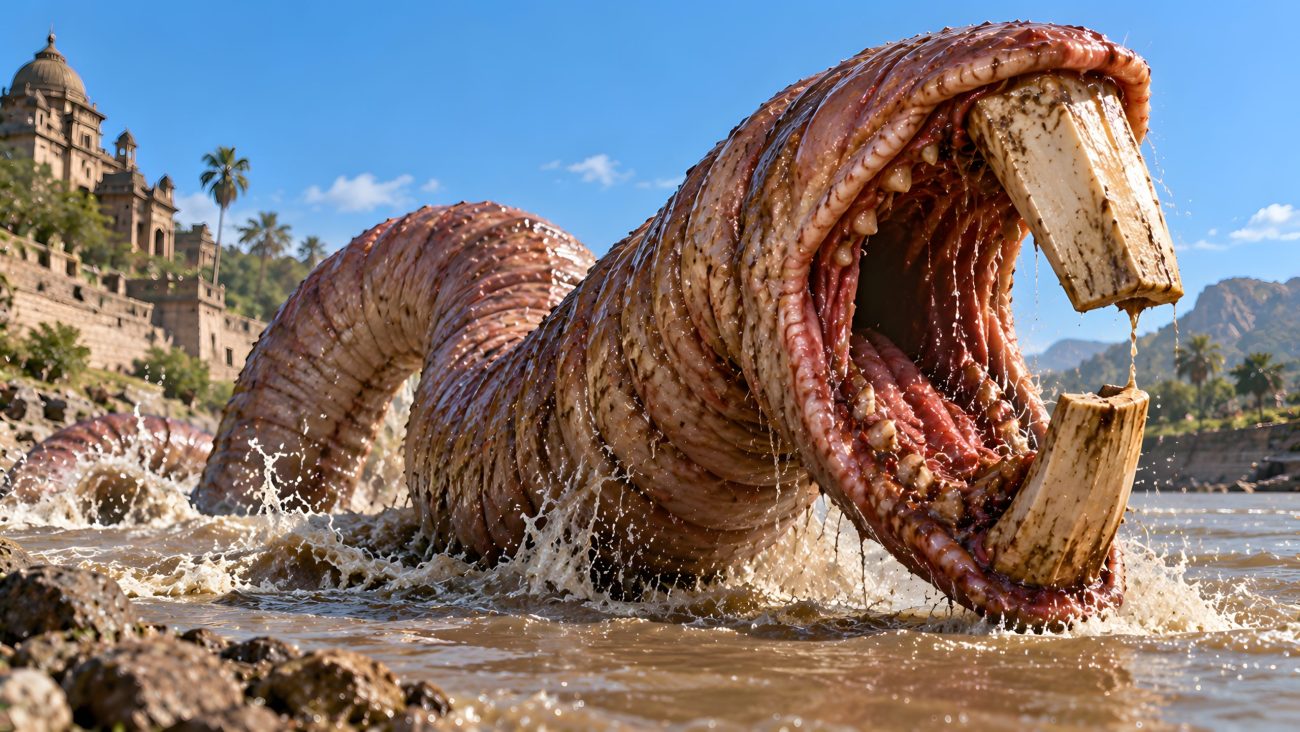
The Indus worm is a gigantic aquatic predator said to inhabit the Indus River in India. It resembles the worms found in figs or rotten wood, but grows to an enormous size, measuring around seven cubits, or more than three metres, in length. Its body is so thick that a ten-year-old boy could barely wrap his arms around it, and its skin is approximately two fingers thick. Its most terrifying features are two enormous, square teeth, one in its upper jaw and one in its lower jaw, each measuring about eighteen inches long.

During the day, the worms remain submerged in the river, wallowing in the mud. At night, they emerge to hunt animals as large as cows and camels. They seize their prey, drag it into the water, and devour it at leisure, crushing flesh, bone, and even stone with their immense teeth. Only the animal’s paunch is left uneaten. There are also accounts of hungry worms attacking drinking camels and oxen in broad daylight, grabbing them by the nose and dragging them beneath the water.

Despite their terrifying nature, the Indus worms are prized for the oil contained within their bodies. This oil is extraordinarily flammable and can consume wood and animals alike. Fires started with it are said to be almost impossible to extinguish, requiring large quantities of clay and rubbish to smother the flames. Because the oil is so rare and valuable, only the king of India is permitted to possess it, and it is stored in clay vessels for use as a devastating weapon during sieges.

Obtaining the oil requires a dangerous expedition. Hunters capture a worm using a hook baited with a lamb or kid chained to it. Once the creature is hauled ashore, it is killed with javelins, swords, and clubs. The carcass is then suspended for thirty days, with vessels placed beneath it to collect the oil that slowly drips from its body. A single worm yields approximately five pints of oil before its remains are discarded and the precious substance is sent to the king.

The Indus worm has sometimes been compared to the Odontotyrannus, another legendary creature associated with India. Both are described as dangerous predators connected with aquatic environments, although their other characteristics differ.


Sources

“Indus Worm.” A Book of Creatures, October 3, 2016. https://abookofcreatures.com/2016/10/03/indus-worm/


Pyrausta

Tradition: Greek mythology, Italian Mythology, Roman Mythology
Alternative Names: Pyrallis, Pyrigonos
Category: Insect, Dragon


The Myth

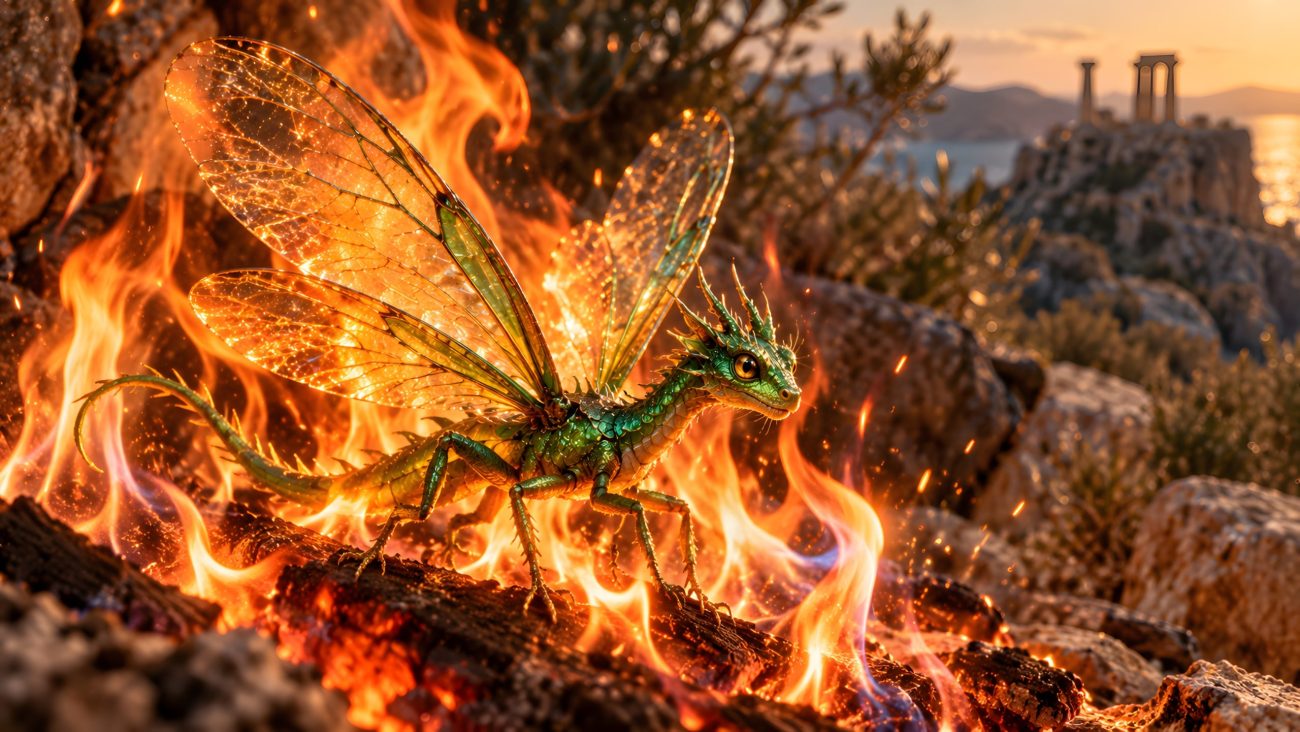
Pyrausta is a tiny, four-legged winged creature said to live within fire. It possesses the delicate, filmy wings of an insect while displaying features associated with a miniature dragon, giving it a strange nature somewhere between the two. Its body is covered in scales and it may possess horns and crests, yet even the largest males are small enough to fit within the palm of a human hand.

The creature is associated with Cyprus and was described in ancient accounts as living directly within flames, much like the legendary salamander. Fire is essential to its existence: while it remains among the flames it survives, but if it ventures too far from the fire it dies. Its entire existence is therefore bound to the heat in which it dwells.

Pyrausta is known by several names. The Greeks called it pyrallis, while pyrigonos was another Greek name for the creature. The name Pyrausta has traditionally been associated with its fiery nature.

Its appearance combines the characteristics of an insect and a tiny dragon. Although dragon-like in its scales, horns, and crests, its diminutive size and wings give it the unmistakable character of an insect. Its coloration can vary enormously, ranging across many possible colors and patterns. Some may be solid-colored, spotted, striped, faded, brilliantly vivid, glowing, flashing, or metallic, while others may have rough, smooth, or slick-scaled surfaces. Some forms can possess subdued coloration suitable for camouflage, while others are conspicuously bright.

Ancient accounts of the Pyrausta’s existence are associated particularly with Pliny the Elder’s Natural History. Later interpretations have suggested that the creature may have been inspired by a real fire-associated insect, with Melanophila acuminata proposed as a possible identification. The Pyrausta nevertheless belongs to the world of legendary creatures, where its extraordinary relationship with fire transformed a small insect into a supernatural being.


Sources

“Pyrausta.” Wikipedia: The Free Encyclopedia. Wikimedia Foundation. Accessed October 3, 2026. https://en.wikipedia.org/wiki/Pyrausta

“Pyrausta.” Warriors of Myth Wiki. Fandom. Accessed October 3, 2026. https://warriorsofmyth.fandom.com/wiki/Pyrausta