Cyclops

Tradition / Region: Greek Mythology, Italian Mythology
Alternate Names:
Category: Giant


The Myth

The Cyclopes are giant one-eyed beings from Greek mythology, later adopted into Roman mythology. Ancient traditions describe several different kinds of Cyclopes, ranging from divine blacksmiths to savage man-eating giants.

In Hesiod’s Theogony, the first Cyclopes were three powerful brothers named Brontes, Steropes, and Arges. They were the sons of Uranus, the sky, and Gaia, the earth. Each possessed a single eye in the center of the forehead and enormous strength. Their names were associated with thunder and lightning, reflecting their connection to storms and divine weapons.

Their father Uranus feared his monstrous children and imprisoned them deep within Tartarus. Later, after Zeus rebelled against the Titans, he freed the Cyclopes from their prison. In gratitude, the Cyclopes forged the thunderbolt of Zeus, the trident of Poseidon, and the helm of invisibility used by Hades. With these weapons, the Olympian gods defeated the Titans and established their rule over the cosmos.

Later myths describe the Cyclopes as master smiths working beside Hephaestus, the god of fire and metalworking. Ancient poets placed their forge beneath volcanic mountains such as Mount Etna in Sicily and the Aeolian Islands. There the Cyclopes forged divine weapons and armor amid smoke, fire, and the roar of the earth. The sound of thunder and volcanic eruptions was sometimes imagined as the labor of the Cyclopes beneath the mountains.

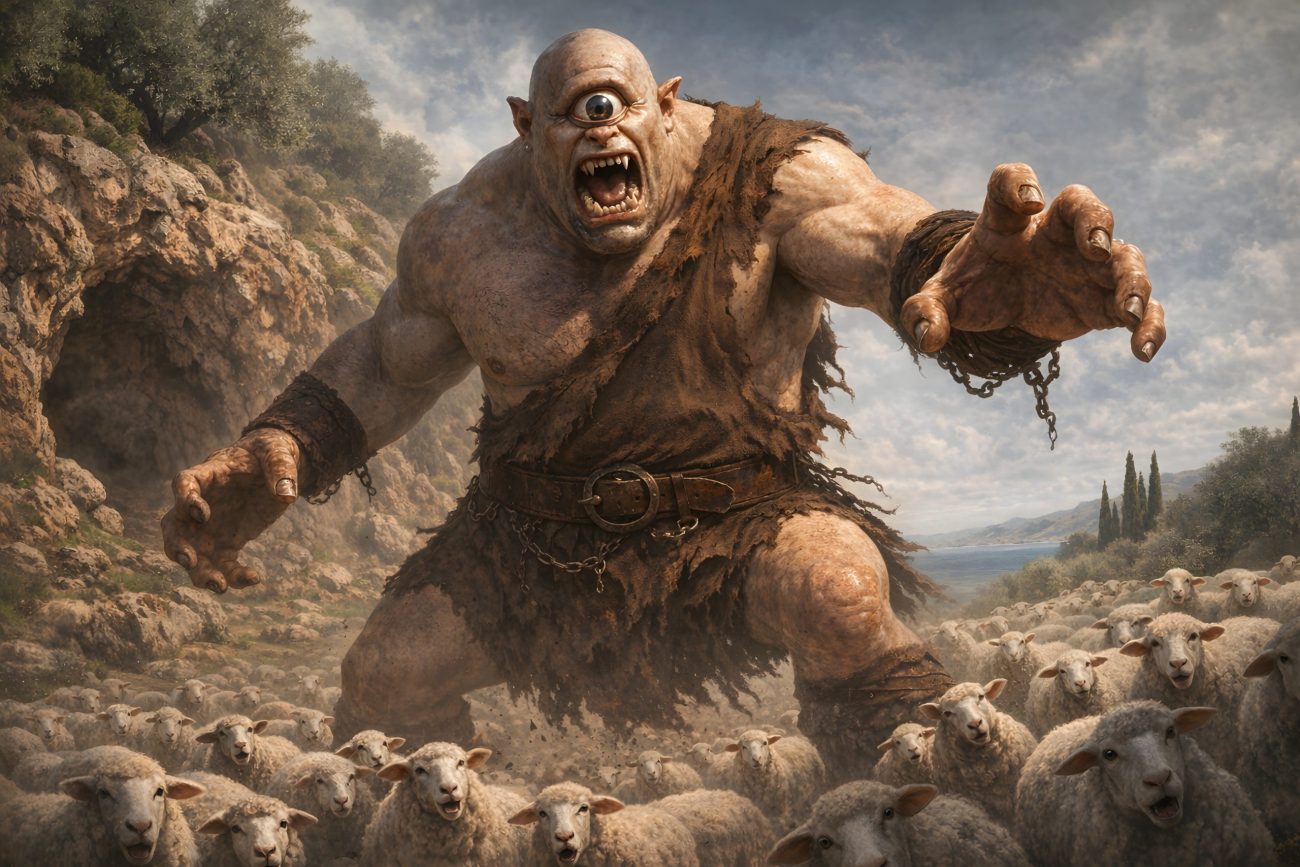
Another famous tradition appears in Homer’s Odyssey. These Cyclopes were no longer divine craftsmen but wild and uncivilized giants who lived apart from society. They dwelled in caves, kept flocks of sheep, and ignored laws, agriculture, and hospitality. The most famous among them was Polyphemus, the giant son of Poseidon.

During his journey home from the Trojan War, Odysseus and his companions entered the cave of Polyphemus searching for food and shelter. The Cyclops returned, sealed the entrance with a massive stone, and began devouring the trapped sailors. Odysseus devised a plan to escape. After offering the giant strong wine, he told Polyphemus that his name was “Nobody.” Once the Cyclops fell asleep, Odysseus and his men sharpened a wooden stake and drove it into his single eye, blinding him.

When the other Cyclopes heard Polyphemus screaming and asked who had harmed him, he answered that “Nobody” was attacking him, causing them to leave without helping. The next morning, Odysseus and his surviving men escaped by hiding beneath the bellies of the giant’s sheep as they left the cave to graze. As Odysseus sailed away, he revealed his true name in pride, provoking the enraged Polyphemus to call upon Poseidon to curse the hero’s voyage home.

A third tradition claimed that Cyclopes built the massive stone walls of ancient cities such as Mycenae, Tiryns, and Argos. The stones were so enormous that later Greeks believed only giants with supernatural strength could have moved them. These fortifications became known as Cyclopean walls.

Over time, the Cyclopes became some of the most famous monsters of Greek mythology. Different stories portrayed them as divine craftsmen, primordial giants, savage shepherds, or legendary builders, but nearly all traditions remembered them as enormous one-eyed beings connected with overwhelming strength, thunder, fire, and destruction.


Sources

Wikipedia contributors. (n.d.). Cyclopes. In Wikipedia, from https://en.wikipedia.org/wiki/Cyclopes


Badalisc

Tradition / Region: Italian Mythology
Alternate Names:
Category: Mountain dweller, Sheep


The Myth

High in the southern Alps, around the village of Andrista, there is said to live a strange creature called the Badalisc. It dwells in the dark forests above the settlement, hidden among rocks, snow, and twisted trees. It has a great head wrapped in goat skin, small horns, a vast gaping mouth, and glowing eyes that shine in the night.

The Badalisc does not live quietly. Throughout the year it troubles the people of the village. It lurks in the woods, watching, listening, knowing their secrets. Though rarely seen, its presence is felt—mischief, unease, whispers of wrongdoing. The villagers know it must be dealt with.

So every year, on the eve of Epiphany, when winter lies deep upon the mountains, the men of the village go out to capture the creature.

They enter the forest masked and disguised. Among them are hunters, sweepers who clear the way, an old man and old woman, a hunchback who strikes the ground with his stick, and a young maiden who serves as bait, for the Badalisc is said to be stirred by desire. After searching the woods, they bind the creature with a rope and drag it down from the mountains into the village.

It is led into the square before the gathered community.

The Badalisc itself does not speak. It is wild and dumb. But through an interpreter its words are given voice. A long speech is read aloud—its “confession.” In this speech the creature reveals the hidden faults, scandals, petty sins, and foolish schemes of the villagers. Nothing escapes it. It mocks, exposes, and ridicules the community. As the words are spoken, the hunchback beats his stick rhythmically, marking the weight of each accusation.

The villagers listen. They laugh, they wince, they recognize themselves in the creature’s gossip.

When the speech is finished, the mood shifts. Singing begins. Dancing follows. Food is shared, especially the great dish of polenta prepared for the occasion. The Badalisc sits in a place of honor during the feast, no longer a menace but part of the celebration.

On the following day, its time among humans ends. The rope is removed. The Badalisc is released and allowed to return to the forest, back to its mountain home.

There it waits through another year—watching, listening, gathering secrets—until once again winter comes, and the villagers climb into the woods to bring it down.


Sources

Wikipedia contributors. (n.d.). Badalisc. In Wikipedia, The Free Encyclopedia. Retrieved February 14, 2026, from https://en.wikipedia.org/wiki/Badalisc


Monaciello

Tradition / Region: Italian Mythology
Alternate Names: Munaciello
Category: House dweller, Gnome


The Myth

The Monaciello, the “little monk,” is one of the most familiar and unsettling spirits of Naples. Small, stocky, and hooded in a monk’s robe, he moves unseen through the city, slipping in and out of homes as easily as water through stone. His presence is felt most often at night, when doors are shut and the streets are quiet.

According to the old stories, the Monaciello knows the hidden world beneath Naples. He travels through underground passages, wells, and tunnels, emerging unexpectedly inside kitchens, cellars, or courtyards. When he appears in a home, he expects hospitality—food, wine, and respect. Families who share what little they have are often rewarded, sometimes waking to find coins, jewels, or other valuables left behind without explanation.

But the Monaciello is quick to anger. If he is refused, mocked, or treated with greed, he becomes spiteful. He may steal valuables, break household items, or plague the residents with bad luck. For this reason, people speak of him cautiously, never boasting about his gifts, for fortune gained through the Monaciello can vanish as suddenly as it appears.

Despite his temper, the Monaciello is not considered evil. In many tales, he appears to the poor or desperate, guiding them to hidden treasure or secretly leaving wealth where it will be found. Such sudden luck is still explained by saying, “Perhaps the little monk has been in the house.”

Thus the Monaciello remains a figure of uncertainty—part helper, part trickster, a spirit of Naples itself. He rewards generosity, punishes arrogance, and reminds those who live above the old stones that unseen guests still walk the city by night.


Sources

Wikipedia contributors. (n.d.). Monaciello. In Wikipedia, The Free Encyclopedia, from https://en.wikipedia.org/wiki/Monaciello