Tradition / Region: Greek Mythology, Italian Mythology
Alternate Names: –
Category: Giant
The Myth
The Cyclopes are giant one-eyed beings from Greek mythology, later adopted into Roman mythology. Ancient traditions describe several different kinds of Cyclopes, ranging from divine blacksmiths to savage man-eating giants.
In Hesiod’s Theogony, the first Cyclopes were three powerful brothers named Brontes, Steropes, and Arges. They were the sons of Uranus, the sky, and Gaia, the earth. Each possessed a single eye in the center of the forehead and enormous strength. Their names were associated with thunder and lightning, reflecting their connection to storms and divine weapons.
Their father Uranus feared his monstrous children and imprisoned them deep within Tartarus. Later, after Zeus rebelled against the Titans, he freed the Cyclopes from their prison. In gratitude, the Cyclopes forged the thunderbolt of Zeus, the trident of Poseidon, and the helm of invisibility used by Hades. With these weapons, the Olympian gods defeated the Titans and established their rule over the cosmos.
Later myths describe the Cyclopes as master smiths working beside Hephaestus, the god of fire and metalworking. Ancient poets placed their forge beneath volcanic mountains such as Mount Etna in Sicily and the Aeolian Islands. There the Cyclopes forged divine weapons and armor amid smoke, fire, and the roar of the earth. The sound of thunder and volcanic eruptions was sometimes imagined as the labor of the Cyclopes beneath the mountains.
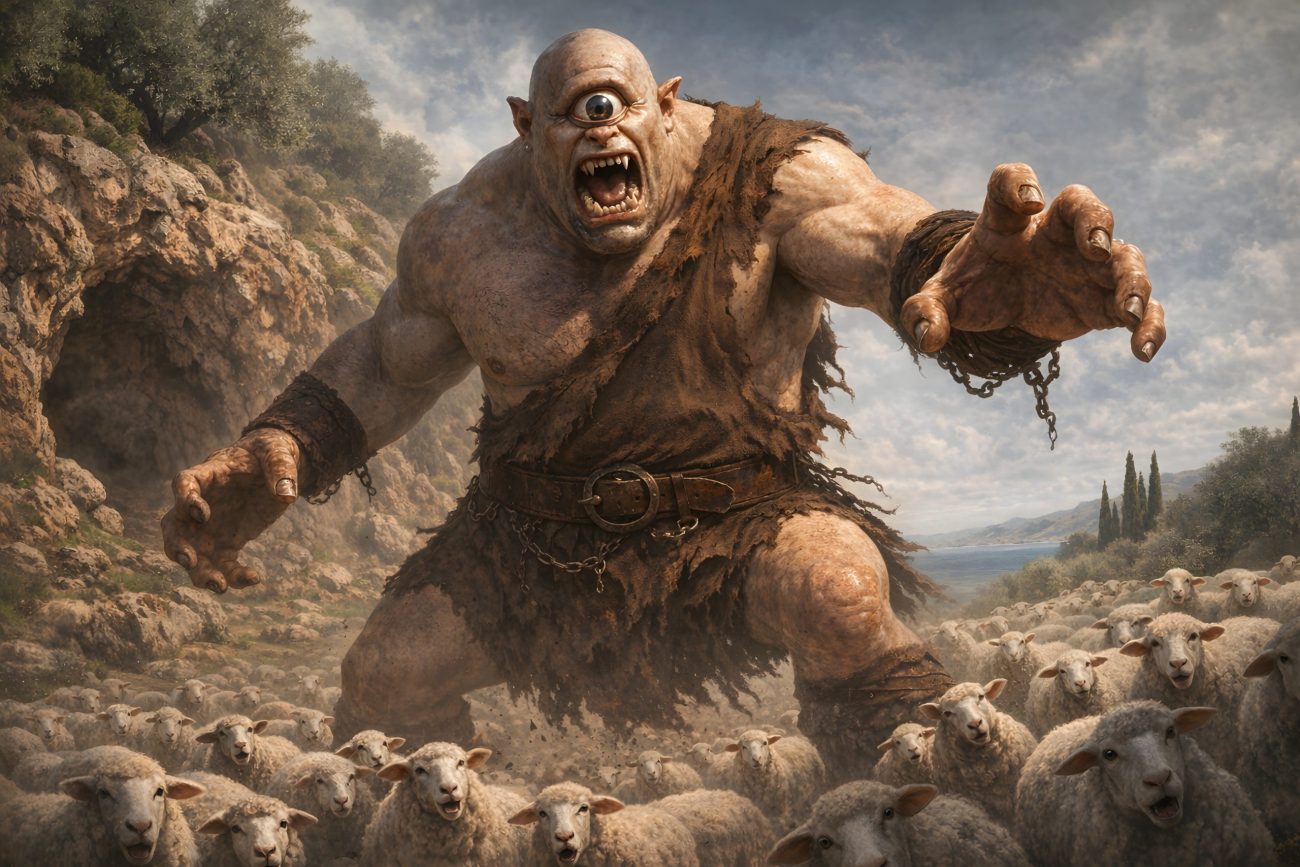
Another famous tradition appears in Homer’s Odyssey. These Cyclopes were no longer divine craftsmen but wild and uncivilized giants who lived apart from society. They dwelled in caves, kept flocks of sheep, and ignored laws, agriculture, and hospitality. The most famous among them was Polyphemus, the giant son of Poseidon.
During his journey home from the Trojan War, Odysseus and his companions entered the cave of Polyphemus searching for food and shelter. The Cyclops returned, sealed the entrance with a massive stone, and began devouring the trapped sailors. Odysseus devised a plan to escape. After offering the giant strong wine, he told Polyphemus that his name was “Nobody.” Once the Cyclops fell asleep, Odysseus and his men sharpened a wooden stake and drove it into his single eye, blinding him.
When the other Cyclopes heard Polyphemus screaming and asked who had harmed him, he answered that “Nobody” was attacking him, causing them to leave without helping. The next morning, Odysseus and his surviving men escaped by hiding beneath the bellies of the giant’s sheep as they left the cave to graze. As Odysseus sailed away, he revealed his true name in pride, provoking the enraged Polyphemus to call upon Poseidon to curse the hero’s voyage home.
A third tradition claimed that Cyclopes built the massive stone walls of ancient cities such as Mycenae, Tiryns, and Argos. The stones were so enormous that later Greeks believed only giants with supernatural strength could have moved them. These fortifications became known as Cyclopean walls.
Over time, the Cyclopes became some of the most famous monsters of Greek mythology. Different stories portrayed them as divine craftsmen, primordial giants, savage shepherds, or legendary builders, but nearly all traditions remembered them as enormous one-eyed beings connected with overwhelming strength, thunder, fire, and destruction.
Sources
Wikipedia contributors. (n.d.). Cyclopes. In Wikipedia, from https://en.wikipedia.org/wiki/Cyclopes