Cyclops

Tradition / Region: Greek Mythology, Italian Mythology
Alternate Names:
Category: Giant


The Myth

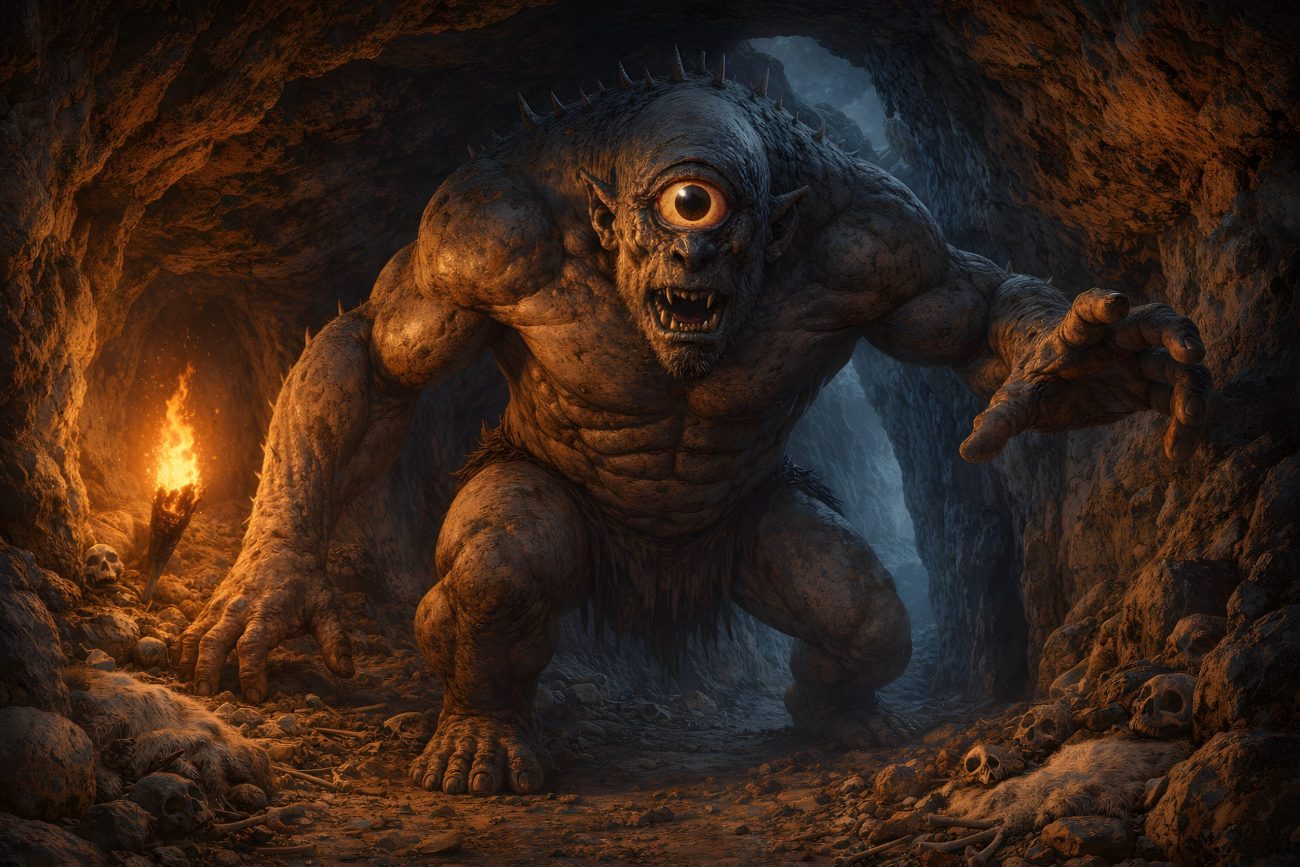
The Cyclopes are giant one-eyed beings from Greek mythology, later adopted into Roman mythology. Ancient traditions describe several different kinds of Cyclopes, ranging from divine blacksmiths to savage man-eating giants.

In Hesiod’s Theogony, the first Cyclopes were three powerful brothers named Brontes, Steropes, and Arges. They were the sons of Uranus, the sky, and Gaia, the earth. Each possessed a single eye in the center of the forehead and enormous strength. Their names were associated with thunder and lightning, reflecting their connection to storms and divine weapons.

Their father Uranus feared his monstrous children and imprisoned them deep within Tartarus. Later, after Zeus rebelled against the Titans, he freed the Cyclopes from their prison. In gratitude, the Cyclopes forged the thunderbolt of Zeus, the trident of Poseidon, and the helm of invisibility used by Hades. With these weapons, the Olympian gods defeated the Titans and established their rule over the cosmos.

Later myths describe the Cyclopes as master smiths working beside Hephaestus, the god of fire and metalworking. Ancient poets placed their forge beneath volcanic mountains such as Mount Etna in Sicily and the Aeolian Islands. There the Cyclopes forged divine weapons and armor amid smoke, fire, and the roar of the earth. The sound of thunder and volcanic eruptions was sometimes imagined as the labor of the Cyclopes beneath the mountains.

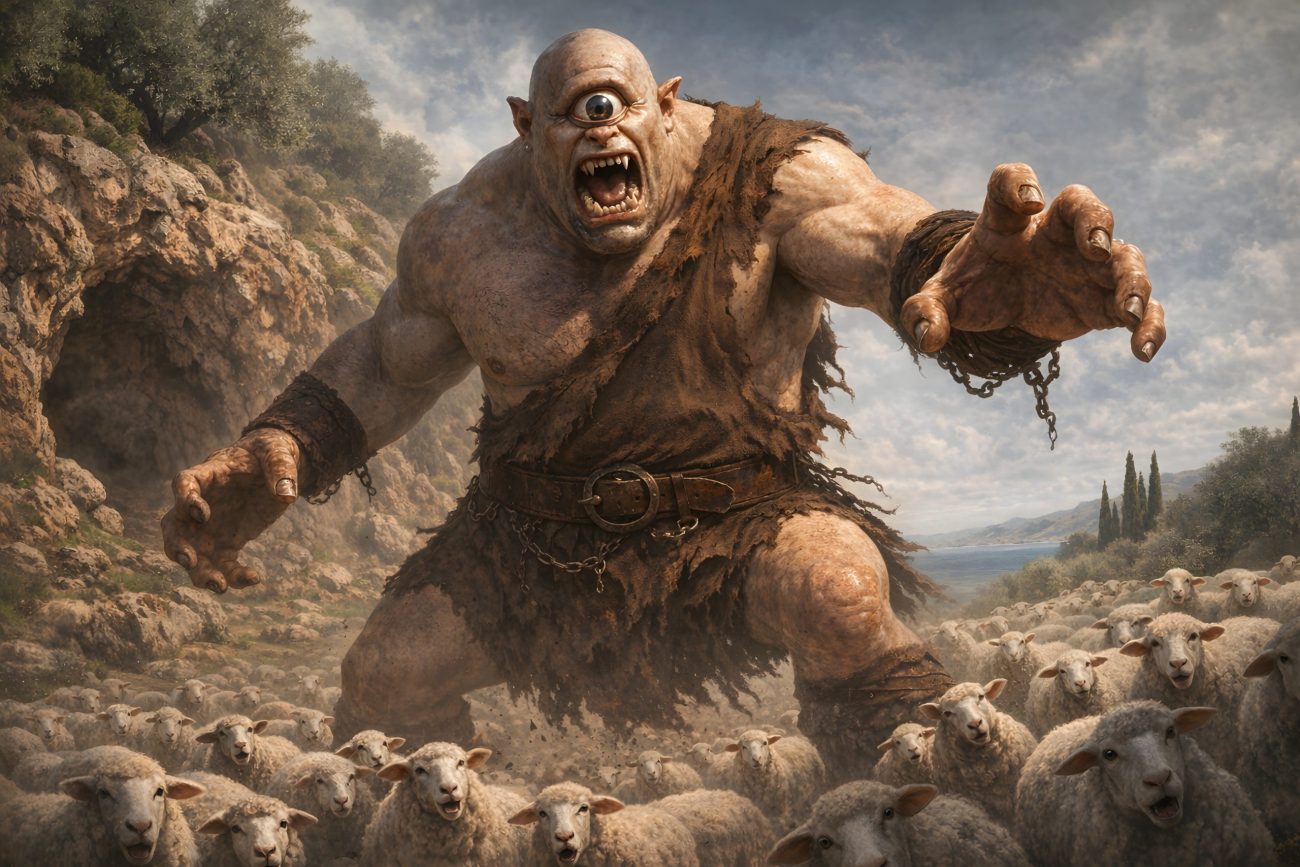
Another famous tradition appears in Homer’s Odyssey. These Cyclopes were no longer divine craftsmen but wild and uncivilized giants who lived apart from society. They dwelled in caves, kept flocks of sheep, and ignored laws, agriculture, and hospitality. The most famous among them was Polyphemus, the giant son of Poseidon.

During his journey home from the Trojan War, Odysseus and his companions entered the cave of Polyphemus searching for food and shelter. The Cyclops returned, sealed the entrance with a massive stone, and began devouring the trapped sailors. Odysseus devised a plan to escape. After offering the giant strong wine, he told Polyphemus that his name was “Nobody.” Once the Cyclops fell asleep, Odysseus and his men sharpened a wooden stake and drove it into his single eye, blinding him.

When the other Cyclopes heard Polyphemus screaming and asked who had harmed him, he answered that “Nobody” was attacking him, causing them to leave without helping. The next morning, Odysseus and his surviving men escaped by hiding beneath the bellies of the giant’s sheep as they left the cave to graze. As Odysseus sailed away, he revealed his true name in pride, provoking the enraged Polyphemus to call upon Poseidon to curse the hero’s voyage home.

A third tradition claimed that Cyclopes built the massive stone walls of ancient cities such as Mycenae, Tiryns, and Argos. The stones were so enormous that later Greeks believed only giants with supernatural strength could have moved them. These fortifications became known as Cyclopean walls.

Over time, the Cyclopes became some of the most famous monsters of Greek mythology. Different stories portrayed them as divine craftsmen, primordial giants, savage shepherds, or legendary builders, but nearly all traditions remembered them as enormous one-eyed beings connected with overwhelming strength, thunder, fire, and destruction.


Sources

Wikipedia contributors. (n.d.). Cyclopes. In Wikipedia, from https://en.wikipedia.org/wiki/Cyclopes


Torx

Tradition / Region: Armenian Mythology
Alternate Names: Torch
Category: Giant


The Myth

Torch is a powerful giant-like being in Armenian mythology, associated with a class of supernatural craftsmen similar to dwarfs and ancient smith-spirits. He is known for great strength as well as skill in crafting and working materials.

He was described as having a massive and rough body, an ugly face, a flat nose, and deep-set, harsh eyes. He belonged to a race connected to ancient beings of great physical power and was believed to dwell in the western regions of Armenia, near the Black Sea.

Torch was renowned not only for his strength but also for his ability as a craftsman. He could shape hard stone, smoothing it and carving figures into it with his fingernails, and was known as both an artisan and an artist.

In one account, he encountered his enemies on the shores of the Black Sea. At the sight of him, they fled by ship and put great distance between themselves and the giant. Torch responded by hurling enormous rocks toward them. The stones struck the sea with such force that some ships were swallowed by the waters, while others were driven far away by the waves caused by the impact.


Sources

Ananikian, M. H. (1925). Armenian Mythology. In The Mythology of All Races, Vol. 7. Published by the Archaeological Institute of America p. 85-86.


Hiderigami

Tradition / Region: Japanese mythology
Alternate Names: Hideri no Kami, Batsu, Hiderimo
Category: Mountain dweller, One eyed


The Myth

Long ago, it was said that drought was not merely the absence of rain, but the presence of a being. Wherever this being lingered, the land dried, rivers shrank, and crops withered under an unforgiving sun. This being came to be known in Japan as Hiderigami, the god of drought.

The origin of this power reaches back to ancient tales from the continent. In the Classic of Mountains and Seas, there is a goddess named Ni, daughter of the Yellow Emperor. After quelling a great storm caused by the dragon Yinglong and the wind god Feng Bo, Ni lost her place in heaven. Wherever she walked upon the earth thereafter, rain ceased to fall. The land cracked and dried beneath her feet. To protect the world, the emperor ordered her to dwell far to the north, beyond the Red River. Yet at times she escaped, and when people chased after her, they cried out, “God, please return to the north,” knowing that her presence meant ruin.

Other ancient writings speak of drought spirits living deep in the mountains. They are described as strange beings—part human, part beast—with twisted forms. Some had only one arm and one leg, their bodies covered in hair, basking openly beneath the burning sun. Others were said to be small, naked creatures with eyes set high upon their heads, able to run as fast as the wind. When these beings appeared, rain vanished, and severe drought followed.

In Japan, these stories were gathered and given form. The drought spirit was called Hideri no Kami, and it was believed to dwell on remote mountains, descending unseen to spread heat and desolation. Some said the drought god crept into human homes, stealing food and goods, draining not only the land but the fortune of families as well.

People feared Hiderigami deeply. When rain failed and rice fields cracked, offerings were made and prayers spoken, begging the god to depart. It was believed that only by appeasing or driving away this being could the sky be moved to weep again.

Thus Hiderigami remained in memory—not always seen, but always felt—an invisible god of heat and hunger, whose presence turned fertile land into dust and reminded people that drought itself could walk the world.


Gallery


Sources

TYZ-Yokai Blog contributors. (n.d.). 干天神 (Hiderigami). In TYZ-Yokai Blog, from https://tyz-yokai.blog.jp/archives/1076296168.html


Interpretive Lenses

Religious Readings
  • Christian Ascetic Deep Dive
Philosophical Readings
  • Nietzschean Deep Dive
Psychological Readings
  • Jungian Deep Dive
Esoteric Deep Dive
  • Hermetic Deep Dive
Political / Social Readings
  • Marxist Deep Dive
Other
  • How to Invite The Hiderigami

Boitáta

Tradition / Region: Brazilian mythology
Alternate Names:
Category: Cow


The Myth

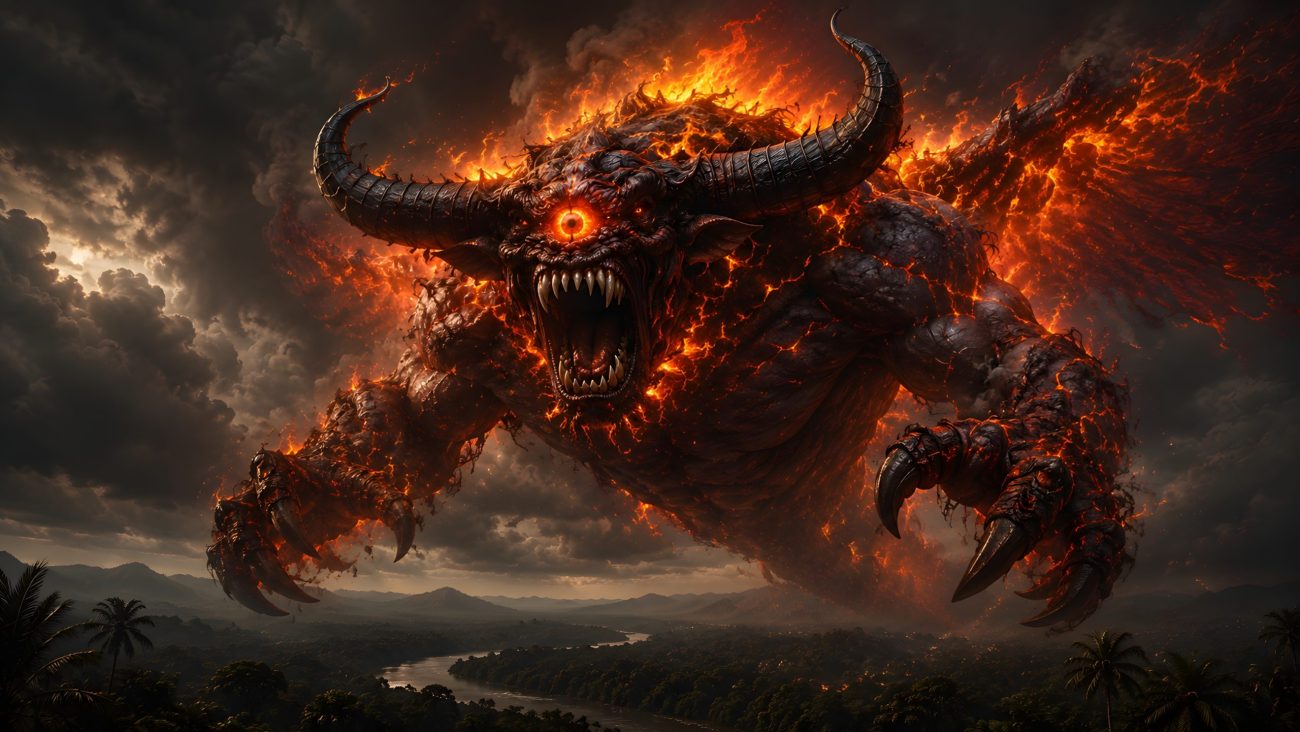
In Santa Catarina, people speak of a Boitáta unlike the ancient serpent of older tales. Here it appears as a bull—vast, unnatural, and terrifying to behold.

Its body is as large as a bull’s, but its limbs end not in hooves, but in massive paws like those of a giant. In the center of its forehead burns a single enormous eye, blazing like living fire, cutting through darkness, mist, and night. No one knows where it dwells, nor what sustains it, and those who see it rarely remain long enough to learn more.

This Boitáta is not bound to the earth. At times it charges into the sea, skimming across the waves like a monstrous seahorse. At other times it rises into the air, flying above forests as if born of flame and shadow. Land, water, and sky offer no refuge from its passage.

Some say its shape was born from confusion and fear, when the fiery serpent of old stories was mistaken for something else and slowly took on horns, bulk, and the form of cattle. Over time, this bull-shape became fixed in the imagination of the people.

In visions and whispered stories, the Boitáta appears with a bovine head, sometimes horned, sometimes winged, sometimes standing upright like a man. Yet one thing never changes: the burning eye that watches without blinking.

To see it is an omen of terror. To follow it is to vanish. And to mistake it for an ordinary bull is to invite destruction, for this Boitáta is not a creature of pasture, but fire given flesh.


Gallery


Sources

Wikipedia contributors. (n.d.). Boitatá. In Wikipedia, The Free Encyclopedia, from https://en.wikipedia.org/wiki/Boitat%C3%A1


Interpretive Lenses

Religious Readings
  • Christian Ascetic Deep Dive
Philosophical Readings
  • Nietzschean Deep Dive
Psychological Readings
  • Jungian Deep Dive
Esoteric Deep Dive
  • Hermetic Deep Dive
Political / Social Readings
  • Marxist Deep Dive
Other
  • How to Invite The Boitáta

One-Eyed Fish of Lake Plöckensteiner

Tradition / Region: Austrian Mythology
Alternative name: –
Category: Fish


The Myth

Lake Plöckensteiner was long believed to be lifeless, a dark mountain lake where no creature could survive. Doubting this belief, a group of men once went to the lake to test it by fishing. For many hours they caught nothing, until at last one man cried out in triumph: a large fish was writhing on his line. Though they continued fishing, no other fish appeared.

As evening fell, the men decided to cook their catch. They placed the fish into a pan of water over the fire. As the water began to heat, a strange sound rose from the lake—a low murmuring that grew louder and clearer. From the depths came a voice asking, “Is everyone there?” Another voice replied, “Everyone is here—except the bull.”

Horrified, the men looked at the pan and realized the fish was still alive. Worse still, they saw that it had only one eye. Overcome with fear, they threw the fish back into the lake. At once, the voices ceased, and the lake fell silent. Terrified, the men fled home.

Another tale tells of a time long ago, when kings once gathered near the lake to mark the borders of three lands. During this age, three men came to the lake in mischief and found that fish leapt willingly into their hands—trout with glowing red mouths and bodies speckled like sparks. They caught many and placed them into pans of water over a fire.

As night fell and the moon rose, the water began to boil, yet the fish did not die. Instead, they grew lively, almost joyful. Suddenly, a great roaring arose—trees seemed to thunder, and the lake roared as though whipped by a storm. Yet the air was still, the sky clear, and the water unbroken. From beneath the lake came voices murmuring, “Not everyone is home… not everyone…”

Stricken with terror, the men threw all the fish back into the lake. Immediately, the roaring ceased. Silence returned, and the moon shone calmly above the water. The men dared not move or speak until morning, when they fled and told what had happened. Upon hearing this, the kings departed and cursed the forest, condemning the place to remain desolate forever.

Thus the lake is remembered as a place where something watches, and where not all who dwell beneath the water may safely be taken.


Sources

SAGEN.at contributors. (n.d.). Die Fische im Plöckensteiner See. In SAGEN.at, from https://www.sagen.at/texte/sagen/oesterreich/oberoesterreich/muehlviertel/ploeckensteinersee.html


Tepegöz

Tradition / Region: Azerbaijani Mythology, Turkic mythology
Alternate Names:
Category: Giant


The Myth

Tepegöz is a huge one-eyed giant who dwells in a cave and feeds on humans. When angered, he forces people inside his lair, where none escape alive. His sense of smell is keen, and he can track victims even in darkness.

There is only one way to survive him. A person must hide beneath a sheep’s skin so the giant cannot detect their scent. When the moment comes, Tepegöz can be slain only by driving a sharp sword into his single eye.

Though powerful and terrifying, Tepegöz is slow-witted. Those who rely on cunning rather than strength alone may overcome him, proving that brute force without intelligence is doomed to fall.


Source

JAMnews contributors. (2017, August 20). The magical creatures of Azerbaijani mythology. In JAMnews, from https://jam-news.net/azerbaijani-demons/