Romŝiwamnari’

Tradition / Region: Brazilian Mythology
Alternative names: Romshiwamnari
Category: Bird


The Myth

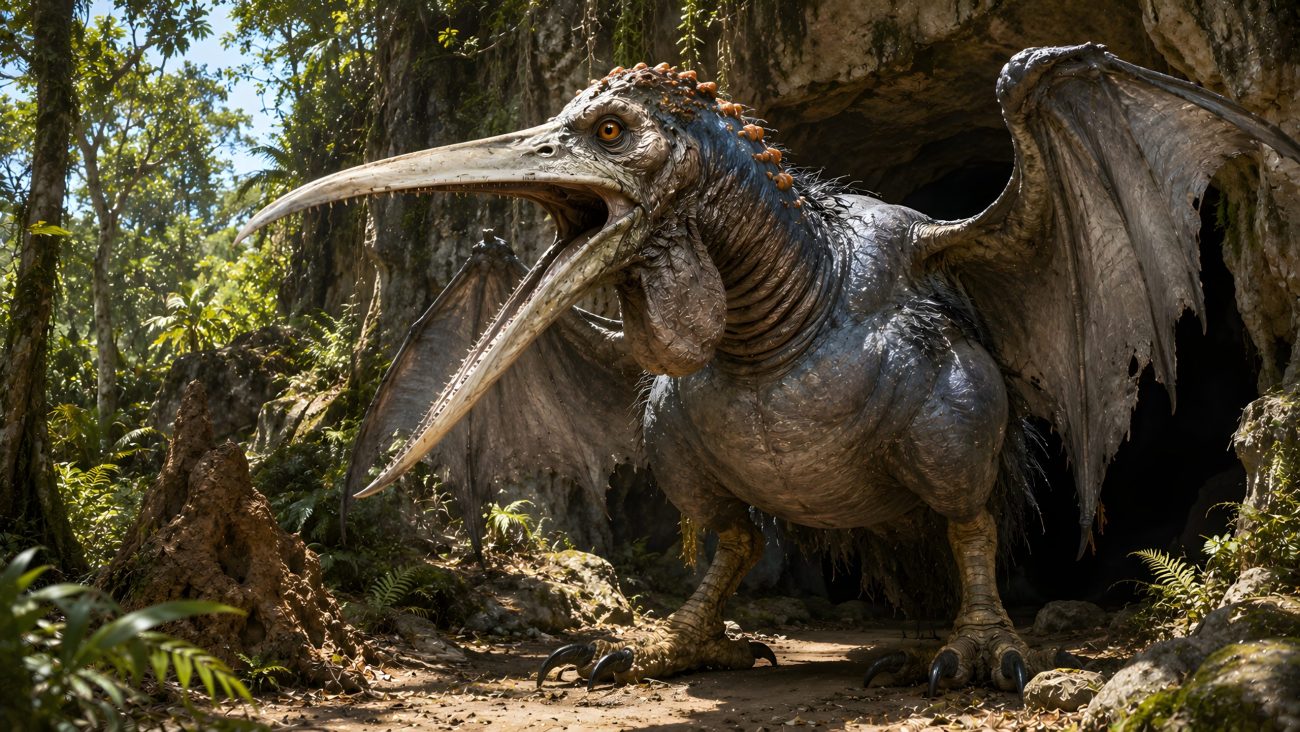
The Romŝiwamnari’ are fearsome forest and cave demons of the Šerente people. They usually appear as enormous birds with flabby, flightless bat-like wings, long scissor-shaped beaks, and haunting whistles that echo through the wilderness. They can also transform into tapirs or stout human figures with large teeth and the tail of a howler monkey. In human form, they are even said to resemble the Pope.

These monstrous beings prey not only upon the living but also upon the souls of the dead. As spirits journey through the realm of death, the Romŝiwamnari’ lie in wait to devour them. Only exceptionally powerful shamans are capable of confronting and destroying the demons in the spirit world.

One legend tells of a hunter and his pregnant wife who encountered two Romŝiwamnari’ inside a cave. The hunter fought bravely to allow his wife to escape, but the demons overwhelmed him and cut off his head. When the villagers later attacked the cave, they killed the two monsters, although two more remained hidden. The hunter’s son grew into a mighty hero before he was a year old, avenged his father by burning the demons’ bones, slew the remaining Romŝiwamnari’, and freed the region from their terror forever.


Sources

A Book of Creatures. (2016, February 5). Romŝiwamnari’. Retrieved June 29, 2026, from https://abookofcreatures.com/2016/02/05/romsiwamnari/


Cuca

Tradition / Region: Brazilian Mythology
Alternative names: Coca, Coco, Cucuy, Cuco, Cucu, Cucuí, El Cucuí
Category: Crocodile


The Myth

The Cuca is the Brazilian form of the Iberian bogeyman known as the Coco or Coca. In Brazil, she is traditionally portrayed as a female humanoid alligator who comes during the night to seize disobedient children. Parents invoke her in lullabies and nursery rhymes, warning that children who refuse to sleep or misbehave will be carried away by the Cuca.

Unlike many other versions of the Coco, which have no fixed appearance, the Brazilian Cuca is depicted with the face and body of an alligator, dressed like a woman. This reptilian form became firmly established through adaptations of Monteiro Lobato’s children’s stories, although in the original novel O Saci (1921), she is only described as having an alligator’s face and clawed fingers.

As a bogeyman, the Cuca serves as a supernatural warning against disobedience. Rather than acting as a guardian or trickster, she is a child-stealing monster who watches from rooftops or lurks in the darkness, waiting for children who ignore their parents. In Brazilian lullabies, she is said to come while parents are away, carrying off children who refuse to sleep.


Sources

Wikipedia contributors. (n.d.). Coco (folklore). In Wikipedia. Retrieved June 29, 2026, from https://en.wikipedia.org/wiki/Coco_(folklore)


Pombero

Tradition / Region: Paraguay Mythology, Brazilian Mythology, Argentine Mythology
Alternative names: Pomberito, Karai Pyhare, Pyrague, Kuarahy Jára, Cho Pombé, Lord of the Night
Category: Goblin


The Myth

The Pombero is a mysterious nocturnal being that inhabits forests, abandoned houses, barns, and lonely rural places throughout the Guaraní-speaking world. Usually active after dark, he is known as the Lord of the Night and is one of the most feared and respected figures in Paraguayan folklore.

He is commonly described as a short, ugly humanoid with extremely short arms and hairy hands and feet. His feet allow him to move silently through the forest, while the touch of his hairy hands is said to send a cold shiver through those he touches. The Pombero possesses many supernatural abilities, including invisibility and the power to squeeze through impossibly narrow openings.

Before appearing, he often announces his presence with strange whistles and the songs of nocturnal birds, which he can imitate perfectly. Because of this, he is regarded as a protector of birds and is said to punish children who hunt them with slingshots.

Although generally considered a mischievous spirit rather than an outright monster, the Pombero delights in causing trouble. He steals eggs, honey, and chickens, scatters grain and food stores, releases livestock, and frightens horses so that riders are thrown to the ground.

He is also associated with mysterious pregnancies and is sometimes blamed for fathering children born unusually hairy or unattractive. In darker traditions, he is said to kidnap lonely or ungrateful young women, force his affection upon them, and violate them. Similar stories are also attributed to the Guaraní being Kurupi.

Because of his unpredictable nature, people seek to appease the Pombero with offerings. Cigars and rum are his favorite gifts, though honey is also considered acceptable. Families in rural Paraguay often leave these offerings outside at night to prevent his mischief.

Those who regularly honor him may gain his friendship. A satisfied Pombero is believed to protect homes, animals, and possessions, and sometimes rewards his benefactors with small gifts of his own.

Thus, the Pombero remains one of the most enduring figures of Guaraní folklore—a silent lord of the forests who walks unseen through the night, bringing either mischief or protection depending on how he is treated.


Sources

Wikipedia contributors. (n.d.). Pombero. In Wikipedia. Retrieved June 13, 2026, from https://en.wikipedia.org/wiki/Pombero

Teju Jagua

Tradition / Region: Paraguay Mythology, Brazilian Mythology
Alternate Names: Teju Jagua, Teju Jagua’i
Category: Dog, Snake, Cave dweller


The Myth

Teju Jagua is the firstborn son of Tau and Kerana, and the eldest of the seven cursed monsters of Guaraní tradition. Because Tau had angered the heavens, all of his children were born deformed and monstrous, and Teju Jagua was the first sign of that curse.

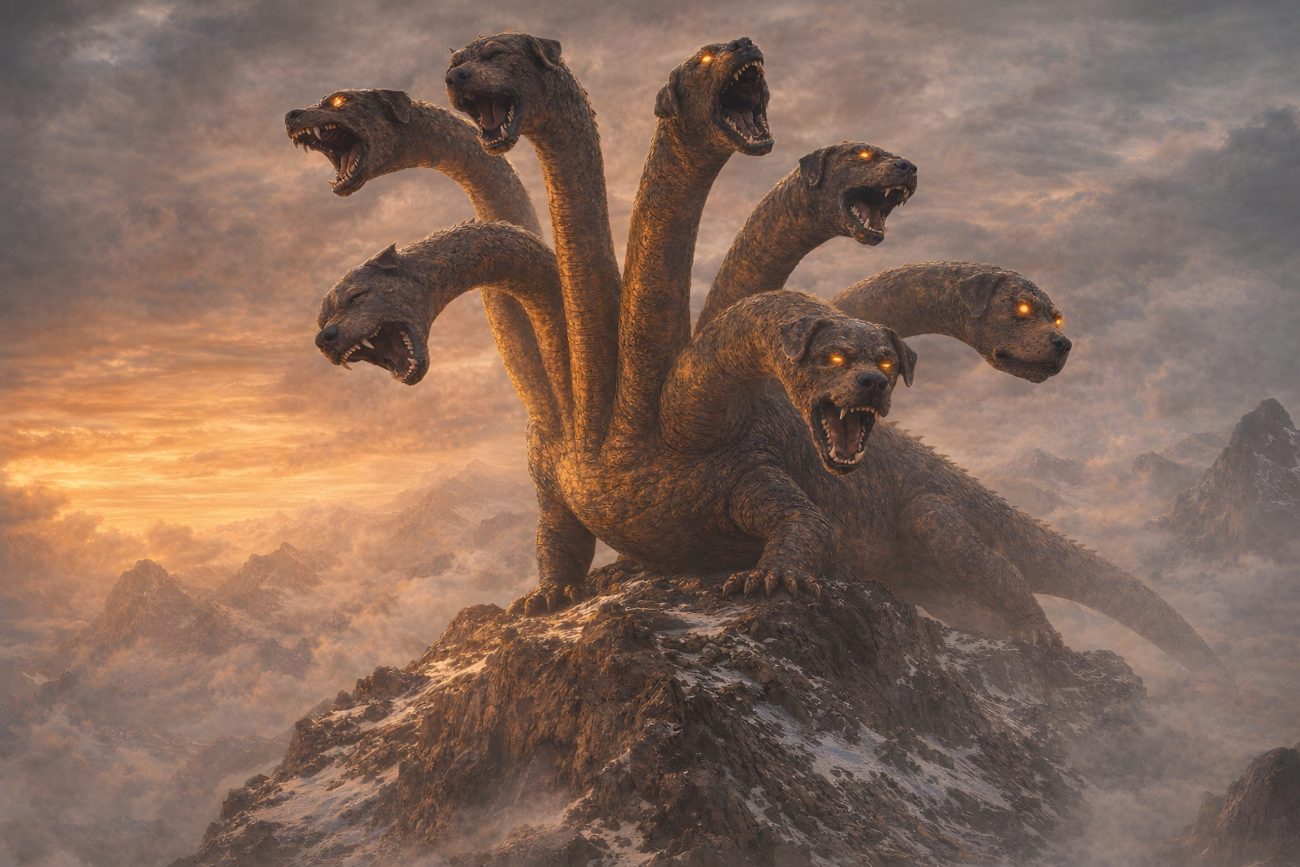
He is described as a gigantic reptilian creature with multiple dog heads — most often seven — each with blazing eyes that can shoot fire. Some stories say he has only a single enormous dog head, but all agree that his body is vast, heavy, and awkward, making it difficult for him to move swiftly.

Although his appearance is the most terrifying of the seven brothers, his nature is not cruel. Tupã, the great god, softened his spirit so that he would not be savage. Instead of preying on people, Teju Jagua lives quietly in caves and hidden places.

He feeds on fruit rather than flesh, and his brother Yasy Yateré brings him honey, which is his favorite food. Because of this peaceful life, he is remembered not as a destroyer but as a guardian.

Teju Jagua became lord of the caves and protector of buried treasures. He is said to dwell among gold and precious stones, and after long years rolling among them, his skin grew smooth and shining.

Thus he is feared for his monstrous form and fiery gaze, yet also respected as a watchful keeper of hidden riches beneath the earth.


Gallery


Sources

Wikipedia contributors. (n.d.). Teju Jagua. In Wikipedia, from https://en.wikipedia.org/wiki/Teju_Jagua


Interpretive Lenses

Religious Readings
  • Christian Ascetic Deep Dive
Philosophical Readings
  • Nietzschean Deep Dive
Psychological Readings
  • Jungian Deep Dive
Esoteric Deep Dive
  • Hermetic Deep Dive
Political / Social Readings
  • Marxist Deep Dive

Iara

Tradition / Region: Brazilian Mythology
Alternate Names: Uiara, Yara, Hiara, Mãe das Águas (“Mother of the Waters”)
Category: Mermaid


The Myth

In the great rivers of the Amazon there lives a being called Iara, the Mother of the Waters. She appears as a beautiful maiden of the river, sometimes sitting upon rocks beneath the sun, combing her long hair and singing with a voice sweeter than any human song.

Men who hear her voice cannot resist it. Drawn by her song, they approach the water and follow her into the depths. Some are drowned at once. Others vanish into her underwater dwelling, where they remain with her until they grow old and die, while she herself never ages. Those who escape her spell return changed—haunted, restless, and forever drawn back toward the river.

One tale tells how a young warrior, son of a chief, heard Iara’s voice at a waterfall. Each night he returned to meet her, ignoring the pleas of his mother and the warnings of his people. At last the villagers saw him with the river maiden. Soon after, he disappeared forever into the waters, and no trace of him was ever found again.

Another story tells how Iara herself was once human. She had been a warrior of great skill, stronger and braver than her brothers. Jealous, they attacked her in the night, but she fought them off and they died by her hand. When her father discovered what had happened, he punished her by casting her into the river to drown. But the fish of the river or the moon-spirit took pity on her and transformed her into a river maiden. From that day on, she lured men to the water in vengeance for the injustice done to her.

Thus Iara is remembered as both enchantress and avenger, the beautiful woman of the river whose song still drifts across the Amazon at dusk, calling the unwary into the deep.


Gallery


Sources

Wikipedia contributors. (n.d.). Iara (mythology). In Wikipedia, The Free Encyclopedia. Retrieved February 14, 2026, from https://en.wikipedia.org/wiki/Iara_(mythology)


Interpretive Lenses

Religious Readings
  • Christian Ascetic Deep Dive
Philosophical Readings
  • Nietzschean Deep Dive
Psychological Readings
  • Jungian Deep Dive
Esoteric Deep Dive
  • Hermetic Deep Dive
Political / Social Readings
  • Marxist Deep Dive
Other
  • How to Invite The Iara

Boi-Vaquim

Tradition / Region: Brazilian mythology
Alternate Names:
Category: Cow


The Myth

On the wide southern plains of Brazil, where cowboys rode beneath endless skies, people told of a bull unlike any other. They called it the Boi-Vaquim.

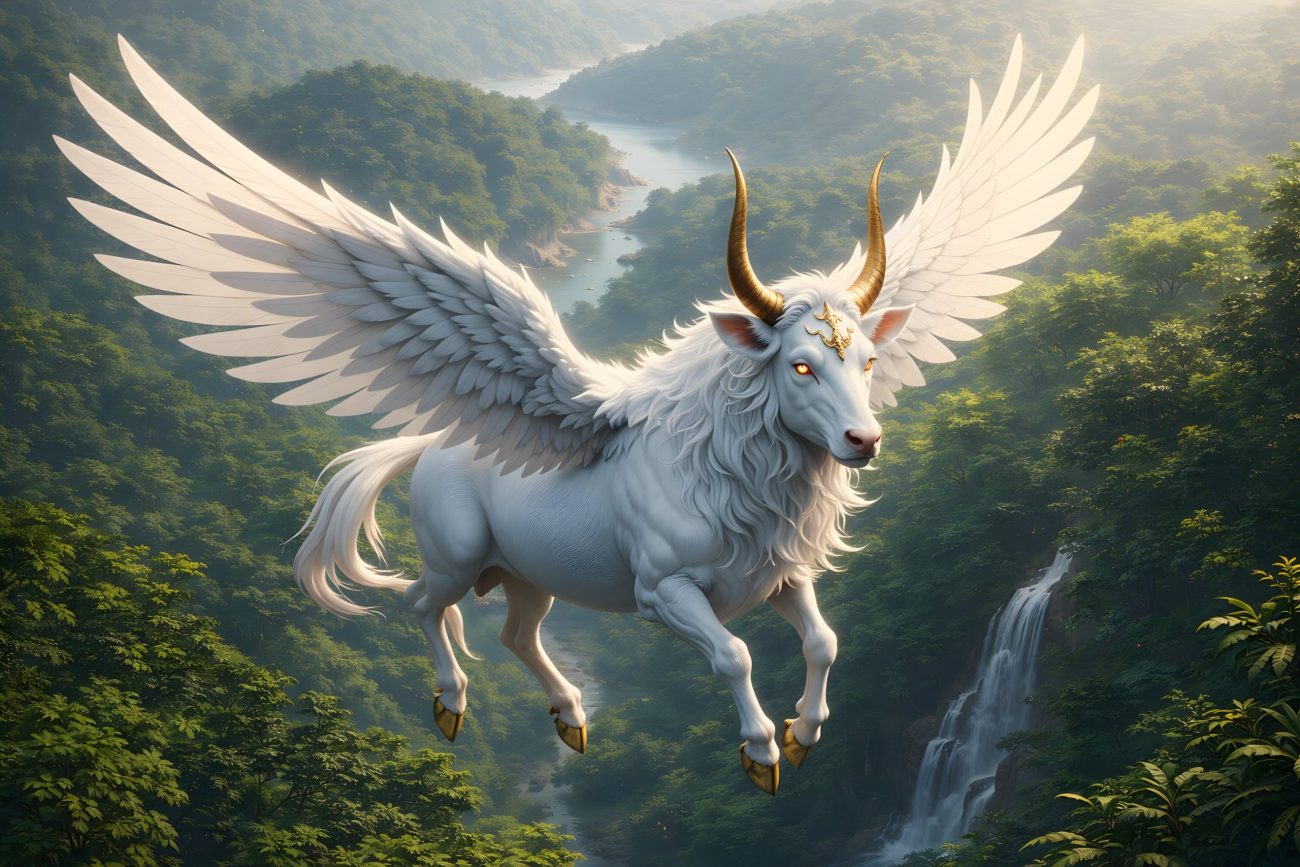
Its horns shone like gold, and its eyes glittered like diamonds. From its body leapt sparks of fire, flashing as it moved across the grasslands. To glimpse it was to feel both awe and dread, for the creature was as beautiful as it was dangerous.

The Boi-Vaquim was said to have wings like a great bird, spreading wide as it crossed the plains, and hooves of gold that left the ground shimmering where they struck. When it charged, the air itself seemed to burn, and even the bravest rider felt his heart falter beneath its gaze.

Some cowhands dreamed of capturing it, imagining the glory of lassoing such a beast and proving their courage before all others. But only a rider of extraordinary strength, mounted on a horse swift and unshakable, could even hope to face it. Many tested their resolve from afar, measuring their nerve against the bull’s blazing presence.

Yet no tale tells of the Boi-Vaquim ever being mastered. It remained free, untamed, and unconquered—a living emblem of the wild southern lands, inspiring fear, respect, and wonder in all who spoke its name.


Sources

Contribuidores da Wikipédia. (2022, May 10). Boi Vaquim. https://pt.wikipedia.org/wiki/Boi_Vaquim


Boitáta

Tradition / Region: Brazilian Mythology
Alternate Names:
Category: Cow


The Myth

In Santa Catarina, people speak of a Boitáta unlike the ancient serpent of older tales. Here it appears as a bull—vast, unnatural, and terrifying to behold.

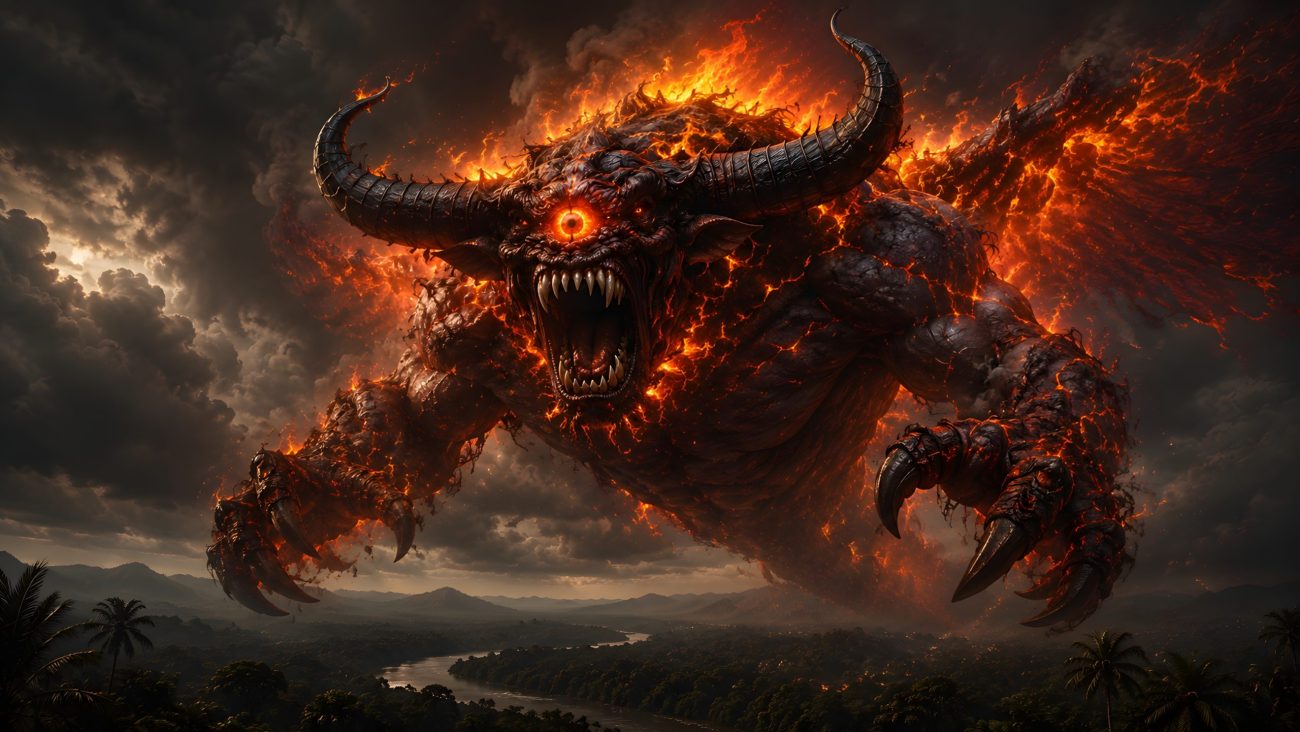
Its body is as large as a bull’s, but its limbs end not in hooves, but in massive paws like those of a giant. In the center of its forehead burns a single enormous eye, blazing like living fire, cutting through darkness, mist, and night. No one knows where it dwells, nor what sustains it, and those who see it rarely remain long enough to learn more.

This Boitáta is not bound to the earth. At times it charges into the sea, skimming across the waves like a monstrous seahorse. At other times it rises into the air, flying above forests as if born of flame and shadow. Land, water, and sky offer no refuge from its passage.

Some say its shape was born from confusion and fear, when the fiery serpent of old stories was mistaken for something else and slowly took on horns, bulk, and the form of cattle. Over time, this bull-shape became fixed in the imagination of the people.

In visions and whispered stories, the Boitáta appears with a bovine head, sometimes horned, sometimes winged, sometimes standing upright like a man. Yet one thing never changes: the burning eye that watches without blinking.

To see it is an omen of terror. To follow it is to vanish. And to mistake it for an ordinary bull is to invite destruction, for this Boitáta is not a creature of pasture, but fire given flesh.


Sources

Wikipedia contributors. (n.d.). Boitatá. In Wikipedia, The Free Encyclopedia, from https://en.wikipedia.org/wiki/Boitat%C3%A1


Boi Laranja

Tradition / Region: Brazilian Mythology
Alternate Names:
Category: Cow


The Myth

They say the Boi Laranja was once an ordinary bull that lived among other cattle in a pasture, alongside beasts such as the Boi Jardim. Yet even in life, it was never truly one of the herd. It kept to itself, standing apart as if it wished no company from animals or people alike.

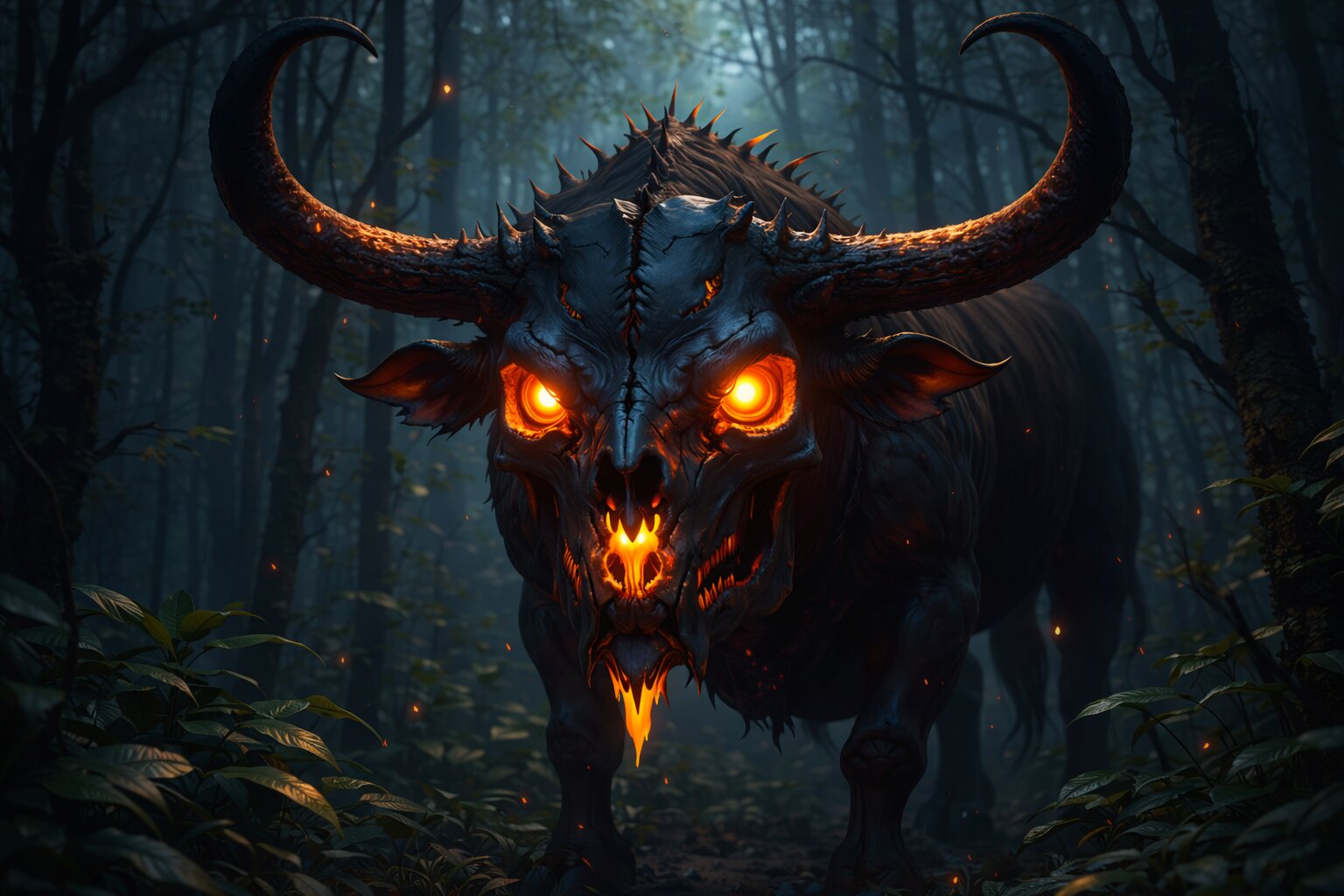
At night, the land where it stayed became a place of dread. Those who passed nearby felt an unexplainable fear settle over them. Some claimed that a single look from the bull was enough to make their legs tremble and their hearts race, as though its gaze carried a weight no living creature should possess.

When the Boi Laranja finally died, the fear did not fade.

Travelers began to report sightings near the same pasture. In the darkness, a massive shape would appear where the bull once stood. Others felt watched as they crossed the land, certain that something unseen was still there, guarding the ground it had claimed in life.

Even now, people warn against passing too close to that place. They say the Boi Laranja did not depart with its death, and that its presence still lingers in the pasture, silent, watchful, and unwilling to let go of the land it once called its own.


Sources

História Jardim contributors. (2022). História e Lenda do Boi Laranja. In HistoriaJardim.blogspot.com, from https://historiajardim.blogspot.com/2022/05/historia-e-lenda-do-boi-laranja-para.html


Boi de Conchas

Tradition / Region: Brazilian mythology
Alternate Names: Ratambufe; Shell Ox
Category: Cow


The Myth

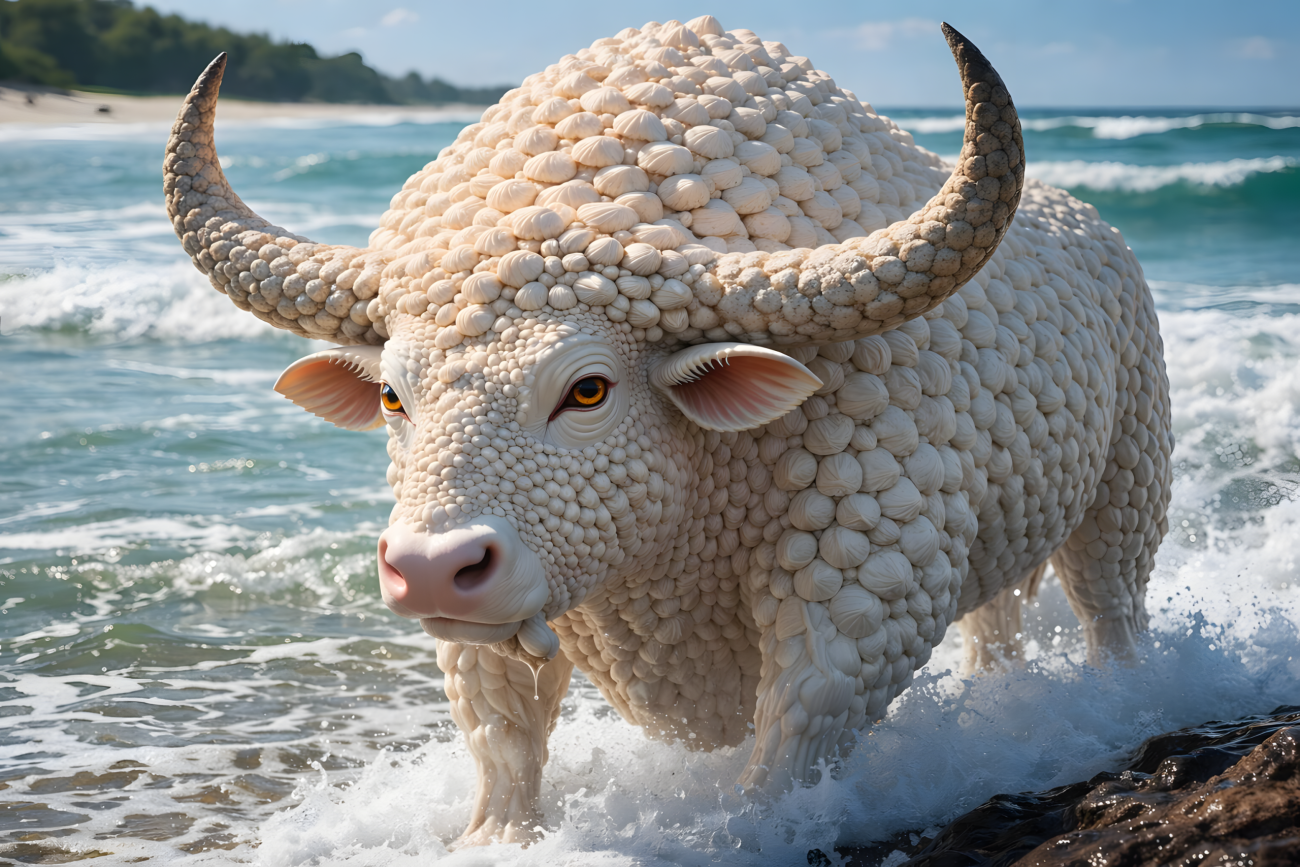
Along the shores where rivers meet the sea, the people tell of a wondrous ox born not only of land, but of water and promise. This creature is known as Boi de Conchas, the Shell Ox.

It was said that a calf was born on Saint Peter’s Day, the feast of the fisherman saint. Because of this sacred timing, its owner promised the young ox that one day it would be taken to see the sea. The promise lingered, carried by time and tide, until it became something more than words.

In later years, people along the coast spoke of a vision rising from the water: an ox entirely white, its body covered in gleaming shells, as if the sea itself had clothed it. This was the Shell Ox, born of devotion and fulfilled promise, emerging where waves touch the land.

Those who saw it said the creature was calm and radiant, neither wild nor fearful. It appeared briefly, a living bridge between earth and ocean, before returning to the waters from which it came.

Thus the Boi de Conchas remains in memory as a gentle marvel—an ox shaped by faith, timing, and the pull of the sea, reminding all who hear the tale that promises, once made, may take on lives of their own.


Sources

São Pedro da Barra, A. M. Ficha 10–Boi Laranja.

Santos, L. G. D. (2020, March 30). Ratambufe – A lenda do Boi de Conchas – FundArt. FundArt. https://fundart.com.br/ratambufe-a-lenda-do-boi-de-conchas/


Boi da Cara Preta

Tradition / Region: Brazilian mythology
Alternate Names: Black-Faced Ox
Category: Cow


The Myth

In Brazil, when night falls and children resist sleep, a familiar name is sometimes whispered: the Black-Faced Ox.

Boi da Cara Preta is imagined as an ox with a darkened face, something both ordinary and unsettling. It is not a beast of fields or farms, but a figure that comes when children refuse to rest or misbehave. Parents sing of it softly, not as a roar or threat, but as a presence that listens from the dark.

In the lullaby, the ox is called upon to come and take the child who will not sleep, especially one who is afraid of silly faces and shadows. The song is gentle, almost playful, yet behind it lingers the idea that something waits just beyond the cradle and the candlelight.

The Black-Faced Ox has no long tale of origins or deeds. It does not rampage or destroy. It exists in the space between comfort and fear, carried by melody rather than story. To children, it is a warning; to adults, a tool; to memory, a shadow shaped like an ox.

And so Boi da Cara Preta endures—not as a monster that acts, but as one that might, lingering in song, rocking back and forth with the rhythm of sleep.


Sources

Guerra, D. (2010). Acalantos afro-brasileiros. Revista África e Africanidades, 8, 1-5.