Ankwunyab the Pig

Tradition / Region: Cameroon Mythology
Alternative names: Ankwunyab, Friend-of-Mine
Category: Pig


The Myth

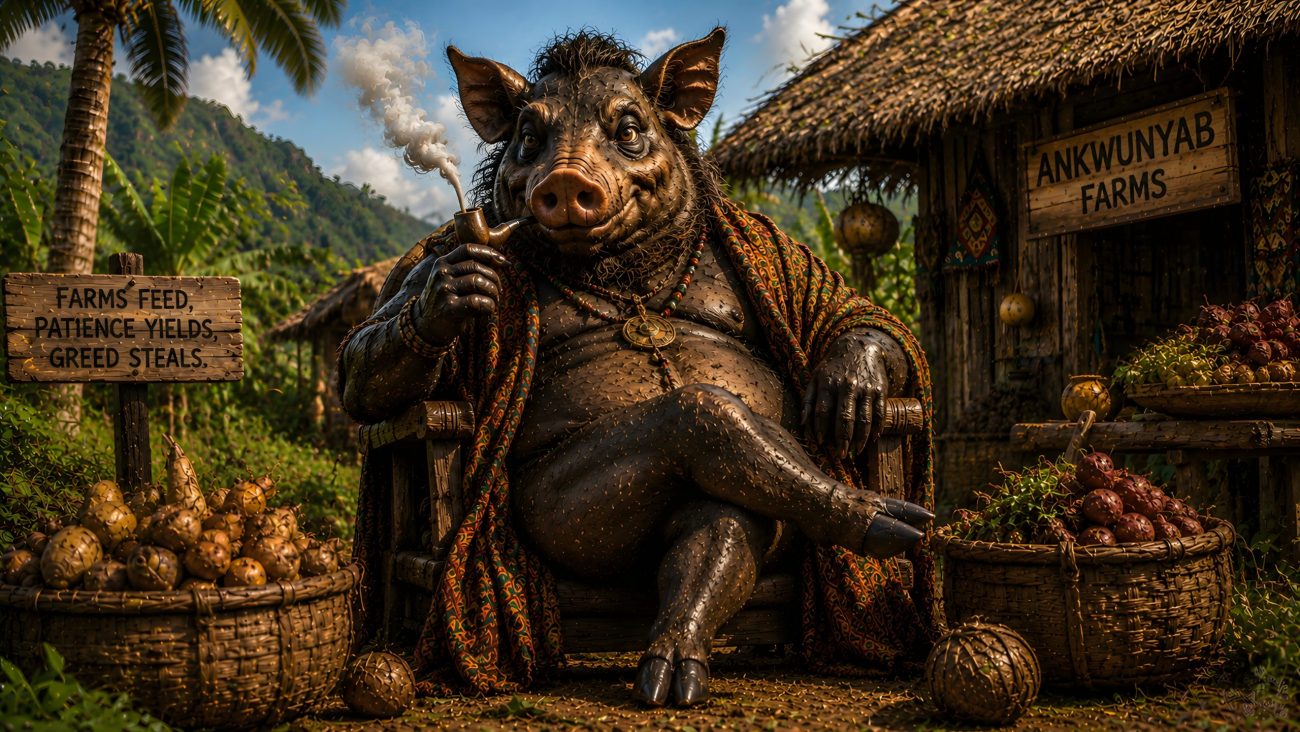
Ankwunyab the Pig appears in Central African animal folklore as a massive, wealthy, hot-tempered pig known for his endless appetite and relentless work ethic. Unlike many trickster animals, Pig is not lazy or foolish by nature. He is industrious, prosperous, and respected for his enormous farms and overflowing harvests. His great hunger is said to drive his tireless labor, making him one of the richest animals in the community.

Pig’s appearance is usually imagined as huge and imposing: a broad-bodied boar with a powerful snout, thick hide, restless little eyes, and an earth-stained body from constantly rooting through farms and soil. His grunts and heavy breathing are emphasized throughout the tale, giving him an intimidating physical presence. Yet despite his strength and wealth, Pig is emotionally vulnerable to manipulation and social obligation.

His greatest weakness is his friendship with Torokee the Tortoise.

Tortoise is everything Pig is not — lazy, cunning, extravagant, and deceitful. For years he borrows food, tools, seeds, oil, and money from Pig without repayment. Eventually Pig lends him a large sum again after Tortoise promises to host a grand feast for visiting in-laws and names Pig as an honored guest.

But moon cycle after moon cycle passes without repayment.

Pig repeatedly visits Tortoise demanding his money, only to hear excuses about failed harvests and hard times. Finally Pig loses patience and threatens serious consequences if the debt is not repaid within eight days.

Tortoise responds with a trap.

On the appointed day, Tortoise hides by pulling himself into his shell while instructing his wife to ignore Pig completely. When Pig arrives, furious and snorting, Mrs. Tortoise silently continues grinding spices with her stone as though he does not exist.

Enraged by the disrespect, Pig finally grabs the grinding stone and hurls it into the bushes.

At that exact moment Tortoise emerges from hiding and pretends horror at what Pig has done. His wife begins crying dramatically, claiming Pig has ruined her ability to cook. Tortoise then calmly declares that Pig cannot receive repayment until the missing grinding stone is recovered.

Pig realizes he has been trapped.

But the debt is so large that he cannot abandon it. Desperate, he begins searching through the earth for the stone.

According to the tale, this is why pigs forever root through dirt with their snouts.

The story transforms Pig into a folkloric explanation for real animal behavior while also presenting him as a tragic figure: hardworking but gullible, powerful but psychologically outmatched by trickster intelligence. Unlike many greedy beasts in folklore, Pig is not evil — merely blinded by anger, appetite, and pride.


Sources

Makuchi. (2008). The sacred door and other stories: Cameroon folktales of the Beba. Athens, OH: Ohio University Press.
Bingfeng

Tradition / Region: Chinese mythology
Alternate Names: Ping Feng, Ping Peng
Category: Pig


The Myth

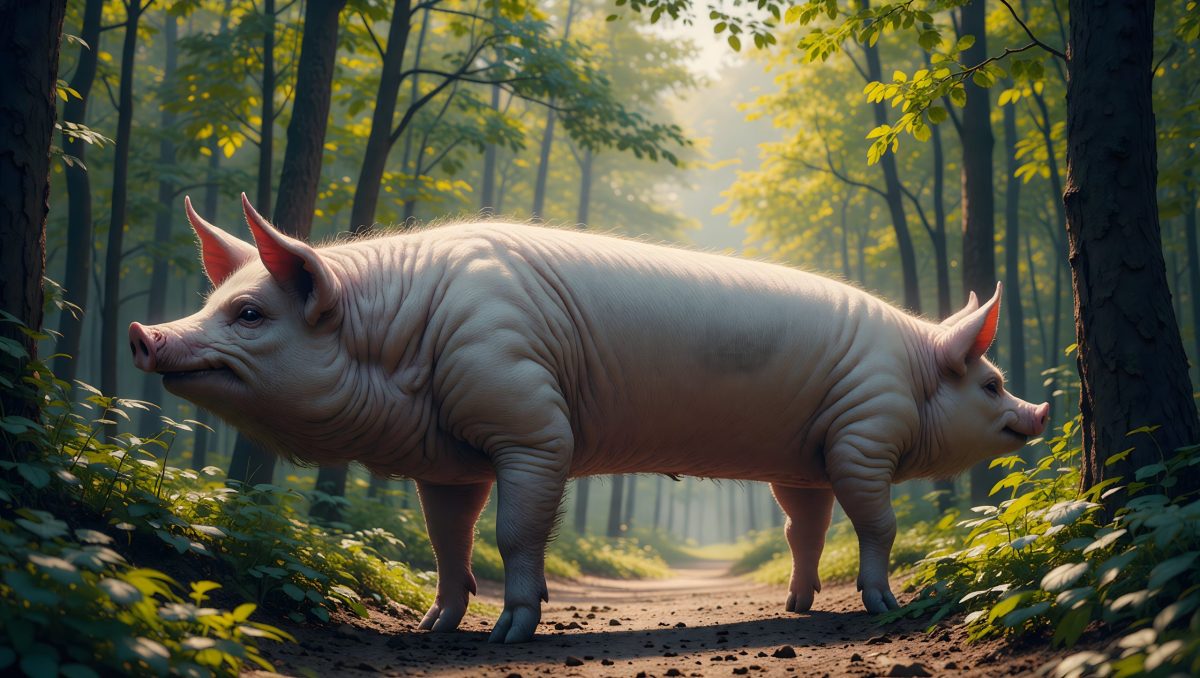
Bingfeng is a strange creature in Chinese legend that lives to the east of the Wuxian Kingdom. It is shaped like a pig but has a head at both the front and the back, and its body is black. It is described as having a demonic aura. Those who touch it may be injured. It cannot move forward normally and instead moves in a tilted manner.

It is recorded in the Classic of Mountains and Seas, including the Overseas Western Classic, and is also referred to in the Great Wilderness West Classic, where it is called Ping Feng or Ping Peng and regarded as the same being. Notes connected to these texts describe it as a beast form and compare it with other creatures having two heads, such as snakes or birds, saying they share the same type of form. Another note describes it as resembling a totem-like dried body of two pigs.

A two-headed pig resembling this creature was also depicted in later printed illustrations.


Gallery


Sources

Wikipedia contributors. (n.d.). 并封. In Wikipedia, from https://zh.wikipedia.org/wiki/%E5%B9%B6%E5%B0%81


Interpretive Lenses

Religious Readings
  • Christian Ascetic Deep Dive
Philosophical Readings
  • Nietzschean Deep Dive
Psychological Readings
  • Jungian Deep Dive
Esoteric Deep Dive
  • Hermetic Deep Dive
Political / Social Readings
  • Marxist Deep Dive

Oriogorukho

Tradition / Region: Papua New Guinea Mythology
Alternate Names: Oriogoruho
Category: Pig, Forest Dweller


The Myth

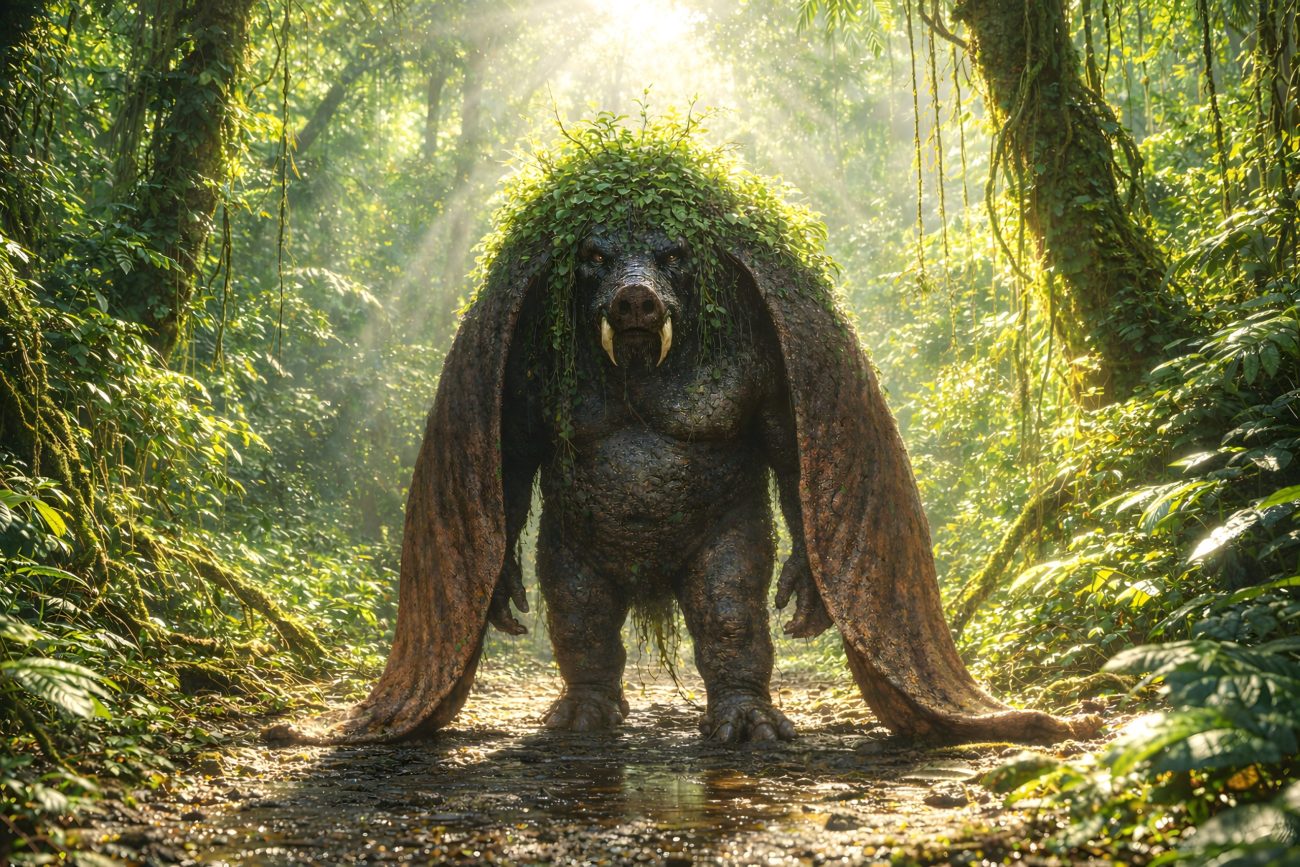
In the folklore of the Kiwai Papuans, Oriogorukho is described as an evil mythical creature that resembles a human in general form, but is clearly distinguished by several frightening features. Most striking are its enormous ears, which hang down to the ground. At night, the creature uses these ears to cover itself while it sleeps.

Although its body is broadly human-like, the Oriogorukho’s legs end in pig-like hooves. From its mouth protrude two pairs of sharp fangs, and instead of hair, bushes and creeping plants grow upon its head. Despite this monstrous appearance, the Oriogorukho possesses the ability to take on the shape of an ordinary human being. When it does so, it can be very difficult, or even impossible, to recognize it for what it truly is.

Oriogorukho are said to live in the forest, where they attack people. Their diet further sets them apart from humans. In addition to human flesh, they consume raw meat, fish, and unripe fruits. According to belief, a person who eats such improper food may themselves begin to transform into an Oriogorukho, with the first visible sign being the growth of the creature’s characteristic drooping ears.

In one tale, a man who has been shamed by his wife leaves his village and wanders into the forest. There he encounters an Oriogorukho and agrees to live together with it. Stories such as this suggest that although the Oriogorukho is regarded as a clearly negative and dangerous being, it is capable of treating people well if they themselves behave well toward it.


Gallery


Sources

Bestiary.us contributors. (n.d.). Oriogorukho. In Bestiary.us, from https://www.bestiary.us/Oriogorukho/


Interpretive Lenses

Religious Readings
  • Christian Ascetic Deep Dive
Philosophical Readings
  • Nietzschean Deep Dive
Psychological Readings
  • Jungian Deep Dive
Esoteric Deep Dive
  • Hermetic Deep Dive
Political / Social Readings
  • Marxist Deep Dive
Other
  • How to Invite The Oriogorukho

Oto Akuka

Tradition / Region: Japanese Mythology
Alternate Names:
Category: Demon, Cow, Pig


The Myth

Oto Akuka is a demon recorded only once, in a single old Japanese scroll. Beyond this appearance, nothing more is known. There are no surviving stories, no extended legends, and no later mentions of the creature.

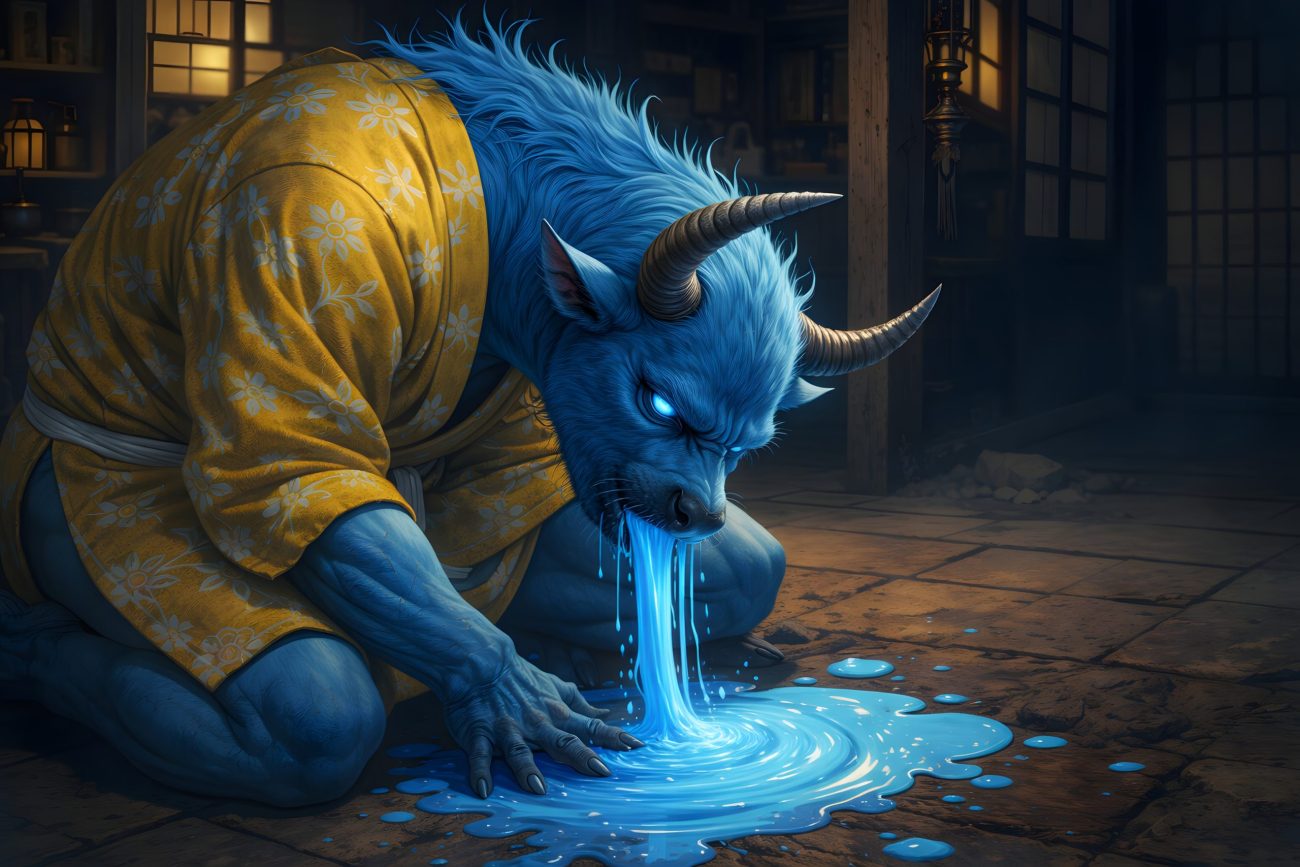
In the scroll, Oto Akuka is shown with blue skin and a beast-like face. Its head is bald and crowned with two horns, and its nose appears crushed, giving it the resemblance of a cow or a pig. The demon is depicted kneeling on the ground. One hand is pressed firmly against the floor, while the other supports its body as it vomits.

The image presents Oto Akuka not as a being that attacks others, but as one overcome by what rises within itself. The demon is shown in the moment of release, brought low and humiliated by its own condition. Its punishment is not delivered by an external force, but unfolds openly through its own body, in full view.

Oto Akuka remains an isolated figure in Japanese folklore—a single, unsettling image preserved in a scroll, offering no tale of origin or aftermath, only the enduring vision of a demon brought to shame.


Gallery


Sources


Youkai Gazou Database. (2007).
鬼;オニ,嘔吐;オウトInternational Research Center for Japanese Studies (Nichibunken). Retrieved from https://www.nichibun.ac.jp/cgi-bin/YoukaiGazou/card.cgi?identifier=U426_nichibunken_0080_0008_0005

Also mentioned in my book Legendary and Mythical Cows

Interpretive Lenses

Religious Readings
  • Christian Ascetic Deep Dive
Philosophical Readings
  • Nietzschean Deep Dive
Psychological Readings
  • Jungian Deep Dive
Esoteric Deep Dive
  • Hermetic Deep Dive
Political / Social Readings
  • Marxist Deep Dive
Other
  • How to Invite The Oto Akuka