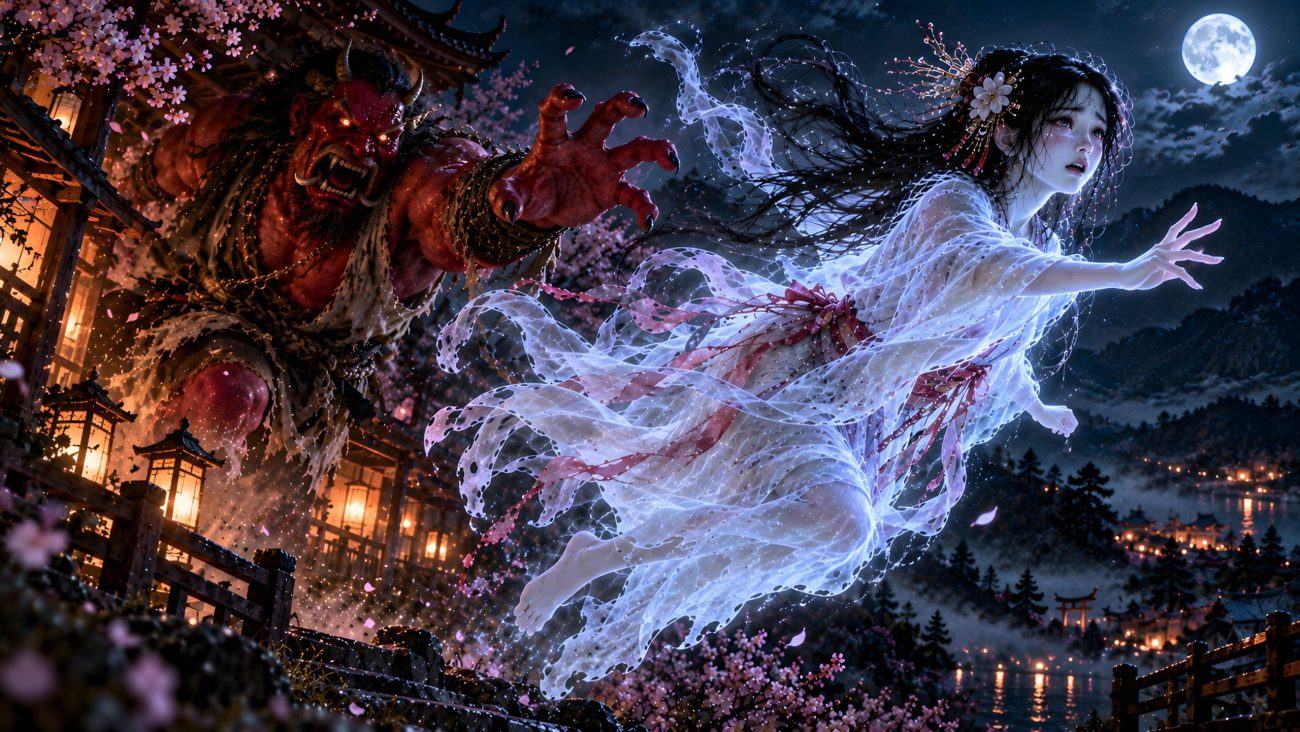
Takatsugu and Masaki

Tradition / Region: Japanese Mythology
Alternate Names: The White Fox of Uenohara
Category: Fox


The Myth

Long ago, after many wanderings, a fox came to live in Uenohara. She had lived for centuries, yet had gained little power. Though she had survived many dangers, she had not become a spirit fox, and she carried the burden of having once taken a human life, even if it had been an enemy.

Thinking on her fate, she resolved to change. Instead of seeking power through trickery, she decided to do good for the world and for people. Taking the form of an old woman, she opened a small tea shop by the roadside.

There she welcomed travelers passing through the region, giving them warmth in winter and rest from the summer heat. The money she earned she did not keep for herself. She gave it to orphaned children, and whenever she encountered people in despair, she tried to save them.

She persuaded lovers who planned to die together to abandon their decision. She fed and clothed those driven to desperation by poverty and gave shelter to the hopeless. Year after year she continued her work, quietly helping anyone who came to her door.

In time, the number of lives she saved was said to have reached nine hundred and ninety-nine.

At last, when she reached the age of one thousand years, her body changed. Her fur turned pure white, and her tail split and multiplied until she bore nine. By the virtue she had gathered through kindness, the fox finally rose to the rank of a great spirit.

Thus she was remembered as the fox of Uenohara, who gained power not through cunning, but through compassion, and whose many good deeds transformed her into a nine-tailed white fox of legend.


Gallery


Sources

Tyz-Yokai Blog. (n.d.). Takatsugu and Masaki. Retrieved March 1, 2026, from https://tyz-yokai.blog.jp/archives/1064835229.html.


Interpretive Lenses

Religious Readings
  • Christian Ascetic Deep Dive
Philosophical Readings
  • Nietzschean Deep Dive
Psychological Readings
  • Jungian Deep Dive
Esoteric Deep Dive
  • Hermetic Deep Dive
Political / Social Readings
  • Marxist Deep Dive

Obana Kitsune

Tradition / Region: Japanese Mythology
Alternate Names: Obanagitsune
Category: Fox


The Myth

In the world of Edo-period theatre there was a fox known as Obana Kitsune, remembered from a dance performed in the play Willow Dolls and Birds Singing.

In this performance, a nun appears on stage, facing forward in calm devotion. Yet when she turns, her face changes, and with the aid of a mask she becomes a fox. Spinning in dance, she reveals her true nature before vanishing as suddenly as she appeared.

This fox was said to be Obana Kitsune, a spirit born from stories of foxes who disguise themselves as monks or nuns to move among humans. Like the foxes of older tales, she takes on holy robes and human form, only to reveal her identity in a sudden transformation.

Her story echoes older performances in which animal spirits disguised as religious figures try to persuade hunters to spare their kind, or escape danger through clever tricks. When her disguise fails, the fox does not fight. Instead she dances, spins, and slips away, leaving only the memory of movement behind.

Thus Obana Kitsune was remembered as a fox of the stage — a spirit who appeared in the form of a nun, revealed herself through dance, and vanished like a performance fading into silence.


Gallery


Sources

Tyz-Yokai Blog. (n.d.). Obana Kitsune. Retrieved March 1, 2026, from https://tyz-yokai.blog.jp/archives/1058717512.html.


Interpretive Lenses

Religious Readings
  • Christian Ascetic Deep Dive
Philosophical Readings
  • Nietzschean Deep Dive
Psychological Readings
  • Jungian Deep Dive
Esoteric Deep Dive
  • Hermetic Deep Dive
Political / Social Readings
  • Marxist Deep Dive

Takuzōsu

Tradition / Region: Japanese Mythology
Alternate Names: Takuzōsu Inari, Hakuzō Inari
Category: Fox


The Myth

At Dentsūin Temple in Koishikawa there was once said to have lived a monk named Takuzōsu. He appeared suddenly in the temple dormitory and astonished the other monks with his knowledge, mastering the teachings of Pure Land Buddhism in only a few years. He spoke fluently on doctrine and scripture, and none doubted his devotion.

One night, however, the head priest dreamed that Takuzōsu appeared before him in radiant form. In the dream the monk revealed his true identity — he was Inari Daimyōjin, a divine being who had once been enshrined in the castle of Ōta Dōkan. He declared that he had come to taste the teachings of the Pure Land and promised to guard the temple. With that, he vanished into the dawn clouds.

Another version of the story tells that Takuzōsu was in truth a fox spirit who had taken the form of a monk. He lived among the clergy, studying and discussing Buddhism by night. One day, while sleeping deeply, his true nature was revealed. Ashamed, he fled the temple and disappeared into the mountains.

Yet even after he vanished, the monks said he continued to visit at night, speaking of Buddhist teachings as before. His writings were preserved, though later readers claimed the characters seemed strangely formed, as if written by something not entirely human.

In time the fox was honored as a protective spirit and enshrined as Takuzōsu Inari, the guardian of the temple. Stories were also told that during his years at the temple he loved soba noodles and sometimes paid for them using leaves that turned to money, or money that turned to leaves by morning.

Because of this, offerings of the first soba of the day were made to the shrine, and Takuzōsu was remembered as a fox who had walked among monks, studied the Dharma, and become a guardian spirit of the temple he once haunted.


Gallery


Sources

Tyz-Yokai Blog. (n.d.). Takuzōsu. Retrieved March 1, 2026, from https://tyz-yokai.blog.jp/archives/1058309922.html.


Interpretive Lenses

Religious Readings
  • Christian Ascetic Deep Dive
Philosophical Readings
  • Nietzschean Deep Dive
Psychological Readings
  • Jungian Deep Dive
Esoteric Deep Dive
  • Hermetic Deep Dive
Political / Social Readings
  • Marxist Deep Dive

Yao no Kitsune

Tradition / Region: Japanese Mythology
Alternate Names: Eight-Tailed Fox
Category: Fox


The Myth

During the reign of Tokugawa Iemitsu, the third shogun of the Edo shogunate, it is said that he once fell gravely ill and was confined to his bed. As his condition worsened, those around him feared the worst.

One night, while he slept, Iemitsu had a vivid dream. In it, a fox with eight tails appeared before him. The fox came from the direction of Nikkō Tōshōgū Shrine and spoke clearly, telling him, “You will soon recover.”

When Iemitsu awoke, his illness began to ease just as the fox had promised. His strength returned, and before long he was restored to health. Believing the vision to be a sign of divine protection, he ordered that the fox from his dream be painted so that its image would be preserved.

The painting was later said to have been created by the shogunate’s official artist, and the story of the dream was remembered as proof that the fox had appeared as a messenger of higher powers.

Thus the Eight-Tailed Fox was remembered not as a trickster or deceiver, but as a spirit of omen and reassurance — a fox who came in a dream from a sacred shrine to promise recovery, and whose appearance was taken as a sign of unseen guardians watching over the ruler of the land.


Gallery


Sources

Tyz-Yokai Blog. (n.d.). Yao no Kitsune. Retrieved March 1, 2026, from https://tyz-yokai.blog.jp/archives/1040893326.html.


Interpretive Lenses

Religious Readings
  • Christian Ascetic Deep Dive
Philosophical Readings
  • Nietzschean Deep Dive
Psychological Readings
  • Jungian Deep Dive
Esoteric Deep Dive
  • Hermetic Deep Dive
Political / Social Readings
  • Marxist Deep Dive

Osangitsune

Tradition / Region: Japanese Mythology
Alternate Names: Three-Tailed Fox of Koetao Pass
Category: Fox


The Myth

Near Koetao Pass in Yuki Town there was said to live a wise fox with three tails. The pass lay close to a cremation ground and was quiet at night, and people whispered that anyone carrying food there might be tricked by the fox. In time it became known simply as the Three-Tailed Fox of the pass.

One evening a man named Zen-san, who lived alone in Mugitani Village, went to town to buy supplies for a memorial service. By the time he finished his shopping, dusk had fallen, and he hurried home over the pass.

On the road he met a young woman who said she too was crossing the mountain to visit relatives. Glad for company, Zen-san walked behind her along the dark path. As they went, he became strangely fascinated by the way she moved. He tried to draw closer, but no matter how he reached out, he could not touch her. When he tried to embrace her, his hands met only empty air.

The woman glanced back and slipped into the bushes with a teasing motion, and Zen-san chased after her. All night he wandered, pursuing her deeper into the mountains, unable to catch her or understand where she went.

At dawn, the voices of villagers searching for him finally brought him back to his senses. He found himself standing atop a rock on Mount Kamatakiyama, far from the path he had followed. The fried tofu he had bought the night before was gone from his bundle.

Only then did he understand. The woman he had followed was the fox of Koetao Pass, and the swaying shapes at her waist had not been folds of cloth, but three tails moving in the darkness.

From that time on, Zen-san’s tale was told as proof that the Three-Tailed Fox still haunted the pass, ready to lead travelers astray with a smile and vanish before dawn.


Gallery


Sources

Tyz-Yokai Blog. (n.d.). Osangitsune. Retrieved March 1, 2026, from https://tyz-yokai.blog.jp/archives/1039219549.html.


Interpretive Lenses

Religious Readings
  • Christian Ascetic Deep Dive
Philosophical Readings
  • Nietzschean Deep Dive
Psychological Readings
  • Jungian Deep Dive
Esoteric Deep Dive
  • Hermetic Deep Dive
Political / Social Readings
  • Marxist Deep Dive

Otonjoro

Tradition / Region: Japanese Mythology
Alternate Names: Otonjoro Fox
Category: Fox


The Myth

In the hills around Tachimi Pass there was said to live a fox spirit known as Otonjoro. People believed she earned this name because she often took the form of a woman called Otomi, who appeared like a wandering prostitute along the road.

Travelers who met her rarely realized at first that she was no human. She spoke gently and moved with ease among people, yet her purpose was often to deceive. Otonjoro was known for clever tricks and strange dealings, and even when she was caught and bound, she was said to slip free and vanish without a trace.

One of her favorite foods was roasted mice. Stories tell that if these were placed out, she would attract customers by transforming fallen leaves into coins and using them as payment. Those who received the coins would test them by tearing them in half. If they did not tear, they were taken as real, and the exchange was accepted.

It was also said that Otonjoro was married to another fox spirit, Keizōbō, who served the lord of Ikeda as a courier, running messages swiftly across the land.

Thus Otonjoro was remembered as a fox who walked the mountain pass in human form — a spirit of disguise and mischief, trading with leaves, slipping from ropes, and leaving behind only stories of her laughter on the road.


Gallery


Sources

Tyz-Yokai Blog. (n.d.). Otonjoro. Retrieved March 1, 2026, from https://tyz-yokai.blog.jp/archives/1010654407.html.


Interpretive Lenses

Religious Readings
  • Christian Ascetic Deep Dive
Philosophical Readings
  • Nietzschean Deep Dive
Psychological Readings
  • Jungian Deep Dive
Esoteric Deep Dive
  • Hermetic Deep Dive
Political / Social Readings
  • Marxist Deep Dive

Yako

Tradition / Region: Japanese Mythology
Alternate Names: Nogitsune, Field Fox
Category: Fox


The Myth

In the regions of Kyūshū, people speak of a fox spirit called the Yako, a small and elusive being that lives among the fields and hills.

Unlike the grand fox spirits of old tales, the Yako is said to be tiny, only a little larger than a mouse and smaller than a cat. It may be black or white, and some say it cannot be seen at all. Though small, it rarely travels alone. Stories tell that when a Yako moves, many others follow it, and people speak of a “thousand-fox company” traveling together unseen.

The Yako is feared most for its power to possess humans. When it slips into a person’s body, illness and strange behavior follow, and this condition is called yako-tsuki. It is said the spirit may hide beneath a person’s arm or enter through a weakness in the body, bringing sickness and weakness in its wake.

Families in some places are believed to keep Yako spirits as familiars. Such households pass the fox down through generations, and their descendants may become possessed as well. These spirits can be sent against enemies, causing misfortune or illness to those the family resents. Yet keeping a Yako is dangerous. If a household cannot sustain it, the fox may instead possess their livestock, bringing trouble to the family itself.

Because of this, people once took precautions. Some avoided letting wounds or scars be touched by unseen spirits, and others scattered ashes or kept protective objects nearby to prevent the fox from entering their homes.

Thus the Yako is remembered as a hidden fox of the countryside — small, invisible, and easily overlooked, yet capable of bringing illness, wealth, or ruin to any household it chooses to follow.


Gallery


Sources

yokai.com. (n.d.). Yako. Retrieved March 1, 2026, from https://yokai.com/youko/.


Interpretive Lenses

Religious Readings
  • Christian Ascetic Deep Dive
Philosophical Readings
  • Nietzschean Deep Dive
Psychological Readings
  • Jungian Deep Dive
Esoteric Deep Dive
  • Hermetic Deep Dive
Political / Social Readings
  • Marxist Deep Dive

Kudagitsune

Tradition / Region: Japanese Mythology
Alternate Names: Izuna
Category: Fox


The Myth

In the mountains of central Japan there are said to live tiny fox spirits known as Kudagitsune, or Pipe Foxes. No larger than a rat, they are thin and quick, easily hidden in sleeves, pockets, or even carried inside bamboo tubes, from which they take their name.

In the wild they live quietly like small animals, keeping to forests and hills and rarely showing themselves to people. But sometimes they are captured or tamed by sorcerers and fortune tellers. Once brought into a household, they become loyal familiars, serving not just one master but an entire family.

Such families gain unusual powers. They can divine the future, uncover hidden matters, and send their fox spirits out to trouble enemies. The Kudagitsune may bring sickness, misfortune, or unrest to those their owners wish to harm. Because of this, households known to keep these spirits are often feared or avoided by their neighbors.

It is said that families with Kudagitsune can easily obtain wealth and goods, as the spirits help them gather what they desire. Yet this blessing carries danger. The foxes multiply quickly, and a household may soon be overrun by dozens of them. If too many gather, they consume the family’s stores and bring ruin. Yet trying to drive them away or give them to others is risky, for the spirits do not always leave peacefully.

Thus the Kudagitsune are remembered as small but powerful foxes of the mountains — spirits easily hidden, easily summoned, and difficult to control once they have made a home among humans.


Gallery


Sources

yokai.com. (n.d.). Kudagitsune. Retrieved March 1, 2026, from https://yokai.com/kudagitsune/?srsltid=AfmBOoqZZZy49yfR6b2t7RCSgU5OdiIb0bLLwmCsJyCVlgHgwzj_CC5m.


Interpretive Lenses

Religious Readings
  • Christian Ascetic Deep Dive
Philosophical Readings
  • Nietzschean Deep Dive
Psychological Readings
  • Jungian Deep Dive
Esoteric Deep Dive
  • Hermetic Deep Dive
Political / Social Readings
  • Marxist Deep Dive

Hafukohotsu Fox

Tradition / Region: Japanese Mythology
Alternate Names: Hafukohotsu Fox of Hirofuchi Mikura
Category: Fox


The Myth

In Hirofuchi Village, where the Date clan once kept its rice storehouses, many old foxes and raccoon dogs were said to live nearby, often frightening the villagers.

One night, a man assigned to guard the storehouse sat alone by the hearth, smoking. Suddenly his father appeared at the door, visiting at an unusual hour with no clear reason. The guard watched him closely and noticed something strange. His father was blind in one eye — the left — yet now that eye was shut while the other was open. Realizing this could not be right, he understood that the visitor must be a fox in disguise.

Hiding his suspicion, he spoke cheerfully.
“I have some rice cakes the villagers gave me. Would you like some?”

The false father smiled and accepted. The guard continued, pretending to think aloud about how his father preferred to eat them. The disguised fox hesitated, unsure of the answer, then finally replied,
“I… like hafukohotsu…”

The guard knew at once the creature had failed to say the name of the kinako rice cakes his real father loved. Still pretending nothing was wrong, he served the fox the bean-flour mochi and let him eat.

Later, as the guard prepared to sleep, he told the visitor there was no spare bedding and asked whether he could sleep wrapped in an empty rice sack. A real father would have taken offense, but the fox eagerly agreed. Seeing his chance, the guard wrapped the sack around him and tied it tightly with rope.

The fox complained mildly but soon fell asleep.

When dawn came and sunlight reached the storehouse, the creature realized it had been trapped. It struggled desperately, but the ropes held fast, and at last its tail slipped from the sack, revealing its true form — a large, old fox.

The story spread quickly through Hirofuchi and beyond. People laughed at the foolish fox who could not pronounce the name of rice cakes and had allowed himself to be tied up so easily. From then on, it was remembered as the Hafukohotsu Fox of Hirofuchi, a tale passed down to remind people that even clever fox spirits can sometimes be outwitted by careful eyes and quick thinking.


Gallery


Sources

Tyz-Yokai Blog. (n.d.). Hafukohotsu Fox. Retrieved March 1, 2026, from https://tyz-yokai.blog.jp/archives/1077543077.html.


Interpretive Lenses

Religious Readings
  • Christian Ascetic Deep Dive
Philosophical Readings
  • Nietzschean Deep Dive
Psychological Readings
  • Jungian Deep Dive
Esoteric Deep Dive
  • Hermetic Deep Dive
Political / Social Readings
  • Marxist Deep Dive

Harugitsune

Tradition / Region: Japanese folklore (Tottori Prefecture)
Alternate Names: Oharu-gitsune, Oharu the Fox
Category: Fox, shapeshifter, household spirit


The Myth

In the port town of Akasaki, there once lived a fox spirit called Harugitsune, known affectionately as Oharu. She made her home in the forest behind Lord Ikeda’s rice storehouse, where a great pine tree stood on a steep cliff. At its roots was a hollow, and there Oharu lived with her children.

To care for them, she often slipped into town disguised as a human maid. She covered her ears with a handkerchief and folded the hem of her kimono to hide her tail. In this form she entered busy homes, helping with chores and quietly taking food back to the forest.

Oharu was mischievous but gentle. While serving tea, she would sometimes scoop ashes from the brazier and drop them into a teacup, smiling to herself. Before long, the townspeople realized she was a fox, yet they did not drive her away. Instead they welcomed her kindly.

Whenever someone teased her by saying, “I saw it, Oharu-san,” she would only laugh softly, “Huff, huff,” even when her tail slipped into view. The people would continue to invite her in, pour tea for her, and watch her playful tricks with fond amusement.

After her work was done, they gave her food to carry home, and she would return to her den in high spirits, smiling as she went back to her waiting children.

It was also said that Oharu kept a lamp burning in her den. She bought oil for it from a local shop at night, paying with coins that turned into camellia leaves by morning. The shopkeeper knew he had been fooled, yet he sold to her willingly, charmed by her gentle nature.

In time, people tied a pole and basket to the great pine tree above her den to use it as a marker for sailors watching the weather. As more people came and went, a path formed through the forest, and eventually the foxes vanished from the hollow at the tree’s base.

Afterward, a shrine to Inari was built on the spot. And though the forest changed, people remembered that once a kindly fox named Oharu had lived there, moving between town and wilderness, laughing softly as she cared for her young.


Gallery


Sources

Tyz-Yokai Blog. (n.d.). Harugitsune. Retrieved March 1, 2026, from https://tyz-yokai.blog.jp/archives/1075303216.html.


Interpretive Lenses

Religious Readings
  • Christian Ascetic Deep Dive
Philosophical Readings
  • Nietzschean Deep Dive
Psychological Readings
  • Jungian Deep Dive
Esoteric Deep Dive
  • Hermetic Deep Dive
Political / Social Readings
  • Marxist Deep Dive