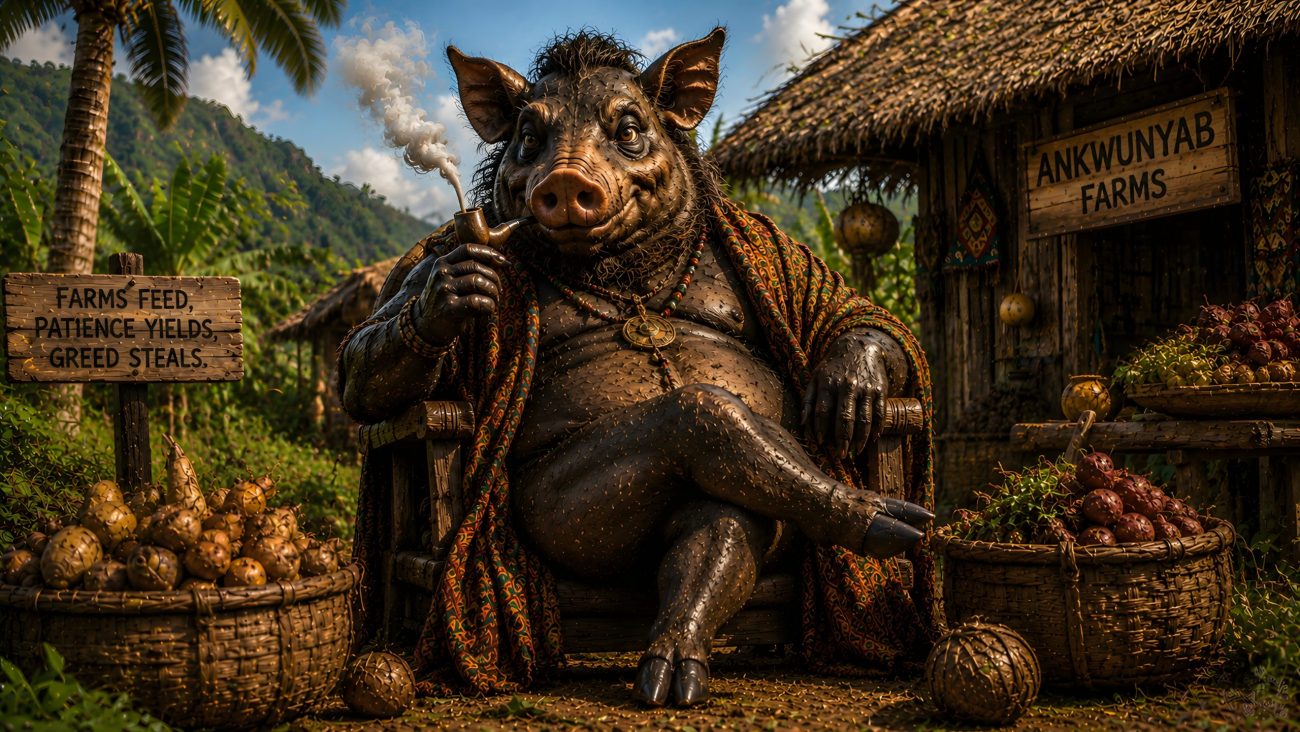
Ankwunyab the Pig

Tradition / Region: Cameroon Mythology
Alternative names: Ankwunyab, Friend-of-Mine
Category: Pig


The Myth

Ankwunyab the Pig appears in Central African animal folklore as a massive, wealthy, hot-tempered pig known for his endless appetite and relentless work ethic. Unlike many trickster animals, Pig is not lazy or foolish by nature. He is industrious, prosperous, and respected for his enormous farms and overflowing harvests. His great hunger is said to drive his tireless labor, making him one of the richest animals in the community.

Pig’s appearance is usually imagined as huge and imposing: a broad-bodied boar with a powerful snout, thick hide, restless little eyes, and an earth-stained body from constantly rooting through farms and soil. His grunts and heavy breathing are emphasized throughout the tale, giving him an intimidating physical presence. Yet despite his strength and wealth, Pig is emotionally vulnerable to manipulation and social obligation.

His greatest weakness is his friendship with Torokee the Tortoise.

Tortoise is everything Pig is not — lazy, cunning, extravagant, and deceitful. For years he borrows food, tools, seeds, oil, and money from Pig without repayment. Eventually Pig lends him a large sum again after Tortoise promises to host a grand feast for visiting in-laws and names Pig as an honored guest.

But moon cycle after moon cycle passes without repayment.

Pig repeatedly visits Tortoise demanding his money, only to hear excuses about failed harvests and hard times. Finally Pig loses patience and threatens serious consequences if the debt is not repaid within eight days.

Tortoise responds with a trap.

On the appointed day, Tortoise hides by pulling himself into his shell while instructing his wife to ignore Pig completely. When Pig arrives, furious and snorting, Mrs. Tortoise silently continues grinding spices with her stone as though he does not exist.

Enraged by the disrespect, Pig finally grabs the grinding stone and hurls it into the bushes.

At that exact moment Tortoise emerges from hiding and pretends horror at what Pig has done. His wife begins crying dramatically, claiming Pig has ruined her ability to cook. Tortoise then calmly declares that Pig cannot receive repayment until the missing grinding stone is recovered.

Pig realizes he has been trapped.

But the debt is so large that he cannot abandon it. Desperate, he begins searching through the earth for the stone.

According to the tale, this is why pigs forever root through dirt with their snouts.

The story transforms Pig into a folkloric explanation for real animal behavior while also presenting him as a tragic figure: hardworking but gullible, powerful but psychologically outmatched by trickster intelligence. Unlike many greedy beasts in folklore, Pig is not evil — merely blinded by anger, appetite, and pride.


Sources

Makuchi. (2008). The sacred door and other stories: Cameroon folktales of the Beba. Athens, OH: Ohio University Press.

Mbe the Cockroach

Tradition / Region: Cameroon Mythology
Alternative names: Mbe
Category: Insect


The Myth

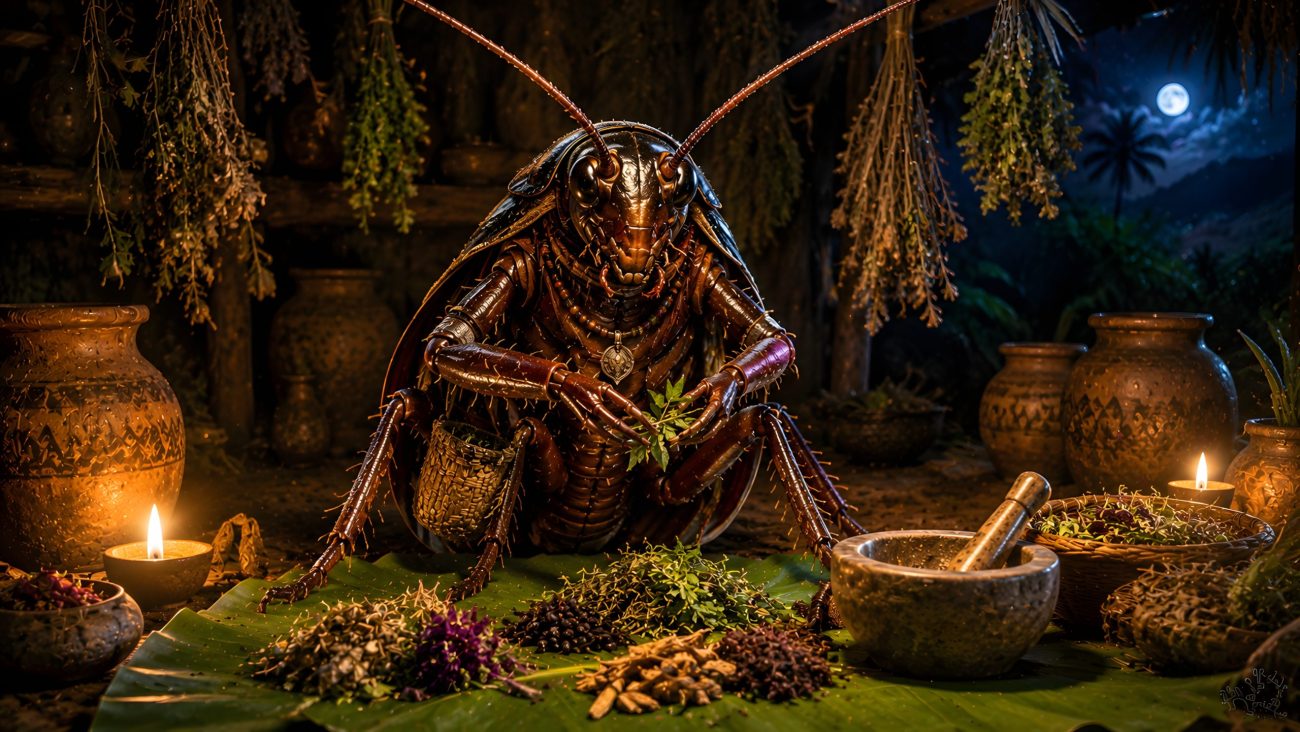
Mbe the Cockroach is portrayed in Beba folklore as a small but highly respected healer associated with medicine, herbal knowledge, and dangerous intelligence. Though physically tiny and vulnerable, Cockroach possesses powerful medical skills feared and admired throughout the land. She carries bags of herbs, healing oils, and secret remedies, functioning almost like a wandering spirit-doctor among animals.

Despite her reputation, Mbe is also deeply mistrusted because of her ancient hostility with Hen. In the tale, Hawk and Hen are inseparable friends whose families live together peacefully until Hawk’s oldest child becomes gravely ill with painful scabies and fever. After every local remedy fails, Hawk travels to seek the help of Cockroach, believing her healing powers can save his child.

Cockroach arrives at Hawk’s compound carrying medicinal herbs and special oils, including python oil used to soothe wounds and induce sleep. Calm and professional, she carefully divides the herbs into piles and instructs Hawk exactly how to prepare the treatments. She promises the child should recover within a week.

But Hen immediately becomes hostile.

Seeing Cockroach inside the home, Hen begins screaming accusations, claiming the healer intends to poison the child rather than cure him. The old hatred between Hen and Cockroach overwhelms reason. Cockroach attempts to ignore the insults and continue her work, but Hen’s rage only grows stronger.

Finally, in a sudden burst of violence, Hen attacks.

She scatters the sacred medicines across the compound, destroying the remedies, then lunges forward and swallows Cockroach whole in a single gulp.

With the healer dead and the medicines ruined, Hawk’s child dies soon afterward.

Hawk becomes consumed with grief and fury. He swears eternal revenge against Hen and her descendants. From that day onward, according to the myth, hawks began hunting chickens and their chicks forever.

In this story, Mbe the Cockroach represents fragile wisdom and vulnerable healing knowledge destroyed by jealousy, mistrust, and uncontrolled anger. Though small and physically weak, Cockroach possesses life-saving powers that larger animals lack. Her death marks the collapse of friendship, medicine, and social harmony, transforming the natural relationship between hawks and chickens into permanent blood-feud.


Sources

Makuchi. (2008). The sacred door and other stories: Cameroon folktales of the Beba. Athens, OH: Ohio University Press.


Aleleb the Bat

Tradition / Region: Cameroon Mythology
Alternative names: Aleleb
Category: Bat


The Myth

Aleleb the Bat is portrayed in Cameroonian folklore as a sorrowful, intelligent creature tied to grief, loyalty, and the origin of nocturnal life. Unlike many trickster bats found in folklore, Aleleb is deeply emotional and devoted to family, especially to his aging mother. He is described as a close companion of Neneb the Sun, and the two share an unusually powerful friendship, constantly visiting one another and living almost like brothers.

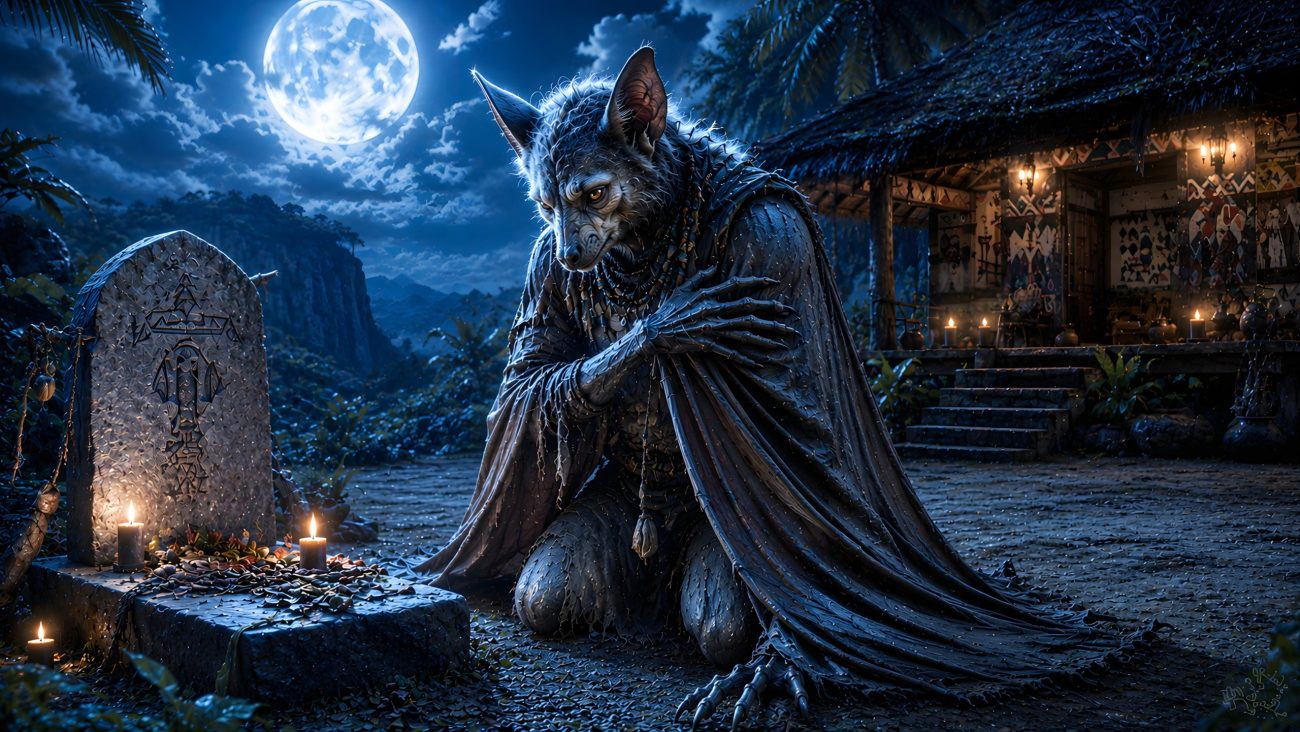
Bat’s mother eventually becomes gravely ill. Aleleb desperately searches for healers, carrying herbs and prayers from compound to compound while traditional healers call upon the ancestors to save her. Despite every effort, she continues to weaken until she finally dies after giving her son final words of wisdom and endurance.

Overwhelmed by grief, Aleleb decides he must bury his mother before nightfall. Because sunset is approaching, he flies to his friend Neneb the Sun and begs him to delay darkness just a little longer so the burial can be completed properly.

But Sun refuses.

Neneb tells Bat he cannot hold back the coming night and suggests waiting until morning instead. To Aleleb, this response feels cold, dishonorable, and cruel. In his deepest moment of suffering, the friend he trusted most chooses not to help him.

Bat returns home devastated and buries his mother in darkness.

After the burial, Aleleb lies beside her grave and swears never again to look upon the face of the Sun. From that day onward, according to the myth, bats abandoned the daylight forever and became creatures of the night.

In this story, Aleleb symbolizes mourning, wounded friendship, filial devotion, and exile from the world of light. The myth explains the nocturnal behavior of bats while also functioning as a moral tale about loyalty and the consequences of refusing compassion to those in grief.


Sources

Makuchi. (2008). The sacred door and other stories: Cameroon folktales of the Beba. Athens, OH: Ohio University Press.


Jengu

Tradition / Region: Sawabantu Mythology, Cameroon Mythology
Alternate Names: Miengu (plural), Bisima; Liengu (Bakweri), Maengu (plural)
Category: Mermaid


The Myth

In the rivers, lakes, and along the shores of the sea in Cameroon dwell the jengu—water spirits of beauty and power.

They are said to appear as radiant beings, often like mermaids, with long flowing hair and shining gap-toothed smiles. Their presence is linked to clear waters and hidden depths. They live beneath the surface, in the currents and tidal places where the worlds of the living and the spirits meet.

The jengu are guardians of the waters and intermediaries between humanity and the ancestors. When illness strikes, when fate turns uncertain, or when guidance is needed, people call upon them. They are believed to heal disease, grant prosperity, and influence destiny. Those who honor them with devotion receive good fortune; those who neglect them may lose their favor.

Among the Duala and other Sawabantu peoples, the jengu are honored through sacred rites and festivals. When the ruling families of the Ngondo declare that the time has come, offerings are gathered from the villages. Trained spiritual specialists prepare themselves through ritual purification and ceremony.

On the night before the festival, these priests perform sacred rites on the islands of the Wouri River. At dawn, the tribute is displayed before the chiefs. Then a jengu specialist carries the offering into the water, swimming out beyond sight. There, beneath the surface, the gift is presented to the miengu.

When the priest returns, he brings back a message from the spirits—a prophecy concerning the year to come.

Among the Bakweri, the jengu also play a role in a young girl’s passage into womanhood, marking her transformation and linking her life to the power of the waters.

Thus the jengu remain: spirits of the deep, bringers of healing and fortune, moving unseen between the living and the ancestral world.


Gallery


Sources

Wikipedia contributors. (n.d.). Jengu. In Wikipedia, The Free Encyclopedia. Retrieved February 14, 2026, from https://en.wikipedia.org/wiki/Jengu


Interpretive Lenses

Religious Readings
  • Christian Ascetic Deep Dive
Philosophical Readings
  • Nietzschean Deep Dive
Psychological Readings
  • Jungian Deep Dive
Esoteric Deep Dive
  • Hermetic Deep Dive
Political / Social Readings
  • Marxist Deep Dive
Other
  • How to Invite The Jengu