Tradition: Brazilian Mythology, Paraguayan Mythology, Guyana Mythology
Alternative Names: Currupira, Korupira
Category: Goblin
The Myth
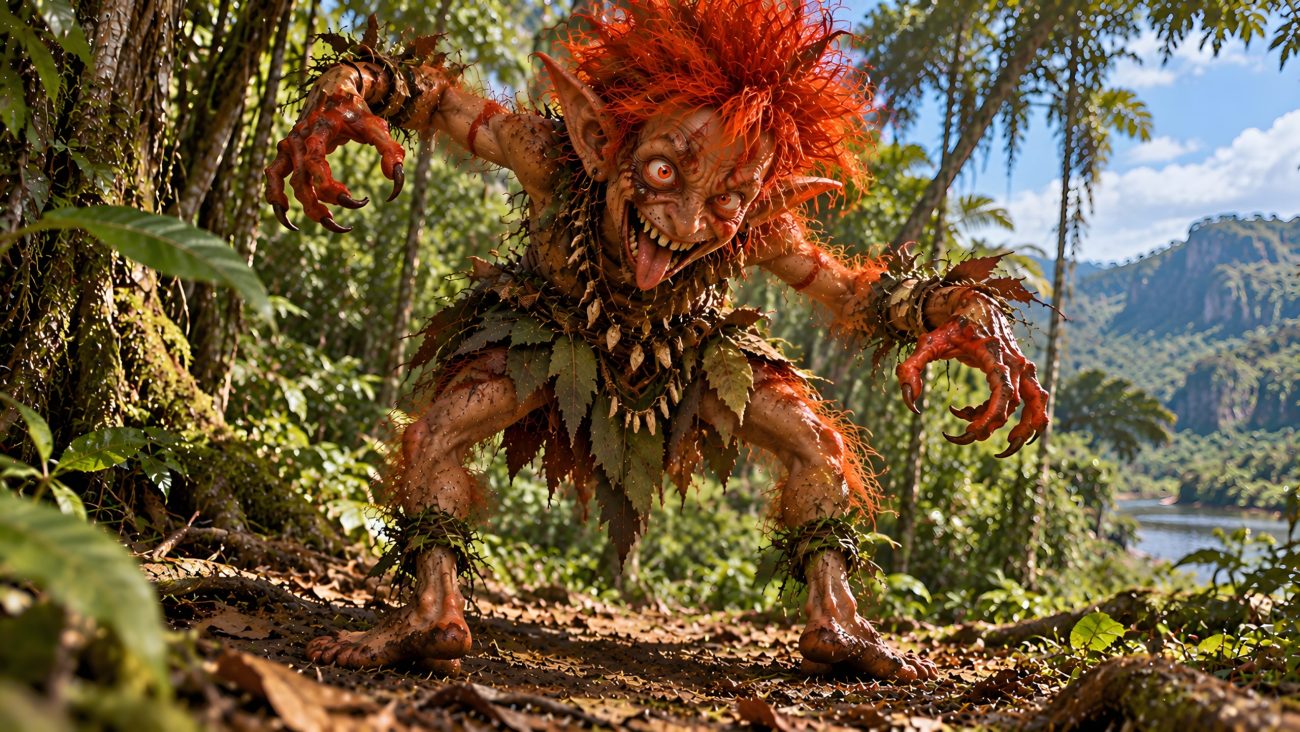
The Curupira is a small, humanoid forest spirit known for its unusual appearance and backward-facing feet. Its feet point in the opposite direction from those of an ordinary human, allowing it to leave footprints that mislead trackers. It is commonly described as a short Indigenous-looking figure, sometimes bald on the head but covered in long, shaggy body hair. Some accounts give it enormous ears and blue or green teeth, while others describe a bright red face, cloven feet, or a single eye. Its hair is sometimes portrayed as red or orange, although this feature may reflect confusion with another Brazilian forest spirit, the Caipora. The Curupira’s appearance varies considerably between regions.
The Curupira inhabits forests across Brazil, Paraguay, and the Guianas, where it acts as a guardian of the natural world. It punishes people who recklessly cut down trees or exploit the forest. One of its characteristic tricks is to make intruders lose their way, causing them to wander endlessly among the trees without finding their way home. Its backward-facing footprints make it especially difficult to follow its movements: anyone attempting to track or escape the creature may instead find themselves following it deeper into the wilderness. The Curupira can also cause nightmares, inspire troubling thoughts, and sow distrust and discord between people.
The Curupira’s temperament differs between accounts. Early Jesuit descriptions from São Paulo portray it as a feared supernatural being capable of inflicting terrible injuries, whose favour could be secured through offerings. In other traditions, it appears as a mischievous trickster that sometimes bungles its schemes and allows humans to outsmart it. Despite this more playful portrayal, it remains dangerous, capable of causing misfortune and death. Its ability to confuse and deceive people has also led to its association with lies and misleading thoughts.
According to some traditions, the Curupira has a wife and children who live inside the hollow trunks of dead trees. Its female relatives are described as having long hair, and the family sometimes enters cultivated fields to steal manioc. Other accounts portray its wife as an ugly, malicious woman who assists in its misdeeds. Some versions even identify the youngest child as Saci, another well-known figure in Brazilian folklore. The Curupira is also sometimes depicted riding a deer, rabbit, pig, or peccary, and in stories from Pernambuco it may be accompanied by a dog named Papa-mel.
Hunters can sometimes appease the Curupira by leaving offerings of tobacco or cachaça, a spirit distilled from sugarcane. The creature is particularly fond of tobacco and may reward hunters who provide it, although they are expected to keep the arrangement secret from their wives. These offerings reflect the belief that the forest spirit can be approached through respect and gifts, even though its behaviour remains unpredictable.
As a guardian of the forest, the Curupira embodies both the dangers of the wilderness and the consequences of exploiting it. It protects trees and wildlife by confusing, frightening, or punishing those who abuse the natural environment. Its backward feet, deceptive tricks, and shifting appearance make it a formidable opponent for anyone who enters the forest without respect for the supernatural forces believed to dwell there.
Sources
“Curupira.” Wikipedia: The Free Encyclopedia. Wikimedia Foundation. Accessed October 17, 2026. https://en.wikipedia.org/wiki/Curupira