Dragon of Wyl

Tradition / Region: Swiss Mythology
Alternative names: Dragon Reed
Category: Crocodile, Dragon


The Myth

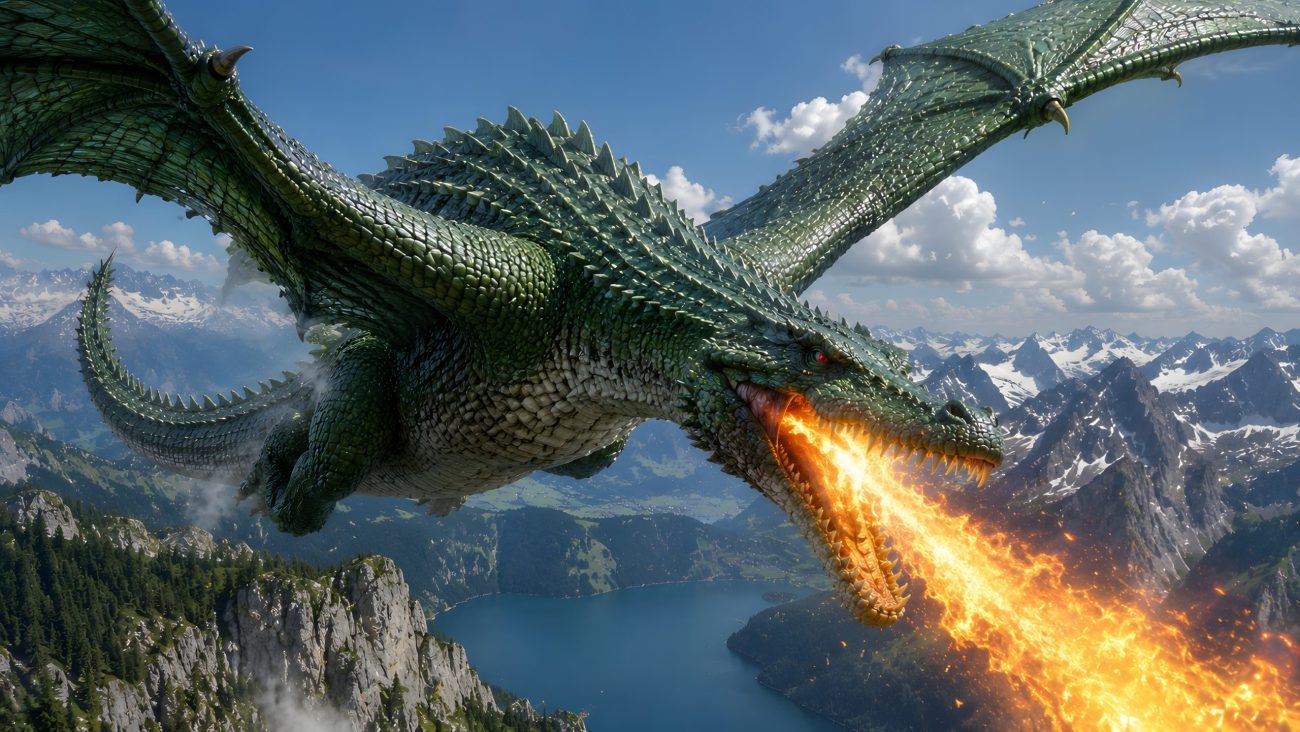
According to a legend from Unterwalden, a terrible dragon once lived in a cave above the village of Wyl on the shores of Lake Lucerne. The monster was described as a hideous lindworm covered in scales with razor-sharp claws. When it flew through the air, it resembled a gigantic flying crocodile, and it could breathe fire from its jaws.

The dragon devastated the surrounding countryside, devouring livestock and shepherds alike. No one was safe from its attacks, and even children and young women gathering food in the fields lived in constant fear. The destruction became so severe that the village earned the name Ödwyl, meaning “Desolate Wyl.”

A banished knight named Struthan Winkelried offered to slay the beast in exchange for permission to return to his homeland. Desperate for deliverance, the people accepted his offer.

Struthan confronted the dragon wearing chainmail and carrying a lance wrapped in thorn bushes. When the fire-breathing monster charged, it hurled itself onto the thorn-covered lance. After a fierce struggle, the dragon was slain.

As the knight withdrew his weapon, some of the dragon’s blood ran onto his bare arm. Although he immediately washed it away, the poisonous blood proved fatal, and he died soon afterward.

The people mourned the hero who had freed them from the dragon’s terror and built a memorial chapel on the place where he had defeated the monster.


Sources

SAGEN.at. (n.d.). Das Drachenried. In Traditionelle Sagen. Retrieved June 29, 2026, from https://www.sagen.at/texte/sagen/schweiz/allgemein/drachenried.html


Ninki Nanka

Tradition / Region: Gambia Mythology
Alternative names:
Category: Crocodile


The Myth

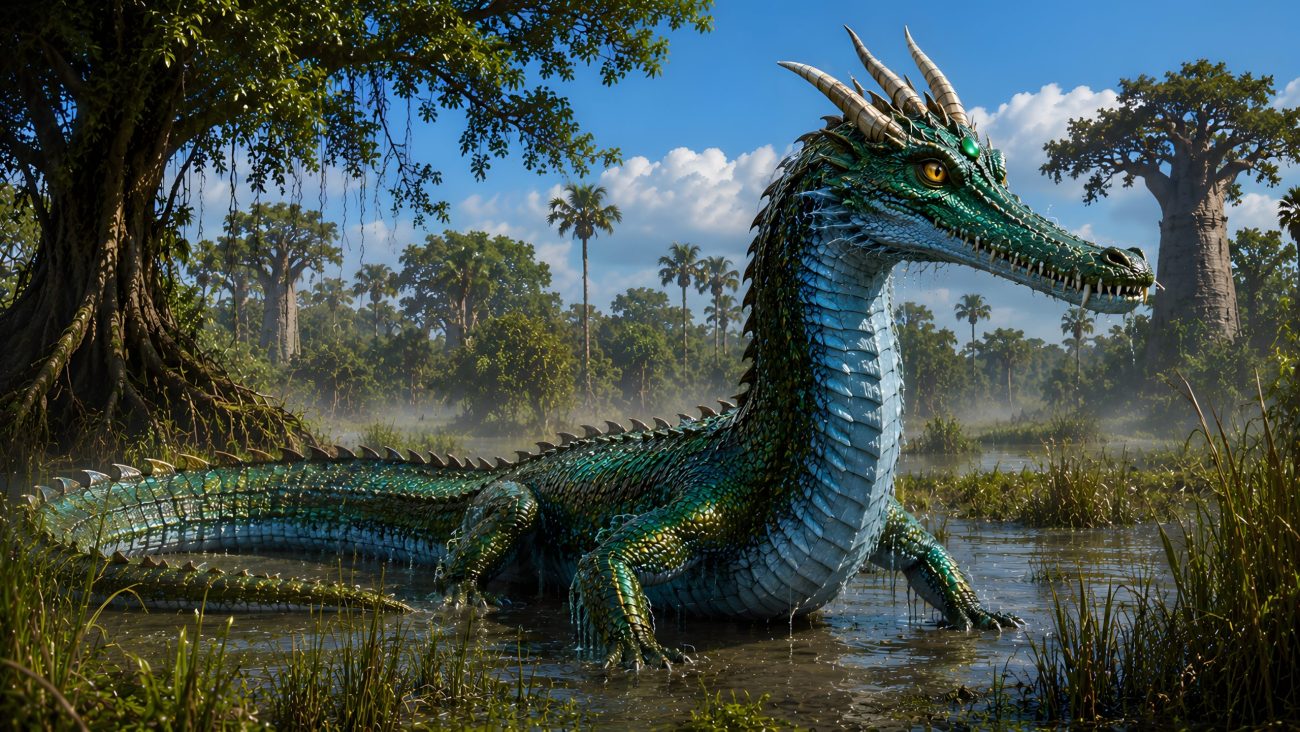
The Ninki Nanka is one of the most feared creatures in the folklore of The Gambia. It is a powerful river or swamp monster said to inhabit marshes, rivers, dense forests, caves, and creeks. Many communities believed that encountering the creature was an omen of death, causing people to avoid otherwise fertile wetlands.

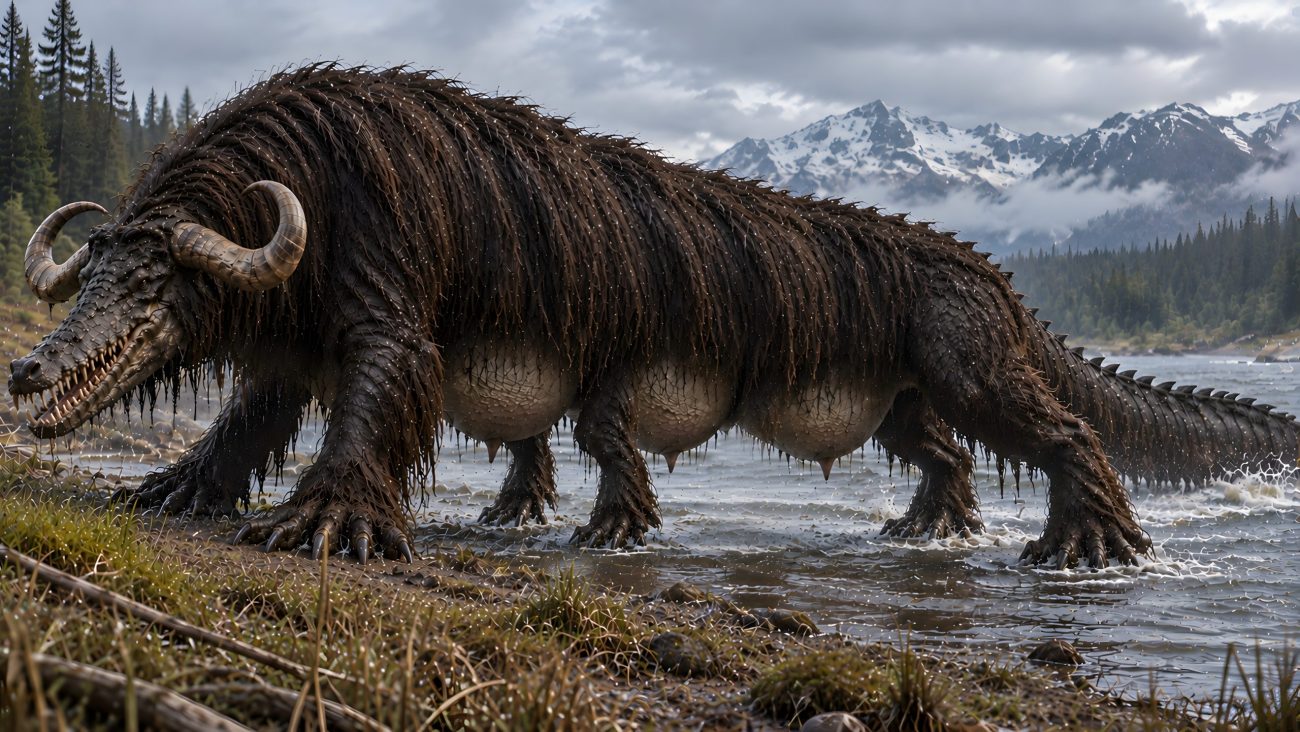
Descriptions of the Ninki Nanka vary, but it is consistently portrayed as a gigantic reptilian beast. It has been described as a dragon with a large body and small legs, a crowned serpent, or a monster with the head of a crocodile and the body of another large animal. Some traditions give it the long neck of a giraffe, a horse-like head with three horns, or even wings and the ability to breathe fire.

The creature’s most dreaded ability is its fatal gaze. According to legend, seeing the body of the Ninki Nanka brings severe illness, while meeting its eyes or seeing its crown results in instant death. Some traditions advise carrying a mirror to deflect its deadly stare. It is also said to possess shimmering scales that allow it to camouflage itself and to draw supernatural power from a magical gem hidden within its head.

In Mandinka tradition, the Ninki Nanka is regarded as a dangerous supernatural being associated with misfortune. It has also been blamed for bringing droughts and famine, reinforcing its reputation as one of the most terrifying spirits of West African folklore.


Sources

Wikipedia contributors. (n.d.). Ninki Nanka. In Wikipedia. Retrieved June 29, 2026, from https://en.wikipedia.org/wiki/Ninki_Nanka


Thuồng Luồng

Tradition / Region: Vietnamese Mythology
Alternative names: Giao Long, Giao Xà
Category: Crocodile


The Myth

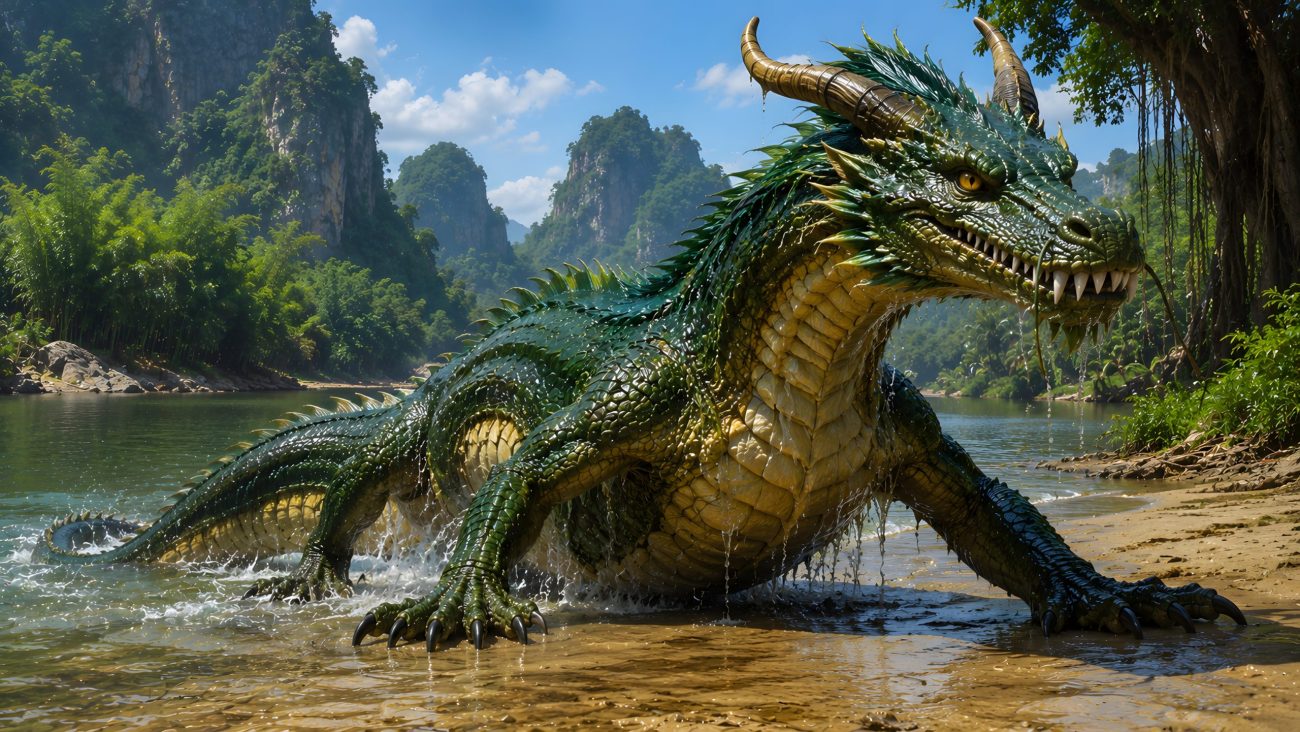
The Thuồng Luồng is a fearsome aquatic monster of Vietnamese folklore, often described as a dragon-like reptile that inhabits rivers and other large bodies of water. It possesses a long, serpentine body, with or without legs, and is commonly said to have horns or a crest upon its head, along with a mouth filled with sharp fangs. Its name Giao Long (“Hybrid Dragon”) reflects its dragon-like appearance while emphasizing that it is not a true dragon.

In popular tradition, the Thuồng Luồng is regarded as a powerful water beast capable of swallowing large animals and even people. Ancient descriptions portray it as resembling a gigantic four-legged serpent covered in thick scales, while later interpretations often compare it to an enormous crocodile. Temples dedicated to the Thuồng Luồng once stood along the great rivers of northern Vietnam, where it was revered as a river deity.

Classical Chinese texts also recount encounters with similar creatures. One legend tells of the warrior Thứ Phi, who leapt into the Yangtze River and slew two Giao Long that had attacked a boat, saving everyone aboard. Another account describes Emperor Wu of Han shooting a Giao Long while traveling by boat. Ancient commentators described the creature as having the body of a snake with four legs, a narrow neck, large scales, and the ability to swallow humans whole.

Over time, some traditions came to associate the Thuồng Luồng with enormous softshell turtles inhabiting the Red River. These giant reptiles were said to bask on sandbanks, lay vast numbers of eggs, and occasionally attack large animals that entered the water. As sightings of these creatures became increasingly rare, stories of the Thuồng Luồng likewise faded, though the monster remains an enduring symbol of the dangers hidden beneath Vietnam’s rivers.


Sources

Wikipedia contributors. (n.d.). Thuồng luồng. In Wikipedia, bách khoa toàn thư mở. Retrieved June 29, 2026, from https://vi.wikipedia.org/wiki/Thu%E1%BB%93ng_lu%E1%BB%93ng


Kagewani

Tradition / Region: Japanese Mythology
Alternative names: Shadow Crocodile
Category: Crocodile


The Myth

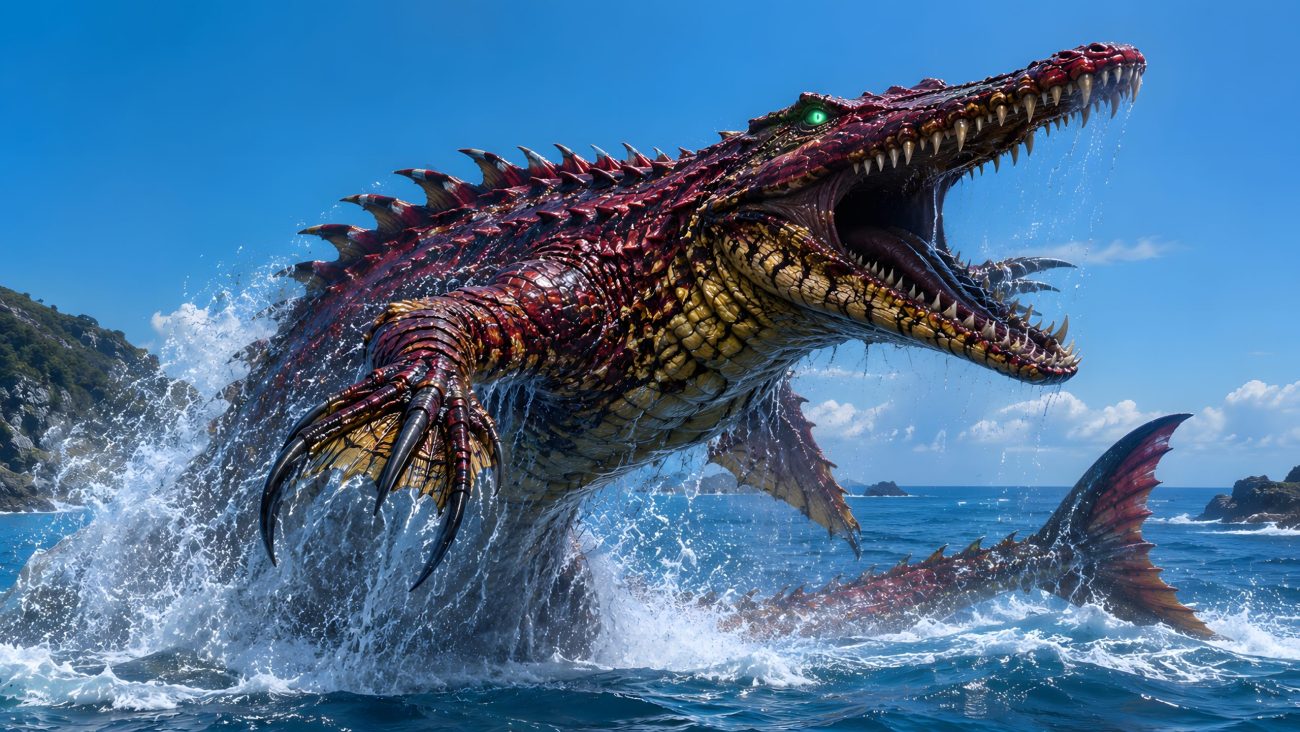
Kagewani is a yōkai from the folklore of Yunotsu in Shimane Prefecture. Although its name means “Shadow Crocodile,” it is actually described as a supernatural shark.

According to legend, the creature swims beneath ships and watches the shadows of sailors reflected on the surface of the sea. If the Kagewani swallows a sailor’s shadow, that person is doomed to die.

One tale tells of a sailor who succeeded in shooting and killing a Kagewani while at sea. However, after returning home, he was walking along the beach when a fish bone pierced the sole of his foot. The wound proved fatal.

Later, the bone was identified as having belonged to the slain Kagewani, and the sailor’s death was regarded as the creature’s final act of vengeance.


Sources

TYZ. (n.d.). 影鰐 (Kagewani). In 新版TYZ 妖怪図鑑. Retrieved June 29, 2026, from https://tyz-yokai.blog.jp/archives/1010654388.html


Cuca

Tradition / Region: Brazilian Mythology
Alternative names: Coca, Coco, Cucuy, Cuco, Cucu, Cucuí, El Cucuí
Category: Crocodile


The Myth

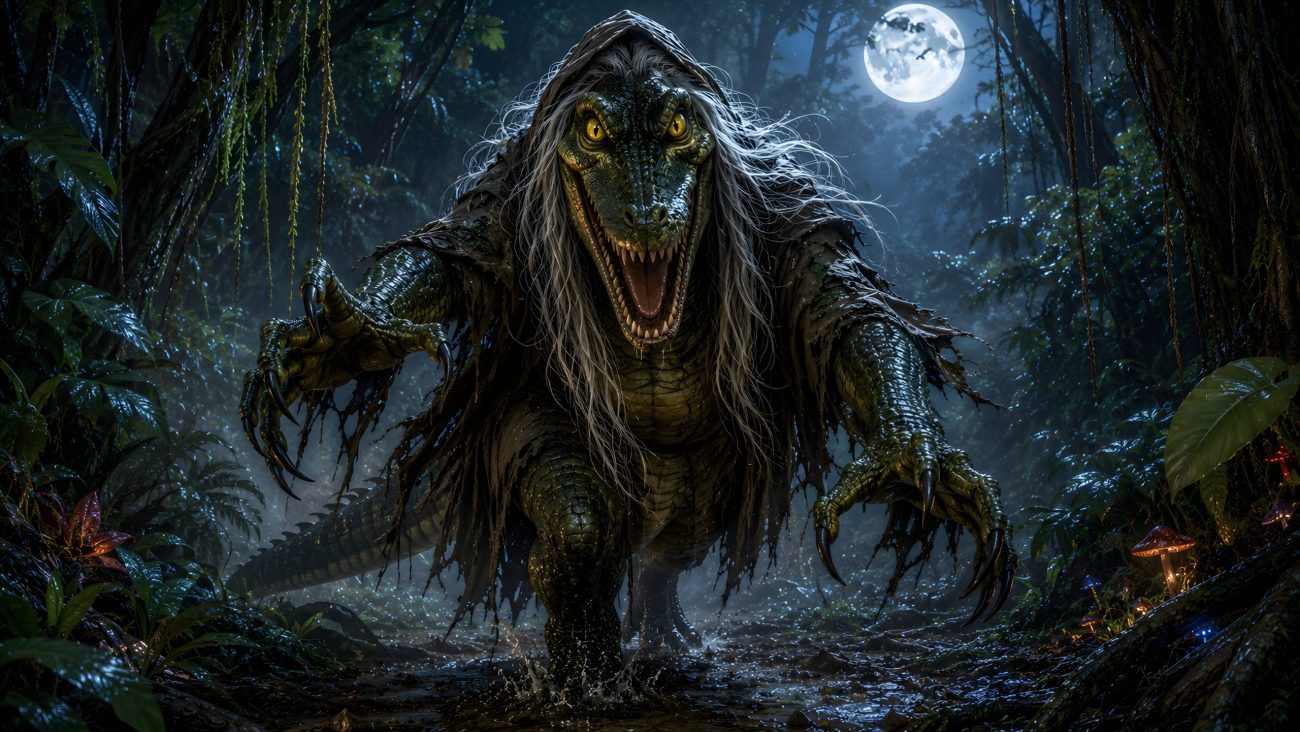
The Cuca is the Brazilian form of the Iberian bogeyman known as the Coco or Coca. In Brazil, she is traditionally portrayed as a female humanoid alligator who comes during the night to seize disobedient children. Parents invoke her in lullabies and nursery rhymes, warning that children who refuse to sleep or misbehave will be carried away by the Cuca.

Unlike many other versions of the Coco, which have no fixed appearance, the Brazilian Cuca is depicted with the face and body of an alligator, dressed like a woman. This reptilian form became firmly established through adaptations of Monteiro Lobato’s children’s stories, although in the original novel O Saci (1921), she is only described as having an alligator’s face and clawed fingers.

As a bogeyman, the Cuca serves as a supernatural warning against disobedience. Rather than acting as a guardian or trickster, she is a child-stealing monster who watches from rooftops or lurks in the darkness, waiting for children who ignore their parents. In Brazilian lullabies, she is said to come while parents are away, carrying off children who refuse to sleep.


Sources

Wikipedia contributors. (n.d.). Coco (folklore). In Wikipedia. Retrieved June 29, 2026, from https://en.wikipedia.org/wiki/Coco_(folklore)


Dungavenhooter

Tradition / Region: American Mythology
Alternative names:
Category: Crocodile


The Myth

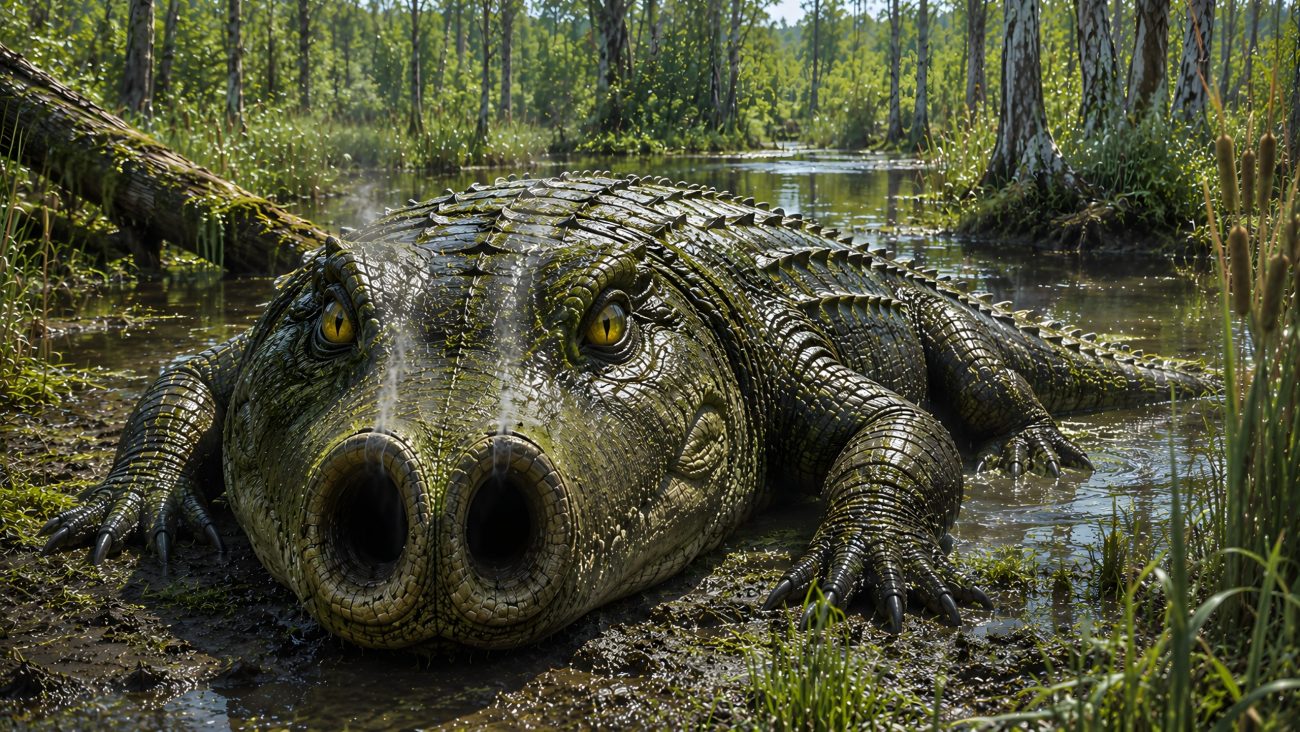
The Dungavenhooter is a legendary fearsome critter of American folklore. It is described as a large crocodilian creature with no mouth and an enormous pair of nostrils through which it feeds.

According to lumberjack tales, the Dungavenhooter lurks in marshes and waits in ambush behind dense brush. It strikes unsuspecting travelers, particularly loggers, with its powerful tail. Rather than biting its victims, it pounds them into a vaporous state before inhaling them through its abnormally large nostrils.

The creature is said to have once inhabited marshlands stretching from Maine to Michigan, though later stories claim it survived only in the Upper Peninsula of Michigan, where it became increasingly rare.

The Dungavenhooter is considered one of the classic fearsome critters of North American lumberjack folklore. It is regarded as a tall-tale creature and is closely associated with stories of the Dungarvon Whooper, although it is portrayed as a monstrous crocodilian rather than a ghost.


Sources

Wikipedia contributors. (n.d.). Dungavenhooter. In Wikipedia. Retrieved June 29, 2026, from https://en.wikipedia.org/wiki/Dungavenhooter


Nanabolele

Tradition / Region: Lesotho Mythology, South African Mythology
Alternative names: Dinanabolele, Linanabolele (plural)
Category: Crocodile


The Myth

The Nanabolele are fearsome reptilian creatures of Basotho folklore that dwell beneath rivers and underground. Their bodies shine in the darkness like the moon and stars, making them as beautiful as they are terrifying. They are powerful predators that devour both people and animals.

The creatures appear in the legend of Thakáne and her brothers. After her brothers completed their initiation rites, they refused to leave the mophato until they received shields, clothing, shoes, hats, and spear bindings made from Nanabolele skin. Determined to fulfill their impossible request, Thakáne journeyed in search of the monsters, guided from river to river by frogs.

At the deepest river, an old woman led Thakáne into a hidden settlement beneath the water. There she learned that the Nanabolele had devoured all the inhabitants, sparing only the old woman to serve them. When the glowing reptiles returned, Thakáne and her companions hid until the creatures fell asleep, then silently killed the largest Nanabolele and removed its hide.

The old woman gave Thakáne a magical pebble before she departed, warning that the surviving Nanabolele would pursue her. Each time the creatures caught up, the pebble transformed into a towering mountain that exhausted the reptiles as they struggled to climb it. Once they were worn out, the mountain shrank back into a pebble, allowing Thakáne to continue her journey.

When Thakáne finally reached home, she called upon the village dogs to drive the Nanabolele away. The reptiles fled back to their underwater home, and the luminous hide of the slain creature was fashioned into the clothing and equipment her brothers had demanded. In recognition of her courage and perseverance, her brothers rewarded Thakáne with one hundred head of cattle.


Sources

A Book of Creatures. (2021, April 16). Nanabolele. Retrieved June 29, 2026, from https://abookofcreatures.com/2021/04/16/nanabolele/


Cocollona

Tradition / Region: Catalan Mythology, Spanish Mythology
Alternative names:
Category: Crocodile


The Myth

The Cocollona is a legendary creature from the city of Girona. According to tradition, it was once a novice nun who sincerely embraced the religious life while the other nuns in her convent neglected their vows and lived carelessly.

The novice repeatedly reproached the other nuns for their behavior. In response, they imprisoned her in a dark, damp cell beneath the convent, where she remained for many years. The constant darkness and humidity gradually transformed her body, causing scales to grow until she became like a crocodile.

Because of her purity and holiness, however, she also developed beautiful butterfly wings upon her back. In this way, she became the Cocollona, a creature that was half crocodile and half butterfly.

After her death, the Cocollona returned as a ghost. It is said to swim through the waters of the Onyar River near the place where she had been imprisoned. According to the legend, only on nights of the full moon, just before dawn, can those with sensitive souls glimpse the ghostly Cocollona gliding silently along the river before disappearing with the first light of day.


Sources

Wikipedia contributors. (n.d.). Cocollona. In Wikipedia. Retrieved June 29, 2026, from https://en.wikipedia.org/wiki/Cocollona


Hoaya

Tradition / Region: Japanese Mythology
Alternative names: Boaya
Category: Crocodile


The Myth

Hoaya is a fearsome river monster described in the Edo-period works Nankai Kibun and Hyōryū Tenjiku Monogatari, which recount the travels of the sailor Sontaro after he drifted to foreign lands. The creature was said to inhabit the rivers of Banjarmasin in southern Borneo, where the local people greatly feared it and believed that killing one would inevitably bring misfortune.

The monster was described as resembling a hornless dragon, with a stern face, long manes and ears, four arms, four legs ending in four claws each, and a body measuring between six and thirteen fathoms in length. It often clung to passing boats, frightening those aboard. In another account, its body is said to have been pale black with a yellow belly and lips, extremely hard scales, and a pointed tail ending in three ridges.

According to local belief, Hoaya climbed into the mountains each spring to lay thirty-six eggs, each about the size of a temari ball. After the young hatched and entered the rivers, the parent relentlessly pursued and devoured them until only one remained. That final offspring was then raised by the parent. Boats avoided Hoaya with their young, as they were believed to become especially aggressive.

One night, a Hoaya broke through the decaying fence surrounding a riverside bathing area and attacked a night watchman, biting off one of his legs. The creature became trapped inside the enclosure, where dozens of people eventually killed it after gunfire failed to penetrate its thick scales. The wounded watchman died the following day. Although the Hoaya’s body was thrown back into the river, no further misfortunes followed, despite the widespread belief that killing one of the creatures would bring disaster.

In Nankai Kibun, the creature is identified as Boaya, which is explained to be a crocodile, although its appearance and behavior are described in a far more legendary manner. The account also suggests that the hornless river dragons described in stories from Siam may have been the same creature.


Sources

Landtman, G. (1970). The Kiwai Papuans of British New Guinea; a nature-born instance of Rousseau’s ideal community. New York: Johnson Reprint Corp., p. 302.


Yamawani

Tradition / Region: Japanese mythology
Alternate Names: Mountain crocodile
Category: Mountain dweller, yōkai, Crocodile


The Myth

In the old illustrated scroll known as the Tosa Obake Zōshi, there appears a strange creature called the Yamawani—the Mountain Crocodile.

It is shown with a grotesquely large mouth, wide and thick-lipped, dominating its face. Its body is less clearly described than its jaws, for it is the mouth that defines it: heavy, fleshy, and capable of swallowing great things in a single gulp.

In the scroll, the Yamawani is said to speak of its kin. “My cousin lives in the sea,” it boasts, referring to the crocodile or shark of the waters. “He too is thick-mouthed and can lick up anything in one bite.” The creature claims a kind of family pride in its devouring nature. Even the crocodile carved or imagined at temples—known for their gaping jaws—is said to share this thick-mouthed likeness.

The Yamawani’s voice is described as making a peculiar sound—“tickle, tickle”—as though it mutters or chuckles through its massive jaws. Whether this is a threat, a laugh, or simply the grinding of its teeth is unclear.

It is not told that it hunts men, nor that it brings disaster like other mountain spirits. Instead, it lingers in the strange borderland between beast and caricature, a mountain echo of the sea’s crocodile, defined by its monstrous mouth and its unsettling presence in the wilderness.

Thus the Yamawani remains in the scrolls: a thick-mouthed being of the mountains, grinning in silence, its jaws large enough to swallow anything in a single bite.


Sources

TYZ-Yokai Blog contributors. (n.d.). 転倒お化け (Yamawani). In TYZ-Yokai Blog, from https://tyz-yokai.blog.jp/archives/1010653500.html