Rohai

Tradition: Japanese mythology
Alternative Names: Robai, Lojay
Category: Dragon


The Myth

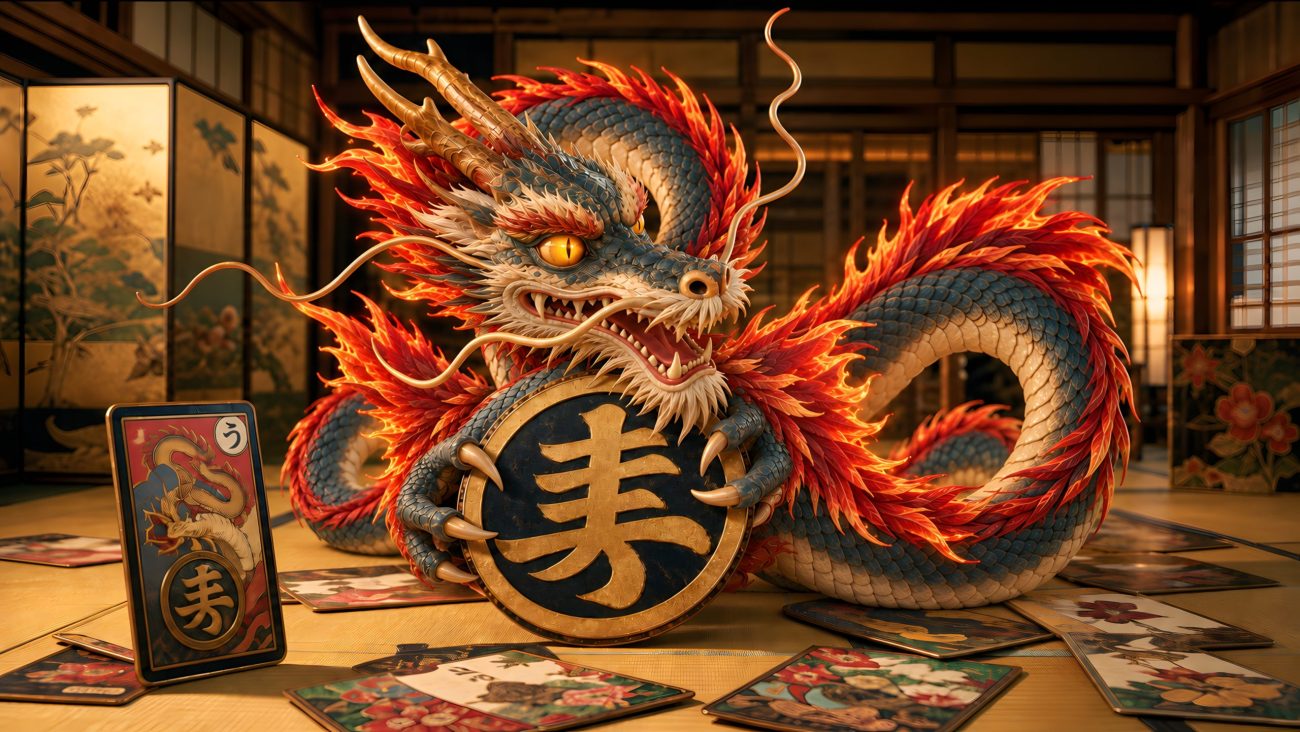
Rohai is a dragon depicted on the traditional Japanese card game Unsun Karuta. The creature appears as a dragon entwined around or holding a symbol, sometimes with wing-like forms or flames rising from its body like wings. It is a distinctly dragon-like figure, separate from the numbered cards and from the other human and divine figures represented in the deck.

Unsun Karuta developed from Portuguese playing cards introduced to Japan during the late 16th century. The Portuguese cards originally had four suits, but the Japanese game developed five suits and a much larger collection of cards, including figures such as Daikoku, Daruma, Hotei, Ebisu, Fukurokuju, a Chinese man, a queen, a king, and a mounted warrior. Rohai represented the dragon among these figures.

Rohai was also called an insect, and was described as being like a flying dragon. Its origins are connected to the dragon cards found in early Portuguese playing cards, where dragons were traditionally used for the aces of the suits. As the cards spread through Portuguese trading ports and settlements, dragon imagery travelled with them and eventually became part of the Japanese card tradition.

In Unsun Karuta, however, Rohai was not simply the ace card. It became its own distinct dragon figure. Some surviving depictions preserve the appearance of a Western dragon, particularly through the wing-like shapes and flames rising from the creature’s body.


Sources

Takahashi, Toshihiro. “鷺龍 [ろうりゅう] (Rōryū).” 新版TYZ 妖怪図鑑 (New TYZ Yokai Encyclopedia). October 21, 2024. https://tyz-yokai.blog.jp/archives/1083031467.html


Okami

Tradition: Japanese mythology
Alternative Names: Ōkami, Kuraokami-no-kami, Takaokami-no-kami, Okagami
Category: Dragon


The Myth

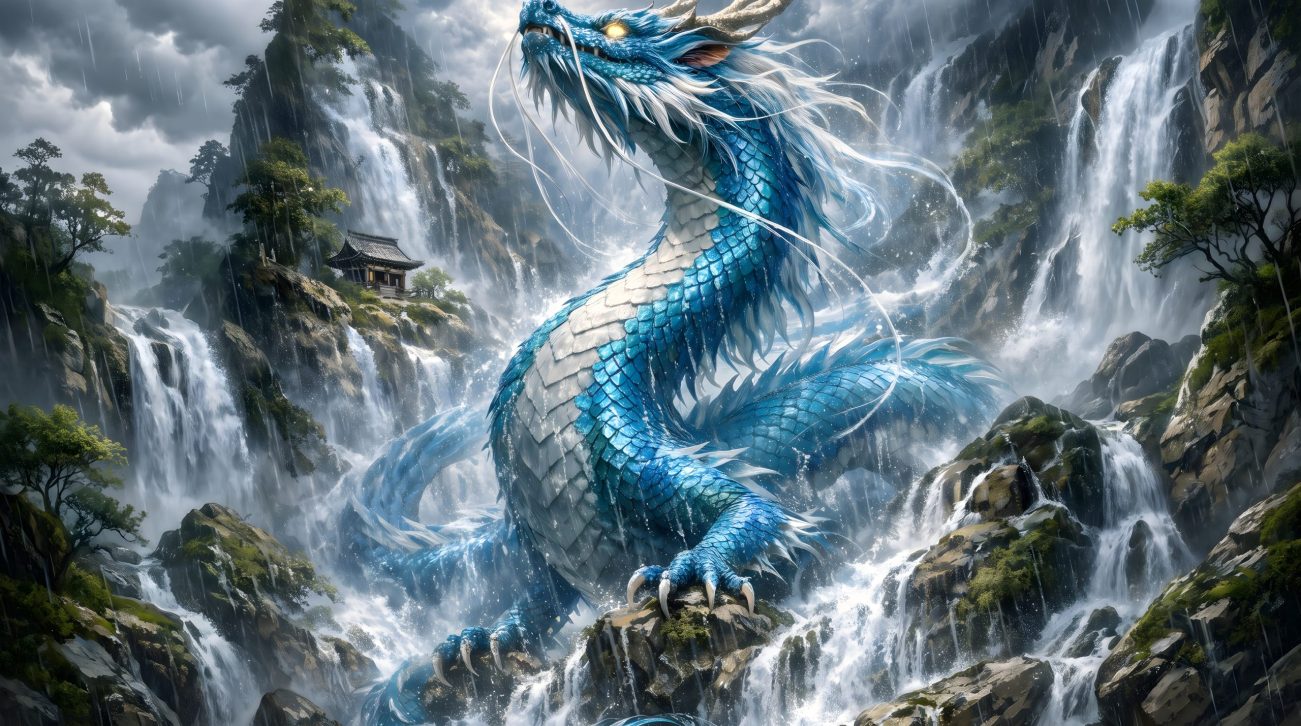
Okami is a powerful dragon god associated with water. It is imagined as a great supernatural dragon dwelling in mountain valleys, deep ravines, hills, and springs. Different traditions distinguish between forms of Okami, with Takaokami associated with the mountains and Kuraokami with the dark valleys.

Okami controls rain and snow and has power over springs and other waters. Because of this, people prayed to the deity for rain during droughts and for protection from destructive floods.

In the Kojiki, Kuraokami-no-kami was born from the blood of Kagutsuchi, the fire god, after Izanagi killed him with his sword. The Nihon Shoki gives different accounts of the birth of Kuraokami and other water-related gods, including a tradition in which Kuraokami, Kurayamatsumi, and Kuramitsuha emerged from Kagutsuchi’s blood.

Okami was worshipped at shrines throughout Japan. At Kifune Shrine in Kyoto, Takaokami is revered as the principal deity. Other shrines dedicated to Okami were established beside rivers and in agricultural areas, reflecting the dragon god’s power over water.

One legend tells of Horyo Myojin, a practitioner of Shugendo who sacrificed himself to save people suffering from drought. After his death, he became a dragon and brought rain to the people.

Okami could also appear in the form of a serpent. The Bungo Province Fudoki tells of a spring inhabited by a snake deity. When Emperor Keikō visited the area, the deity prevented the people from safely drawing water from the spring.

Okagami is also invoked as a deity capable of controlling snowfall. A poem in the Man’yōshū describes snow that had been requested from Okagami on a mountain, showing the dragon god’s power over the falling snow as well as rain.


Sources

Takahashi, Toshihiro. “龗 [おかみ] (Okami).” 新版TYZ 妖怪図鑑 (New TYZ Yokai Encyclopedia). January 27, 2024. https://tyz-yokai.blog.jp/archives/1083024550.html


Wani

Tradition: Japanese mythology
Alternative Names: Wani
Category: Dragon


The Myth

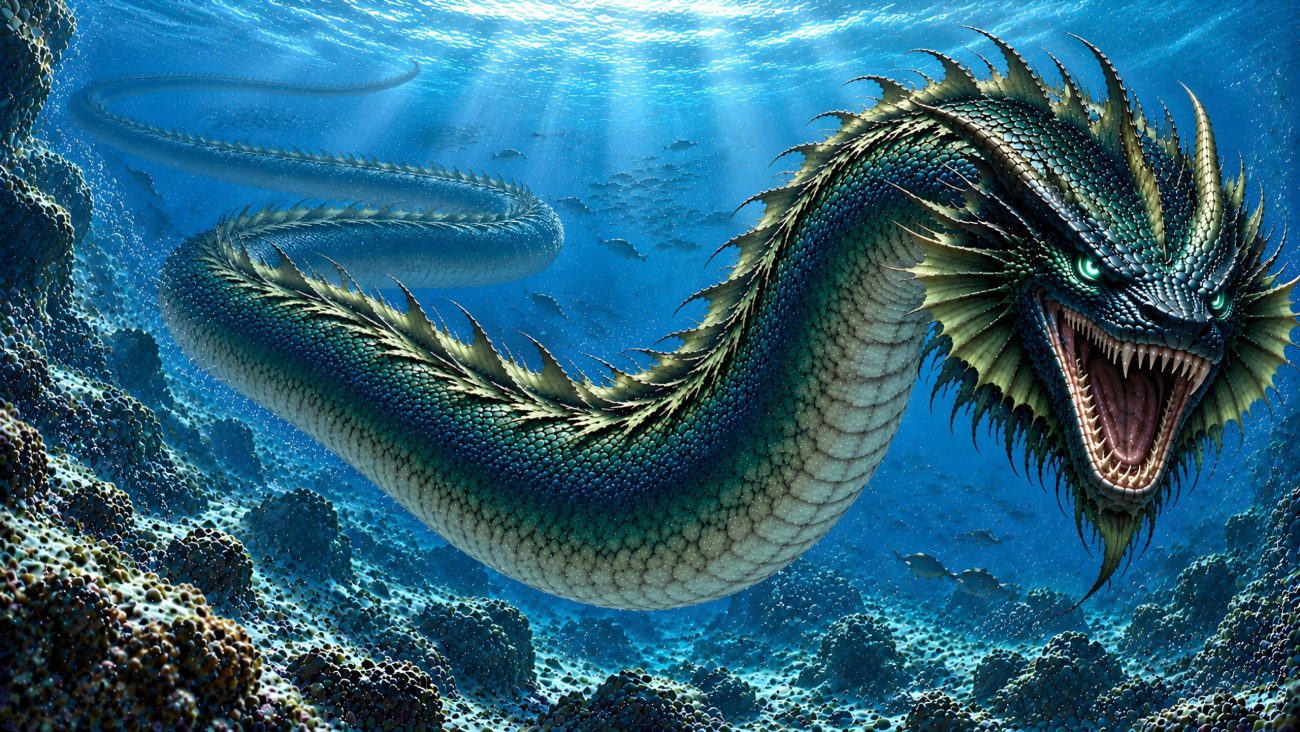
Wani are enormous sea monsters said to dwell in the depths of oceans, seas, and lakes. They possess long, serpentine bodies and fins and can breathe both air and water. Although monstrous in their natural form, wani are capable of transforming themselves into humans, and stories even tell of wani and human beings falling in love.

Wani are regarded as rulers of the oceans and gods of the sea. Far beneath the surface they dwell in magnificent coral palaces, where they maintain a society that mirrors the political world of humans. Their underwater kingdoms contain kings and queens, princes and princesses, courtiers, servants, and other ranks. Among them, Watatsumi, also known as Ryūjin, is the greatest of the sea dragons. He rules the ocean from the magnificent Ryūgū-jō and possesses the tide jewels kanju and manju, with which he controls the ebb and flow of the sea.

The wani appear in some of Japan’s earliest written mythology, particularly the Kojiki and Nihon shoki, although their stories are believed to preserve traditions considerably older than these texts. Their ultimate origins are uncertain, and similarities have been noted between the wani and other great aquatic beings such as the Chinese long and the Indian naga.

The word wani originally appeared in the Kojiki written phonetically using man’yōgana. It was later written with the character 鰐. The word came to encompass sharks and other dangerous sea creatures encountered by sailors and fishermen, perhaps reflecting the way real marine predators could become identified with the enormous serpents of mythology. Over time its meaning expanded to include crocodiles and eventually became associated specifically with crocodiles. Today, wani and the kanji 鰐 normally mean “crocodile,” even though the older mythology describes a very different kind of creature.

One of the greatest stories involving the wani concerns Toyotama-hime, the daughter of Watatsumi. She encountered Hoori, a human hero and grandson of Amaterasu, after he descended into the realm beneath the sea. Hoori had accidentally lost his brother Hoderi’s fishing hook and, unable to find it, eventually discovered the palace of the Dragon King. There he asked Watatsumi for help recovering the lost hook.

With the Dragon King’s assistance, Hoori eventually found the hook. During his stay in the underwater palace, however, he fell in love with Watatsumi’s daughter, Toyotama-hime. The two married and lived together beneath the sea for three years.

Eventually Hoori grew homesick and longed to return to the world above. He and Toyotama-hime therefore returned to the surface together, bringing Hoderi’s lost hook with them. Once back on land, Toyotama-hime became pregnant and prepared to give birth.

She warned Hoori not to look upon her during childbirth. In order to bear the child, she explained, she had to abandon her human appearance and assume her true form. But Hoori could not overcome his curiosity. He secretly looked at his wife as she gave birth and was horrified to discover that the woman he loved had become an enormous wani, cradling their newborn son.

Toyotama-hime was devastated by his betrayal and ashamed that he had witnessed her true nature. Unable to forgive him, she fled back into the sea and never again saw Hoori or the child she had given birth to.

Her sister Tamayori took responsibility for raising the abandoned child. He grew to adulthood and eventually married Tamayori. Their son was Jimmu, who became the first emperor of Japan. Through Toyotama-hime and her wani lineage, the ancient sea-dragon tradition thus became intertwined with the legendary ancestry of Japan’s imperial line.


Sources

“Wani.” Yokai.com: The Japanese Yokai Encyclopedia. Accessed October 3, 2026. https://yokai.com/wani/
Yinglong

Tradition: Japanese mythology, Chinese mythology
Alternative Names: Yinglong, Winged Dragon, Flying Dragon
Category: Dragon


The Myth

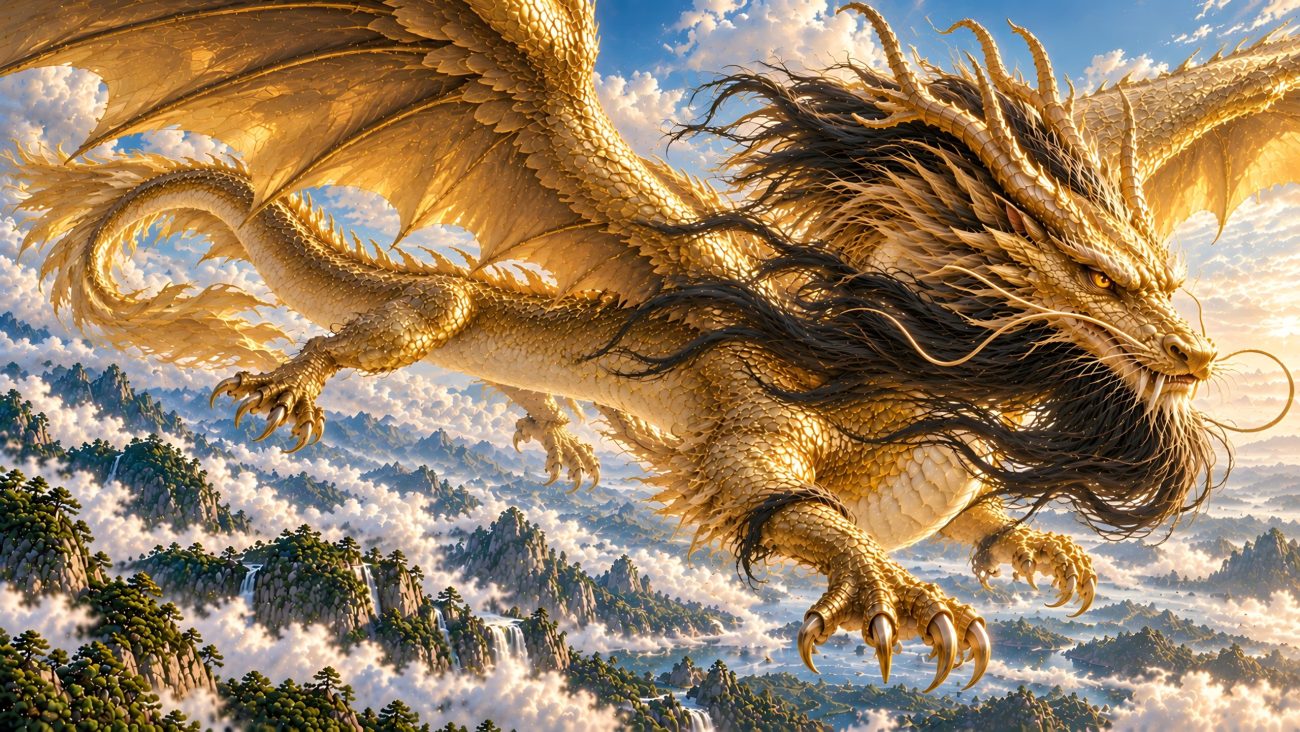
Yinglong is a winged dragon, distinguished from other dragons by its great wings. It is generally depicted with a dragon’s body and wings, although some representations give it the head of a dragon and the body of a bird. Its wings and tail feathers may even resemble the fins of a fish, giving the creature an unusual combination of dragon, bird, and aquatic features.

According to the Sancai Tuhui, Yinglong dwells on Gongqiu Mountain. The winged dragon also appears in several great stories of ancient Chinese mythology, where it becomes involved with the Yellow Emperor, Chiyou, Nuwa, and Yu.

During the great war between the Yellow Emperor and Chiyou, the Yellow Emperor commanded Yinglong to attack the fields of Ganyi. The dragon’s powers were therefore brought directly into the struggles of the ancient divine rulers.

Yinglong was later subdued by Nuwa, who made the powerful dragon serve as the beast that pulled her vehicle. Yu, meanwhile, encountered Yinglong during his legendary efforts to control the great floods. As Yu worked to bring the waters under control, Yinglong used its tail to draw characters upon the ground, marking out the paths by which the waters could be guided. In this role the dragon became a guardian of the waters and an aid in one of the greatest acts of flood control in Chinese mythology. This account was later transmitted directly into Japan through the Wakan Sansai Zue.

The Shanhaijing, in its Dadong Huangjing, places Yinglong at the southern end of the world. There the dragon is said to have become unable to return to Heaven because it had killed Chiyou and Kuafu. Its presence upon the earth was consequently associated with drought, and Yinglong was said to bring drought across the land. Yet the dragon also possessed a strange connection with rain: if people imitated the form of Yinglong, heavy rain was said to follow.

The Huainanzi presents Yinglong within a different kind of cosmic lesson. It describes the soaring serpent moving through mist and Yinglong rising upon clouds, alongside other creatures whose abilities become effective when they encounter the environment suited to them. The passage emphasizes that every being has its own particular strengths and must fulfill its proper role.

The image of Yinglong continued into the artistic traditions of China and Japan. Dragons possessing the same characteristic wings are sometimes called “Flying Dragons” in paintings and decorative sculpture. At Nikkō Tōshōgū Shrine, for example, two such Flying Dragons are carved soaring above waves in the Water Pavilion.

These winged dragons are frequently shown together with waves and flowing water. Their imagery came to be associated with protection against fire, while their connection with water gave them an auspicious character. The tradition also became linked with the legend of the carp climbing the Dragon Gate waterfall and transforming into a dragon, making the dragon and the Dragon Gate motif symbols of transformation and good fortune.


Sources

Takahashi, Toshihiro. “応竜 [おうりゅう] (Yìnglóng).” 新版TYZ 妖怪図鑑 (New TYZ Yokai Encyclopedia). October 21, 2024. https://tyz-yokai.blog.jp/archives/1082948842.html


Enryū

Tradition: Japanese mythology, Chinese mythology
Alternative Names: Yanlong, Salt Dragon, Shio Ryū
Category: Dragon


The Myth

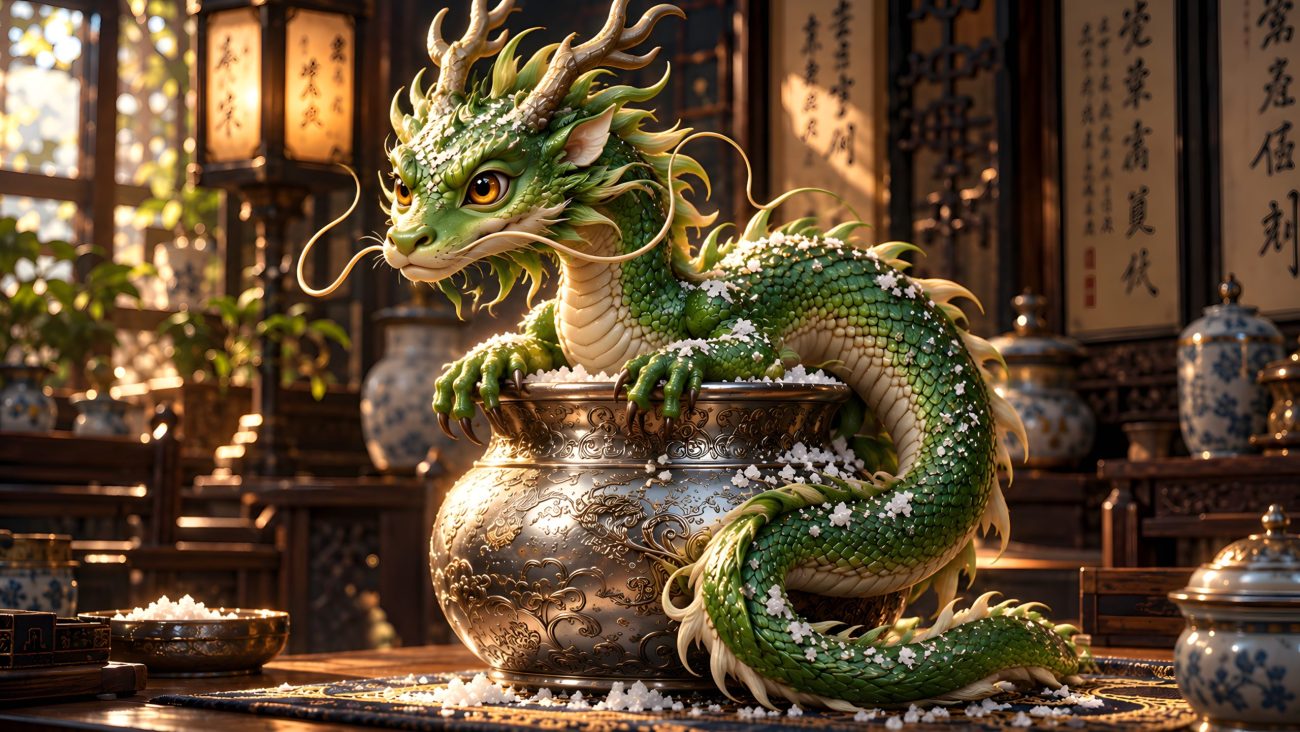
Enryū, the Salt Dragon, was a strange little dragon believed to produce a valuable substance used in tonics. Unlike the enormous dragons of storms and rivers, the Salt Dragon was described as a creature only about one foot long. Its body was covered in scales from which salt could mysteriously emerge.

According to the Compendium of Materia Medica, quoting the Records of Spring Shore, the creature was obtained during the Northern Song dynasty in the reign of Emperor Huizong. Xiao Zhu encountered a Salt Dragon while defeating the Nanman and brought the strange creature into his possession.

The dragon was kept in a silver tub with a jade bowl inside. It was fed salt taken from seawater, and after consuming the salt, more salt would seep from between its scales. The substance produced by the living dragon was regarded as medicinal. Taken together with warm wine, it was believed to increase yang energy and strengthen vitality.

Cai Jing, also called Cai Yuandu in the Records of Spring Shore, was said to have possessed one of these dragons. His Salt Dragon eventually died, however, in a rather peculiar manner. Cai attempted to obtain salt directly by licking the creature’s body. The dragon’s carcass was subsequently preserved by salting it. Even in death it retained value, since a tonic could still be extracted from the preserved body, although its effectiveness was believed to gradually diminish.

The Japanese commentary Bencao Gangmu Keimō repeated the account of the Salt Dragon but admitted that its nature was “not detailed,” offering little additional information about the creature.

The Salt Dragon later appeared in Japanese writings as well. Yanagi Rikyo’s Hitori Ne retold the story of Cai Yuanqing and his Salt Dragon from the Harunogi Kibun. The author remarked that such creatures were rarely discussed because the country in which they were supposedly found was no longer frequently visited, and therefore recorded the strange story for posterity. The same account was subsequently quoted in Keisai Eisen’s Makura Bunko.

The creature also became a subject for Japanese artists. The Illustrated Compendium of Chinese Characters depicts a Salt Dragon peering from a silver jar while reaching toward salt offered to it on a spoon by a boy. Uoya Hokkei created another well-known image of the creature, showing a Salt Dragon receiving salt from a woman. The accompanying humorous poem compares the salt caught between the dragon’s scales to light snow resting upon the swaying branches of a willow.

Thus the Salt Dragon was imagined as a peculiar living source of salt: a tiny dragon that consumed seawater salt, produced more through its scales, and could itself become an ingredient in mysterious medicines even after death.


Sources

Takahashi, Toshihiro. “延竜 [えんりゅう] (Enryū).” 新版TYZ 妖怪図鑑 (New TYZ Yokai Encyclopedia). October 21, 2024. https://tyz-yokai.blog.jp/archives/1083002104.html


Seiryū

Tradition: Japanese mythology
Alternative Names: Seiryū, Seiryō, Shōryū, Sōryū, Azure Dragon
Category: Dragon


The Myth

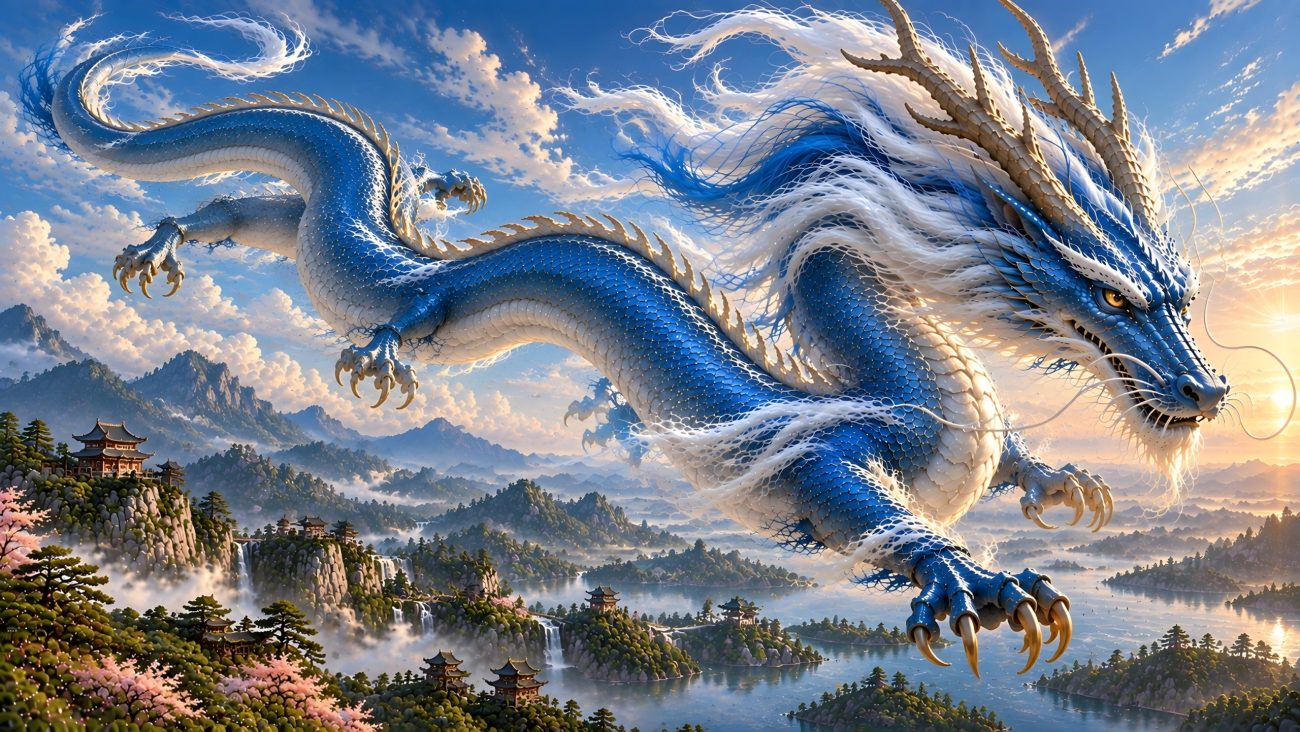
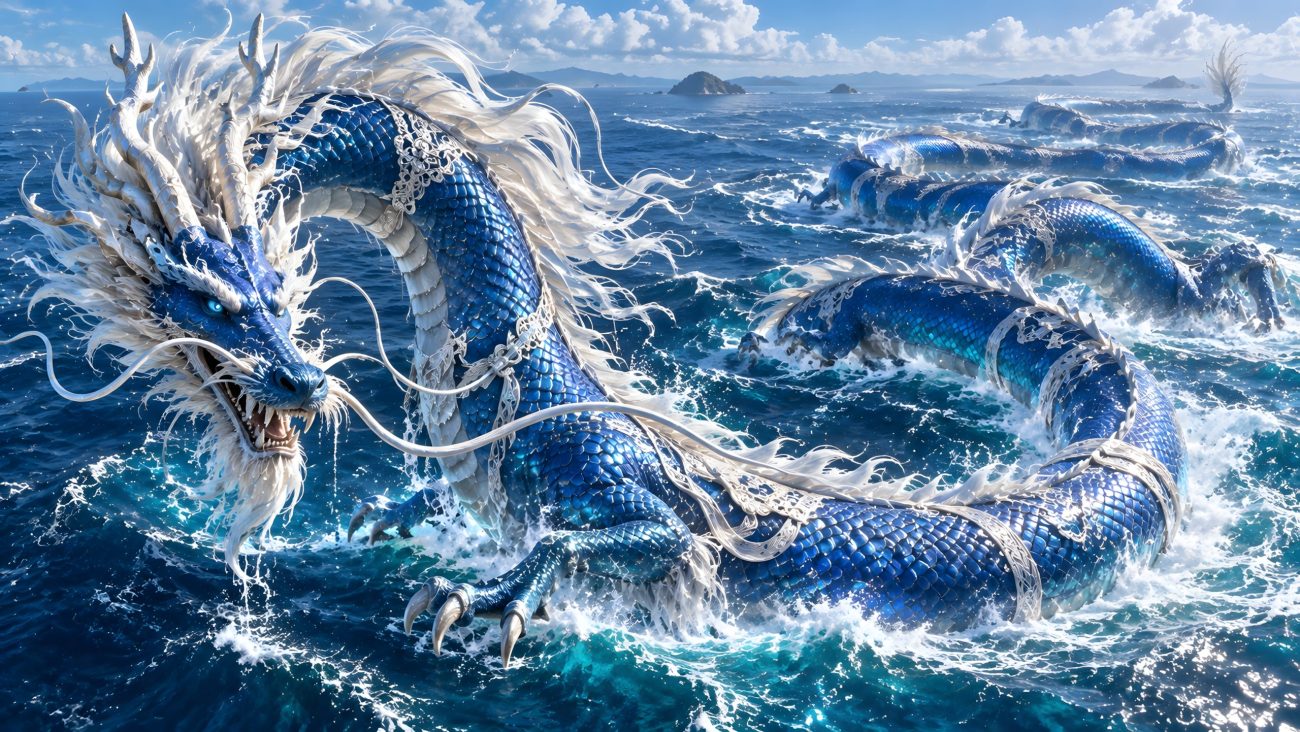
Seiryū, the Azure Dragon, is a great blue dragon who guards the eastern direction of the heavens. He is one of the Four Symbols, four mythical beasts associated with the four directions and the cosmic order. Seiryū represents the east and is connected with the element of wood, spring, and the planet Jupiter.

The tradition of the Four Symbols originated and became established in China during the Han dynasty through ideas concerning Yin and Yang and the Five Elements. Each direction was associated with a particular celestial beast, and these beings became important not only in cosmology but also in ritual practices and the planning of cities.

The Azure Dragon appears alongside the Vermilion Bird, Black Tortoise, and White Tiger as part of this cosmic arrangement. The Book of Rites describes military banners bearing the Four Symbols: the Vermilion Bird was placed at the front, the Black Tortoise at the rear, the Azure Dragon on the left, and the White Tiger on the right. These sacred beasts therefore accompanied armies as symbols representing the ordered directions of the heavens.

The Huainanzi further associates the east with wood, Taihao and Jumang with the governance of spring, Jupiter with the corresponding celestial body, and the Azure Dragon with the beast of the eastern direction.

The image of Seiryū later became deeply established in Japan. One of the most important surviving representations can be found in the murals of the Takamatsuzuka and Kitora Tumuli in Asuka, Nara Prefecture. The tombs were constructed around the seventh and eighth centuries, and their chambers contain representations of the Four Symbols. The artistic tradition was transmitted from the continent through China and Korea, with comparable representations appearing in Chinese tombs from the Han through the Six Dynasties and in the tombs of Goguryeo, Baekje, and Goryeo.

The Four Symbols also became part of Japanese court ritual. The Shoku Nihongi records that during the New Year’s ceremony held in the Daigokuden in 701, seven banners decorated with the Four Symbols together with crows, the sun, and the moon were erected and displayed. This ceremonial arrangement was modeled on the culture of Tang China.

Thus Seiryū is not simply a dragon of the eastern sky, but one of the four great beings through which the heavens, directions, seasons, elements, and earthly ritual were understood as part of a single cosmic order.


Sources

Takahashi, Toshihiro. “青竜 [せいりゅう] (Seiryū).” 新版TYZ 妖怪図鑑 (New TYZ Yokai Encyclopedia). October 21, 2024. https://tyz-yokai.blog.jp/archives/1082920496.html


Santōryū

Tradition: Japanese mythology
Alternative Names: Three-Headed Dragon, Three-Headed Dragon Mummy
Category: Dragon


The Myth

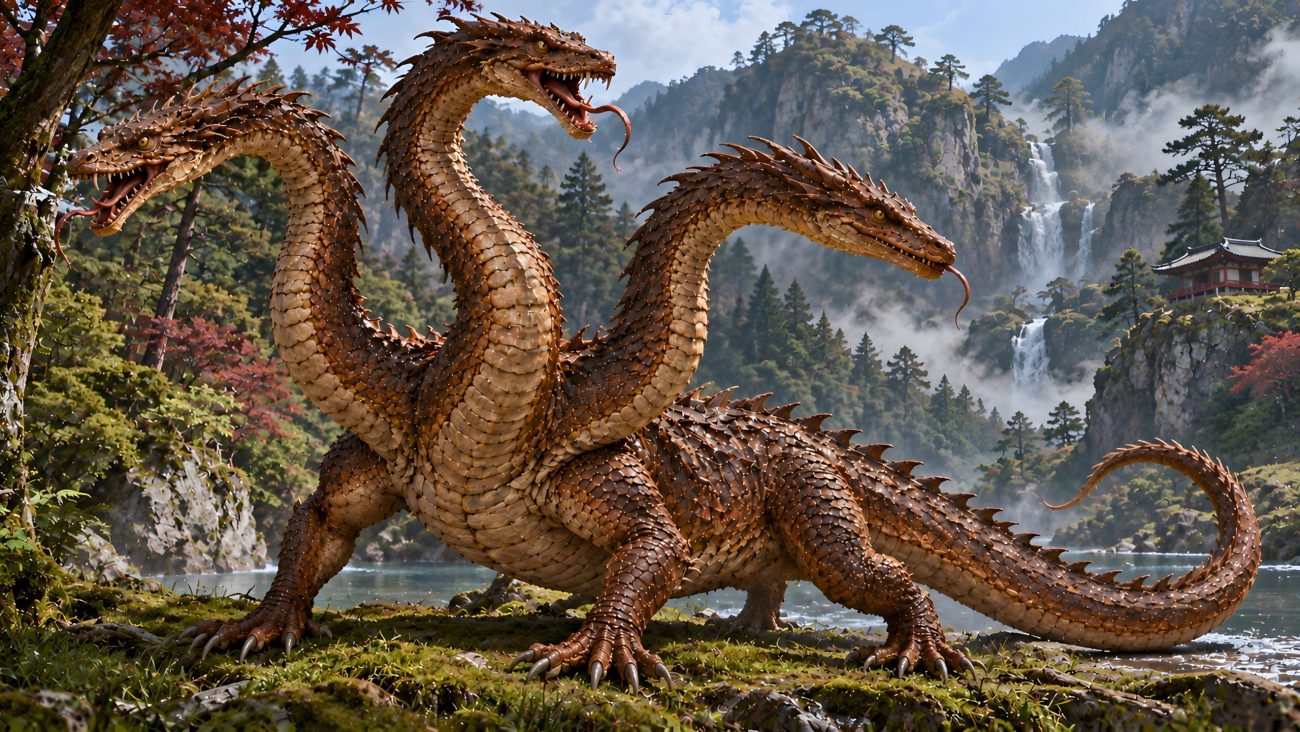
Santōryū is described as a strange three-headed dragon with a reptilian body and three long, slender necks extending from it, each ending in a head. The creature’s appearance resembles an artificial specimen made by combining the body of a small crocodile with three snakes.

Two objects described as “Three-Headed Dragon Mummies” are preserved among the yokai materials at the Japan Yokai Museum in Miyoshi, Hiroshima Prefecture. They were reportedly displayed as sideshow curiosities during the Shōwa period and later exhibited at various yokai exhibitions.

A sideshow flyer known as the “Great Yokai Exhibition” describes the creature as a “Gunma Prefecture Specialty Three-Headed Dragon,” presenting it alongside other supposed regional curiosities such as the “Tochigi Prefecture Specialty Cat Mermaid” and the “Ibaraki Prefecture Specialty Fox-Raccoon Dog.”

The true nature of the Santōryū, however, remains uncertain. There are no other documents or testimonies that objectively establish whether the sideshow described by the flyer actually took place, or whether the mummy and its associated materials were genuinely produced during the Shōwa period. The history of the Three-Headed Dragon therefore remains open to further investigation.


Sources

Takahashi, Toshihiro. “三頭竜 [さんとうりゅう] (Santōryū).” 新版TYZ 妖怪図鑑 (New TYZ Yokai Encyclopedia). October 21, 2024. https://tyz-yokai.blog.jp/archives/1082925945.html


Sekiryū

Tradition: Japanese mythology
Alternative Names: Red Dragon
Category: Dragon


The Myth

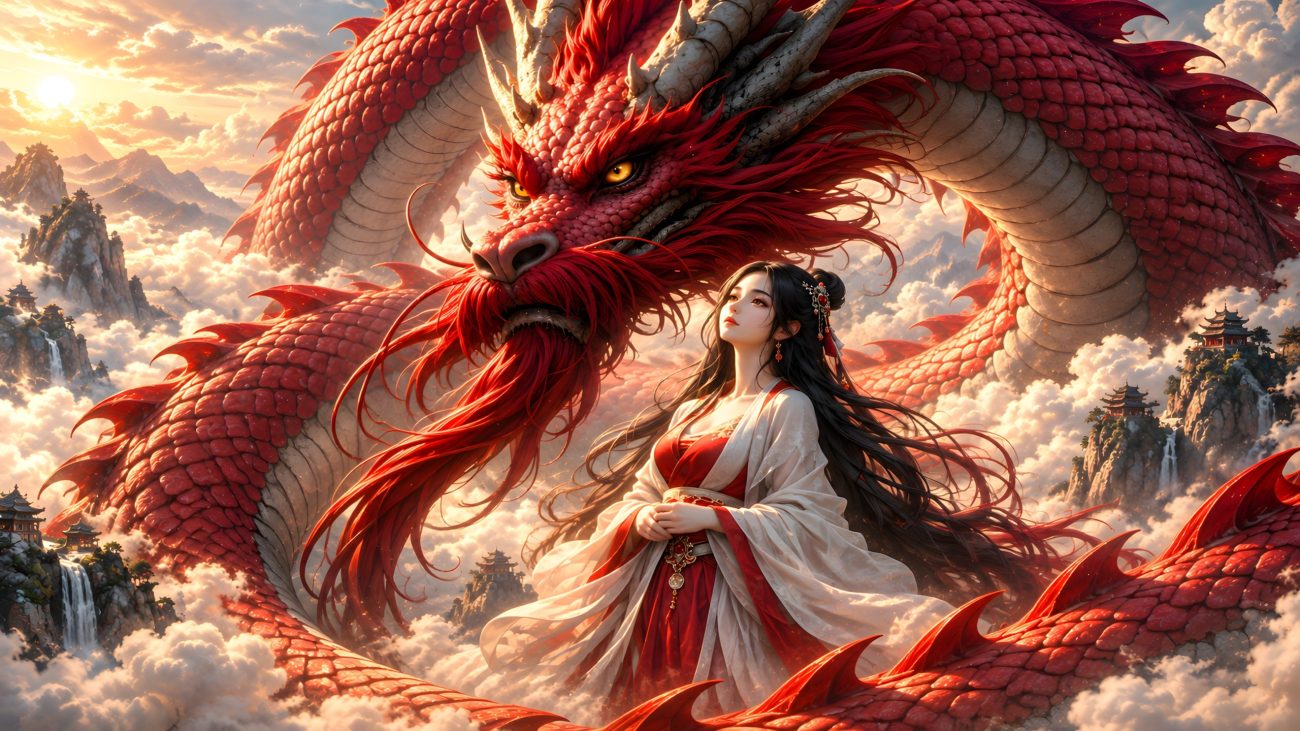
Sekiryū is a dragon with a brilliant red body, appearing in Japanese legends and tales as a supernatural being associated with extraordinary births and immense martial power.

In the Zen Taiheiki, the Red Dragon is said to have played a part in the birth of Sakata Kintoki, better known as Kintarō, who later became one of Minamoto no Yorimitsu’s Four Heavenly Kings. In the fourth year of Ten’en, 976, Yorimitsu visited Mount Ashigara. As he approached the red clouds hanging over the mountain, he encountered an old woman of about sixty and a young man of about twenty who was still dressed like a child. Despite the rugged rocks and steep terrain, the pair moved across the mountain as effortlessly as though they were walking on level ground.

The old woman was the young man’s mother. She described her son as one who had been “conceived between heaven and earth” and had received the command of Heaven. He had neither a surname nor a known father. She then revealed the strange circumstances surrounding his birth.

Before becoming pregnant, the woman had been sleeping upon the mountaintop when she dreamed that she united with a Red Dragon. She awoke to the sound of violent thunder. From this mysterious encounter the extraordinary child was conceived.

As the boy grew, his supernatural nature became increasingly apparent. He could cross mountains with ease, moving over the wild terrain as though it were nothing, and possessed immense strength. He was even capable of lifting enormous rocky cliffs with his bare hands.

When Yorimitsu learned of the young man’s remarkable martial abilities, he recognized his extraordinary potential. The two exchanged cups of sake in a formal bond between lord and retainer, and Yorimitsu bestowed upon him the name Sakata Kintoki. Thus the Red Dragon became the supernatural father of a warrior whose immense strength and martial prowess would make him one of Yorimitsu’s legendary Four Heavenly Kings.

The tale also recalls an older Chinese tradition concerning Liu Bang, the founder and first emperor of the Former Han Dynasty. According to the Records of the Grand Historian, Liu Bang’s mother once dreamed that she had mated with a dragon before becoming pregnant with him. The dragon was identified as a red dragon. The connection between the two stories was recognized within the Japanese tradition, and the Chronicles of Great Peace has Yorimitsu invoke the example when recognizing Kintoki’s extraordinary martial ability.

The strange birth of Kintoki was not universally accepted as a literal encounter with a dragon. The Commentary on the Mountains offers a much more skeptical interpretation, suggesting that the mountain woman may have had relations with several men and, not knowing the true father of her child, claimed that she had conceived him through a dream involving the Red Dragon in order to avoid accusations. The text compares this explanation with stories such as that of Yang Guozhong’s wife in the Tianbao Yishi, where women are said to have concealed questionable pregnancies by claiming that they had conceived through the influence of the sun, moon, or a supernatural dream.

Sekiryū therefore stands at the boundary between divine dragon mythology and the legendary origins of extraordinary heroes: a red dragon appearing in a dream, accompanied by thunder, becomes the mysterious father of a child whose superhuman strength marks him as destined for greatness.


Sources

Takahashi, Toshihiro. “赤竜 [せきりゅう] (Sekiryū).” 新版TYZ 妖怪図鑑 (New TYZ Yokai Encyclopedia). October 21, 2024. https://tyz-yokai.blog.jp/archives/1082924042.html


Mizuchi

Tradition: Japanese mythology
Alternative Names: Mi-tsu-chi, Great Mizuchi, Water Dragon
Category: Dragon


The Myth

Mizuchi is a powerful water spirit appearing in the form of a great serpent or dragon, associated with rivers, pools, and dangerous waters. In ancient tradition, the creature was feared as a deadly being capable of poisoning those who came near its waters. The name itself was associated with water and spirit, and Mizuchi could be understood as a master or spirit of the water.

One of the oldest tales of the Mizuchi takes place in Kibi Province during the reign of Emperor Nintoku. At a fork in the Kawashima River lived a great water serpent that would breathe or spit venom, poisoning and killing people who passed by. The monster dwelt in a pool and had become a deadly menace to those who approached the river.

A man named Agatamori came to the pool determined to destroy the creature. Rather than simply attack it, he challenged the Mizuchi to prove its supernatural power. He threw three calabashes onto the surface of the water and declared that if the creature could make them sink, he would submit to it; if it failed, Agatamori would kill it.

The Mizuchi transformed itself into a deer and attempted to sink the floating gourds, but it could not. Agatamori then slew the monster. He searched the depths of the pool and discovered that the creature was not alone. A whole tribe of water dragons occupied a cavern beneath the water. Agatamori killed them all, and their blood turned the river red. The pool thereafter became known as Agatamori’s Pool.

Another ancient story tells of a River God whose waters repeatedly broke the great dikes along the Yodo River. An oracle commanded that two men be sacrificed to the river deity. One of them refused to accept his fate and used the same test of the floating calabash to challenge the supposed divine command. When a whirlwind came and tried to sink the gourd but failed, the man escaped his sacrifice through his own cleverness.

The River God in this story is associated by later interpreters with the Mizuchi, suggesting an ancient conception of water dragons not merely as monsters but as powerful spirits or gods of rivers who could demand offerings and even human sacrifice.

Mizuchi also appears in an ancient Japanese poem, where the speaker imagines possessing a sword powerful enough to ride into a green pool and slay the Mizuchi dwelling there. Thus the creature remained an embodiment of the dangerous and mysterious power believed to inhabit Japan’s waters.


Sources

“Mizuchi.” Wikipedia: The Free Encyclopedia. Wikimedia Foundation. Accessed October 2, 2026. https://en.wikipedia.org/wiki/Mizuchi


Kuzuryū

Tradition: Japanese mythology
Alternative Names: Nine-Headed Dragon, Kuzuryū Gongen, Kuzuryū Ōkami,
Category: Dragon


The Myth

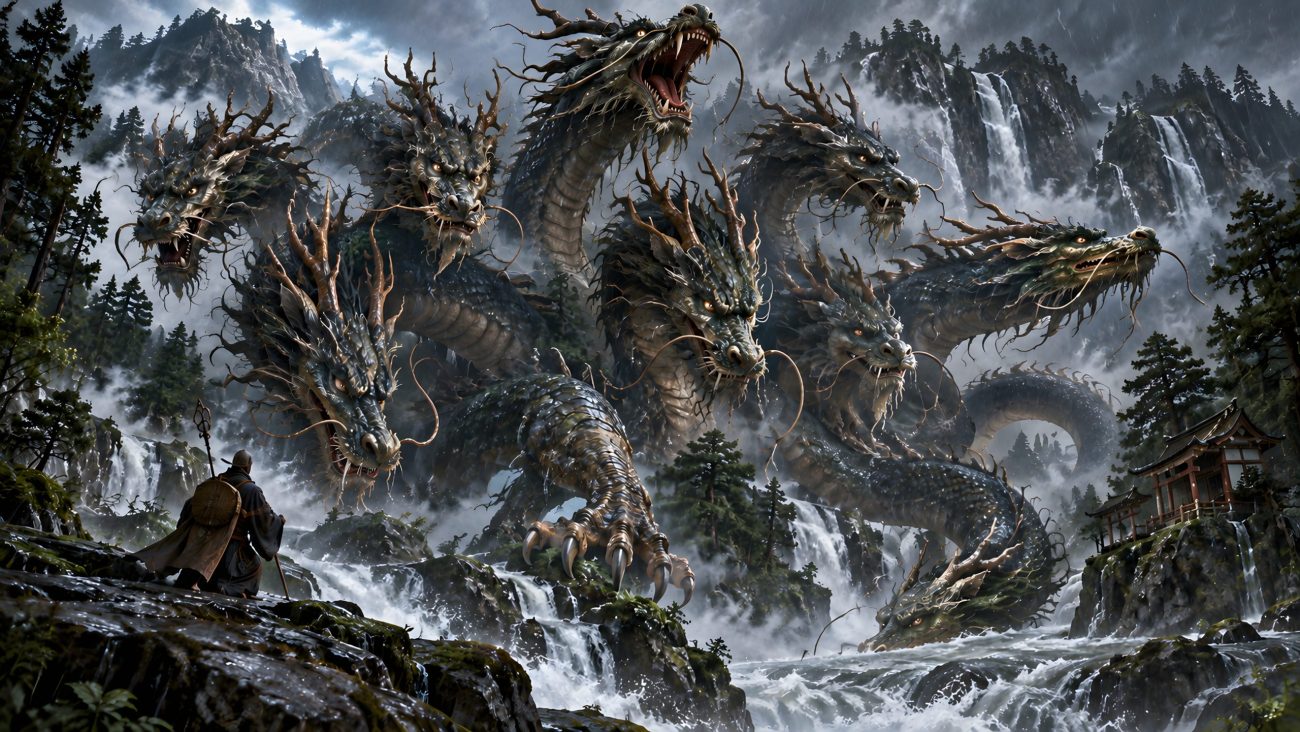
The Nine-Headed Dragon, or Kuzuryū, is a great dragon with nine heads and a single tail. It is especially associated with water, mountains, rain, and sacred places throughout Japan.

At Mount Togakushi in Shinshu, a great dragon with nine heads and one tail was said to dwell when a scholar-ascetic arrived there in search of a place where Buddhism could flourish. The dragon, also described as an oni, had become a harmful presence in the mountain. Through the power and merit of the Lotus Sutra, the ascetic overcame its harmful influence and caused the dragon to repent.

Kuzuryū then vowed to protect Mount Togakushi and urged the ascetic to establish a great temple there. Afterward, the dragon concealed itself by sealing the treasure cave with a huge rock. The cave was the place where the vajra thrown from Mount Iizuna had landed. This act was said to give Mount Togakushi its name, while the ascetic established Kenkōji Temple, later associated with Togakushi Shrine, where Kuzuryū Gongen was enshrined.

Kuzuryū became especially revered as a water god. People prayed to it for rain, and a particular ritual involved taking water from Taneike Pond to Togakushi Shrine and having prayers for rain performed over it. The water was then carried back without allowing it to touch the ground and sprinkled over the rice fields, after which rain was expected to fall.

Kuzuryū was also believed to have a fondness for pears. Offerings of pears were traditionally made to the dragon to relieve toothaches. People suffering from tooth pain could write their names and the location of the pain on pears, pray toward Mount Togakushi from a distance, and then set the pears afloat in a river.

Another legend connects the Nine-Headed Dragon directly with the creation of Mount Togakushi. When Amaterasu Ōmikami hid inside the Heavenly Rock Cave, Tajikarao no Mikoto attempted to open it. He pulled with such force that the rock was thrown down into the lower world, where it became Mount Togakushi. The Nine-Headed Dragon God appeared in response to the sound of the falling rock, and the Kuzuryū of Togakushi was regarded as a temporary manifestation of this Dragon God.

Nine-headed dragons appear in other Japanese legends as well. At Lake Ashi in Hakone, a poisonous dragon once rampaged through the waters until the monk Manmaki subdued it, after which the dragon became a god and was enshrined as Kuzuryū Daimyōjin. In Fukui, a nine-headed dragon is said to have swum along the Kuzuryū River as though carrying the floating statue of Hakusan Gongen. On Mount Onikiri in Chiba, another nine-headed dragon was defeated by Yamato Takeru and subsequently enshrined at Jinnoji Temple.

In Tadami, Fukushima, the name of the Kuguryū district is connected to another legend in which a nine-headed dragon rose from a swamp and ascended into heaven. Across these traditions, the Nine-Headed Dragon appears as a powerful supernatural being of water and mountains, sometimes dangerous and destructive, but capable of repentance and becoming a divine protector.


Sources

Takahashi, Toshihiro. “九頭竜 [くずりゅう] (Kuzuryū).” 新版TYZ 妖怪図鑑 (New TYZ Yokai Encyclopedia). October 21, 2024. https://tyz-yokai.blog.jp/archives/1082950617.html