Tradition / Region: Vietnamese Mythology
Alternative names: Giao Long, Giao Xà
Category: Crocodile
The Myth
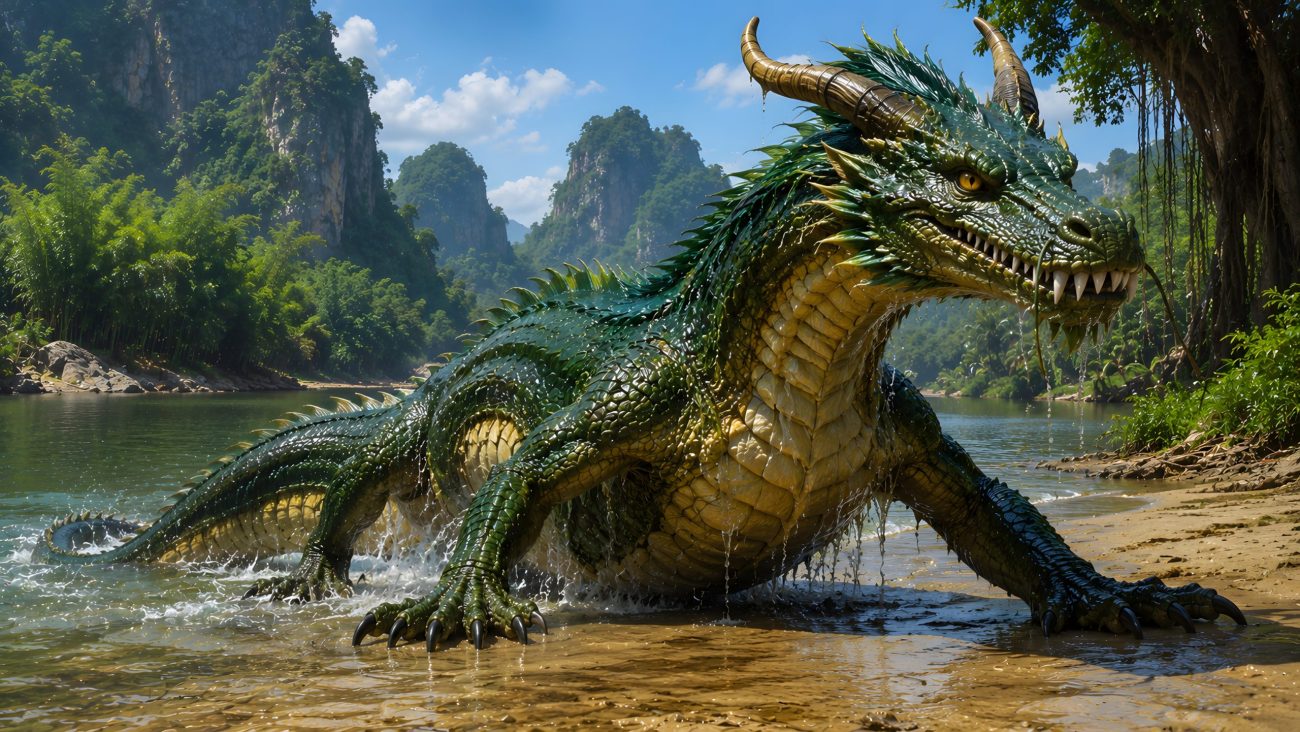
The Thuồng Luồng is a fearsome aquatic monster of Vietnamese folklore, often described as a dragon-like reptile that inhabits rivers and other large bodies of water. It possesses a long, serpentine body, with or without legs, and is commonly said to have horns or a crest upon its head, along with a mouth filled with sharp fangs. Its name Giao Long (“Hybrid Dragon”) reflects its dragon-like appearance while emphasizing that it is not a true dragon.
In popular tradition, the Thuồng Luồng is regarded as a powerful water beast capable of swallowing large animals and even people. Ancient descriptions portray it as resembling a gigantic four-legged serpent covered in thick scales, while later interpretations often compare it to an enormous crocodile. Temples dedicated to the Thuồng Luồng once stood along the great rivers of northern Vietnam, where it was revered as a river deity.
Classical Chinese texts also recount encounters with similar creatures. One legend tells of the warrior Thứ Phi, who leapt into the Yangtze River and slew two Giao Long that had attacked a boat, saving everyone aboard. Another account describes Emperor Wu of Han shooting a Giao Long while traveling by boat. Ancient commentators described the creature as having the body of a snake with four legs, a narrow neck, large scales, and the ability to swallow humans whole.
Over time, some traditions came to associate the Thuồng Luồng with enormous softshell turtles inhabiting the Red River. These giant reptiles were said to bask on sandbanks, lay vast numbers of eggs, and occasionally attack large animals that entered the water. As sightings of these creatures became increasingly rare, stories of the Thuồng Luồng likewise faded, though the monster remains an enduring symbol of the dangers hidden beneath Vietnam’s rivers.
Sources
Wikipedia contributors. (n.d.). Thuồng luồng. In Wikipedia, bách khoa toàn thư mở. Retrieved June 29, 2026, from https://vi.wikipedia.org/wiki/Thu%E1%BB%93ng_lu%E1%BB%93ng