Li Long

Tradition: Chinese mythology
Alternative Names: Lilyu, Liryo, Black Dragon
Category: Dragon


The Myth

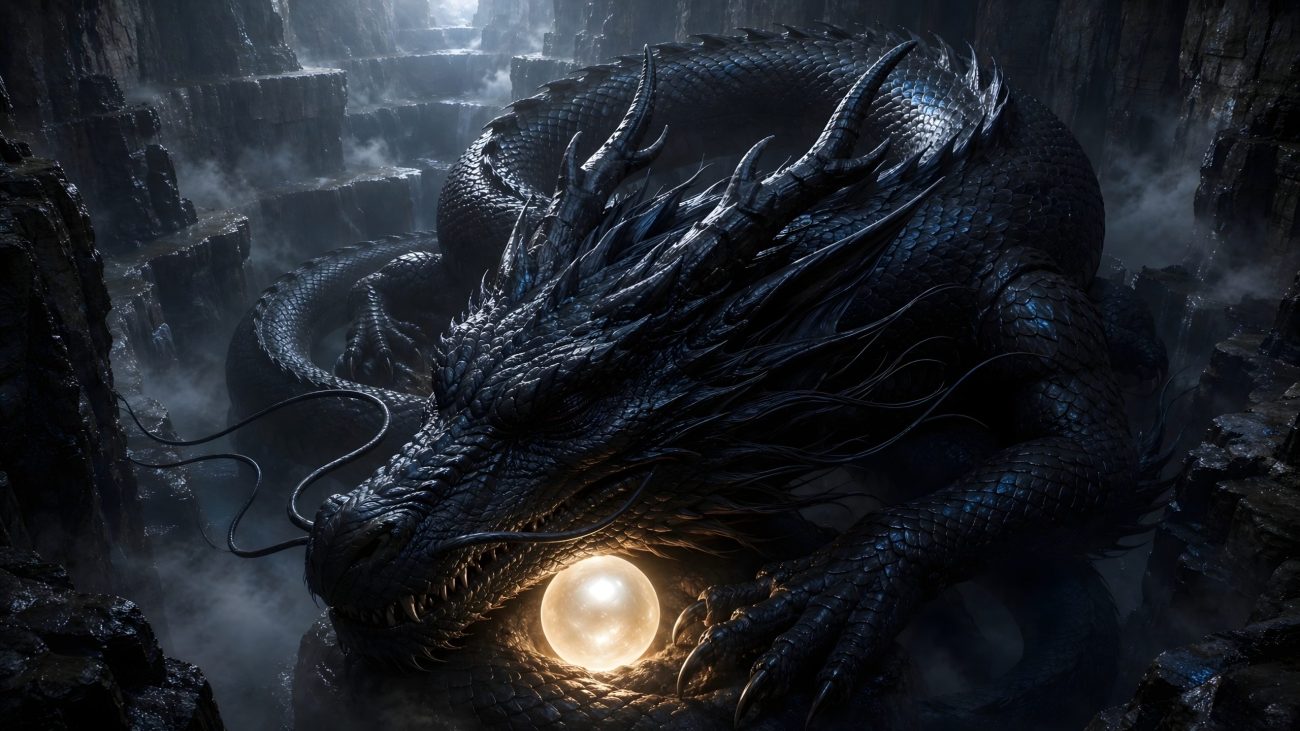
Li Long is a black dragon said to dwell in a nine-layered abyss. It guards precious treasures hidden deep beneath the water, making the dragon’s domain a place of immense danger for anyone seeking its riches.

One famous tale tells of a poor family who made their living weaving grass and catching fish along a river. One day, the family’s son dived into a deep pool and discovered a jewel worth a thousand pieces of gold. When he returned with the treasure, his father was horrified rather than pleased. He told his son to smash the jewel with a stone, explaining that such a priceless jewel must have been lying beneath the jaws of a Li Long in the nine-fold abyss.

The young man had survived only because the dragon happened to be asleep. Had it awakened, the dragon would have devoured him completely. The father used the story as a warning: treasures of extraordinary value can demand extraordinary risks.

The image of the jewel beneath the dragon’s jaw became a famous symbol of something precious that can only be obtained by risking one’s life. To seek such a treasure was compared to taking the pearl from the dragon’s jaws. The dragon’s pearl could therefore represent an almost impossible prize, hidden behind terrible danger.

The dragon was also associated with another dangerous treasure: the precious jewel believed to be contained within the brain of a dragon king. Buddhist traditions likewise spoke of dragon pearls as treasures of extraordinary rarity. Stories and religious performances developed around the image of dragons guarding such jewels, including a medieval Japanese temple performance in which male and female dragons were said to protect the sacred jewel while songs, dances, and music were performed to summon the dragon god and bring prosperity and happiness.

Li Long thus became more than a terrifying guardian of an abyss. Its jaws came to represent the boundary between enormous danger and extraordinary treasure: the greater the prize, the closer one must come to the dragon.


Sources

Takahashi, Toshihiro. “驪龍 [りりゅう] (Riryū).” 新版TYZ 妖怪図鑑 (New TYZ Yokai Encyclopedia). January 6, 2024. https://tyz-yokai.blog.jp/archives/1082940932.html
Red Dragon

Tradition: Chinese mythology
Alternative Names: Chìlóng, Southern Sea Dragon King, Guangli King, Zhaoming
Category: Dragon


The Myth

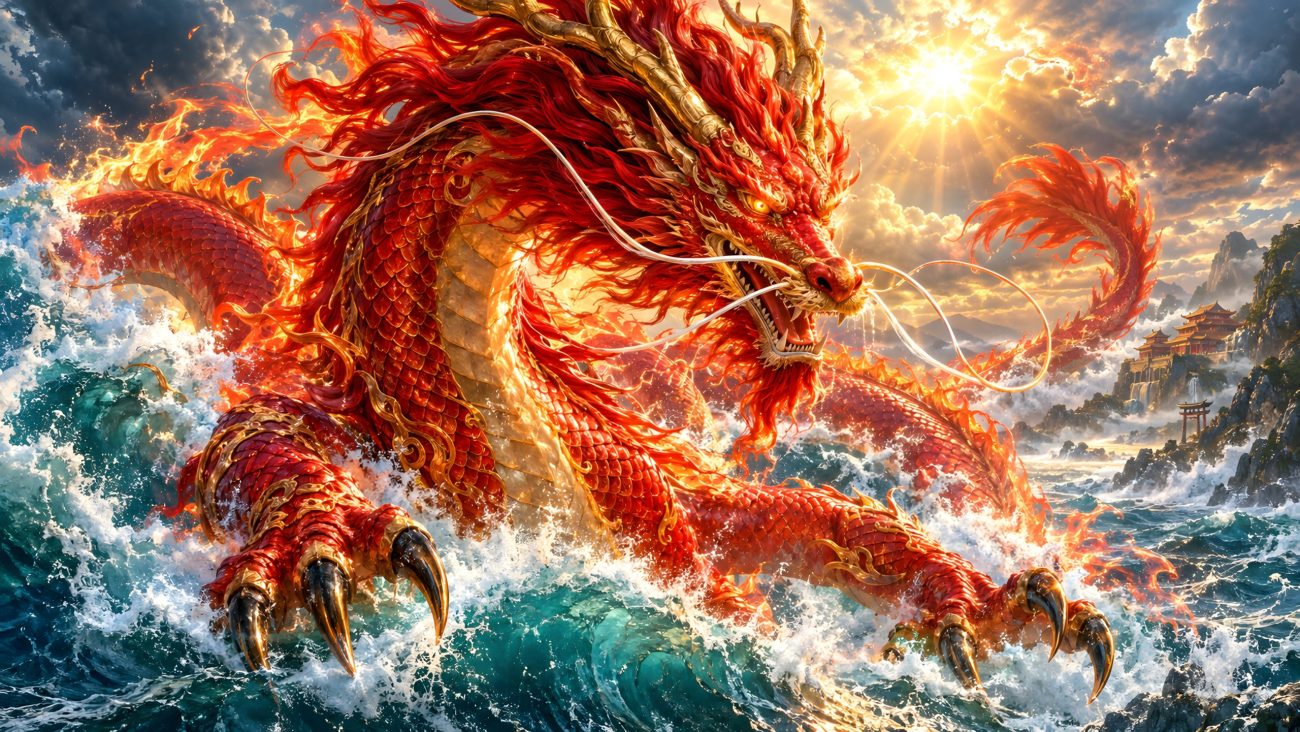
The Red Dragon is a powerful dragon associated with the south, fire, and the Southern Sea. In Chinese tradition, the southern direction is connected with the element of fire, and the Red Dragon embodies this fiery power. It can also appear as the Southern Sea Dragon King, one of the Four Dragon Kings who rule the seas.

The Southern Sea Dragon King is a mighty supernatural ruler associated with the waters of the southern sea. He is known as Zhaoming and Guangli King, while in the classic novel Fengshen Bang he is called Ao Qin. His connection with the south brings together two seemingly opposite powers: the blazing force of fire and the vast waters of the sea.

The Red Dragon is also linked with the ancient southern deity Zhurong, the god of fire. Zhurong was associated with the south and was even described as the deity of the Southern Sea. In later tradition, this southern divine power became increasingly represented through the figure of the Dragon King, bringing the ancient southern god together with the powerful dragon rulers of the waters.

The Southern Sea Dragon King was greatly revered, and people called upon him during dangers at sea. Along the southeastern coast, sailors developed customs of calling upon the Southern Sea deity for protection when crossing dangerous waters. One tradition tells of sailors who saw the sea god himself standing upon the water, towering above them with red hair and a long beard, wearing magnificent robes, a crown, and a sword. Terrified and amazed, they fell down and worshipped him as he passed slowly across the surface of the sea, leaving a brilliant light behind him.

The Red Dragon therefore embodies the mysterious power of the southern waters: a dragon ruler connected with fire, storms, the sea, and divine protection.


Sources

“赤龍 (Chìlóng; Red Dragon).” Chinese Wikipedia. Wikimedia Foundation. Accessed October 3, 2026. https://zh.wikipedia.org/wiki/%E8%B5%A4%E9%BE%8D


Hong

Tradition: Chinese mythology
Alternative Names: Jiang, Rainbow Dragon
Category: Dragon


The Myth

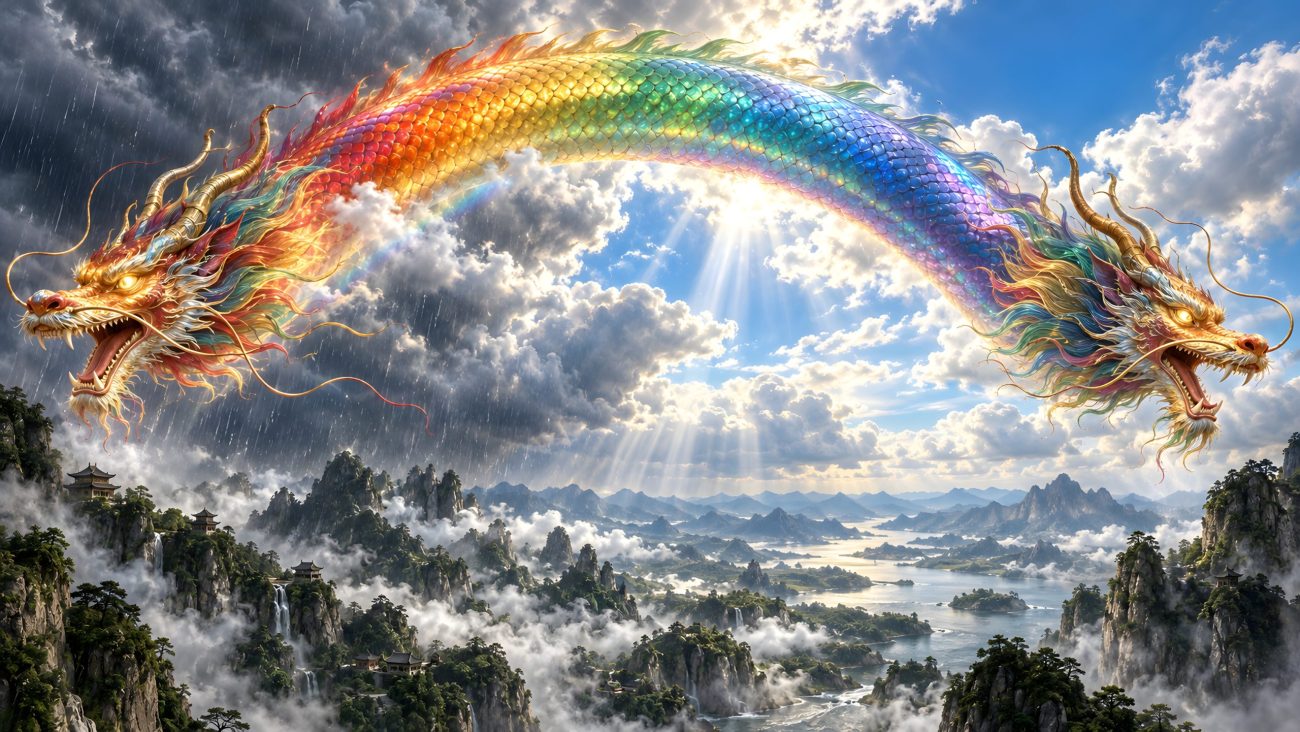
Hong is a strange Chinese dragon associated with the rainbow. It is depicted as a great serpentine or dragon-like creature with a head at each end of its body, forming the arched shape of a rainbow across the sky.

The oldest known representations of the Chinese word for “rainbow” depict an arched serpent or dragon with open-mouthed heads at both ends. Early Chinese tradition therefore connected the rainbow itself with a supernatural dragon. In some early representations, the creature was specifically shown with two dragon heads, one at either end of the arc.

Hong was associated with the changing of the weather. The appearance of a rainbow marked the end of rain and the return of clear skies. The dragon was therefore understood as a being capable of moving between the heavens and the earth: when ascending, the dragon could bring thunder and heavy rain, while its descent was associated with the ending of the storm and the clearing of the sky.

The rainbow thus became a manifestation of the dragon itself. What appeared in the heavens as a brilliant arc was imagined as the body of a supernatural dragon, with its two heads extending beyond the visible ends of the rainbow.


Sources

“Hong (rainbow dragon).” Wikipedia: The Free Encyclopedia. Wikimedia Foundation. Accessed October 3, 2026.
https://en.wikipedia.org/wiki/Hong_(rainbow-dragon)


Zhulong

Tradition: Chinese mythology
Alternative Names: Zhuyin, Torch Dragon, Torch Shade, Chuolong, Zhuolong
Category: Dragon


The Myth

Zhulong, the Torch Dragon, is a gigantic scarlet dragon deity with a human face and a serpent-like body. His enormous body was said to stretch for a thousand leagues, and some traditions describe him with strange vertical eyes that appear as a straight seam when closed. He dwells in the far north, in remote mountains where the sun itself does not reach, and possesses a supernatural torch-like radiance capable of illuminating the darkness.

Zhulong’s most extraordinary power is his control over light and darkness. When he opens his eyes, daylight appears across the world; when he closes them, night falls. His very presence therefore becomes part of the rhythm of day and night. His breath has a similarly cosmic effect. When he blows, winter arrives, while his call brings summer. If he truly breathes, tremendous gales arise, and the wind and rain themselves are said to answer his command.

The ancient traditions place Zhulong in different remote mountains. At Mount Bell, the deity called Torch Shade lives upon the lower slopes, illuminating the surrounding darkness with his supernatural power. He neither eats nor drinks, and in the account he does not normally breathe or sleep. His immense body lies beyond the ordinary human world, associated with the distant regions where darkness dominates.

At Mount Brillianttail, Zhulong appears as a scarlet god-human with a human face and serpent’s body. His strange eyes stand vertically upon his face. When they close, darkness covers the world; when they open, light returns. He is described as shining his torch across the “ninefold darkness,” illuminating the regions untouched by ordinary sunlight. The wind and rain are also under his command, making the dragon not merely a source of light but a cosmic power governing the elements.

An old tradition preserved by Guo Pu explains why the Torch Dragon is necessary. The sky was believed to be incomplete in the northwest, leaving that region without the normal balance of yin and yang. A dragon therefore carried a torch in its mouth to illuminate the heavens. Zhulong’s light becomes a supernatural answer to the places where the sun cannot reach.

The Songs of Chu preserves the same mystery surrounding the Torch Dragon. Its Heavenly Questions asks where the sun does not shine and how the Torch Dragon illuminates that hidden region. Elsewhere, the Torch Dragon is associated with the frozen northern mountains, appearing as a blazing red presence in the darkness.

The Huainanzi places the Torch Dragon even farther beyond the reach of sunlight. He dwells north of Wild Goose Gate and hides within Abandoned Wings Mountain, a place where he never sees the sun. Here his body is described differently: he has a human face and a dragon’s body but no feet. Despite the variations in his physical form, his association with the remote northern darkness and supernatural illumination remains constant.

A later tradition preserves a related image of a gigantic dragon carrying a torch through the darkness of the far north. In this account, the dragon travels to a mountain that neither the sun nor moon illuminates and holds a torch in its jaws, lighting the mountain completely. Strange luminous plants grow there, their glowing stalks serving as torches in the darkness.

Zhulong is therefore far more than a conventional dragon. He is a cosmic being whose body and actions are woven into the structure of the world itself. His opening eyes bring daylight, his closing eyes bring night, his breath summons the seasons and winds, and his torch penetrates the darkness where the sun cannot reach.


Sources

“Zhulong (mythology).” Wikipedia: The Free Encyclopedia. Wikimedia Foundation. Accessed October 3, 2026. https://en.wikipedia.org/wiki/Zhulong_(mythology)


Yinglong

Tradition: Japanese mythology, Chinese mythology
Alternative Names: Yinglong, Winged Dragon, Flying Dragon
Category: Dragon


The Myth

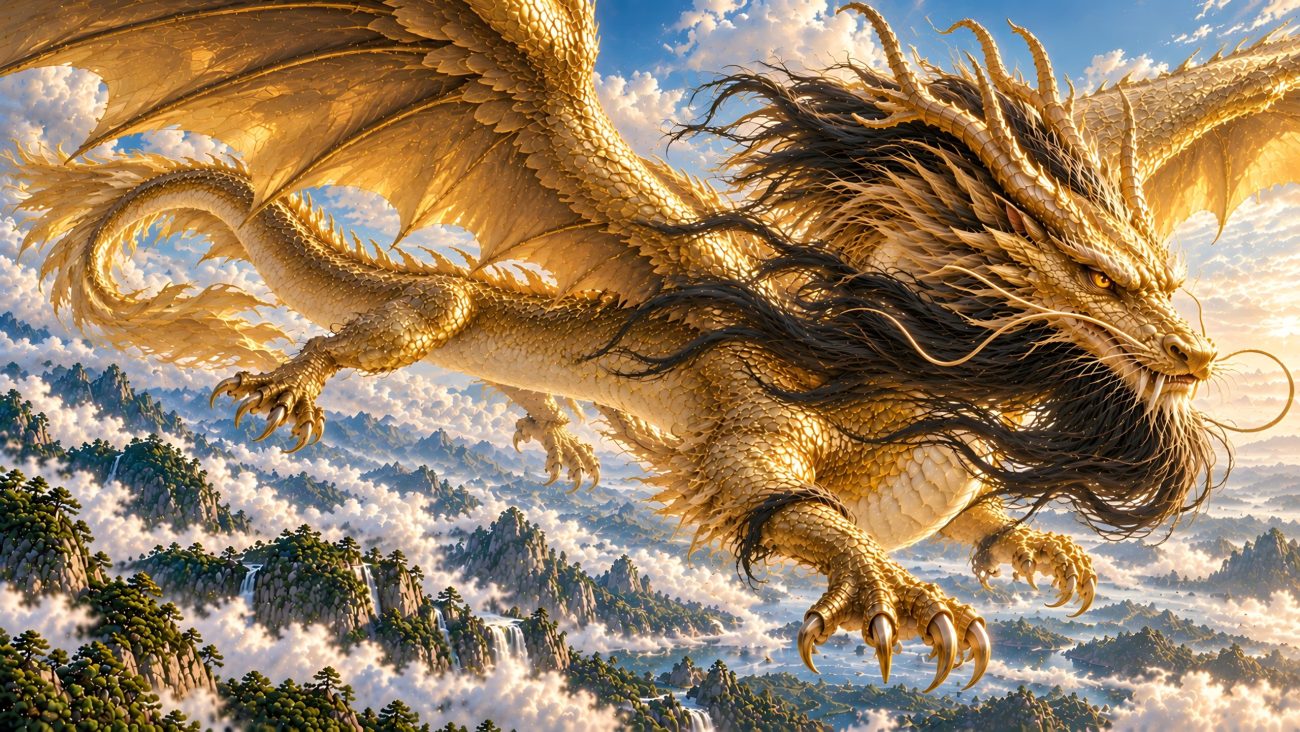
Yinglong is a winged dragon, distinguished from other dragons by its great wings. It is generally depicted with a dragon’s body and wings, although some representations give it the head of a dragon and the body of a bird. Its wings and tail feathers may even resemble the fins of a fish, giving the creature an unusual combination of dragon, bird, and aquatic features.

According to the Sancai Tuhui, Yinglong dwells on Gongqiu Mountain. The winged dragon also appears in several great stories of ancient Chinese mythology, where it becomes involved with the Yellow Emperor, Chiyou, Nuwa, and Yu.

During the great war between the Yellow Emperor and Chiyou, the Yellow Emperor commanded Yinglong to attack the fields of Ganyi. The dragon’s powers were therefore brought directly into the struggles of the ancient divine rulers.

Yinglong was later subdued by Nuwa, who made the powerful dragon serve as the beast that pulled her vehicle. Yu, meanwhile, encountered Yinglong during his legendary efforts to control the great floods. As Yu worked to bring the waters under control, Yinglong used its tail to draw characters upon the ground, marking out the paths by which the waters could be guided. In this role the dragon became a guardian of the waters and an aid in one of the greatest acts of flood control in Chinese mythology. This account was later transmitted directly into Japan through the Wakan Sansai Zue.

The Shanhaijing, in its Dadong Huangjing, places Yinglong at the southern end of the world. There the dragon is said to have become unable to return to Heaven because it had killed Chiyou and Kuafu. Its presence upon the earth was consequently associated with drought, and Yinglong was said to bring drought across the land. Yet the dragon also possessed a strange connection with rain: if people imitated the form of Yinglong, heavy rain was said to follow.

The Huainanzi presents Yinglong within a different kind of cosmic lesson. It describes the soaring serpent moving through mist and Yinglong rising upon clouds, alongside other creatures whose abilities become effective when they encounter the environment suited to them. The passage emphasizes that every being has its own particular strengths and must fulfill its proper role.

The image of Yinglong continued into the artistic traditions of China and Japan. Dragons possessing the same characteristic wings are sometimes called “Flying Dragons” in paintings and decorative sculpture. At Nikkō Tōshōgū Shrine, for example, two such Flying Dragons are carved soaring above waves in the Water Pavilion.

These winged dragons are frequently shown together with waves and flowing water. Their imagery came to be associated with protection against fire, while their connection with water gave them an auspicious character. The tradition also became linked with the legend of the carp climbing the Dragon Gate waterfall and transforming into a dragon, making the dragon and the Dragon Gate motif symbols of transformation and good fortune.


Sources

Takahashi, Toshihiro. “応竜 [おうりゅう] (Yìnglóng).” 新版TYZ 妖怪図鑑 (New TYZ Yokai Encyclopedia). October 21, 2024. https://tyz-yokai.blog.jp/archives/1082948842.html


Enryū

Tradition: Japanese mythology, Chinese mythology
Alternative Names: Yanlong, Salt Dragon, Shio Ryū
Category: Dragon


The Myth

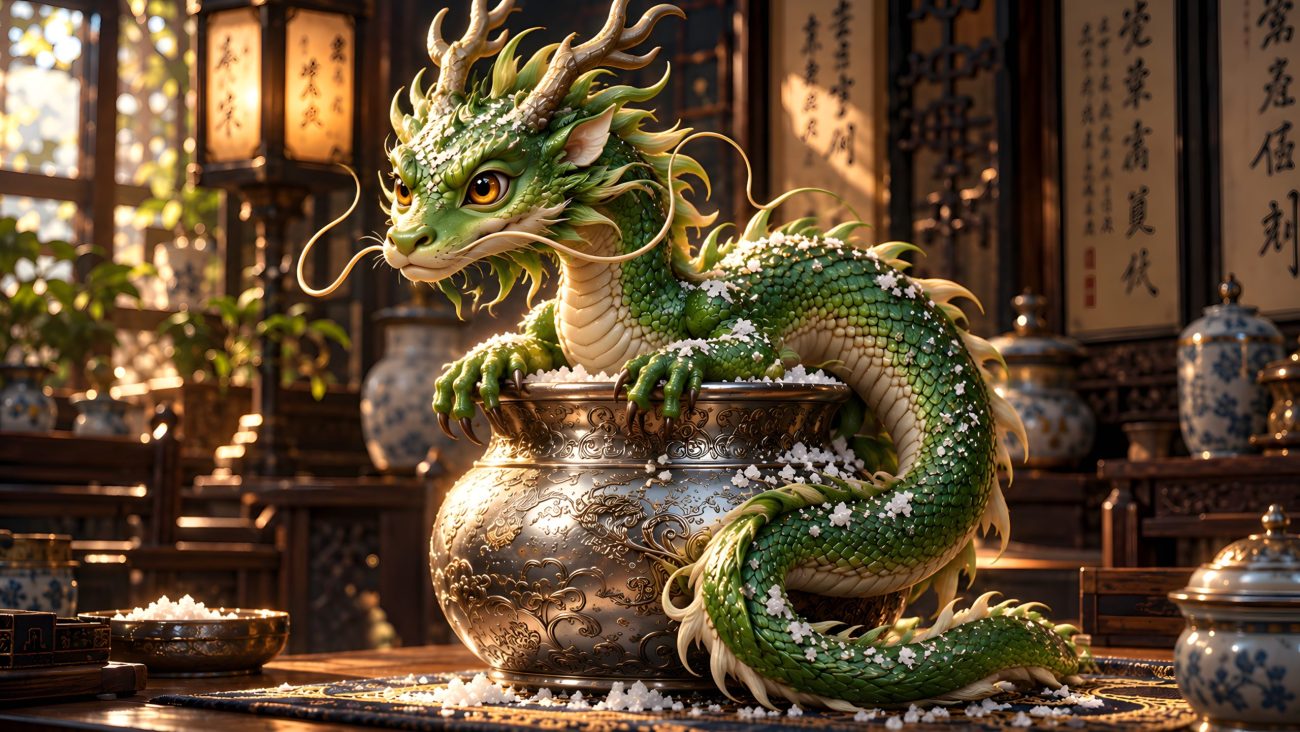
Enryū, the Salt Dragon, was a strange little dragon believed to produce a valuable substance used in tonics. Unlike the enormous dragons of storms and rivers, the Salt Dragon was described as a creature only about one foot long. Its body was covered in scales from which salt could mysteriously emerge.

According to the Compendium of Materia Medica, quoting the Records of Spring Shore, the creature was obtained during the Northern Song dynasty in the reign of Emperor Huizong. Xiao Zhu encountered a Salt Dragon while defeating the Nanman and brought the strange creature into his possession.

The dragon was kept in a silver tub with a jade bowl inside. It was fed salt taken from seawater, and after consuming the salt, more salt would seep from between its scales. The substance produced by the living dragon was regarded as medicinal. Taken together with warm wine, it was believed to increase yang energy and strengthen vitality.

Cai Jing, also called Cai Yuandu in the Records of Spring Shore, was said to have possessed one of these dragons. His Salt Dragon eventually died, however, in a rather peculiar manner. Cai attempted to obtain salt directly by licking the creature’s body. The dragon’s carcass was subsequently preserved by salting it. Even in death it retained value, since a tonic could still be extracted from the preserved body, although its effectiveness was believed to gradually diminish.

The Japanese commentary Bencao Gangmu Keimō repeated the account of the Salt Dragon but admitted that its nature was “not detailed,” offering little additional information about the creature.

The Salt Dragon later appeared in Japanese writings as well. Yanagi Rikyo’s Hitori Ne retold the story of Cai Yuanqing and his Salt Dragon from the Harunogi Kibun. The author remarked that such creatures were rarely discussed because the country in which they were supposedly found was no longer frequently visited, and therefore recorded the strange story for posterity. The same account was subsequently quoted in Keisai Eisen’s Makura Bunko.

The creature also became a subject for Japanese artists. The Illustrated Compendium of Chinese Characters depicts a Salt Dragon peering from a silver jar while reaching toward salt offered to it on a spoon by a boy. Uoya Hokkei created another well-known image of the creature, showing a Salt Dragon receiving salt from a woman. The accompanying humorous poem compares the salt caught between the dragon’s scales to light snow resting upon the swaying branches of a willow.

Thus the Salt Dragon was imagined as a peculiar living source of salt: a tiny dragon that consumed seawater salt, produced more through its scales, and could itself become an ingredient in mysterious medicines even after death.


Sources

Takahashi, Toshihiro. “延竜 [えんりゅう] (Enryū).” 新版TYZ 妖怪図鑑 (New TYZ Yokai Encyclopedia). October 21, 2024. https://tyz-yokai.blog.jp/archives/1083002104.html


Mao Long

Tradition: Chinese mythology
Alternative Names: Hairy Dragon
Category: Dragon


The Myth

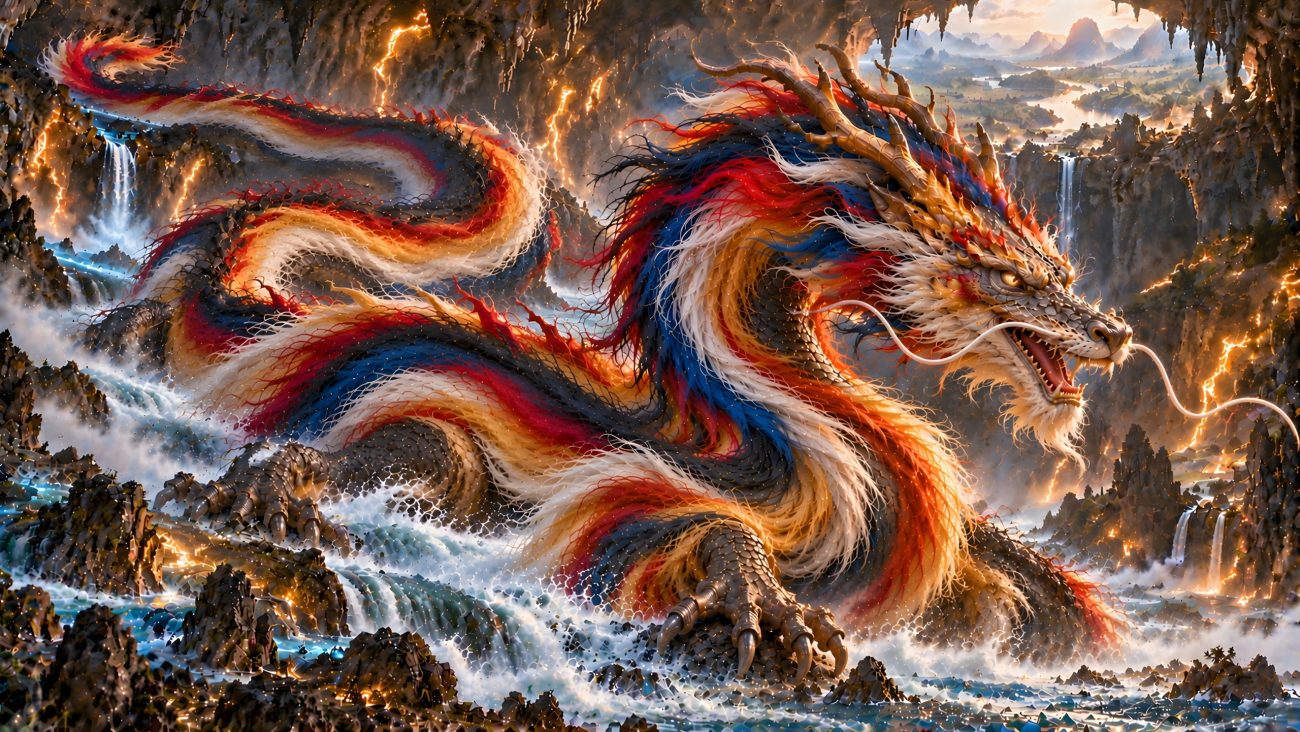
Mao Long is a strange dragon covered in hair of five different colors. It lived deep beneath the earth in a mysterious cave called Yin Yuan Li, located in the southern land of Nanxun. The cave was connected to the earth’s veins and was also inhabited by Mao Yu, a hairy fish. The hairy dragons and hairy fish lived together within the hidden cavern, while the bones of such creatures could sometimes be found scattered across the marshlands above.

During the time of Shun, the kingdom of Nanxun presented two Mao Longs to the rulers, one male and one female. Because of these remarkable dragons, a special palace was established for the raising and keeping of dragons. The tradition of raising dragons continued through the Xia Dynasty, and the clan associated with these dragon keepers took its name from the creatures.

When Yu undertook the great task of guiding the rivers, he rode upon a Mao Long. The hairy dragon carried him through the waters as he brought order to the rivers and helped bring peace to the four seas. Once the waters and the land had been brought under control, Yu released the dragon back into the waters, allowing it to return to its natural realm.


Sources

“毛龙 (Máolóng; Hairy Dragon).” Chinese Wikipedia. Wikimedia Foundation. Accessed October 2, 2026. https://zh.wikipedia.org/wiki/%E6%AF%9B%E9%BE%99


Poison Dragon

Tradition: Chinese mythology
Alternative Names: Dulong (毒龙)
Category: Dragon


The Myth

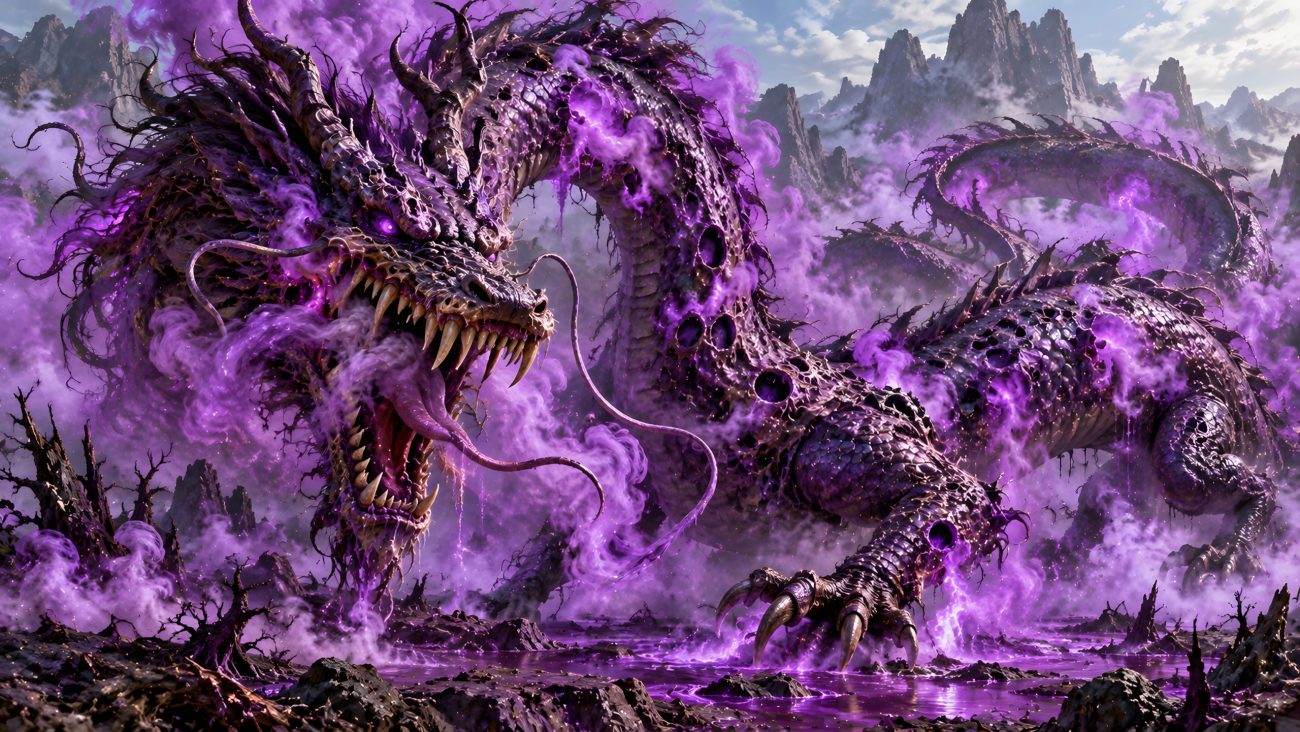
The Poison Dragon is an evil dragon of Chinese legend, a dangerous and malevolent creature associated particularly with the ancient Western Regions. Unlike benevolent dragons that govern rain and water, the Poison Dragon is remembered as a hostile supernatural being whose nature is expressed through its name: the poisonous dragon.

Ancient Chinese records repeatedly mention Poison Dragons. They appear in works such as the You Tianzhu Ji (Record of a Journey to Tianzhu), the Luoyang Qielan Ji (Record of the Buddhist Monasteries of Luoyang), and the Liang Jing Ji (Record of the Two Capitals). These accounts place the creatures especially within the lands of the ancient Western Regions, where encounters with strange dragons and supernatural beings formed part of the legendary landscape.

The Poison Dragon also appears in the later Xiuyun Ge, where Poison Dragon and other demons gather together after being summoned. The gathered creatures initially believe that they have been called together to fight the Daoist of Wanxing Terrace. Poison Dragon explains that this is not their purpose: they have instead been ordered by an immortal to assemble the demons and form a magical array against Sanjian.

Thus the Poison Dragon appears in Chinese legendary literature as a distinctly malevolent dragon, associated with poisonous and demonic forces rather than the protective or auspicious nature commonly attributed to other Chinese dragons.


Sources

“毒龙 (Dúlóng; Poison Dragon).” Chinese Wikipedia. Wikimedia Foundation. Accessed October 2, 2026. https://zh.wikipedia.org/wiki/%E6%AF%92%E9%BE%99


Lao Jian

Tradition: Chinese mythology
Alternative Names: Old Jian, Lao Jian, Jian Shi
Category: Dragon


The Myth

Lao Jian is a poisonous dragon of ancient Chinese mythology, a dangerous creature associated with floods and destructive waters. His presence could cause severe water damage, and his power was great enough that he had to be subdued by Li Bing, the governor and general of Shu.

During the Qin Dynasty, Li Bing confronted the poisonous dragon Jian Shi and subdued it, binding it with chains and locking it on the river. Once the dragon had been restrained, the flooding ceased.

The identity of Jian is connected with Nie Zi, a wicked dragon from the legend of Wang Niang Tan. When Nie Zi transformed himself into a dragon, his mother managed to hold onto one of his feet, preventing that foot from undergoing the transformation. He therefore remained lame, and this peculiar deformity gave rise to the name Jian.

The name is further connected with Nie Zi’s surname, Nie, which is said to echo the name of the dragon. Thus Lao Jian is remembered as the poisonous, crippled dragon whose watery power was finally restrained by Li Bing.


Sources

“老蹇 (Lǎojiǎn).” Chinese Wikipedia. Wikimedia Foundation. Accessed October 2, 2026. https://zh.wikipedia.org/wiki/%E8%80%81%E8%B9%87


Hakuryū

Tradition: Japanese mythology, Chinese Mythology
Alternative Names: Hakuryū, White Dragon
Category: Dragon


The Myth

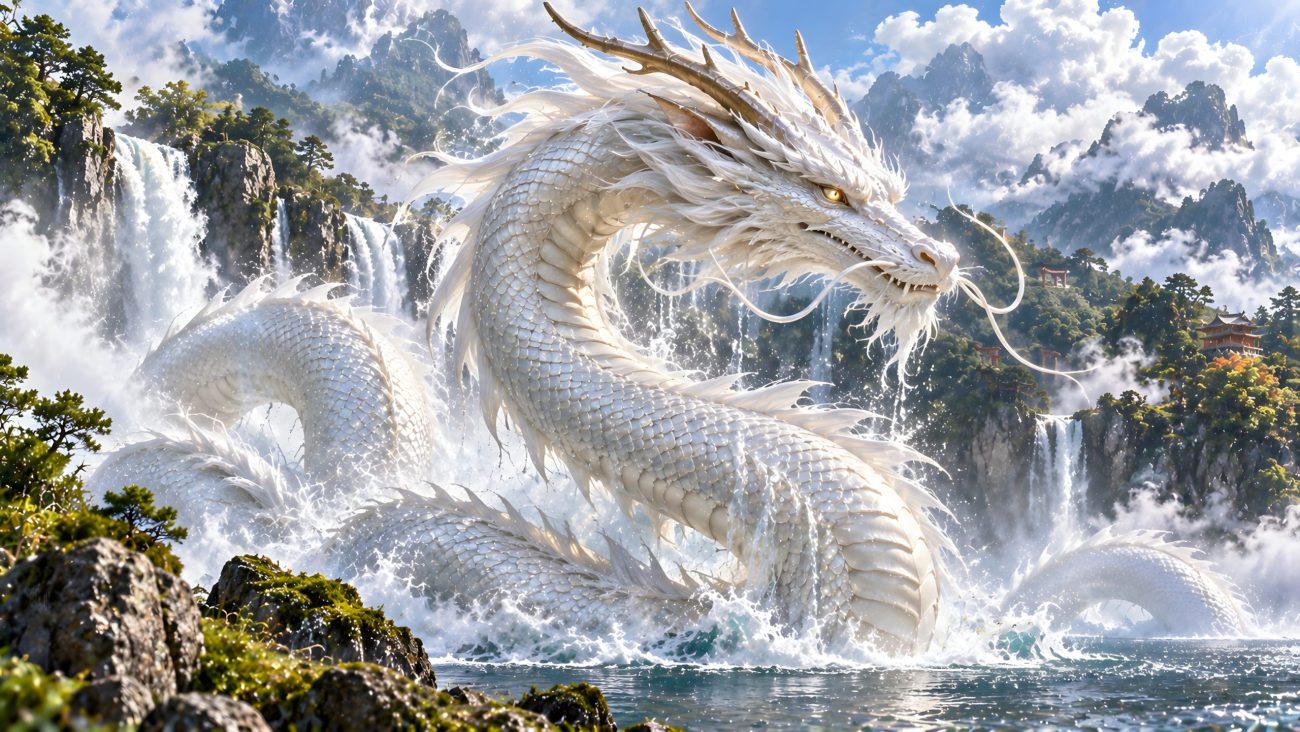
The Hakuryū is a white-bodied dragon, its pale form marking it as an auspicious and noble being. White dragons appear in legends, folktales, and the origin stories of temples and shrines, where they are often regarded as masters or gods of mountains, rivers, and lakes. In traditional dictionary definitions, the white dragon is described as a messenger of the Emperor of Heaven.

One of the oldest stories associated with the Hakuryū tells of a white dragon that descended to the Qingleng Abyss. There, it transformed itself into a fish and swam through the waters. A fisherman named Yu Qie encountered the fish and shot it in the eye.

The wounded dragon fled back to heaven and complained to the Emperor of Heaven about what had happened. But the Emperor rebuked it. Since the dragon had deliberately taken the form of a fish, he argued, it had placed itself among creatures naturally hunted by human beings. If Yu Qie had merely shot a fish, what crime had he committed?

The story was later used by Wu Zixu to warn the King of Wu. He explained that the white dragon was a noble creature of the Emperor of Heaven, while Yu Qie was merely a low-ranking official of the state of Song. Yet by disguising itself as a fish, the dragon had allowed itself to be treated like an ordinary creature. Likewise, if a ruler abandoned the dignity of his position and mingled with common people as though he were one of them, he could expose himself to dangers that would otherwise never reach him. The King of Wu was persuaded by the warning and changed his mind.

From this tale came the expression “white dragon in fish clothes,” describing a person of high status who disguises themselves in humble clothing, as well as the misfortunes that can result from such a disguise.

The Hakuryū could also appear as a terrifying force of nature. In 819, during the tenth year of the Kōnin era, a white dragon was said to have appeared in Kyoto amid a violent storm that damaged houses. White dragons were consequently associated not only with celestial power but with the destructive forces of wind and water.

The name Hakuryū could even be applied to the natural world: white, foaming streams and waterfalls were sometimes described as white dragons rushing through the landscape.


Sources

Takahashi, Toshihiro. “白竜 [はくりゅう] (Hakuryū).” 新版TYZ 妖怪図鑑 (New TYZ Yokai Encyclopedia). October 21, 2024. https://tyz-yokai.blog.jp/archives/1082944130.html