Tradition: Japanese mythology, Chinese mythology
Alternative Names: Yinglong, Winged Dragon, Flying Dragon
Category: Dragon
The Myth
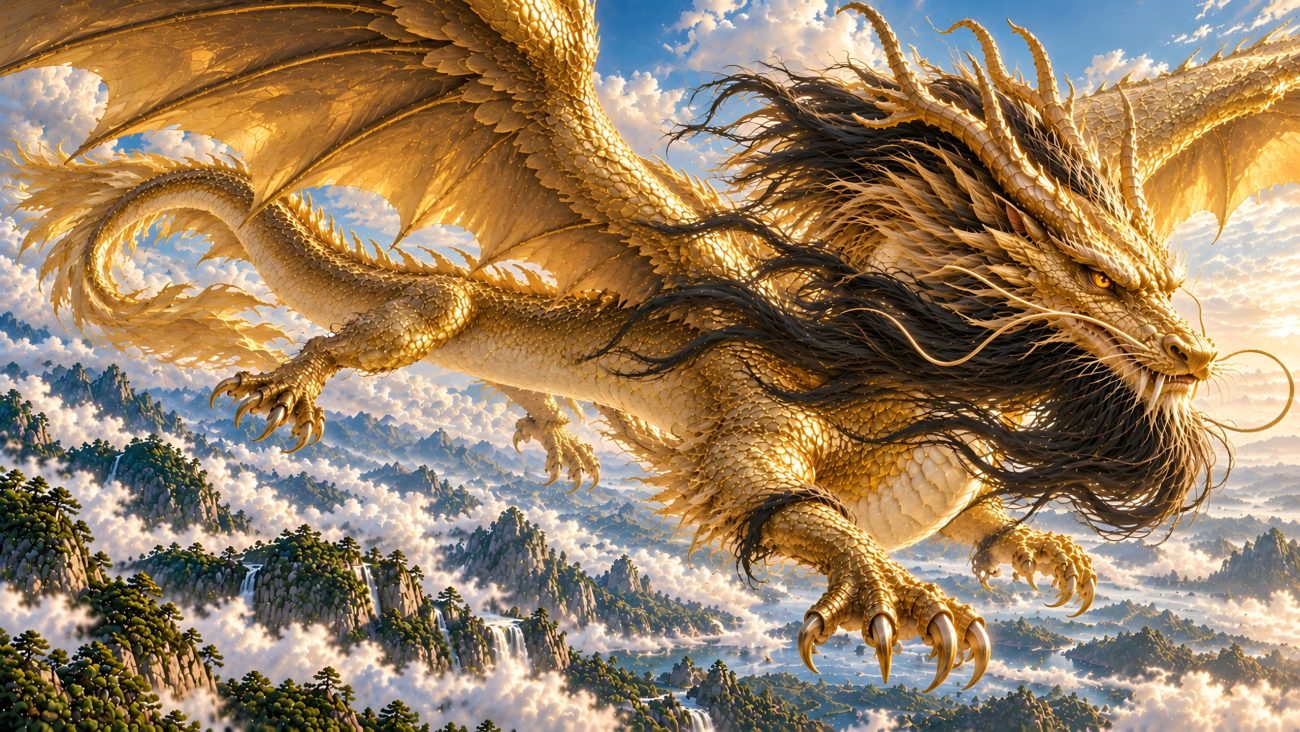
Yinglong is a winged dragon, distinguished from other dragons by its great wings. It is generally depicted with a dragon’s body and wings, although some representations give it the head of a dragon and the body of a bird. Its wings and tail feathers may even resemble the fins of a fish, giving the creature an unusual combination of dragon, bird, and aquatic features.
According to the Sancai Tuhui, Yinglong dwells on Gongqiu Mountain. The winged dragon also appears in several great stories of ancient Chinese mythology, where it becomes involved with the Yellow Emperor, Chiyou, Nuwa, and Yu.
During the great war between the Yellow Emperor and Chiyou, the Yellow Emperor commanded Yinglong to attack the fields of Ganyi. The dragon’s powers were therefore brought directly into the struggles of the ancient divine rulers.
Yinglong was later subdued by Nuwa, who made the powerful dragon serve as the beast that pulled her vehicle. Yu, meanwhile, encountered Yinglong during his legendary efforts to control the great floods. As Yu worked to bring the waters under control, Yinglong used its tail to draw characters upon the ground, marking out the paths by which the waters could be guided. In this role the dragon became a guardian of the waters and an aid in one of the greatest acts of flood control in Chinese mythology. This account was later transmitted directly into Japan through the Wakan Sansai Zue.
The Shanhaijing, in its Dadong Huangjing, places Yinglong at the southern end of the world. There the dragon is said to have become unable to return to Heaven because it had killed Chiyou and Kuafu. Its presence upon the earth was consequently associated with drought, and Yinglong was said to bring drought across the land. Yet the dragon also possessed a strange connection with rain: if people imitated the form of Yinglong, heavy rain was said to follow.
The Huainanzi presents Yinglong within a different kind of cosmic lesson. It describes the soaring serpent moving through mist and Yinglong rising upon clouds, alongside other creatures whose abilities become effective when they encounter the environment suited to them. The passage emphasizes that every being has its own particular strengths and must fulfill its proper role.
The image of Yinglong continued into the artistic traditions of China and Japan. Dragons possessing the same characteristic wings are sometimes called “Flying Dragons” in paintings and decorative sculpture. At Nikkō Tōshōgū Shrine, for example, two such Flying Dragons are carved soaring above waves in the Water Pavilion.
These winged dragons are frequently shown together with waves and flowing water. Their imagery came to be associated with protection against fire, while their connection with water gave them an auspicious character. The tradition also became linked with the legend of the carp climbing the Dragon Gate waterfall and transforming into a dragon, making the dragon and the Dragon Gate motif symbols of transformation and good fortune.
Sources
Takahashi, Toshihiro. “応竜 [おうりゅう] (Yìnglóng).” 新版TYZ 妖怪図鑑 (New TYZ Yokai Encyclopedia). October 21, 2024. https://tyz-yokai.blog.jp/archives/1082948842.html