Tradition: Russian Mythology
Alternative Names: Zmey, Zmeya, Zmiy, Zmeyevich
Category: Dragon
The Myth
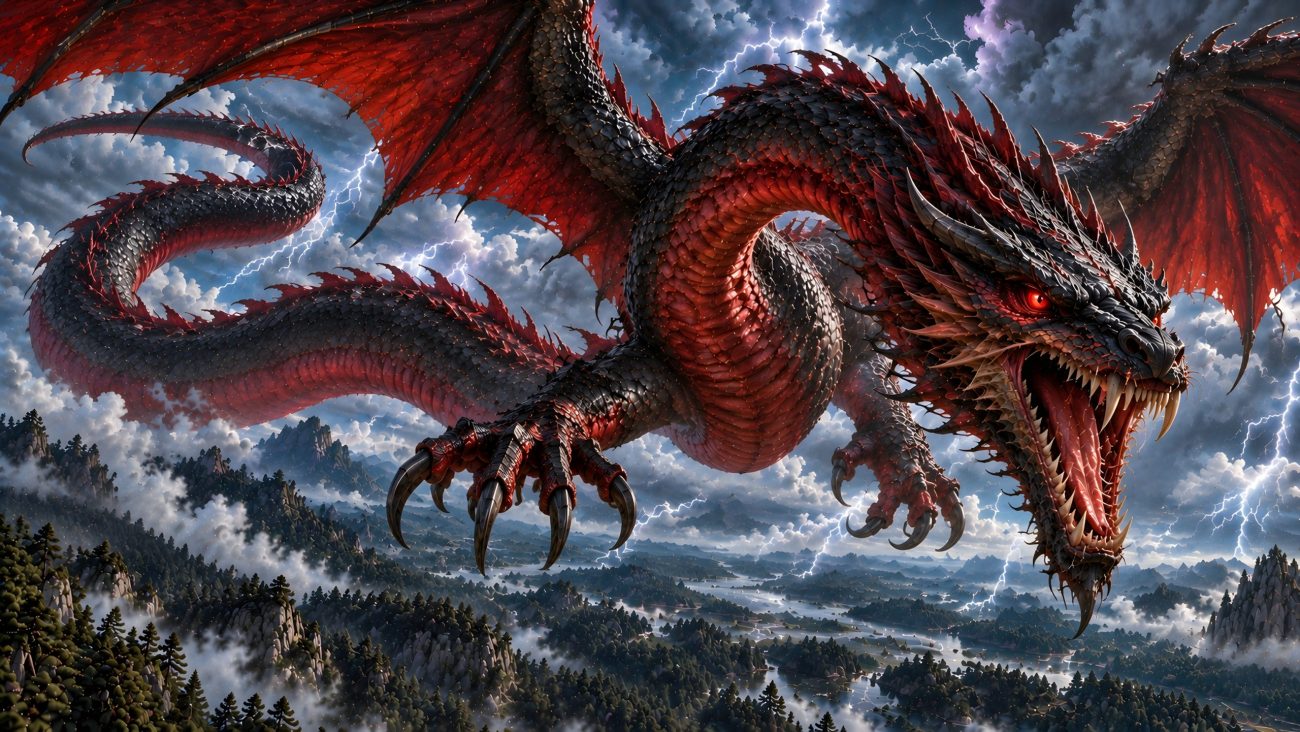
The Zmei is a flying dragon-serpent of Russian folklore, although its appearance can vary considerably. Later descriptions portray it covered in green or red scales with iron claws, while many Zmei are monstrous creatures with multiple heads. They may possess three, six, nine, or twelve heads, and some are capable of breathing fire. The name itself simply means “serpent,” but when used for a dragon it generally implies a flying serpent. Female dragons are called Zmeya, and while male dragons are more common in prose folktales, female dragons appear frequently in epic poetry.
The Zmei is not always purely beast-like. It can move between the forms of serpent, dragon, and human, sometimes appearing as a handsome young man capable of enchanting or seducing women. In the tale of The Milk of Wild Beasts, a Zmei takes the form of a beautiful youth and becomes involved with the family of Ivan Tsarevich. The creature’s shapeshifting can become extraordinarily elaborate: it may disguise itself as ordinary household objects such as a broom, a mop, or an oven fork, attempting to remain hidden from those searching for it. Ivan’s loyal animals, however, are able to recognize the supernatural intruder. In The Crystal Mountain, a Zmei even assumes the form of a golden goat.
The most terrifying Zmei are those with many heads. In Ivan the Peasant’s Son and the Little Man the Size of a Finger, dragons with three, six, nine, and twelve heads appear in succession, each becoming a greater challenge for the hero. The twelve-headed dragon is so difficult to destroy that even after Ivan cuts away almost all of its heads, the final head requires the strength of six men supplied by the Tsar.
Closely related creatures appear in the form of the Chudo-Iudo, monstrous humanlike beings who ride horses and possess several heads. Their heads can even grow back after being cut off, making them extraordinarily difficult to kill. Their supernatural nature blurs the boundary between human warrior and dragon, a characteristic that appears throughout Zmei folklore.
The Zmei can also take on a more human character. The famous Tugarin Zmeyevich is a serpent-like hero and monster who can ride a horse as a human warrior would. He confronts the bogatyr Alyosha Popovich and is eventually slain. Tugarin possesses the enormous appetite associated with a dragon, even swallowing an entire swan and spitting out its bones. He is also described with wings, although some songs rationalize these as artificial paper wings attached to his horse. His character combines the appearance and powers of a dragon with the behavior of a human warrior and pagan adversary.
Another celebrated Zmei is Zmei Gorynych, the “Serpent Gorynych,” a distinctly dragon-like creature associated with water, fire, and numerous heads. He may possess anywhere from three to twelve heads and is capable of breathing fire. Yet even Gorynych is not always a purely monstrous beast and can appear in human form. In Russian heroic tradition, Zmei Gorynych and similar Zmei frequently become adversaries of the bogatyri, including heroes such as Dobrynya Nikitich.
The epic ballad Dobrynya and the Zmei tells of a dragon dwelling around the Puchai River and the caves of the Saracen Mountains. The creature raises its young there and keeps captives within its lair. Possessing the power of flight, it can travel great distances, and one such Zmei flies all the way to Kiev to abduct a princess. Dobrynya eventually confronts and destroys the creature.
The Zmei’s ability to appear as a human also gives it a darker role as a supernatural lover. In The Milk of Wild Beasts, a Zmei takes the form of a handsome young man and seduces the sister of Ivan Tsarevich. She then pretends to be ill and sends Ivan on a dangerous quest to obtain the milk of a wolf, a bear, and a lioness. When Ivan is eventually separated from his magical animal companions, the Zmei reveals its true nature and prepares to devour him. A closely related tale replaces the princess with Ivan’s unfaithful wife and features Zmei Zmeyevich, the “Serpent, Son of Serpent.”
The Zmei can also appear in tales as the lover of the sorceress Marinka. Zmei Gorynych or Tugarin Zmeyevich enters the story as her supernatural lover, although their roles are brief and they are swiftly killed. In some traditions, Zmei Zmeyevich even appears as a tsar, showing how far the creature can move between the forms of monster, warrior, lover, and ruler.
Among the most famous enemies of the Zmei are the Russian bogatyri, whose battles with these creatures turn the dragon-serpent into a symbol of the supernatural adversary standing against the heroic warrior. Across Russian wonder tales and epic poetry, the Zmei therefore occupies an unusual space: it may be an enormous many-headed dragon, a flying serpent, a fire-breathing beast, a seductive young man, or a nearly human warrior bearing the blood and nature of a serpent.
Sources
“Zmei (Russian folklore).” Wikipedia: The Free Encyclopedia. Wikimedia Foundation. Accessed October 3, 2026. https://en.wikipedia.org/wiki/Zmei_(Russian_folklore)