Tradition: Romanian mythology
Alternative Names: Zmei, Zmeoaică, Zmeoaice
Category: Dragon
The Myth
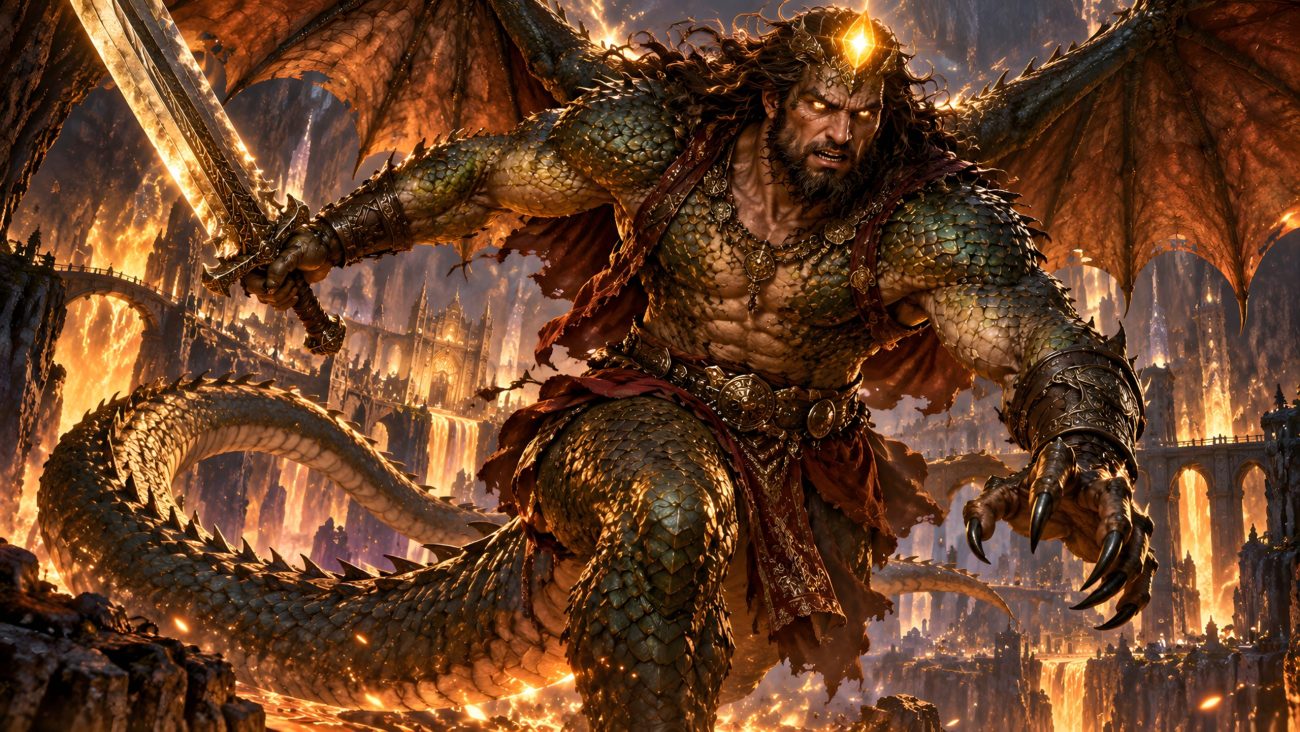
The Zmeu is a strange and formidable creature, neither fully dragon nor fully human. It is often imagined as a humanoid being with arms and legs, a human-like face, and a large, thick body. Some descriptions give it a body covered in scales, a serpent’s tail, and bat-like wings, while others describe a man’s head upon a bird-like body ending in a serpent’s tail. It can speak, ride a horse, wield weapons, create magical objects, and move through the world much like a monstrous human warrior. Some traditions instead portray the Zmeu as an enormous man-eating giant with a rocky tail, while others reduce it to a somewhat larger and heavier human figure.
The creature can also take more overtly supernatural forms. Some Zmei fly through the sky breathing fire, while others can change their shape. They may appear as a living trail of flame or something resembling fireworks moving through the night sky. In certain stories, the Zmeu possesses a magical precious stone fixed to its head, shining with a brilliance like the sun. Other tales reduce the creature to a king of serpents, while popular tradition sometimes confuses the Zmeu with the Balaur, another Romanian dragon. The supernatural creatures ridden by the Șolomonarii are likewise identified as either Zmei or Balauri depending on the tradition.
The Zmeu is one of the great adversaries of Romanian fairy-tale heroes. It commonly dwells in the other world, celălalt tărâm, sometimes beneath the earth in a dark and supernatural kingdom. From there it enters the human world to steal treasures, abduct women, or impose its destructive power upon mankind. Its enormous strength, ability to fly and shapeshift, and mastery of magical objects make it a formidable enemy, but its powers ultimately fail against the courage and martial skill of the heroic Făt-Frumos.
The Zmeu is especially associated with greed and selfishness. It steals things of immense value, forcing a heroic prince to journey into danger and recover what has been taken. In the ballad of Greuceanu, the creature commits one of its greatest acts of theft: it steals the sun and the moon from the sky, plunging humanity into darkness. Greuceanu must confront the supernatural forces responsible and restore light to the world.
In Prâslea the Brave and the Golden Apples, the Zmeu repeatedly steals the king’s precious golden apples. Prâslea follows the trail of the theft into the supernatural realm, pursuing the creature into its dark domain. In some forms of the tale, the Zmeu can even transform into a bird while stealing the apples, linking the Romanian story to a wider family of European tales in which a magical bird carries away a king’s precious treasure.
The Zmeu is also a kidnapper of young women. It frequently carries a beautiful maiden away to its otherworldly fortress, intending to make her his wife. The heroic Făt-Frumos then enters the Zmeu’s realm, confronts the monster, and kills it, freeing the captive woman. She subsequently becomes the hero’s bride-to-be. The Zmeu can therefore stand between the hero and both the treasure and the woman he must rescue, making the confrontation a struggle against the creature’s greed, violence, and desire to possess what belongs to the human world.
The creature’s courtship can take an even more sinister form. Sometimes a Zmeu appears not as a monstrous warrior but as a flame entering the chamber of a young girl or widow. Once inside, the flame transforms into a man and attempts to seduce her. Its ability to cross from supernatural fire into human form makes the Zmeu a particularly uncanny presence: it can arrive as something apparently impossible, only to become a human-looking lover once it reaches its victim.
The Zmeu is almost invariably overcome by the courage of a young prince or wandering knight. Its supernatural strength and magical abilities cannot compensate for the hero’s determination and martial skill. Whether it has stolen the sun and moon, carried away golden apples, or abducted a maiden into its underground kingdom, the creature ultimately becomes the monster standing between Făt-Frumos and the restoration of order.
The female Zmeu is known as the Zmeoaică, and the plural forms are Zmei and Zmeoaice. Together, the Zmei occupy a broad place in Romanian folklore, sometimes resembling dragons, giants, ogres, devils, vampires, or monstrous serpent-kings. Yet their distinctly human qualities—walking on two legs, speaking, riding horses, making weapons, taking lovers, and ruling supernatural kingdoms—set them apart from the purely animal-like dragon.
Sources
“Zmeu.” Wikipedia: The Free Encyclopedia. Wikimedia Foundation. Accessed October 3, 2026. https://en.wikipedia.org/wiki/Zmeu