Tradition: Japanese mythology, Chinese mythology
Alternative Names: Yanlong, Salt Dragon, Shio Ryū
Category: Dragon
The Myth
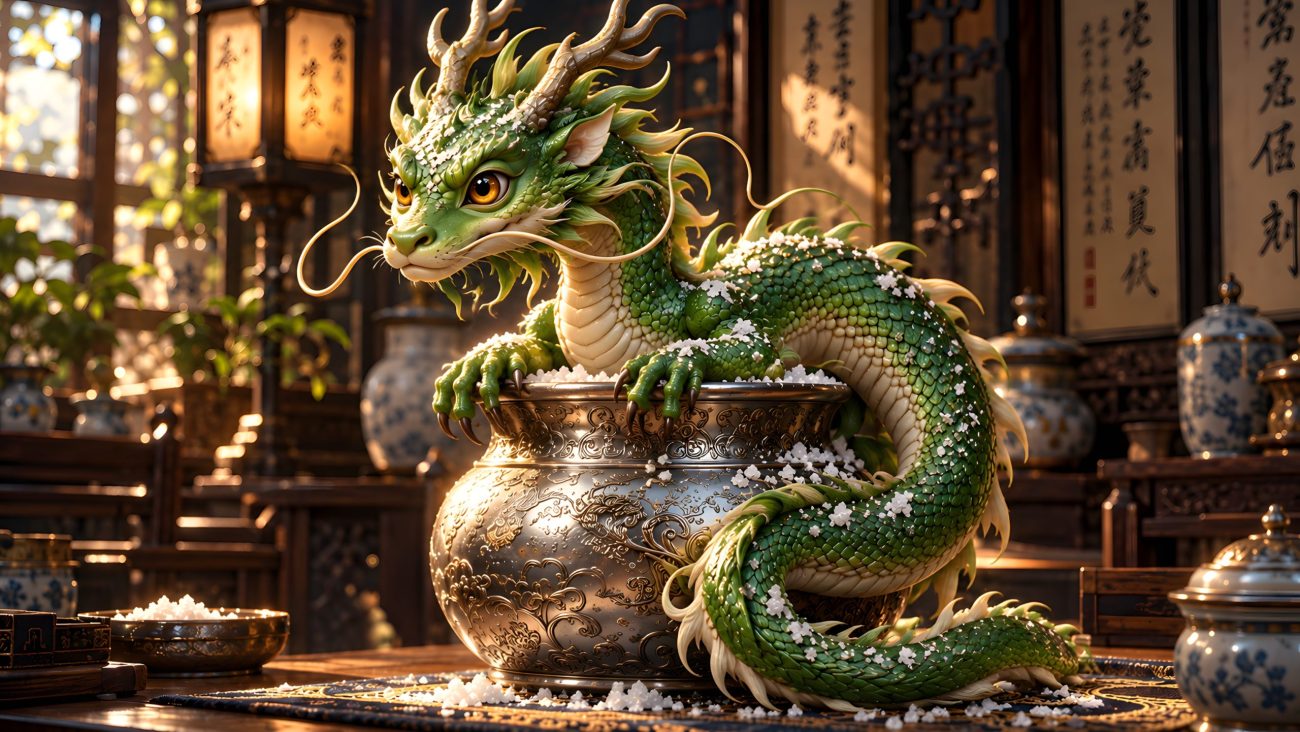
Enryū, the Salt Dragon, was a strange little dragon believed to produce a valuable substance used in tonics. Unlike the enormous dragons of storms and rivers, the Salt Dragon was described as a creature only about one foot long. Its body was covered in scales from which salt could mysteriously emerge.
According to the Compendium of Materia Medica, quoting the Records of Spring Shore, the creature was obtained during the Northern Song dynasty in the reign of Emperor Huizong. Xiao Zhu encountered a Salt Dragon while defeating the Nanman and brought the strange creature into his possession.
The dragon was kept in a silver tub with a jade bowl inside. It was fed salt taken from seawater, and after consuming the salt, more salt would seep from between its scales. The substance produced by the living dragon was regarded as medicinal. Taken together with warm wine, it was believed to increase yang energy and strengthen vitality.
Cai Jing, also called Cai Yuandu in the Records of Spring Shore, was said to have possessed one of these dragons. His Salt Dragon eventually died, however, in a rather peculiar manner. Cai attempted to obtain salt directly by licking the creature’s body. The dragon’s carcass was subsequently preserved by salting it. Even in death it retained value, since a tonic could still be extracted from the preserved body, although its effectiveness was believed to gradually diminish.
The Japanese commentary Bencao Gangmu Keimō repeated the account of the Salt Dragon but admitted that its nature was “not detailed,” offering little additional information about the creature.
The Salt Dragon later appeared in Japanese writings as well. Yanagi Rikyo’s Hitori Ne retold the story of Cai Yuanqing and his Salt Dragon from the Harunogi Kibun. The author remarked that such creatures were rarely discussed because the country in which they were supposedly found was no longer frequently visited, and therefore recorded the strange story for posterity. The same account was subsequently quoted in Keisai Eisen’s Makura Bunko.
The creature also became a subject for Japanese artists. The Illustrated Compendium of Chinese Characters depicts a Salt Dragon peering from a silver jar while reaching toward salt offered to it on a spoon by a boy. Uoya Hokkei created another well-known image of the creature, showing a Salt Dragon receiving salt from a woman. The accompanying humorous poem compares the salt caught between the dragon’s scales to light snow resting upon the swaying branches of a willow.
Thus the Salt Dragon was imagined as a peculiar living source of salt: a tiny dragon that consumed seawater salt, produced more through its scales, and could itself become an ingredient in mysterious medicines even after death.
Sources
Takahashi, Toshihiro. “延竜 [えんりゅう] (Enryū).” 新版TYZ 妖怪図鑑 (New TYZ Yokai Encyclopedia). October 21, 2024. https://tyz-yokai.blog.jp/archives/1083002104.html