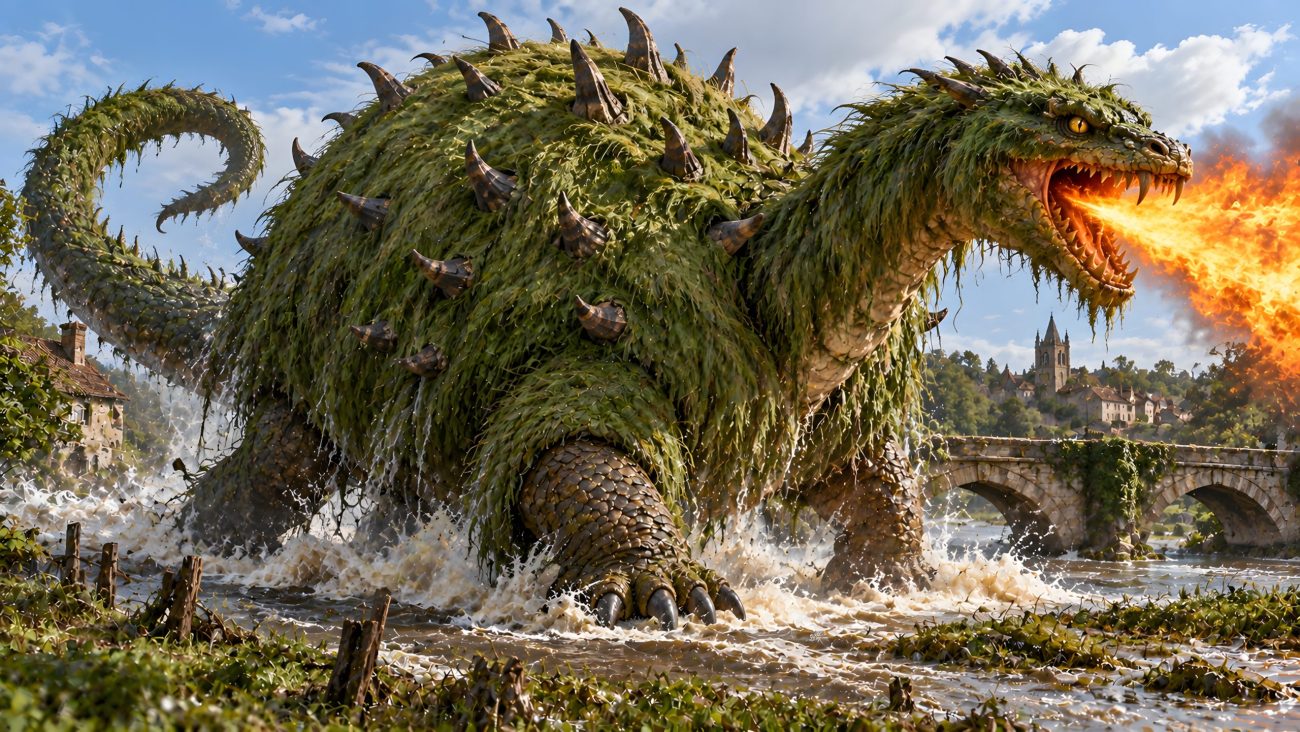
Tradition: French Mythology
Alternative Names: Velue, Peluda, “The Shaggy One,” “The Hairy One”
Category: Dragon, Turtle
The Myth
The Velue, whose name means “the shaggy one” or “the hairy one,” was a monstrous dragon said to haunt the Huisne River near La Ferté-Bernard in the Sarthe. Its body was enormous and egg-shaped, roughly the size of a large ox, and covered entirely in shaggy green fur. Sharp spikes protruded from its hairy hide, while its head resembled that of a terrifying serpent. Its immense legs were compared to those of a tortoise, and behind it dragged a powerful serpentine tail capable of killing a man or beast with a single sweep.
The Velue was said to have survived the biblical Flood after being overlooked by Noah. Having escaped the destruction of the world, the creature supposedly carried a grudge against creation and devoted the rest of its existence to destruction and spite.
It breathed fire and laid waste to farms, fields, and crops around the Huisne. Flocks of sheep disappeared down its enormous jaws, with their shepherds sometimes following them as the dragon’s dessert. Walls and moats offered little protection. The Velue was bold enough to enter the streets of the old city itself, terrifying the inhabitants and spreading destruction wherever it went.
Whenever people tried to drive it away, the monster retreated into the Huisne. Its gigantic body displaced so much water that the river overflowed its banks, flooding the surrounding countryside and ruining the fields. The dragon could therefore destroy the land whether it was upon the riverbank or beneath the water.
Women and children were said to be among the Velue’s favorite prey, and it possessed a particular appetite for agnelles, the “she-lambs” of the land—the beautiful and virtuous young women of La Ferté-Bernard. This taste eventually brought about its downfall.
After the Velue seized a young maiden and devoured her, her fiancé set out in pursuit of the monster. He followed its trail to its lair beneath an ivy-covered bridge over the Huisne. There he confronted the beast and struck at its vulnerable tail with his weapon. The blow killed the Velue instantly, bringing an end to the creature that had terrorized the countryside. Its death was celebrated throughout the region.
The story belongs to the tradition of French local dragons such as the Tarasque. Its surviving form is relatively recent: its foundations appear to reach back to the fifteenth century, while the tale was revived and considerably expanded during the nineteenth century. It never developed the major festivals or fixed iconographic traditions associated with some better-known French dragons, although a terracotta fountain sculpture dating from the seventeenth or eighteenth century, discovered in a ditch along the road to La Chapelle-Saint-Rémy, is considered the oldest surviving depiction associated with the Velue.
The association between the Velue and the word agnelles may itself preserve an older local joke. During the sixteenth century, La Ferté-Bernard sided with the Catholic League during the wars of Henri IV. Its governor, Dragues de Comnène, claimed descent from eastern kings and was known for his cunning. During a siege commanded by René de Bouillé, he sent soldiers out of the city disguised as women. The deception nearly succeeded when some of the besiegers approached the apparent damsels gallantly, only to discover that they were walking into an ambush. René de Bouillé’s forces eventually drove the disguised soldiers away, and the incident delighted Henri IV. It gave rise to jokes about the “agnelles de la Ferté“—the “she-lambs of La Ferté”—of whom, as the saying went, only two were needed to strangle a wolf.
The creature is sometimes called Peluda, but this name is a later Spanish rendering of the French Velue. Its popularity as a name for the monster owes much to Jorge Luis Borges, and it is not an original Occitan name for the dragon.
Sources
“Velue.” A Book of Creatures. January 18, 2019. https://abookofcreatures.com/2019/01/18/velue/