Genbu

Tradition: Chinese Mythology, Japanese Mythology
Alternative Names: 玄武, Xuanwu, Black Tortoise, Black Warrior, Genbu
Category: Turtle


The Myth

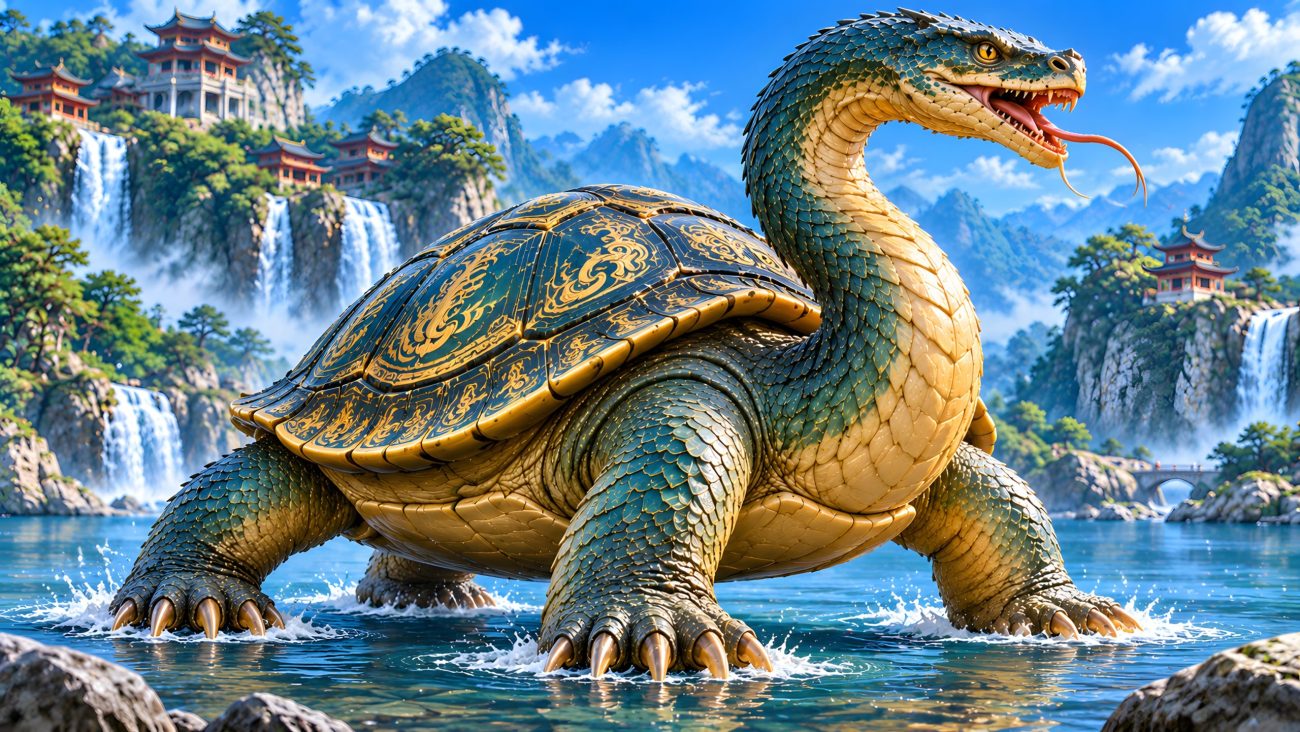
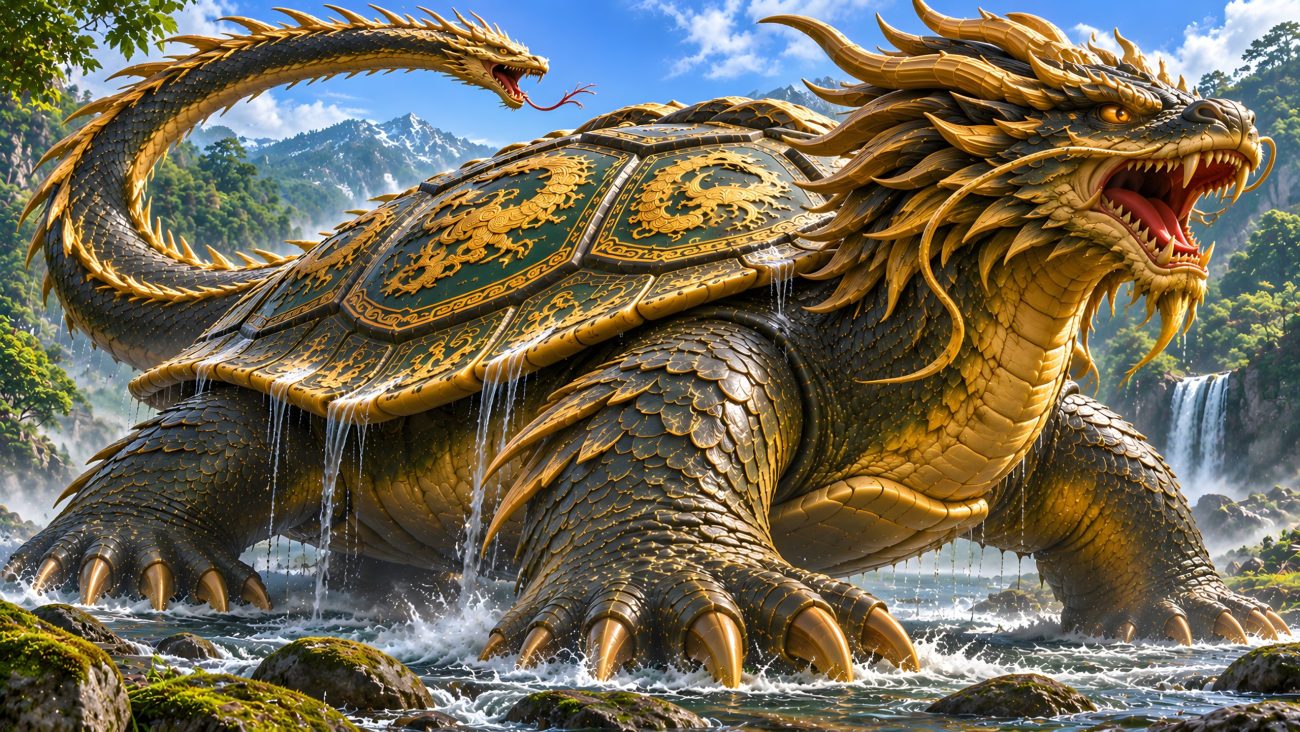
Genbu is one of the Four Symbols, the four sacred creatures that guard the cardinal directions in Chinese cosmology. It protects the north and is associated with the element of water and the season of winter. Genbu is usually depicted as a large tortoise entwined with a serpent, or as a creature whose tail takes the form of a snake.

The creature’s name combines gen, meaning black, with bu, associated with martial strength or armour. Ancient Chinese texts describe Genbu as a northern deity connected with water. The tortoise and serpent became linked in traditional explanations of the creature, including the belief that the serpent represented the tortoise’s male counterpart. However, some sources use Genbu simply as another name for a tortoise.

Together with the Azure Dragon of the east, the White Tiger of the west, and the Vermilion Bird of the south, Genbu became an important symbol of direction and protection. Through the transmission of Chinese culture to Japan, it also appeared in Japanese paintings, decorative objects, and other artistic traditions.


Sources

“Genbu (Xuanwu).” 新版TYZ 妖怪図鑑 (New TYZ Yokai Encyclopedia). https://tyz-yokai.blog.jp/archives/1085334207.html
    Bixi

    Tradition: Chinese Mythology
    Alternative Names: 貔屭, Bixi, Guifu, Baxia, Tianxia, Longgui, Dragon Turtle
    Category: Turtle


    The Myth

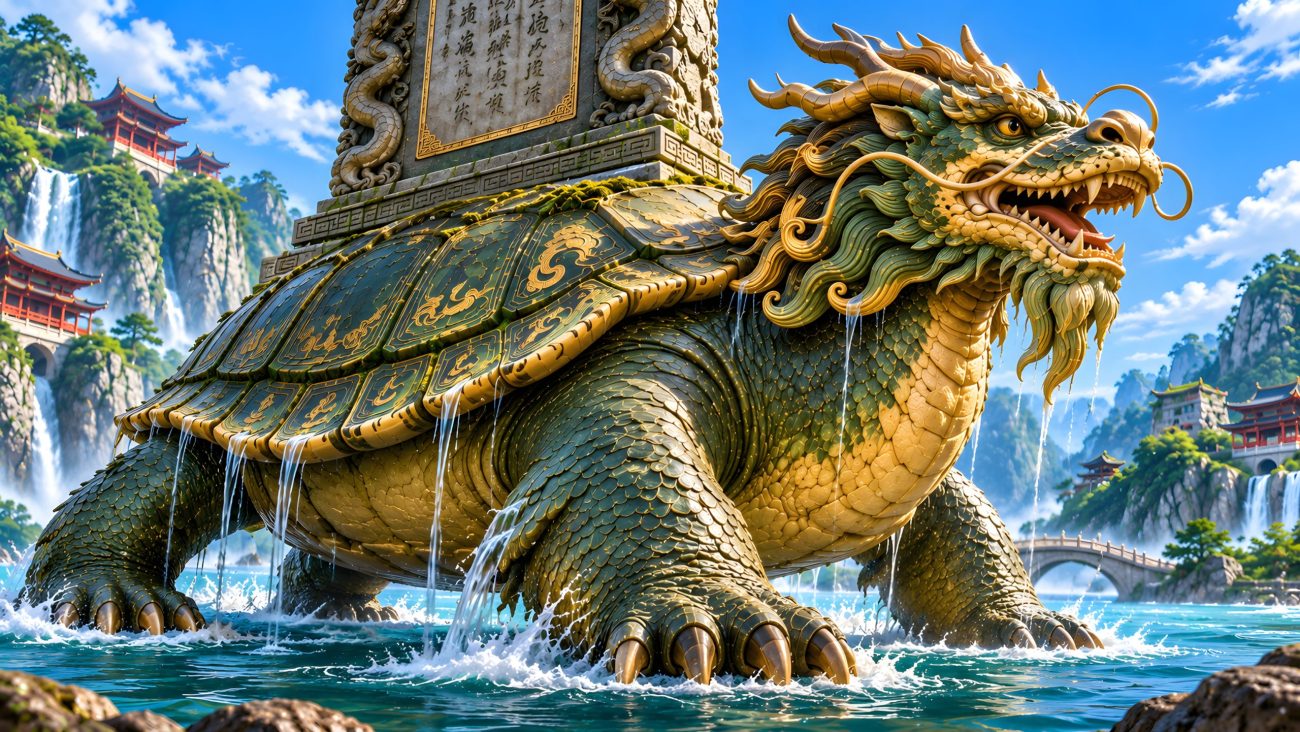
    Bixi is one of the Nine Sons of the Dragon in Chinese mythology. It resembles a giant turtle, but unlike an ordinary turtle, it has teeth and immense strength. It is famous for carrying heavy loads and is traditionally depicted supporting stone steles and monuments.

    According to legend, Bixi once carried mountains across the land and stirred up storms in rivers, lakes, and seas. When the legendary ruler Yu the Great controlled the floods, he subdued Bixi and commanded it to help move mountains, dig channels, and clear riverbeds. After the floods were brought under control, Yu feared that Bixi would return to causing trouble. He therefore placed a massive stone monument recording his achievements on its back, weighing it down and preventing it from roaming freely.

    Bixi became a symbol of strength, endurance, and the bearing of heavy burdens. Its likeness is commonly carved at the bases of important stone monuments throughout China and other parts of East Asia. Some later tales also describe Bixi spirits transforming into women.


    Sources

    “赑屃 (Bìxì).” Chinese Wikipedia. Wikimedia Foundation. https://zh.wikipedia.org/wiki/%E8%B4%94%E5%B1%AD


    Aspidochelone

    Tradition: Greek Mythology
    Alternative Names: Asp-Turtle, Fastitocalon, Zaratan, Jasconius
    Category: Turtle


    The Myth

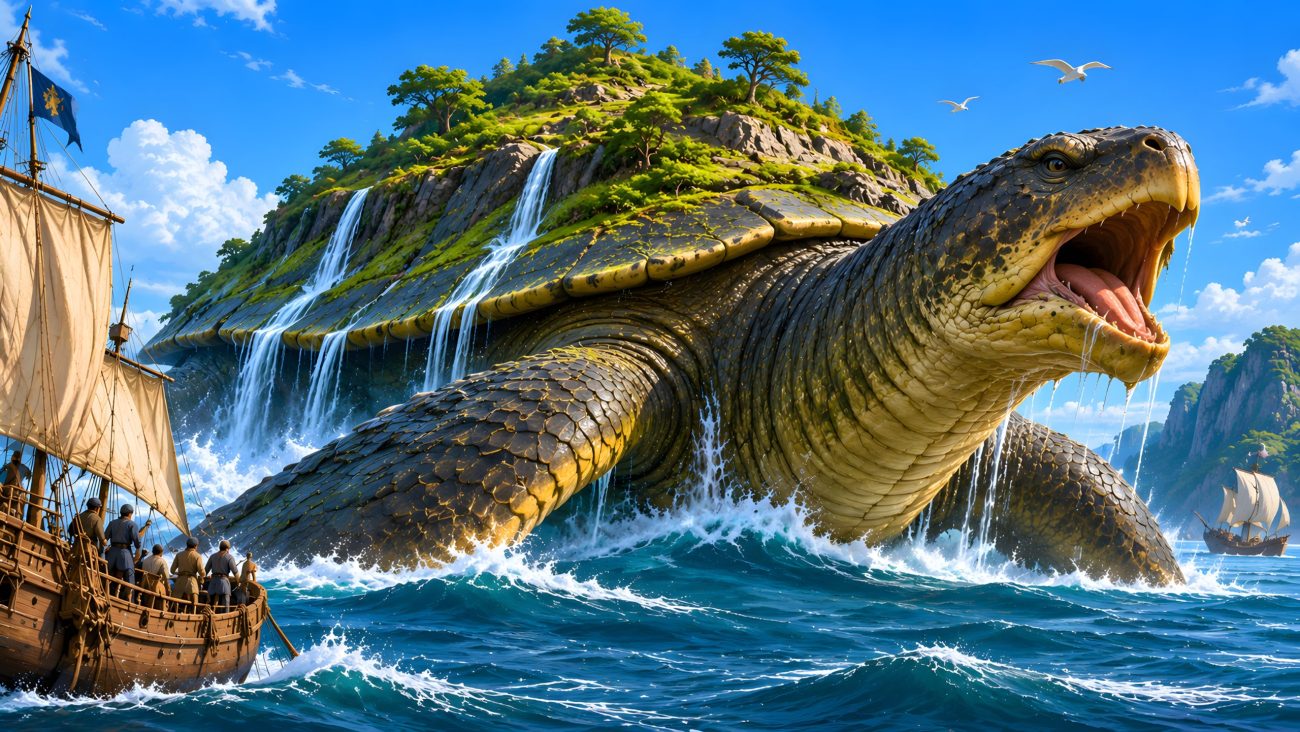
    The Aspidochelone is a gigantic sea creature described in the Physiologus and medieval bestiaries as either a whale or a vast sea turtle. Its enormous back resembles a rocky island, complete with sand and vegetation, making it difficult for sailors to distinguish it from land.

    When sailors mistake the creature for an island, they anchor their ships beside it and climb onto its back to rest or prepare food. The heat from their fires awakens the creature, which dives beneath the waves and drags the sailors and their ships into the depths. The Aspidochelone is also said to emit a sweet smell that attracts fish, which it then devours.

    The legend appears in the Physiologus, a Christian text dating to around the second century AD, and in later medieval bestiaries. Its story served as a moral allegory: just as the creature deceives sailors with its island-like appearance, Satan deceives people with false promises before leading them to destruction.


    Sources

    “Aspidochelone.” Wikipedia: The Free Encyclopedia. Wikimedia Foundation. https://en.wikipedia.org/wiki/Aspidochelone


    Moha-Moha

    Tradition: Australian Mythology
    Alternative Names: Chelosauria lovelli, Dangerous Turtle, Monster Turtle Fish
    Category: Turtle


    The Myth

    The Moha-Moha was a mysterious creature reportedly seen on Great Sandy Island, Queensland, on June 8, 1890, by schoolteacher Selina Lovell and several companions. Known to local people as the “dangerous turtle,” it was said to attack coastal camps and seize people by the leg.

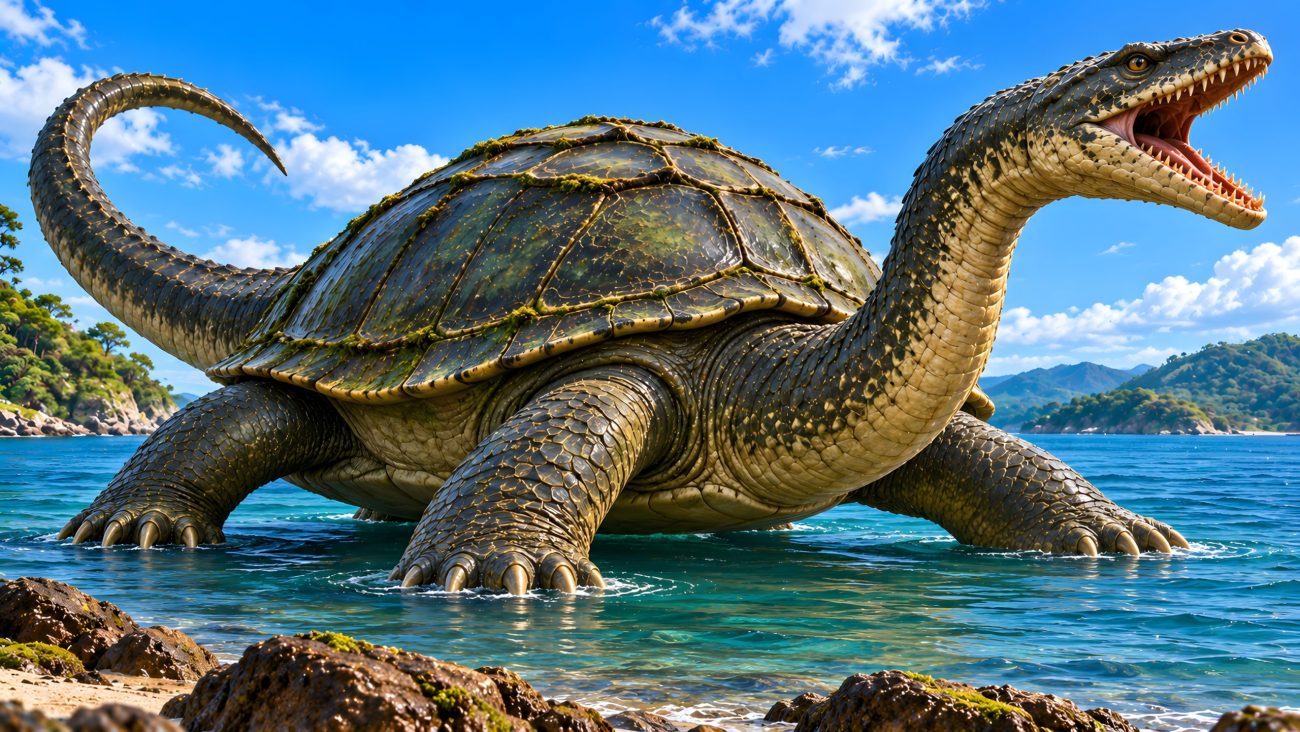
    Lovell described the creature as approximately 30 feet long, with an enormous dome-shaped, slate-grey shell, a long neck, and a tail around twelve feet long. Its head was saurian, with serrated jaws, greenish-white skin, white spots, and a very black eye. Its smooth, glossy body and unusual tail appeared so different that Lovell felt they might belong to two separate animals. She watched it for about half an hour before it raised its body and tail above the water, tossed fish into the air, and disappeared into deeper water.

    The account attracted public attention after its publication in Land and Water in January 1891. Naturalist William Saville-Kent subsequently named the creature Chelosauria lovelli. However, the report was met with considerable scepticism and ridicule. Later researchers questioned Lovell’s reliability, and one proposed explanation was that she had seen a turtle entangled in a fishing net, with debris creating the impression of an enormous tail. The Moha-Moha therefore remains an unverified creature of Australian folklore.


    Sources

    “Moha-Moha.” A Book of Creatures, May 10, 2021. https://abookofcreatures.com/2021/05/10/moha-moha/


    Umibōzu

    Tradition: Japanese Mythology
    Alternative Names: 海坊主, Sea Monk
    Category: Turtle


    The Myth

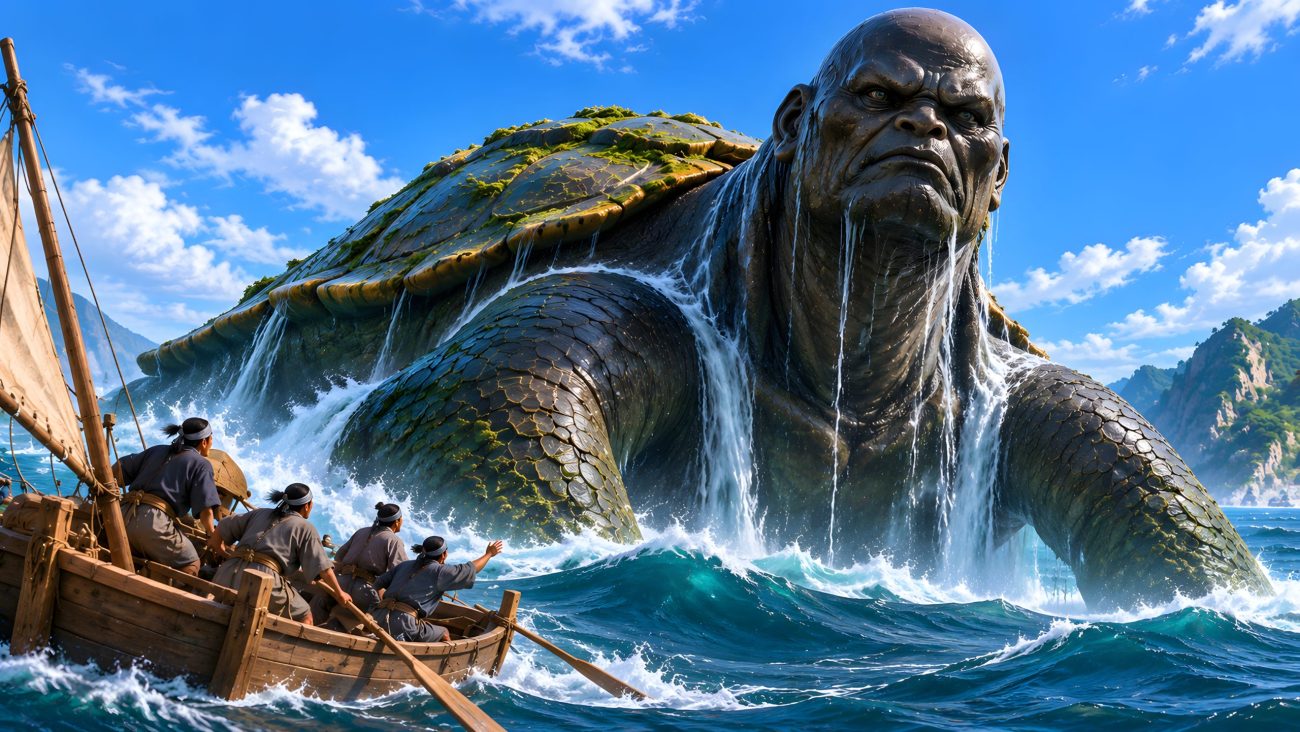
    The Umibōzu is a sea-dwelling yokai found in coastal folklore throughout Japan. It is usually described as a gigantic, pitch-black humanoid creature that rises from the ocean and can capsize ships. Some accounts describe it as reaching heights of around 30 metres. It is also regarded as an omen of misfortune.

    Descriptions of the Umibōzu vary by region. The Saikai Zokudan describes it as having a turtle’s body and a human face, identifying it with the Chinese Heshangyu. In Kesennuma, Miyagi Prefecture, it was said to transform into a beautiful woman and challenge men rowing boats at night to a swimming contest. In Uwajima, Ehime Prefecture, a tale tells of an Umibōzu that disguised itself as a masseur and killed a hunter’s wife.

    In some regions, the Umibōzu appears like a ship ghost and asks sailors to lend it a ladle. Anyone who hands one over risks having the creature scoop seawater into the boat until it sinks. To survive, sailors must give it a ladle with a hole in the bottom, preventing it from filling the vessel.

    Although the Umibōzu is usually associated with disaster, not every tradition considers it harmful. In Nakajima, Ehime Prefecture, it was believed that anyone who saw one would enjoy a long life. Japanese illustrations frequently depict it as a black humanoid rising from the waves, sometimes with fin-like features.


    Sources

    “Umibōzu.” 新版TYZ 妖怪図鑑 (New TYZ Yokai Encyclopedia). https://tyz-yokai.blog.jp/archives/1010652604.html


    Jíchō

    Tradition: Chinese Mythology
    Alternative Names: 吉弔, Chō
    Category: Turtle


    The Myth

    The Jíchō is a turtle-like creature believed to be born from the eggs of dragons. According to the Wakan Sansai Zue, which draws on the Chinese Bencao Gangmu, dragons always lay two eggs, one of which may produce a Jíchō with the head of a snake and the body of a turtle. It inhabits the Lingnan region of southern China, living in water or among trees.

    The Jíchō’s fat, known as chōshi, was traditionally believed to treat malignant swellings and deafness. It was said to seep away easily through ordinary containers, so it had to be stored in special vessels to prevent it from leaking.

    A pale blue-yellow substance resembling cattail fluff, sometimes found clinging to driftwood near water, was also believed to be the Jíchō’s reproductive fluid and was called shishōka. Traditional texts attributed medicinal properties to it and described its use in sexual health practices. However, later Japanese naturalists disputed this explanation, identifying the substance found in Lake Biwa and elsewhere as a natural material rather than the essence of a mythical creature.


    Sources

    “Kitcho.” 新版TYZ 妖怪図鑑 (New TYZ Yokai Encyclopedia). https://tyz-yokai.blog.jp/archives/1083015723.html


    Sai

    Tradition: Japanese Mythology
    Alternative Names: 犀, Water Rhinoceros, Suixi
    Category: Turtle


    The Myth

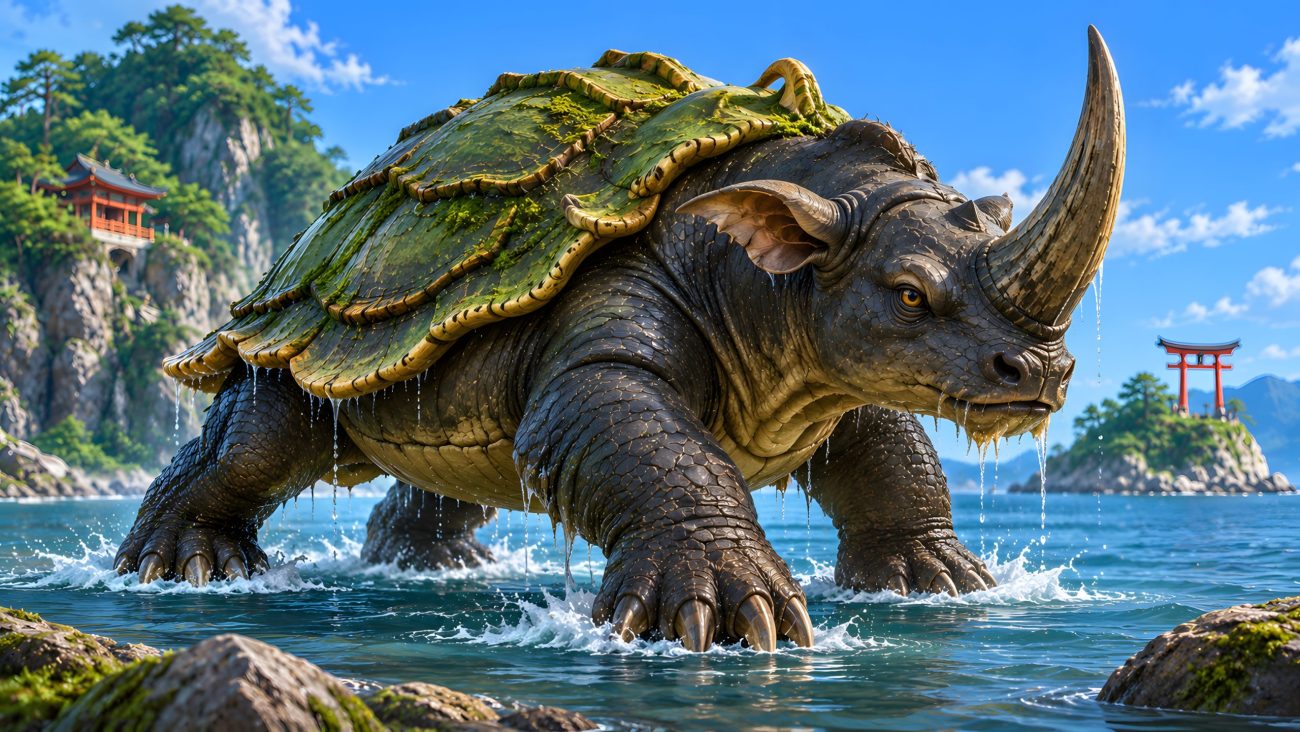
    The Sai is a legendary rhinoceros depicted in traditional Japanese art as a water-dwelling beast with the body of a water buffalo, hooves, a large horn on its head, and a shell covering its back. It was regarded as a sacred creature believed to ward off fires. Its image appeared in temple and shrine carvings, as well as in traditional paintings and illustrated scrolls. Rhinoceros horn was also valued for medicinal purposes, contributing to the reverence surrounding its depictions.

    Chinese texts distinguished between three kinds of rhinoceros: the mountain rhinoceros, which lived in forests; the water rhinoceros, which entered and left the water and was described as having a beaded shell on its back; and the female rhinoceros, which was said to possess a single horn. The water rhinoceros was particularly associated with the sacred, fire-protecting creature depicted in Japanese art.

    A tale from Sado Kaidan Moshio-gusa tells of a farmer in Ogawa Village on Sado Island whose bull repeatedly disappeared at night. The farmer secretly followed it to the coast, where it met a strange, bull-like beast with a single horn on its forehead that leapt from the sea. The two fought with their horns for hours, but neither could win. Believing that his bull’s tail was preventing victory, the farmer cut it off. The following night, the one-horned beast threw the bull several jō through the air, causing it to strike a rock and die. The creature then returned to the sea, leaving the farmer to realise that his intervention had been mistaken.


    Sources

    “Rhino.” 新版TYZ 妖怪図鑑 (New TYZ Yokai Encyclopedia). https://tyz-yokai.blog.jp/archives/1079588568.html


    Lukwata

    Tradition: Uganda Mythology, Kenyan Mythology
    Alternative Names: Balukwata
    Category: Turtle


    The Myth

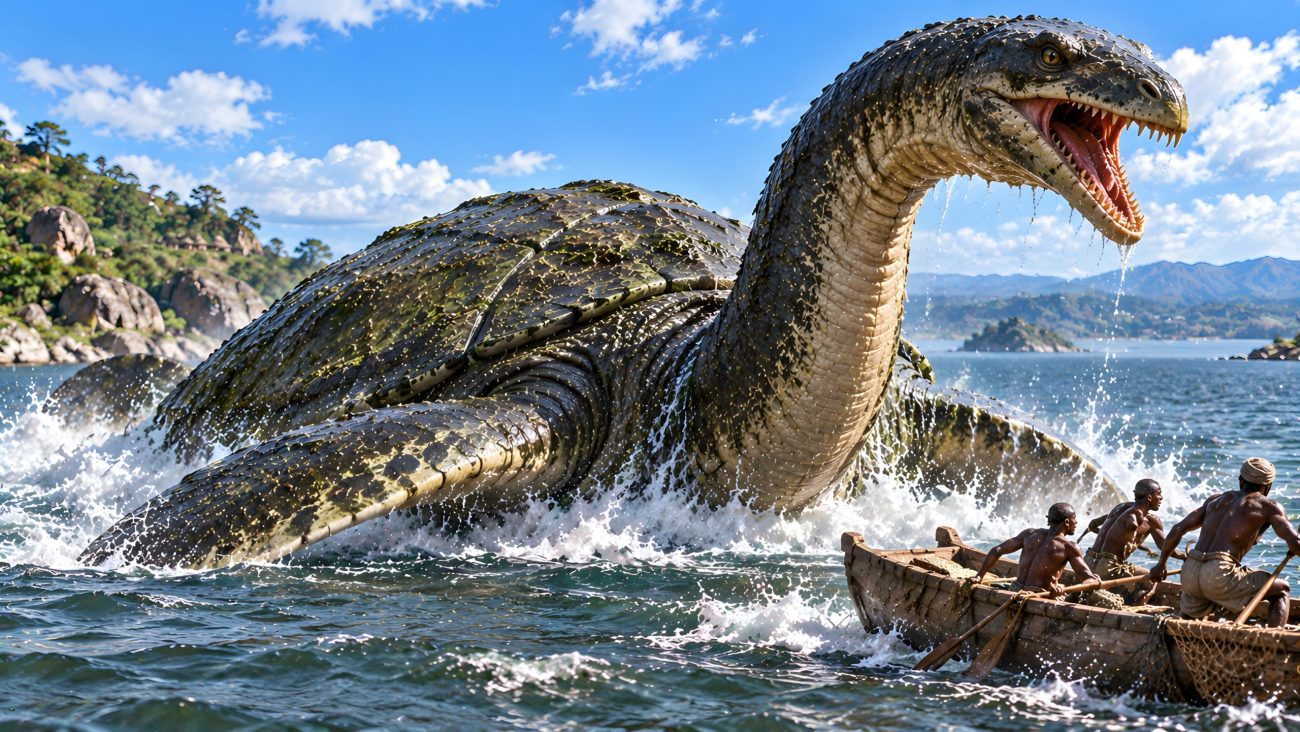
    The Lukwata is a gigantic aquatic monster from Lake Victoria, known in traditions around Uganda and Kenya. It is described variously as a sea serpent, a giant fish, or a cetacean. Accounts portray it with a dark, rounded, lizard-like or snake-like head, a long neck, flippers, a short tail, and a thick, soft, rubbery shell. It is associated with whirlpools and is said to attack fishermen’s canoes.

    The Lukwata has been known around the lake since ancient times. The Baganda, Kavirondo, and Wasoga peoples once sacrificed livestock to it. When the creature disappeared around the time of a sleeping-sickness epidemic, some believed that foreigners had killed it and brought the disease upon the people as a result. Witnesses reported seeing it swimming in the lake, while others claimed to have heard its distant bellowing. Its battles with crocodiles were said to leave pieces of skin that could be made into powerful amulets.

    In one Baganda folktale, the Lukwata befriends a monkey. When the king of the Lukwata falls ill, his wizard declares that eating a monkey’s heart will cure him. The Lukwata invites its friend across the lake, intending to take him to the king. Halfway across, it reveals the truth. The clever monkey claims that he has left his heart in a tree and asks to be taken back to retrieve it. The Lukwata believes him and returns to shore, allowing the monkey to escape into the trees. The monkey then mocks the creature for its foolishness.


    Sources

    “Lukwata.” A Book of Creatures, July 29, 2019. https://abookofcreatures.com/2019/07/29/lukwata/


    Jiǔwěi Guī

    Tradition: Chinese Mythology
    Alternative Names: 九尾龟, Nine-Tailed Turtle
    Category: Turtle


    The Myth

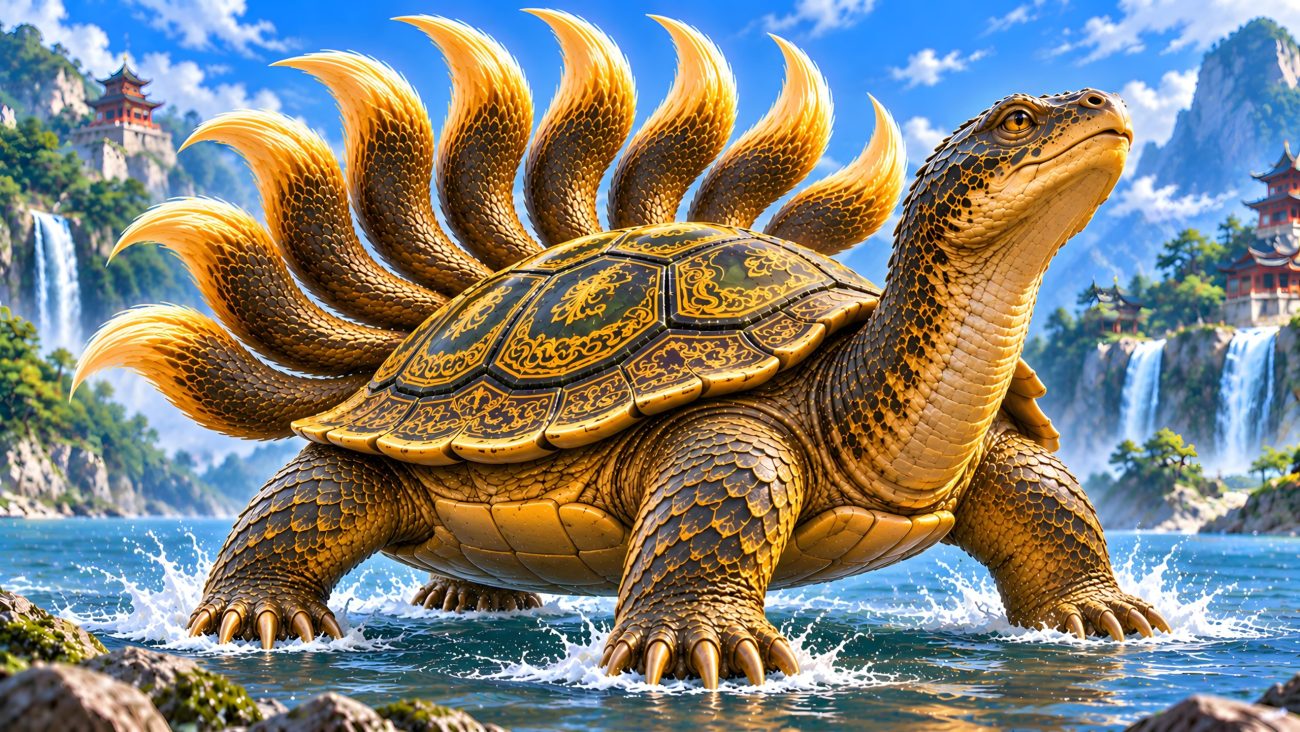
    The Jiǔwěi Guī is a supernatural turtle from Chinese folklore, described as being over one chi in diameter and possessing nine tails.

    According to a tale recorded by Lu Can in the Gengbian, a man named Wang, known as the Butcher, and his son encountered a fisherman carrying a huge turtle. They bought it and placed it beneath a pillar, intending to cook it into soup. A merchant from Jiangxi recognised the creature as a sacred Nine-Tailed Turtle and offered to buy it. To prove its identity, he stepped on its shell, revealing four small tails on each side in addition to its main tail.

    Wang refused to sell the turtle, and he and his son cooked and ate it. That night, a great flood surged inland from the sea, covering the land with water three feet deep. When the waters receded, the merchant visited Wang’s home and found only their clothes and bedding. The father and son had disappeared. People believed that the spirits of the underwater realm had taken them away and killed them.


    Sources

    “九尾龟 (Nine-Tailed Turtle).” Chinese Wikipedia. Wikimedia Foundation. https://zh.wikipedia.org/wiki/%E4%B9%9D%E5%B0%BE%E9%BE%9C


    Zhubieyu

    Tradition: Chinese Mythology
    Alternative Names: Pearl Turtle, 珠鳖鱼
    Category: Turtle


    The Myth

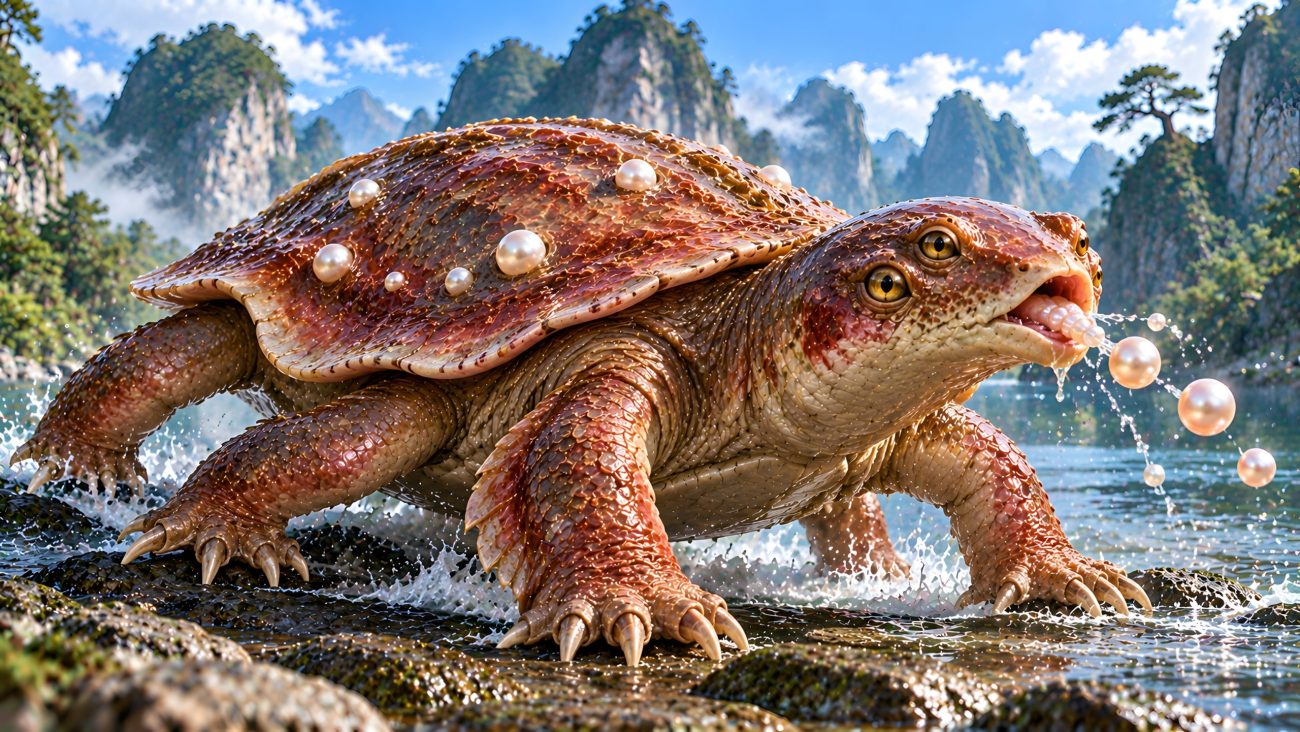
    The Zhubieyu is an unusual aquatic creature found in the Li River and Yu Lake near Vine Mountain in Chinese tradition. It resembles a lung or a piece of dried meat, with four eyes and six legs. The creature contains pearls and can spit them out. Its flesh tastes both sweet and sour.

    The Zhubieyu is considered a delicacy, and eating it is believed to protect against seasonal epidemics and furunculosis. The scholar Guo Pu described these creatures as “floating lungs” embodying Heaven, Earth, and humanity, remarking on the irony that their usefulness leads to their capture and consumption.

    The Zhubieyu is thought to resemble a softshell turtle, sometimes described as a red or pearled softshell.


    Sources

    “Zhubieyu.” A Book of Creatures, July 17, 2015. https://abookofcreatures.com/2015/07/17/zhubieyu/