Genbu

Tradition: Chinese Mythology, Japanese Mythology
Alternative Names: 玄武, Xuanwu, Black Tortoise, Black Warrior, Genbu
Category: Turtle


The Myth

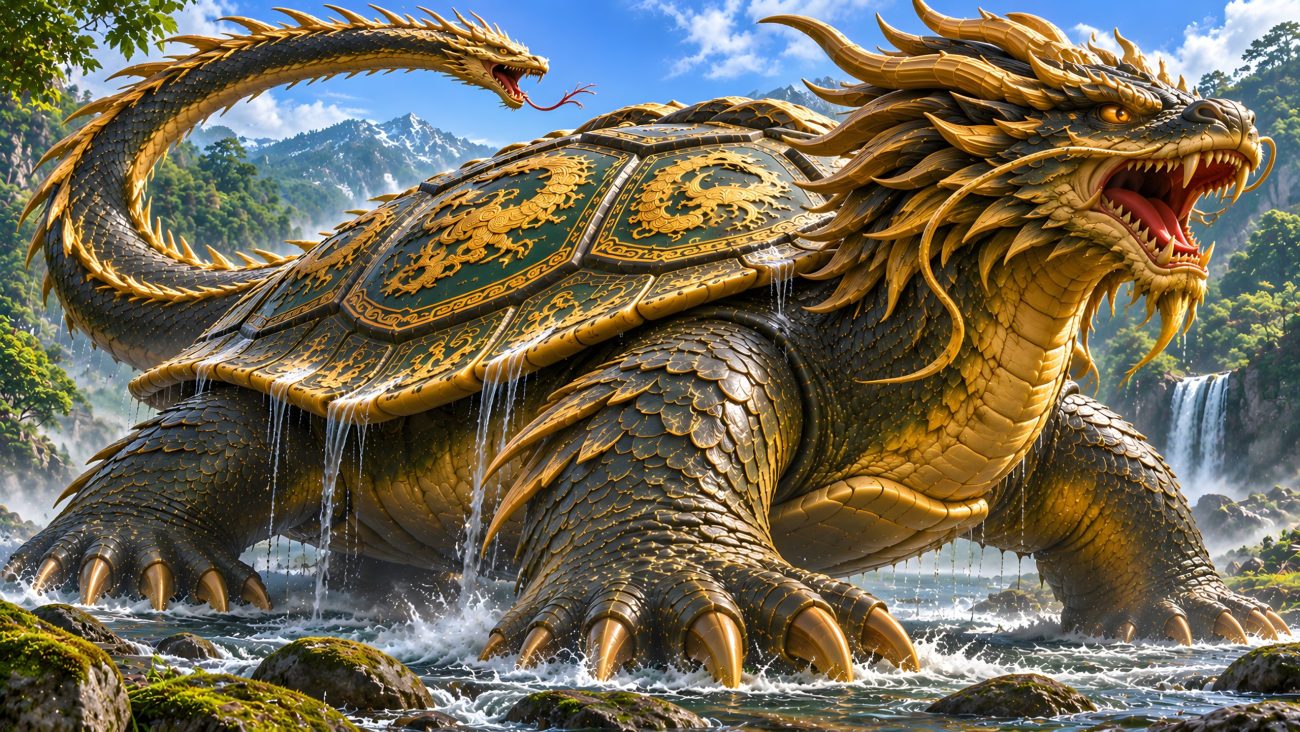
Genbu is one of the Four Symbols, the four sacred creatures that guard the cardinal directions in Chinese cosmology. It protects the north and is associated with the element of water and the season of winter. Genbu is usually depicted as a large tortoise entwined with a serpent, or as a creature whose tail takes the form of a snake.

The creature’s name combines gen, meaning black, with bu, associated with martial strength or armour. Ancient Chinese texts describe Genbu as a northern deity connected with water. The tortoise and serpent became linked in traditional explanations of the creature, including the belief that the serpent represented the tortoise’s male counterpart. However, some sources use Genbu simply as another name for a tortoise.

Together with the Azure Dragon of the east, the White Tiger of the west, and the Vermilion Bird of the south, Genbu became an important symbol of direction and protection. Through the transmission of Chinese culture to Japan, it also appeared in Japanese paintings, decorative objects, and other artistic traditions.


Sources

“Genbu (Xuanwu).” 新版TYZ 妖怪図鑑 (New TYZ Yokai Encyclopedia). https://tyz-yokai.blog.jp/archives/1085334207.html

    Umibōzu

    Tradition: Japanese Mythology
    Alternative Names: 海坊主, Sea Monk
    Category: Turtle


    The Myth

    The Umibōzu is a sea-dwelling yokai found in coastal folklore throughout Japan. It is usually described as a gigantic, pitch-black humanoid creature that rises from the ocean and can capsize ships. Some accounts describe it as reaching heights of around 30 metres. It is also regarded as an omen of misfortune.

    Descriptions of the Umibōzu vary by region. The Saikai Zokudan describes it as having a turtle’s body and a human face, identifying it with the Chinese Heshangyu. In Kesennuma, Miyagi Prefecture, it was said to transform into a beautiful woman and challenge men rowing boats at night to a swimming contest. In Uwajima, Ehime Prefecture, a tale tells of an Umibōzu that disguised itself as a masseur and killed a hunter’s wife.

    In some regions, the Umibōzu appears like a ship ghost and asks sailors to lend it a ladle. Anyone who hands one over risks having the creature scoop seawater into the boat until it sinks. To survive, sailors must give it a ladle with a hole in the bottom, preventing it from filling the vessel.

    Although the Umibōzu is usually associated with disaster, not every tradition considers it harmful. In Nakajima, Ehime Prefecture, it was believed that anyone who saw one would enjoy a long life. Japanese illustrations frequently depict it as a black humanoid rising from the waves, sometimes with fin-like features.


    Sources

    “Umibōzu.” 新版TYZ 妖怪図鑑 (New TYZ Yokai Encyclopedia). https://tyz-yokai.blog.jp/archives/1010652604.html


    Sai

    Tradition: Japanese Mythology
    Alternative Names: 犀, Water Rhinoceros, Suixi
    Category: Turtle


    The Myth

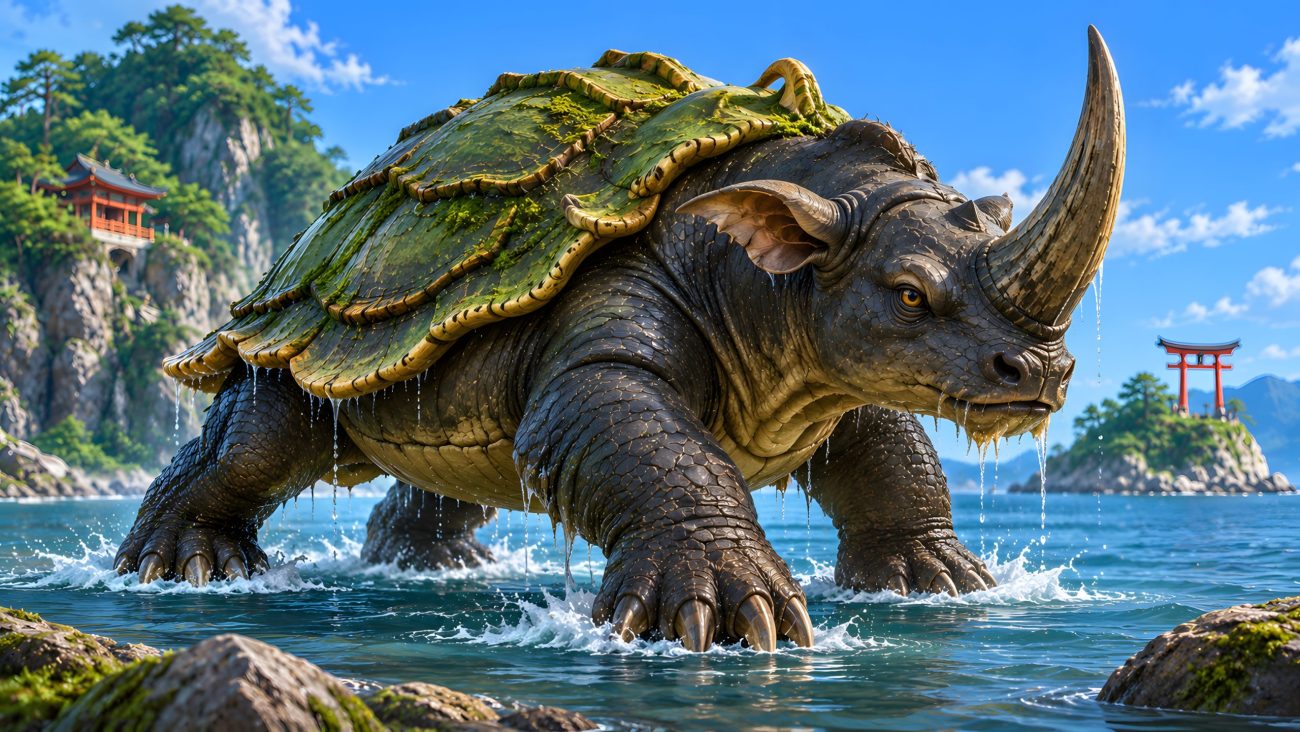
    The Sai is a legendary rhinoceros depicted in traditional Japanese art as a water-dwelling beast with the body of a water buffalo, hooves, a large horn on its head, and a shell covering its back. It was regarded as a sacred creature believed to ward off fires. Its image appeared in temple and shrine carvings, as well as in traditional paintings and illustrated scrolls. Rhinoceros horn was also valued for medicinal purposes, contributing to the reverence surrounding its depictions.

    Chinese texts distinguished between three kinds of rhinoceros: the mountain rhinoceros, which lived in forests; the water rhinoceros, which entered and left the water and was described as having a beaded shell on its back; and the female rhinoceros, which was said to possess a single horn. The water rhinoceros was particularly associated with the sacred, fire-protecting creature depicted in Japanese art.

    A tale from Sado Kaidan Moshio-gusa tells of a farmer in Ogawa Village on Sado Island whose bull repeatedly disappeared at night. The farmer secretly followed it to the coast, where it met a strange, bull-like beast with a single horn on its forehead that leapt from the sea. The two fought with their horns for hours, but neither could win. Believing that his bull’s tail was preventing victory, the farmer cut it off. The following night, the one-horned beast threw the bull several jō through the air, causing it to strike a rock and die. The creature then returned to the sea, leaving the farmer to realise that his intervention had been mistaken.


    Sources

    “Rhino.” 新版TYZ 妖怪図鑑 (New TYZ Yokai Encyclopedia). https://tyz-yokai.blog.jp/archives/1079588568.html


    Kinki

    Tradition: Japanese Mythology
    Alternative Names: 金亀, Golden Turtle
    Category: Turtle


    The Myth

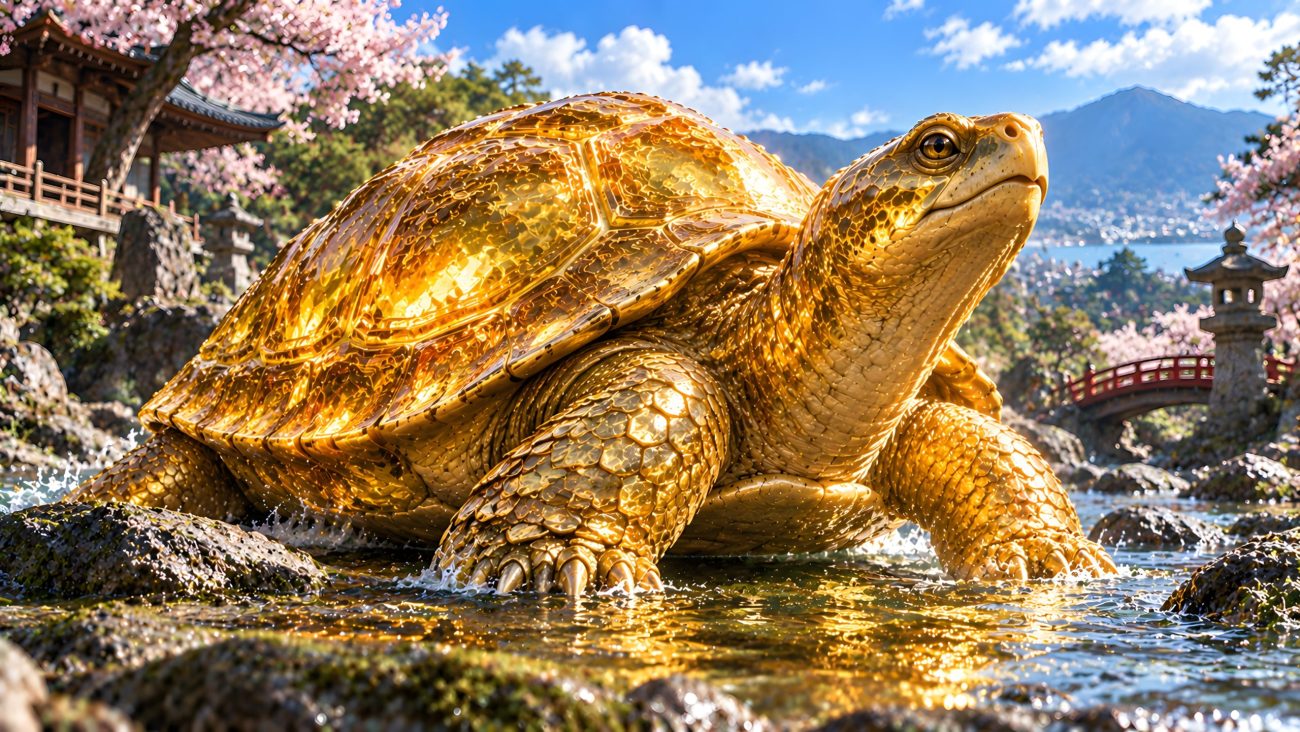
    The Kinki is a mysterious golden turtle reportedly discovered in Kōjimachi, Tokyo, in August 1880. It was found by a pet dog belonging to Shib a Shōzō. The dog had a habit of bringing stones to its owner when hungry, but on this occasion it dropped a turtle instead. The creature was approximately four sun in diameter, with a beautiful, translucent golden shell. It was placed in water to keep it alive and later donated to a museum.

    A follow-up report in the Tōkyō Nichinichi Shimbun in October 1880 described a dream in which a small turtle appeared beside a person’s pillow and lamented that, had it emerged fifteen or sixteen years earlier, it might have been celebrated as a Kinki and become the inspiration for a new Japanese era name.

    The story refers to the historical belief that extraordinary turtles could be regarded as auspicious omens. Rare turtles presented to the imperial court had previously been associated with era names such as Reiki (715–717) and Hōki (770–781).


    Sources

    “Golden Turtle.” 新版TYZ 妖怪図鑑 (New TYZ Yokai Encyclopedia). https://tyz-yokai.blog.jp/archives/1074264664.html


    Oketsu

    Tradition: Japanese Mythology
    Alternative Names: オケツ
    Category: Turtle


    The Myth

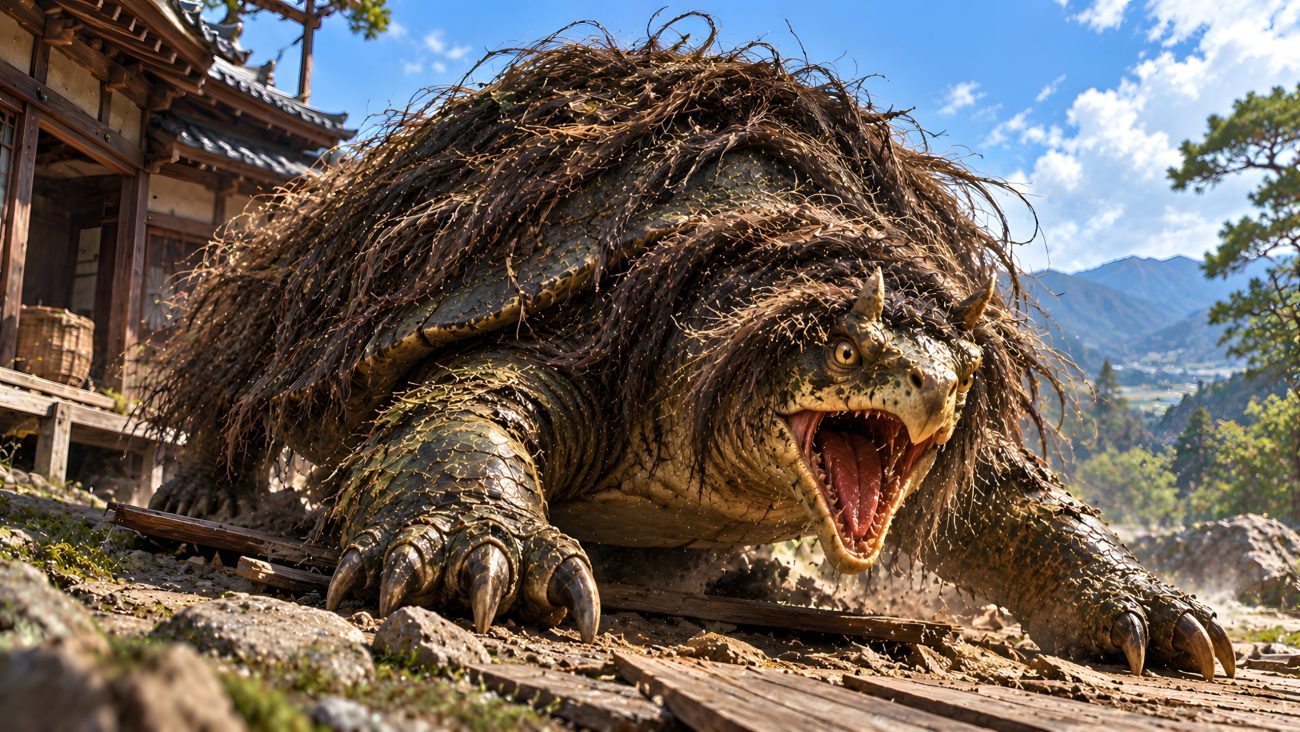
    The Oketsu is a monstrous creature from folklore in Okayama Prefecture, Japan, particularly around Okayama City. It is said to sometimes be born during childbirth if proper precautions are not taken. It resembles a turtle with shaggy hair growing across its back and immediately attempts to crawl beneath the floor after birth. If it is not killed quickly, it hides beneath the birthing woman’s bed and kills her.

    One tale tells of a woman from Oda District who gave birth to an Oketsu resembling a horned demon. It rushed beneath the floor as soon as it emerged. Another woman from the same district gave birth to an Oketsu in the form of a small snake. When those present attempted to kill it, the creature begged to be spared until the fifth month. It was kept in a box and continued growing larger as the days passed. When the appointed month arrived, a loud noise was heard during a heavy rainstorm, and the snake had mysteriously disappeared.


    Sources

    “Oketsu.” 新版TYZ 妖怪図鑑 (New TYZ Yokai Encyclopedia). https://tyz-yokai.blog.jp/archives/1067313183.html


    Suppon

    Tradition: Japanese Mythology
    Alternative Names: Suppon, 泥亀, Softshell Turtle
    Category: Turtle


    The Myth

    The Suppon, or Japanese softshell turtle, was regarded as a supernatural creature in various parts of Japan. It was sometimes associated with the Kappa and was believed in places such as Kyoto and Hyōgo to drag people underwater. The Suppon was also known for its vengeful nature, and many tales describe it taking revenge on those who mistreated it.

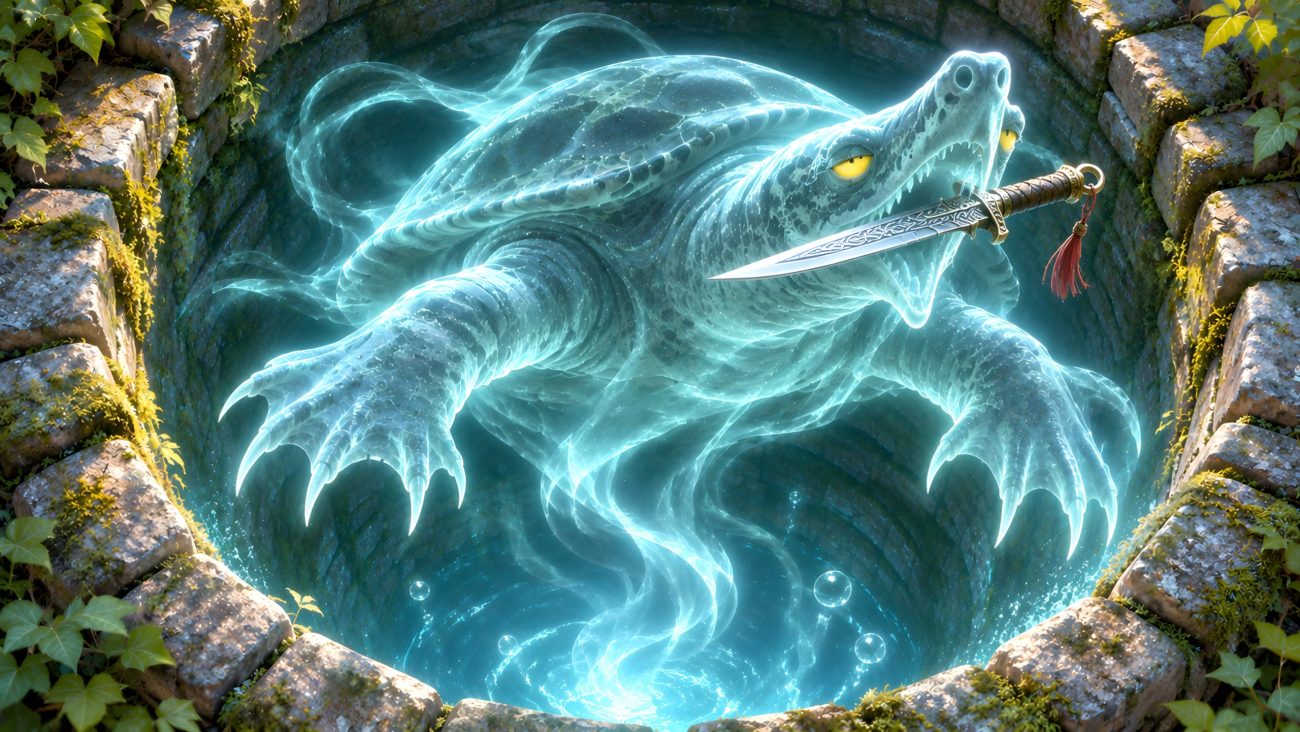
    One story tells of a turtle seller in Sakai, Senshū, who accidentally dropped his knife into a well while preparing to butcher a Suppon. He jokingly promised to spare its life if it retrieved the knife. The turtle descended into the well and returned with the knife in its mouth. However, the man immediately broke his promise and cut off its head. The severed head clamped onto his neck and refused to let go, eventually biting him to death.

    Another tale tells of Seisuke, a man from Yōida village in Tajima, who caught a large Suppon during the Tenmei era. While attempting to kill it near a temple pond, he dropped his knife into the water and promised to spare the turtle if it retrieved the weapon. The Suppon returned with the knife, but Seisuke killed it anyway and held a drinking feast with its meat. During the meal, he felt something caught in his throat, which developed into severe pain. After nine days, he died raving mad.


    Sources

    “Suppon.” 新版TYZ 妖怪図鑑 (New TYZ Yokai Encyclopedia). https://tyz-yokai.blog.jp/archives/1010654250.html


    Kimyōja

    Tradition: Japanese Mythology
    Alternative Names: 奇妙蛇, Strange Snake, Deformed Snake
    Category: Turtle


    The Myth

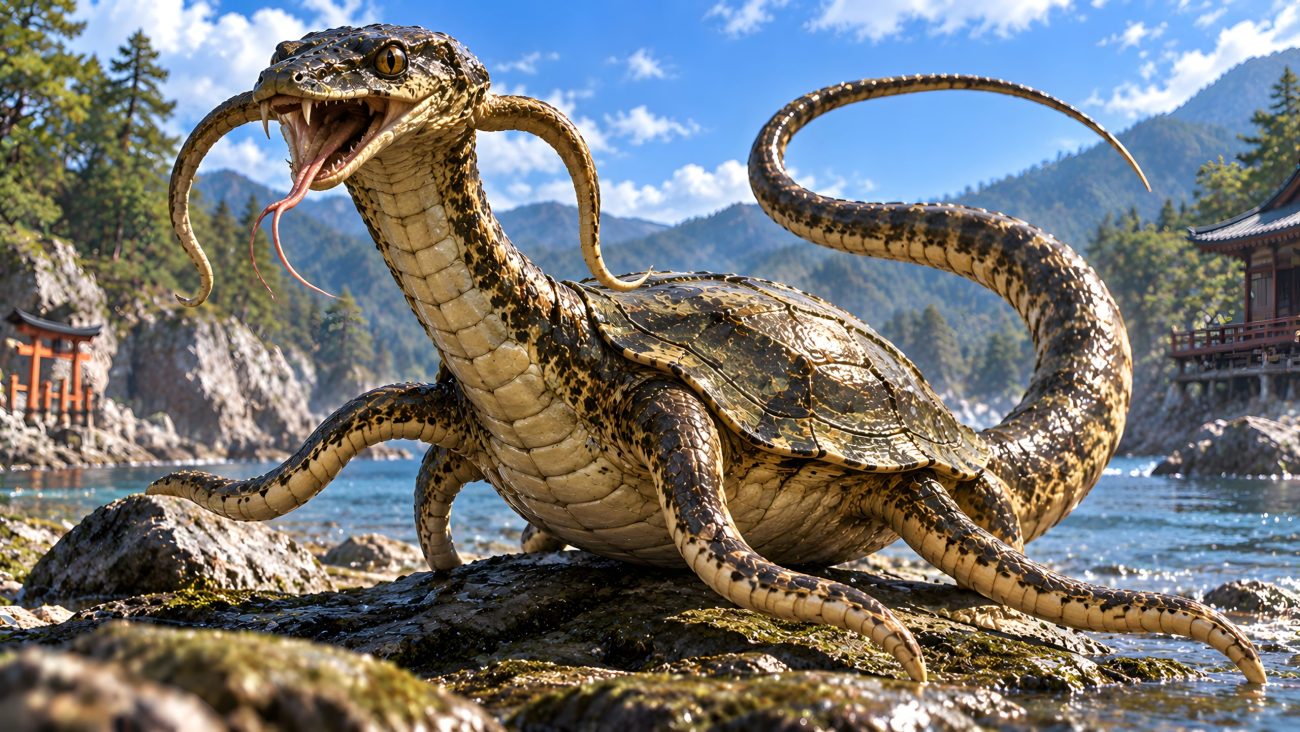
    The Kimyōja was a strange snake captured in 1906 in Shichigahama Village, Miyagi District, Miyagi Prefecture, Japan, by a man named Kan tarō Satō. Its body measured approximately two inches long and one inch wide, while its tail measured seven inches. It was covered in snake scales, and the undersides of its body and tail had the segmented appearance of a snake’s belly.

    The creature had unusual appendages: tail-like growths on both sides of its neck and additional limb-like tails extending from either side of its body. Local residents speculated that it might be a hybrid between a softshell turtle and a snake. Newspaper reports stated that it remained alive after being captured. The creature was reported under different headlines, including “Kimyōja” in Shin Aichi, “Deformed Animal” in the Yomiuri Shimbun, and “Strange-Shaped Snake” in the San’in Shimbun.


    Sources

    “Kimyoja.” 新版TYZ 妖怪図鑑 (New TYZ Yokai Encyclopedia). https://tyz-yokai.blog.jp/archives/1010654251.html


    Shōgorō

    Tradition: Japanese Mythology
    Alternative Names: 鉦五郎, Gong-goro, Ghost Gong
    Category: Turtle


    The Myth

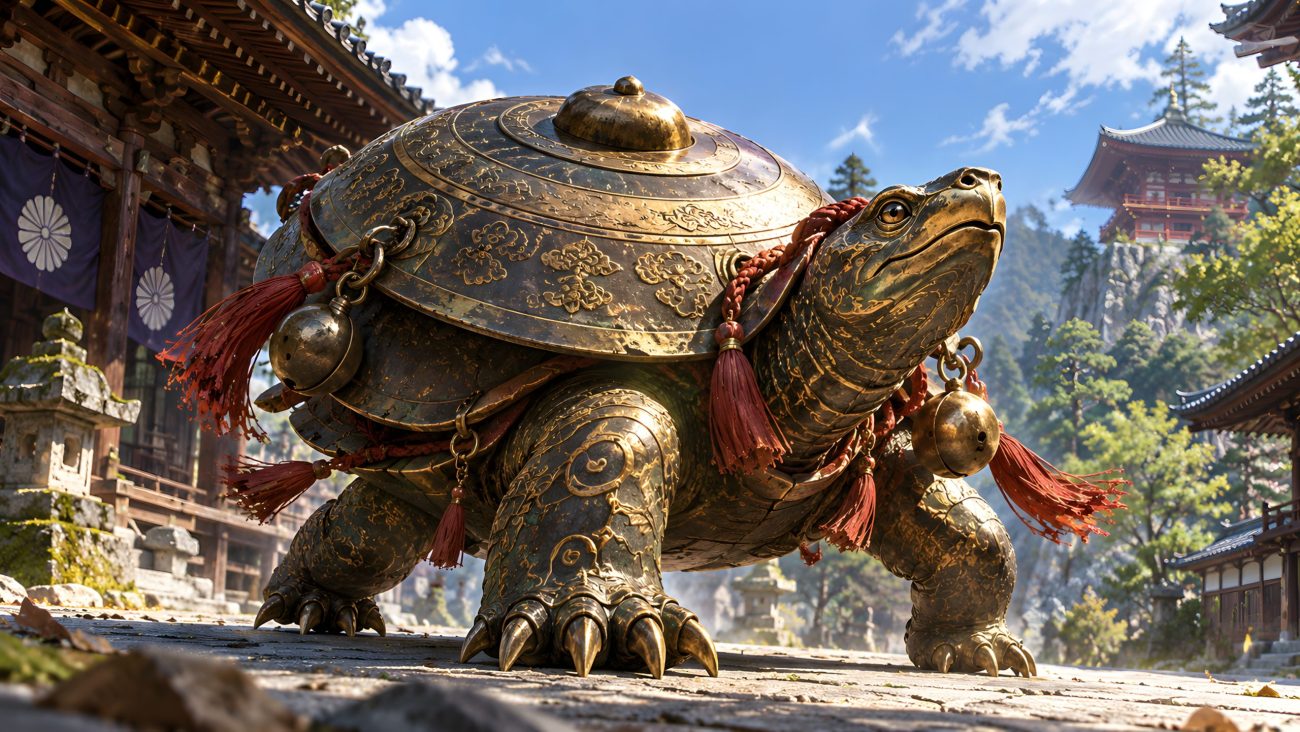
    The Shōgorō is a type of tsukumogami, a spirit inhabiting an old household object. It forms when a neglected Buddhist gong called a shōgo, a small, bowl-shaped metal instrument struck with a mallet during religious services, becomes old and worn. The Shōgorō resembles a metal turtle and wanders around at night, striking its body and ringing out its notes. It is generally harmless, although its nighttime noises can disturb people’s sleep.

    The creature’s name combines shōgo, meaning gong, with gorō, a common element in boys’ names. It can also be interpreted as a combination of shōgo and goryō, referring to the ghost of a noble or aristocrat.

    One legend connects the Shōgorō to Yodoya Tatsugorō, a wealthy Osaka merchant whose family fortune was confiscated by shogunate officials in the early eighteenth century. Tatsugorō lost his possessions, including his beloved golden chicken, and died from grief. Unable to pass on, his spirit attempted to attach itself to the golden chicken but became confused by the similar Japanese readings of “gong” and “golden.” Instead, it entered a nearby Buddhist gong, which became a Shōgorō.


    Sources

    “Shōgorō.” Yokai.com. https://yokai.com/shougorou/