Tradition: Japanese Mythology
Alternative Names: 鉦五郎, Gong-goro, Ghost Gong
Category: Turtle
The Myth
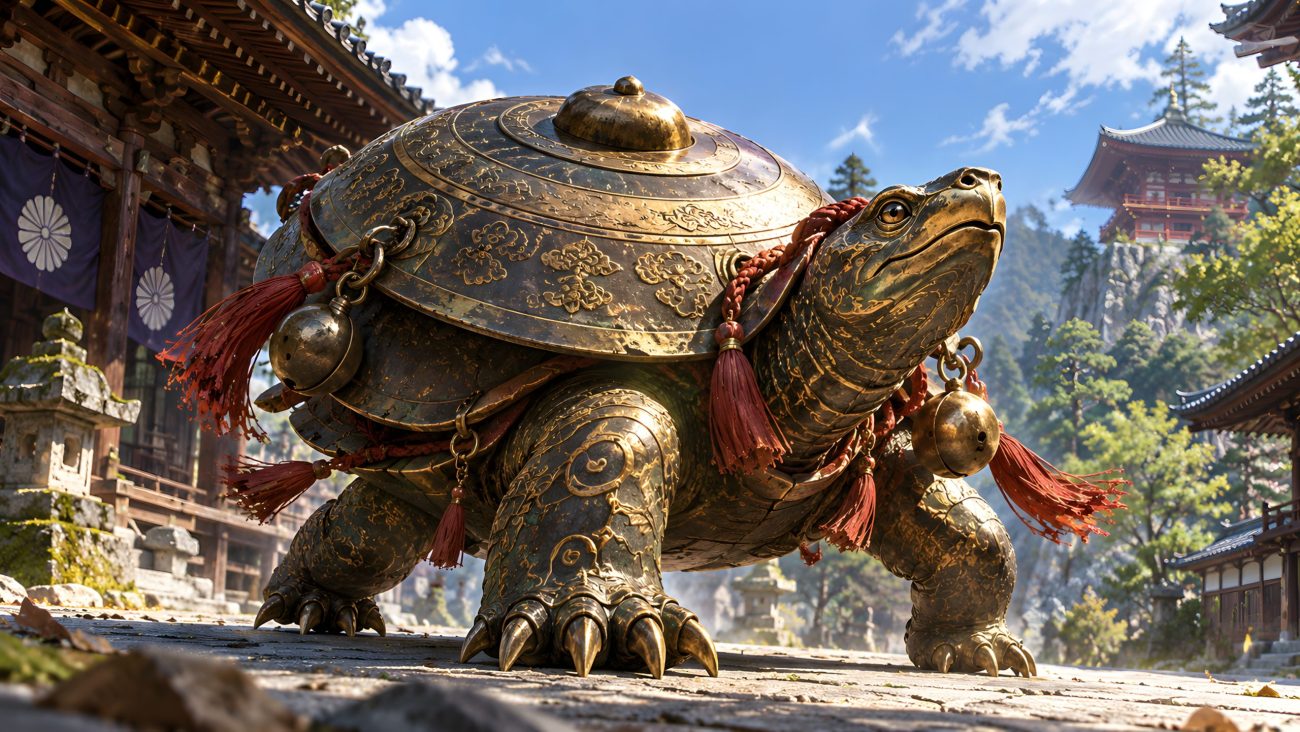
The Shōgorō is a type of tsukumogami, a spirit inhabiting an old household object. It forms when a neglected Buddhist gong called a shōgo, a small, bowl-shaped metal instrument struck with a mallet during religious services, becomes old and worn. The Shōgorō resembles a metal turtle and wanders around at night, striking its body and ringing out its notes. It is generally harmless, although its nighttime noises can disturb people’s sleep.
The creature’s name combines shōgo, meaning gong, with gorō, a common element in boys’ names. It can also be interpreted as a combination of shōgo and goryō, referring to the ghost of a noble or aristocrat.
One legend connects the Shōgorō to Yodoya Tatsugorō, a wealthy Osaka merchant whose family fortune was confiscated by shogunate officials in the early eighteenth century. Tatsugorō lost his possessions, including his beloved golden chicken, and died from grief. Unable to pass on, his spirit attempted to attach itself to the golden chicken but became confused by the similar Japanese readings of “gong” and “golden.” Instead, it entered a nearby Buddhist gong, which became a Shōgorō.
Sources
“Shōgorō.” Yokai.com. https://yokai.com/shougorou/