Garyō

Tradition: Chinese mythology
Alternative Names: Garyō, Drawing the Dragon and Dotting Its Eyes
Category: Dragon


The Myth

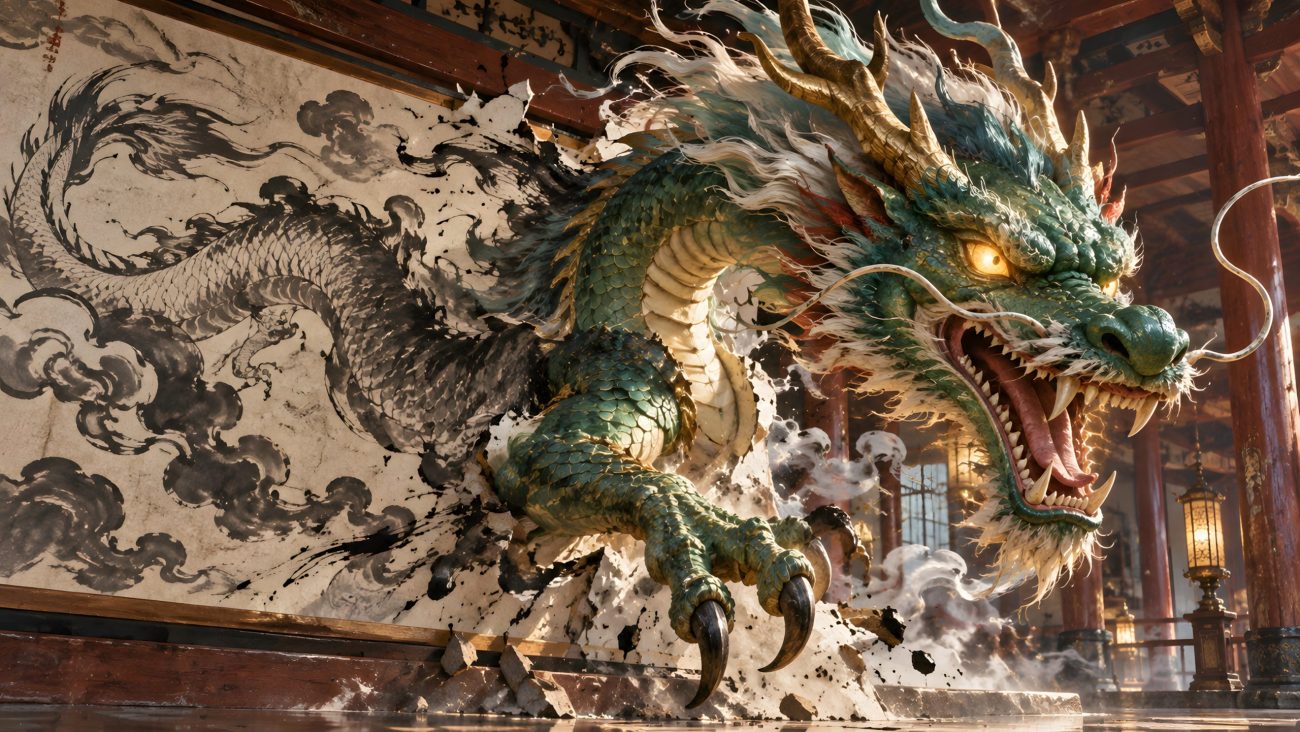
The Garyō is a dragon depicted in painted form, but one capable of becoming a living creature when its eyes are completed. Its most important feature is therefore the eyes: without them, the painted dragon remains motionless on the wall, but once they are added, the dragon can awaken and fly into heaven.

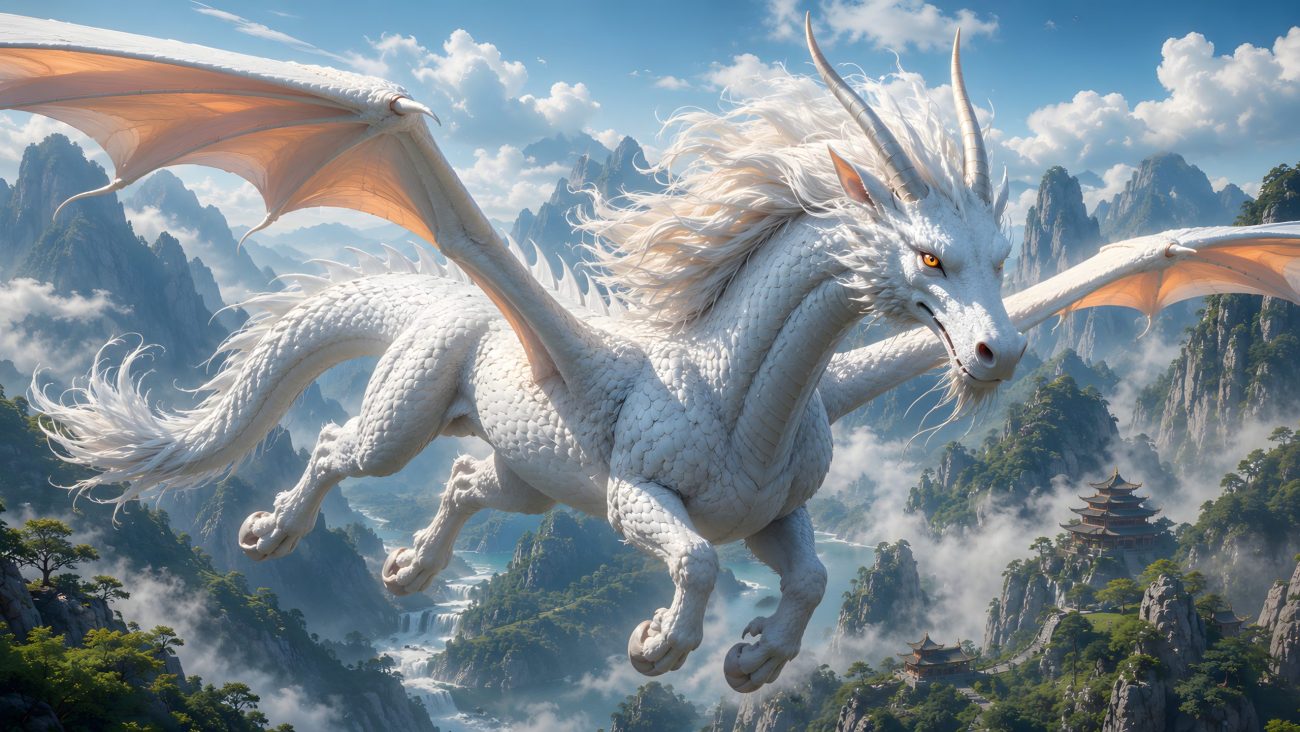
The story comes from the famous painter Zhang Sengyao of the Liang dynasty. When the Anle Temple in Jinling was being decorated, Zhang painted four white dragons upon its walls. Yet he deliberately left their eyes unfinished.

When people asked why, Zhang warned them that painting in the eyes would cause the dragons to fly away. They dismissed his warning as nonsense and insisted that he complete the paintings.

At last, Zhang took up his brush and dotted the eyes of two of the dragons. At that very moment, thunder and lightning erupted, the wall was broken apart, and the two dragons sprang from the painting and ascended into heaven upon the clouds.

The other two dragons remained upon the wall, still without eyes. They had been left untouched, and so the temple retained two dragons that never came to life.

From this tale came the expression of “drawing the dragon and dotting its eyes,” referring to the crucial final touch that brings an otherwise incomplete work to completion.


Sources

Takahashi, Toshihiro. “臥竜 [がりょう] (Garyō).” 新版TYZ 妖怪図鑑 (New TYZ Yokai Encyclopedia). October 21, 2024. https://tyz-yokai.blog.jp/archives/1083003608.html
Daryū

Tradition: Chinese mythology
Alternative Names: Daryū, Daryu, Dajilong, Dōnglóng, Amadatsu, Crocodile Dragon, 鼉龍
Category: Dragon, Crocodile


The Myth

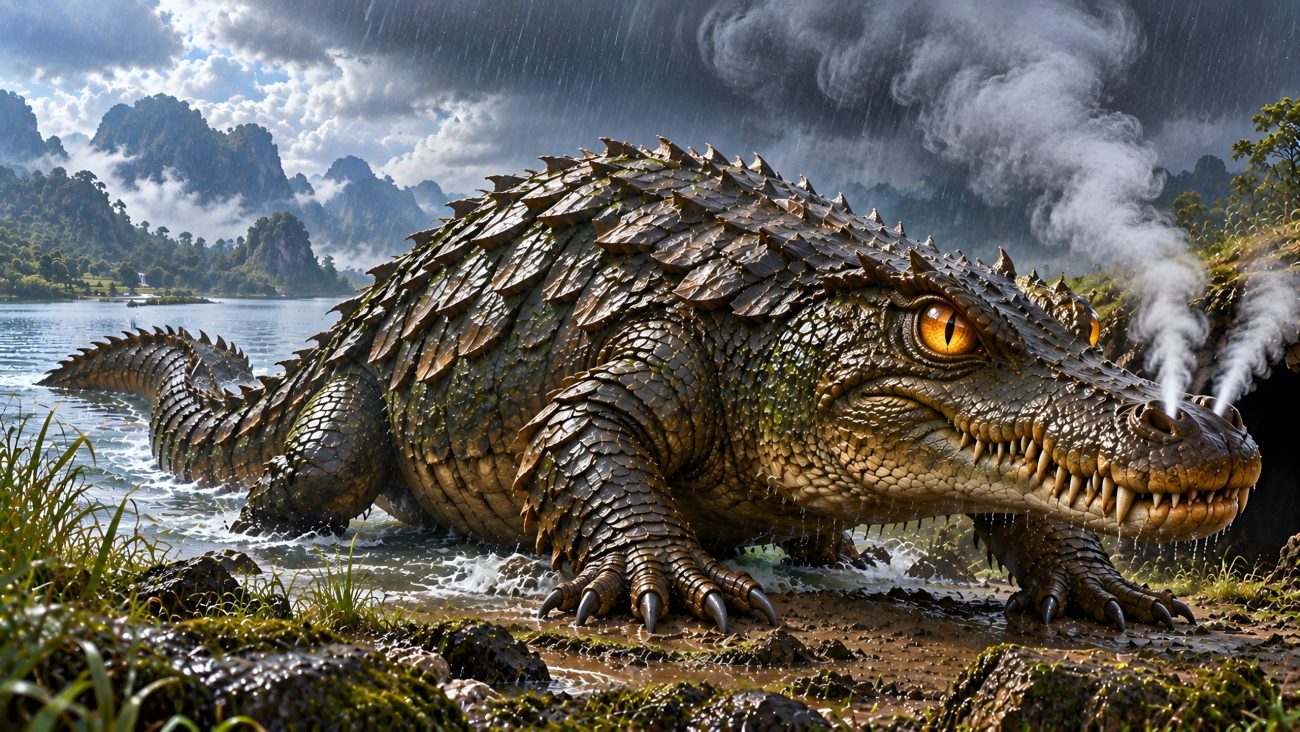
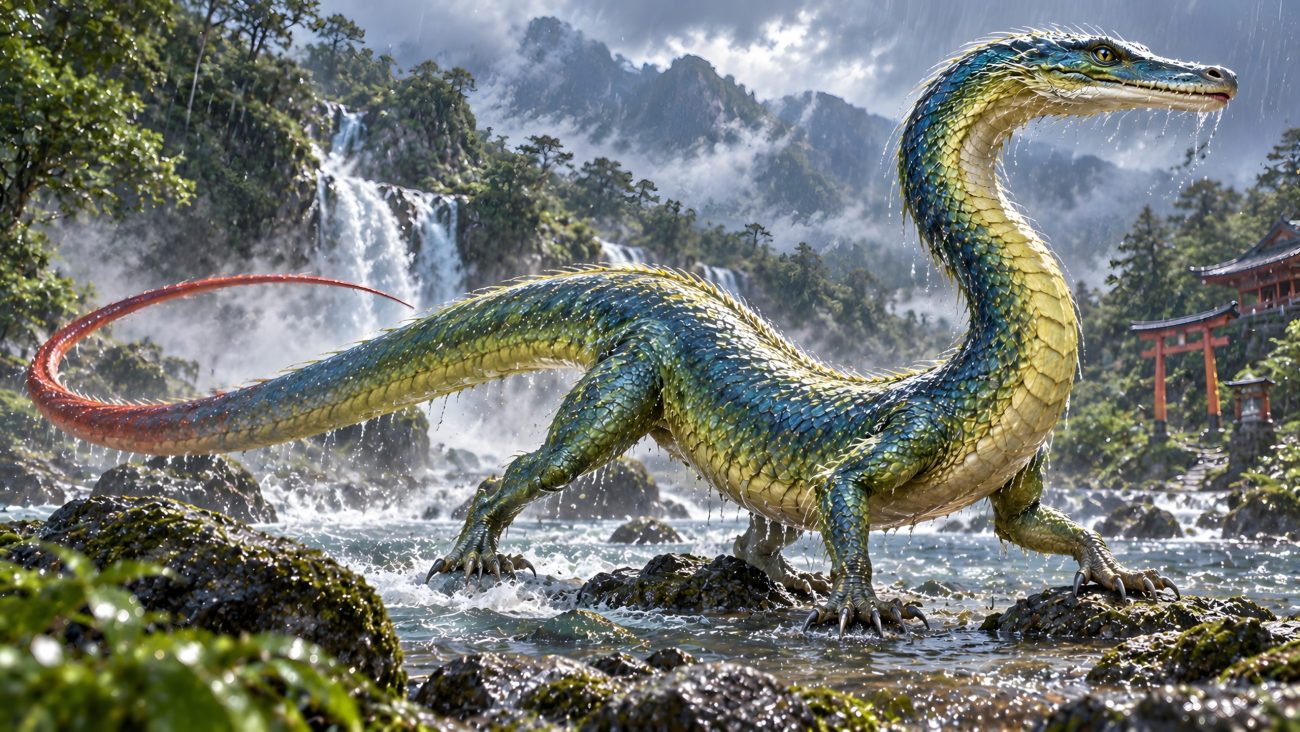
The Daryū is a type of dragon resembling a gigantic crocodile or other heavily scaled reptile. It is about one to two zhang long and has a sturdy body covered in hard scales. Its shape has been compared to a gecko or pangolin. Despite its great strength, it is said to be fond of sleeping and spends much of its time with its eyes closed.

The Daryū lives around the rivers and lakes of China, particularly the Yangtze River and Dongting Lake. Its burrows are said to extend extremely deep into the earth, making it difficult for fishermen to capture. They lure the creature from its burrow with bait before dragging it out with hooks.

At night the Daryū produces a terrifying cry that frightens sailors. This sound was known as the “Daryū drum” and was regarded as a sign by which rain could be predicted. The creature itself was also believed to possess the power to exhale air that formed clouds and brought rain.

Its hard scales or shell were believed to possess supernatural powers. They could be used to cure women’s diseases and were also considered effective against various evil spirits.

The Daryū was not merely a creature of Chinese books. In the southern Japanese islands, crocodile-like animals were sometimes reported under the name Daryū. On Amami Ōshima they were known locally as Amadatsu. On one occasion, people from Sumiyo village succeeded in capturing one. Although they feared that the creature was poisonous, they boiled and ate its flesh and found it remarkably delicious.

Another account describes a gigantic crocodile captured on Amami Ōshima in 1800, measuring around six metres in length. It was caught in a net and beaten by the islanders, and was depicted as a huge, hornless dragon.

Stories from the Satsunan Islands also tell of a fierce dragon appearing in the waters around Iwo Jima. Unlike the sleepy Daryū of Chinese descriptions, this creature was dangerous and would attack anyone it encountered, making it a source of fear among the islanders.

The Daryū was sometimes treated alongside other hornless rain dragons such as the Chiryū. Both were associated with rainfall and could be represented as enormous crocodile-like creatures.


Sources

Takahashi, Toshihiro. “地竜 [ちりゅう] (Chiryū).” 新版TYZ 妖怪図鑑 (New TYZ Yokai Encyclopedia). October 21, 2024. https://tyz-yokai.blog.jp/archives/1082955065.html


Chiryū

Tradition: Chinese mythology, Japanese mythology
Alternative Names: Chiryū, Chi Long, Chi, Ri, Amariyō, Amariyū, Rain Dragon, 螭龍
Category: Dragon


The Myth

The Chiryū is a type of dragon without horns. It is described as red, white, blue, or yellowish-blue in color, with a long, slender tail. Some Japanese descriptions compare it to a mizuchi, but without horns, while others say that it resembles a large lizard.

The Chiryū was known in Japan through Chinese writings and was identified with the Rain Dragon, a dragon associated with bringing rain, as well as with the mizuchi, a dragon-serpent associated with watersides. Its lack of horns was considered one of its defining characteristics.

Chinese descriptions distinguish the Chiryū from other kinds of dragons according to their physical features. Scaled dragons are called Jiaolong, winged dragons are Yinglong, horned dragons are Qiulong, while dragons without horns are Chiryū.

In Japan, the Chiryū became known by the name Amariyō or Amariyū, meaning Rain Dragon. It was described as belonging to the dragon family, without horns, with a long thin tail and a body sometimes compared to that of a large lizard.

Because of its lizard-like appearance and its characteristic lack of horns, foreign reptiles displayed in Japan were sometimes casually described as “children of the Chiryū.”


Sources

Takahashi, Toshihiro. “地竜 [ちりゅう] (Chiryū).” 新版TYZ 妖怪図鑑 (New TYZ Yokai Encyclopedia). October 21, 2024. https://tyz-yokai.blog.jp/archives/1082955065.html


Jiao

Tradition: Chinese mythology
Alternative Names: Jiao, Jiaolong, 蛟, 潜蛟
Category: Dragon


The Myth

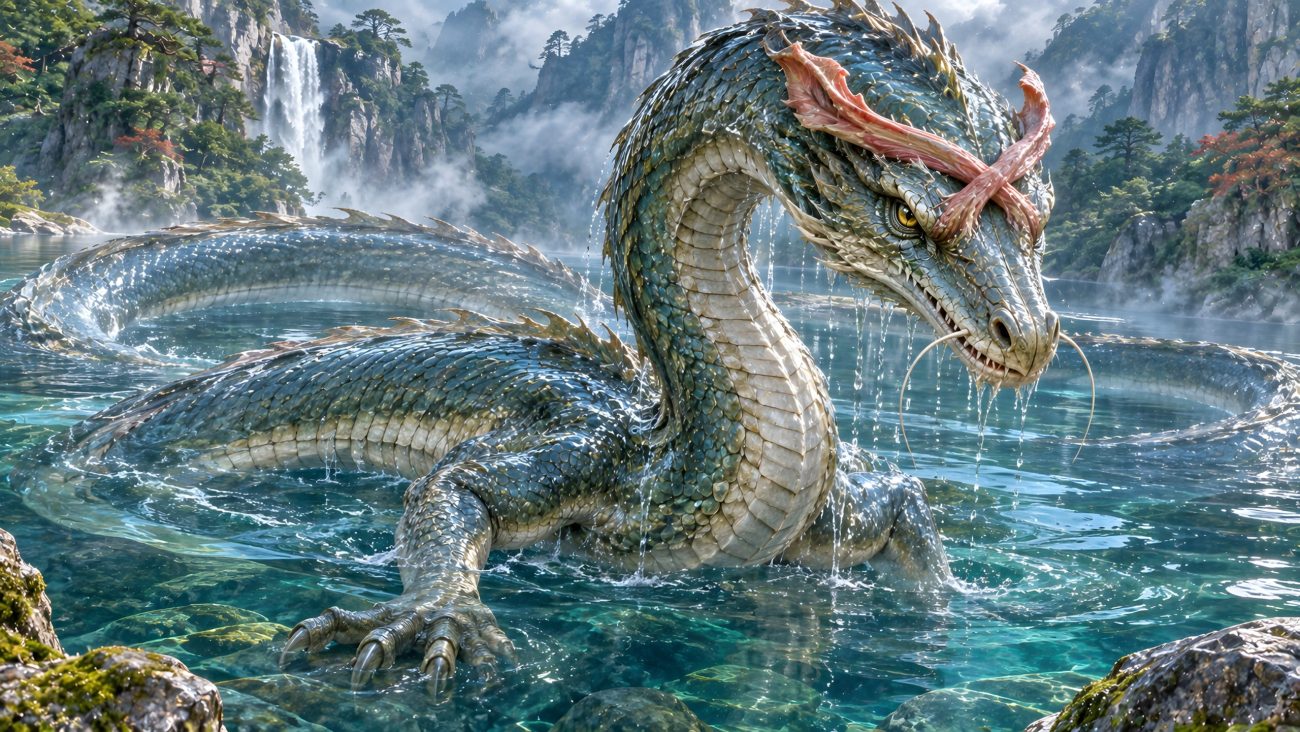
Jiao is a powerful aquatic creature resembling a dragon, but with shorter horns or sometimes no horns at all. It has protruding fleshy structures between and above the eyes. It is generally described as having a snake-like body and four legs, with some traditions describing it as having a dragon’s head and a snake’s body. Its voice is said to resemble the bellowing of a cow.

Jiao live in lakes, deep pools, ponds, and rivers, often hiding beneath the water or inside deep rocky caves. Those living secretly in ponds and rivers are sometimes called qianjiao, or “hidden jiao.”

Jiao are regarded as lesser beings among the dragon kind. According to one tradition, a snake can transform into a Jiao after five hundred years of cultivation, while a Jiao can transform into a dragon after another thousand years. Some traditions instead say that Jiao can become dragons after spending five hundred years hidden in cold waters and then ascend into heaven. Not every Jiao succeeds, however. Some eventually flow into the sea and become servants of the Dragon Kings, living within their underwater courts.

Jiao compete with one another for control of lakes and other bodies of water. Powerful Jiao can claim large and comfortable lakes, while weaker ones are forced to inhabit smaller ponds and rivers. They are also said to eat fish, causing losses for fishermen. According to one belief, placing a soft-shelled turtle among a school of fish will prevent a Jiao from approaching.

Jiao have a connection to rain and water, but their powers are weaker than those of true dragons and Dragon Kings. They possess only a limited ability to summon rain clouds and cannot control water as dragons do. Their spiritual power is said to be sufficient mainly to prevent the springs within their territory from drying up.

Some traditions distinguish different members of the Jiao kind according to their horns. A one-horned Jiao is called a Qiulong, a two-horned one a Qilong, while a hornless dragon is called a Panlong. The female Jiao is traditionally associated with the Panlong.

In the Qing-dynasty novel Ba Xian De Dao Zhuan, a Jiao dragon spirit becomes an enemy of Zhang Guolao. Their conflict continues throughout the story, and the Jiao dragon spirit is eventually killed by Zhongli Quan, the Thunder God, and the Lightning Goddess. After his death, his wife He Chunying seeks revenge for her husband and becomes an opponent of the Eight Immortals.


Sources

“蛟 (Jiāo; Flood Dragon).” Chinese Wikipedia. Wikimedia Foundation. Accessed September 19, 2026. https://zh.wikipedia.org/wiki/%E8%9B%9F


Jidiao

Tradition: Chinese mythology
Alternative Names: Jidiao, 吉弔
Category: Dragon, Turtle


The Myth

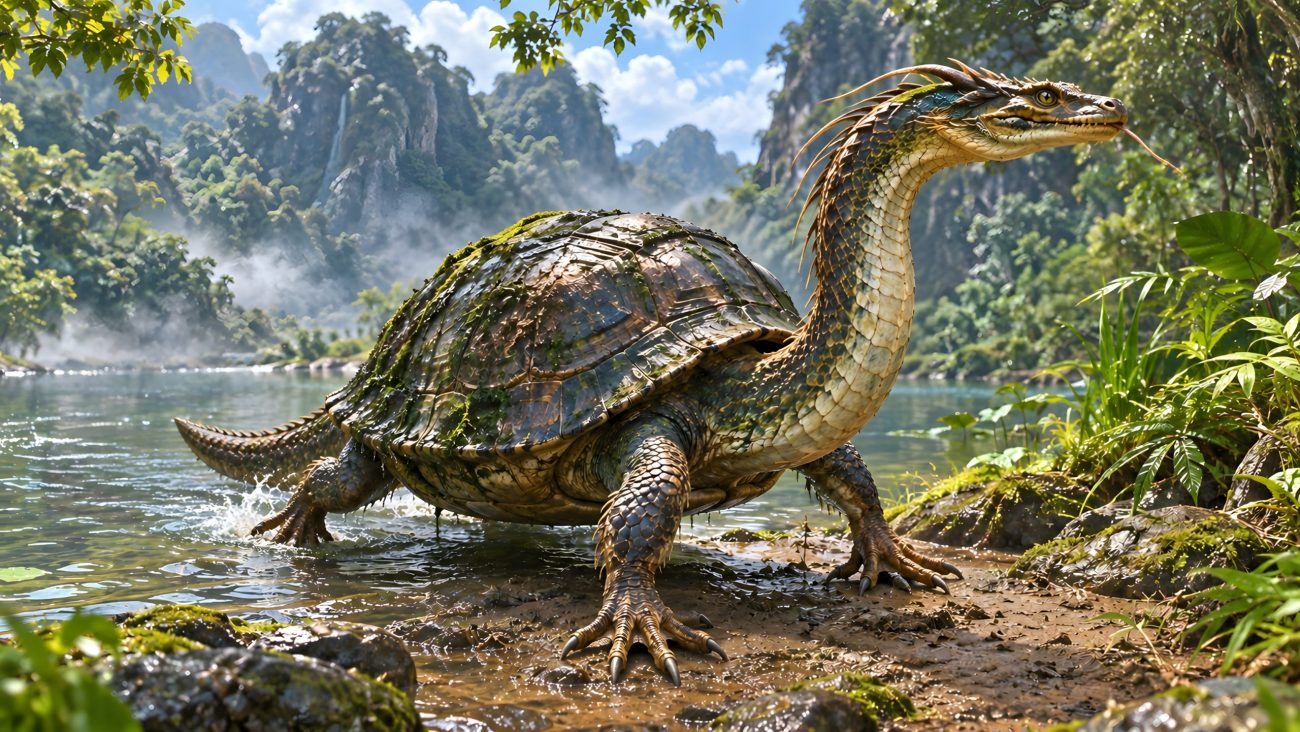
Jidiao has the body and shell of a turtle, but its head resembles that of a dragon or snake. Its legs resemble the feet of a bird, with four toes. It is an aquatic creature, though it can also live among trees.

Jidiao is said to live in southern China, particularly around Guangdong and Guangxi, and in areas near the border with Vietnam. It inhabits places near water as well as forests.

According to one tradition, when a dragon lays eggs, it produces two eggs. One hatches into a dragon, while the other becomes a Jidiao. Another account says that a dragon produces three eggs, one of which becomes a Jidiao.

The Jidiao has an unusually long head and tail, so that they cannot both be withdrawn completely into its turtle shell.

Ancient accounts also describe a special fat or oil obtained from the Jidiao. This substance was said to be extremely light and capable of penetrating materials more effectively than clarified butter. It was collected in containers, with eggshells said to be the only vessels that would not allow it to leak through. The fat was used medicinally against poisonous swellings and injuries caused by leeches.


Sources

“吉弔 (Jídiào).” Chinese Wikipedia. Wikimedia Foundation. Accessed September 19, 2026. https://zh.wikipedia.org/wiki/%E5%90%89%E5%BC%94


Bái Lóngmǎ

Tradition / Region: Chinese Mythology
Alternative names: White Dragon Horse, Jade Dragon, Yì Mǎ (Will Horse)
Category: Horse, Dragon


The Myth

The White Dragon Horse was originally the third son of Ao Run, the Dragon King of the Western Sea. After accidentally burning a sacred pearl bestowed by the Jade Emperor, he was sentenced to death. Guanyin Bodhisattva intervened, sparing his life and instructing him to wait at Eagle Sorrow Gorge for the monk Tang Sanzang, whose pilgrimage to India would become his path to redemption.

Before recognizing the monk, the dragon emerged from the river and devoured Tang Sanzang’s white horse. Guanyin then revealed his true purpose and ordered him to transform into a white horse to replace the one he had eaten. After shedding his dragon horns and scales, he became Tang Sanzang’s faithful mount, carrying the monk throughout the long journey to obtain the Buddhist scriptures.

Unlike Sun Wukong, Zhu Bajie, and Sha Wujing, the White Dragon Horse rarely fought. He quietly endured the hardships of the journey, serving with unwavering loyalty while transporting his master across mountains, rivers, and deserts.

His greatest act of heroism came when Tang Sanzang was captured by the Yellow-Robed Demon after Sun Wukong had been dismissed from the pilgrimage. Realizing that the entire quest would fail if he remained passive, the White Dragon Horse cast off his saddle, transformed back into his dragon form, and infiltrated the demon’s palace disguised as a palace maid. Although he was defeated and wounded in battle, he escaped and urged Zhu Bajie to seek out Sun Wukong and beg him to return, leading to Tang Sanzang’s rescue.

After the successful completion of the pilgrimage and the return with the sacred scriptures, the Buddha rewarded the White Dragon Horse for his faithful service by elevating him to the rank of Guangli Bodhisattva of the Eight Heavenly Dragons. He then regained his true dragon form in the Dragon Transformation Pool and took his place among the celestial dragon guardians of the Buddhist paradise.


Sources

Wikipedia contributors. (n.d.). 白龙马. In 维基百科,自由的百科全书. Retrieved June 29, 2026, from https://zh.wikipedia.org/wiki/%E7%99%BD%E9%BE%99%E9%A9%AC