Lǘ Yāo

Tradition / Region: Chinese mythology
Alternative names: Donkey Monster, Donkey Demon, Donkey Ghost
Category: Horse


The Myth

Lǘ Yāo is a monstrous donkey spirit that appears in several collections of Chinese supernatural tales. Although its appearance varies between stories, it is consistently portrayed as a dangerous and uncanny creature capable of frightening or harming humans.

In the Miscellaneous Morsels from Youyang, a ghost resembling a blue donkey is briefly mentioned.

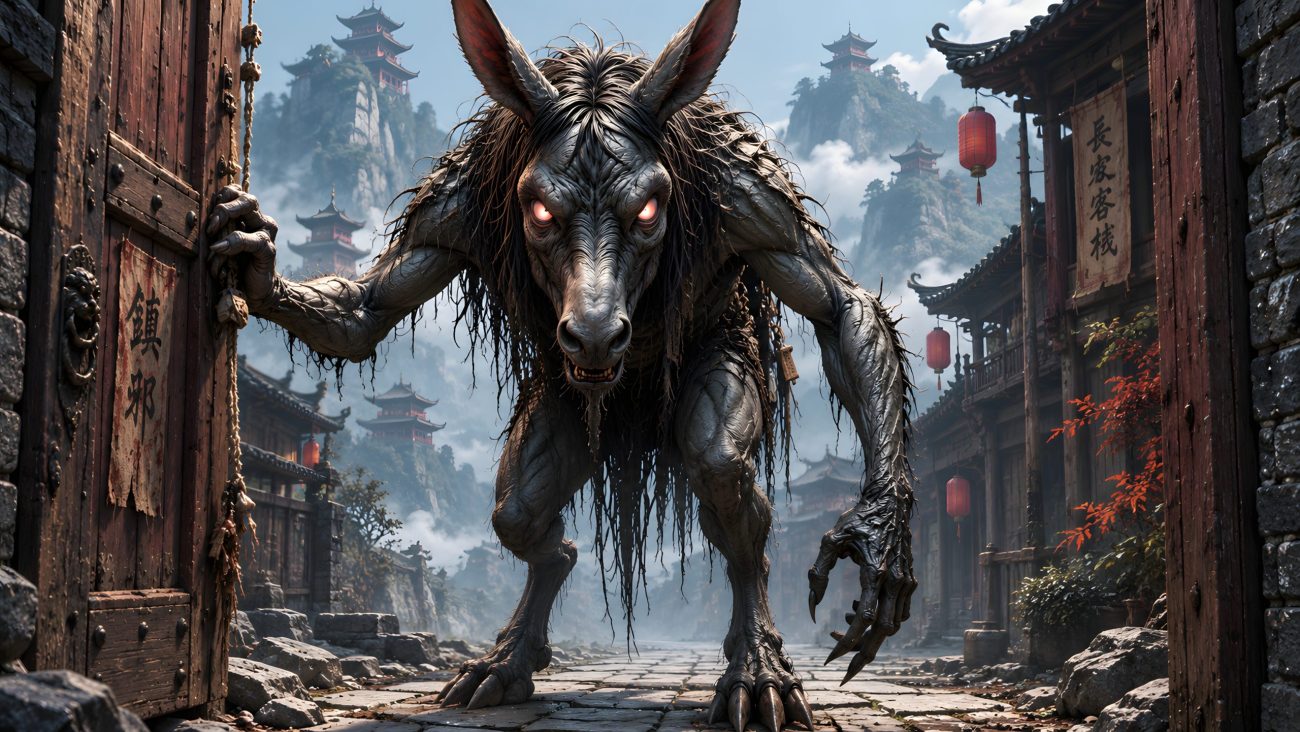
In the Xuanshi Zhi, Wang Xun and his companions were holding a banquet when a giant black, hairy arm suddenly reached into the room, demanding food. After repeatedly taking the offered meat, the arm was severed with a sword. Rather than a human limb, it proved to be the leg of a donkey. The following day, Wang Xun learned that a nearby man’s donkey had mysteriously lost one of its legs.

The Record of Examining the Gods, preserved in the Taiping Guangji, describes a donkey demon with human-like hands and feet but covered in long black hair. It wandered into towns at night searching for food, and wherever it appeared an unbearable stench filled the streets.

In the Qing dynasty tale The Revenge of the Donkey, a man named Huang Mingwu rode a black donkey that suddenly began to speak. The animal claimed to be the reincarnation of a man named Yuan San and declared that it had returned to take revenge on Huang Mingwu.

Another Qing dynasty account, Notes from the Right Terrace Immortal Pavilion, tells of a donkey demon haunting the Feng family. Their youngest son repeatedly fell ill and later described a long-eared, hairy figure that appeared beside his bed and forced mud into his mouth. The family concluded that a donkey demon was responsible. Although the Feng family was later destroyed during the Taiping Rebellion, the creature’s lair was said to remain, and it continued to appear from time to time.


Sources

Wikipedia contributors. (n.d.). 驴妖. In 维基百科,自由的百科全书. Retrieved June 29, 2026, from https://zh.wikipedia.org/wiki/%E9%A9%B4%E5%A6%96

Lu Shu

Tradition / Region: Chinese Mythology
Alternative names: Lushu
Category: Horse


The Myth

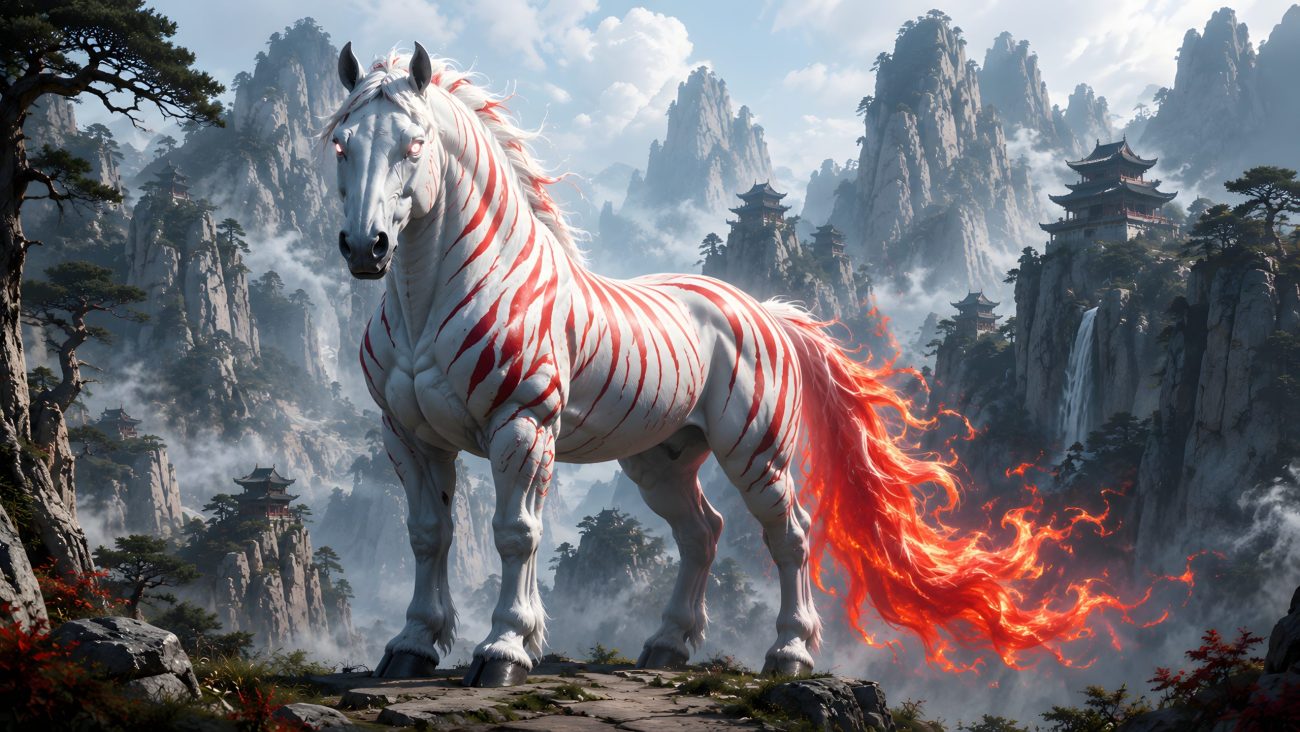
Lu Shu is a mythical beast described in the Classic of Mountains and Seas. It dwells on Mount Niuyang and resembles a horse, but has a white head, tiger-like stripes across its body, and a red tail. Its cry is said to sound like a song or ballad.

The creature is also described in the Taiping Yulan, which states that it travels in groups, raising its head and calling loudly as it leaps across the land.

According to the Classic of Mountains and Seas, wearing the hide of a Lu Shu brings good fortune to one’s descendants. The Taiping Yulan similarly states that wearing its fur ensures that one’s offspring will become as numerous as clouds.

Later tradition records that during the Chongzhen reign of the Ming dynasty, people in the Minnan region claimed to have seen the Lu Shu.


Sources

Wikipedia contributors. (n.d.). 鹿蜀. In 维基百科,自由的百科全书. Retrieved June 29, 2026, from https://zh.wikipedia.org/wiki/%E9%B9%BF%E8%9C%80


Qianlima

Tradition / Region: Chinese Mythology, Korean Mythology
Alternative names: Chollima (Korean), Cheollima (Korean), Senrima (Japanese), Thousand-li Horse
Category: Horse


The Myth

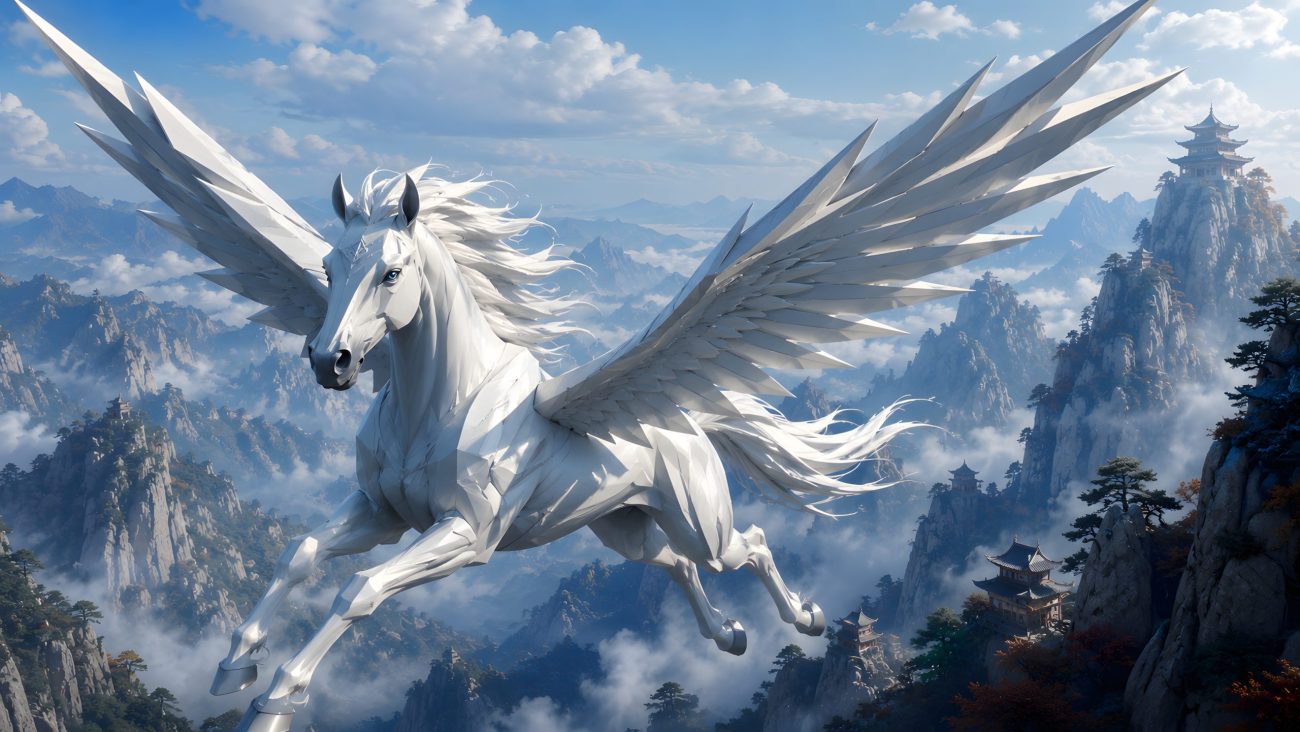
The Qianlima is a mythical winged horse in Chinese tradition renowned for its extraordinary speed and grace. It is said to be capable of traveling one thousand li in a single day, a distance of roughly four hundred kilometers, and is considered so swift and elegant that no mortal can ride it.

Beginning around the 3rd century BCE, the Qianlima became a powerful symbol in Chinese literature. It represented individuals of exceptional talent whose abilities had not yet been recognized. The legendary horse judge Bole was celebrated for his ability to identify a true Qianlima, making the horse a metaphor for gifted people discovered by a wise ruler.

The Qianlima also came to symbolize remarkable horses, including the famous Red Hare, whose speed and endurance embodied the qualities associated with the legendary steed.

Beyond China, the mythical horse became known throughout East Asia. In Korea it is called Chollima or Cheollima, where it became an important national symbol of North Korea and gave its name to the Chollima Movement.


Sources

Wikipedia contributors. (n.d.). Qianlima. In Wikipedia. Retrieved June 29, 2026, from https://en.wikipedia.org/wiki/Qianlima


Cán Nǚ

Tradition / Region: Chinese Mythology
Alternative names: Silkworm Goddess, Silkworm Horse Goddess
Category: Horse, Deity


The Myth

Cán Nǚ, the Silkworm Goddess, is a Chinese goddess associated with silkworms and the origin of silk. She is commonly depicted as a beautiful young woman riding a white horse and is especially revered in the legends of southern China.

According to the legend, during the reign of Emperor Ku, a young woman’s father left on a distant expedition. Longing for his safe return, she jokingly promised the family’s white stallion that she would marry it if it could bring her father home. The horse immediately broke free and galloped away. Several days later, it returned with her father, having fulfilled the impossible task.

When the father learned of his daughter’s promise, he feared the consequences. He killed the faithful horse, skinned it, and hung its hide in the courtyard. Later, while playing nearby, the girl mocked the horse’s hide for having wished to marry a human. Suddenly, the hide came to life, wrapped itself around her, and carried her away.

After several days, the girl’s family discovered her in a mulberry tree. The horse’s hide still enclosed her body, her head had taken on the appearance of a horse, and she was spinning fine silk from the branches. From that time onward, the strange insect became known as the silkworm, and the tree was called the mulberry.

Some time later, the girl’s parents saw her descend from the heavens on a cloud, attended by heavenly guards and riding a magnificent horse. She explained that because of her filial devotion and unwavering loyalty, the Heavenly Emperor had made her an immortal and granted her a place among the celestial beings. Assuring them that she now lived happily in Heaven, she departed once more.

In gratitude for the gift of silk, later generations worshipped her as the Silkworm Goddess. Temples dedicated to her were established in regions such as Sichuan and Jiangnan, where she was often portrayed as a beautiful maiden riding a white horse or as the Horse-Headed Goddess.


Sources

Wikipedia contributors. (n.d.). 蚕女. In 维基百科,自由的百科全书. Retrieved June 29, 2026, from https://zh.wikipedia.org/wiki/%E8%9A%95%E5%A5%B3


Bo

Tradition / Region: Chinese Mythology
Alternative names: Zibai
Category: Horse


The Myth

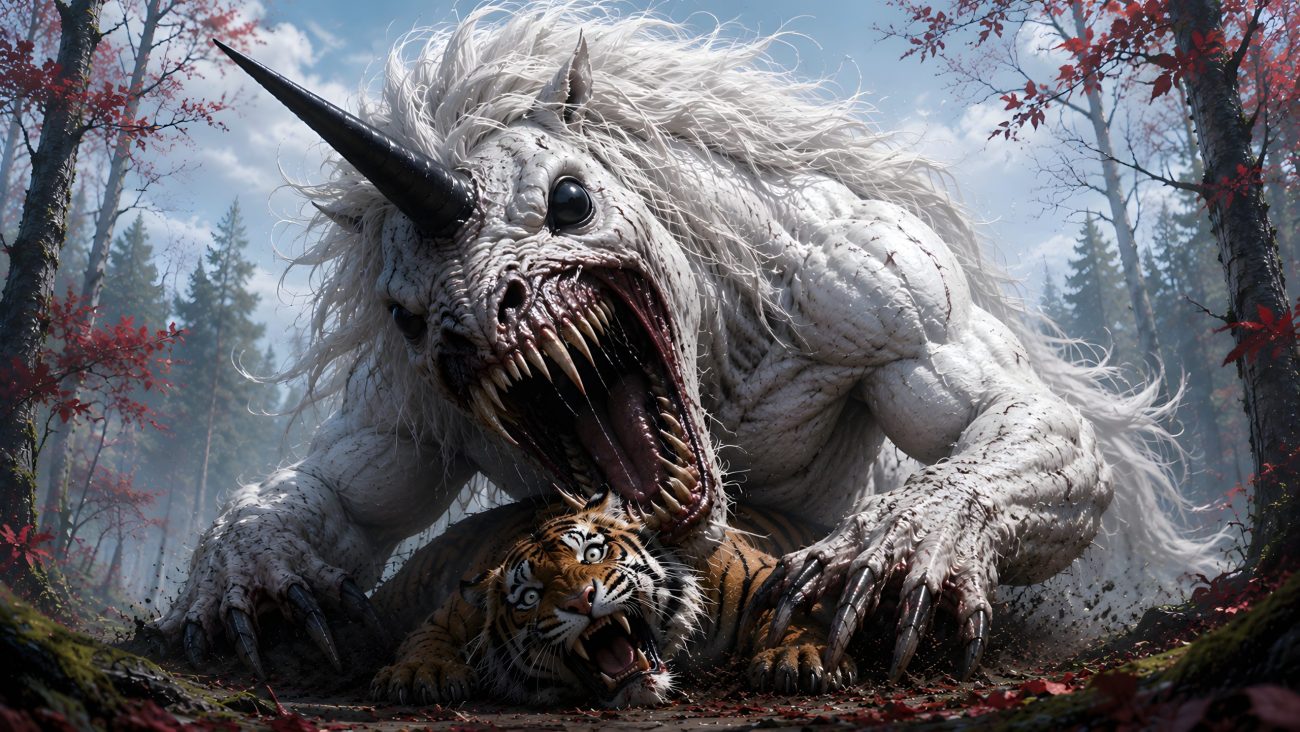
The Bo is a legendary beast recorded in the Classic of Mountains and Seas. It resembles a white horse with a black tail, a single horn on its head, tiger-like teeth, and sharp claws on all four feet. Its cry is said to sound like the beating of a drum.

Despite its horse-like appearance, the Bo is a fierce predator that hunts and devours tigers and leopards. Because of its extraordinary strength and fearsome nature, it was believed to possess the power to protect people from armies.

The Classic of Mountains and Seas places the creature on Mount Zhongqu, where it dwells among deposits of jade, gold, realgar, and white jade. Another passage also describes a similar white horse-like beast with saw-like teeth that preys upon tigers and leopards.

The Yi Zhou Shu refers to the same creature under the name Zibai, describing it as a white horse-like animal with saw-like teeth that feeds on tigers and leopards.

According to later folklore, the horn of the Bo resembled that of a rhinoceros and was believed to possess medicinal properties, particularly the ability to neutralize poison and cure illness.


Sources

Wikipedia contributors. (n.d.). . In 维基百科,自由的百科全书. Retrieved June 29, 2026, from https://zh.wikipedia.org/wiki/%E9%A7%AE


Bái Lóngmǎ

Tradition / Region: Chinese Mythology
Alternative names: White Dragon Horse, Jade Dragon, Yì Mǎ (Will Horse)
Category: Horse, Dragon


The Myth

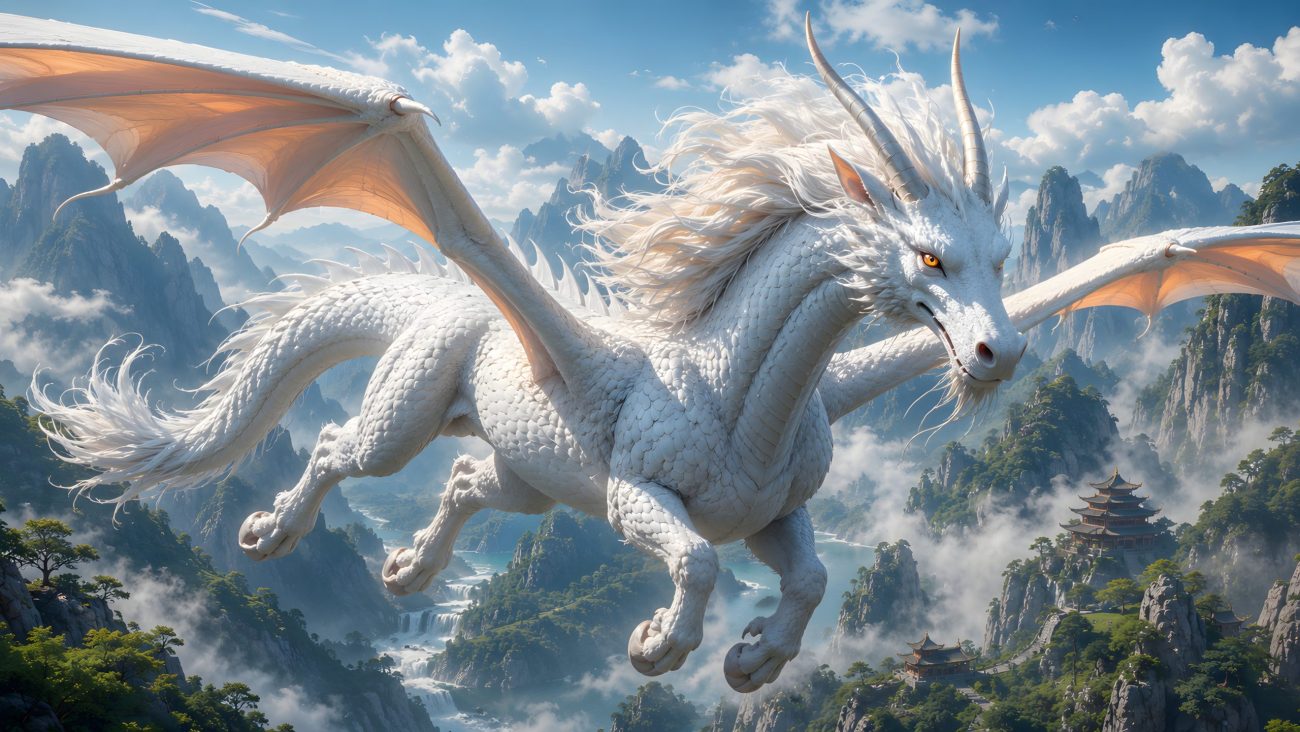
The White Dragon Horse was originally the third son of Ao Run, the Dragon King of the Western Sea. After accidentally burning a sacred pearl bestowed by the Jade Emperor, he was sentenced to death. Guanyin Bodhisattva intervened, sparing his life and instructing him to wait at Eagle Sorrow Gorge for the monk Tang Sanzang, whose pilgrimage to India would become his path to redemption.

Before recognizing the monk, the dragon emerged from the river and devoured Tang Sanzang’s white horse. Guanyin then revealed his true purpose and ordered him to transform into a white horse to replace the one he had eaten. After shedding his dragon horns and scales, he became Tang Sanzang’s faithful mount, carrying the monk throughout the long journey to obtain the Buddhist scriptures.

Unlike Sun Wukong, Zhu Bajie, and Sha Wujing, the White Dragon Horse rarely fought. He quietly endured the hardships of the journey, serving with unwavering loyalty while transporting his master across mountains, rivers, and deserts.

His greatest act of heroism came when Tang Sanzang was captured by the Yellow-Robed Demon after Sun Wukong had been dismissed from the pilgrimage. Realizing that the entire quest would fail if he remained passive, the White Dragon Horse cast off his saddle, transformed back into his dragon form, and infiltrated the demon’s palace disguised as a palace maid. Although he was defeated and wounded in battle, he escaped and urged Zhu Bajie to seek out Sun Wukong and beg him to return, leading to Tang Sanzang’s rescue.

After the successful completion of the pilgrimage and the return with the sacred scriptures, the Buddha rewarded the White Dragon Horse for his faithful service by elevating him to the rank of Guangli Bodhisattva of the Eight Heavenly Dragons. He then regained his true dragon form in the Dragon Transformation Pool and took his place among the celestial dragon guardians of the Buddhist paradise.


Sources

Wikipedia contributors. (n.d.). 白龙马. In 维基百科,自由的百科全书. Retrieved June 29, 2026, from https://zh.wikipedia.org/wiki/%E7%99%BD%E9%BE%99%E9%A9%AC


Jiliang

Tradition / Region: Chinese Mythology
Alternative name: Jiliang, Jiliang Horse, Jisi’s Chariot
Category: Horse


The Myth

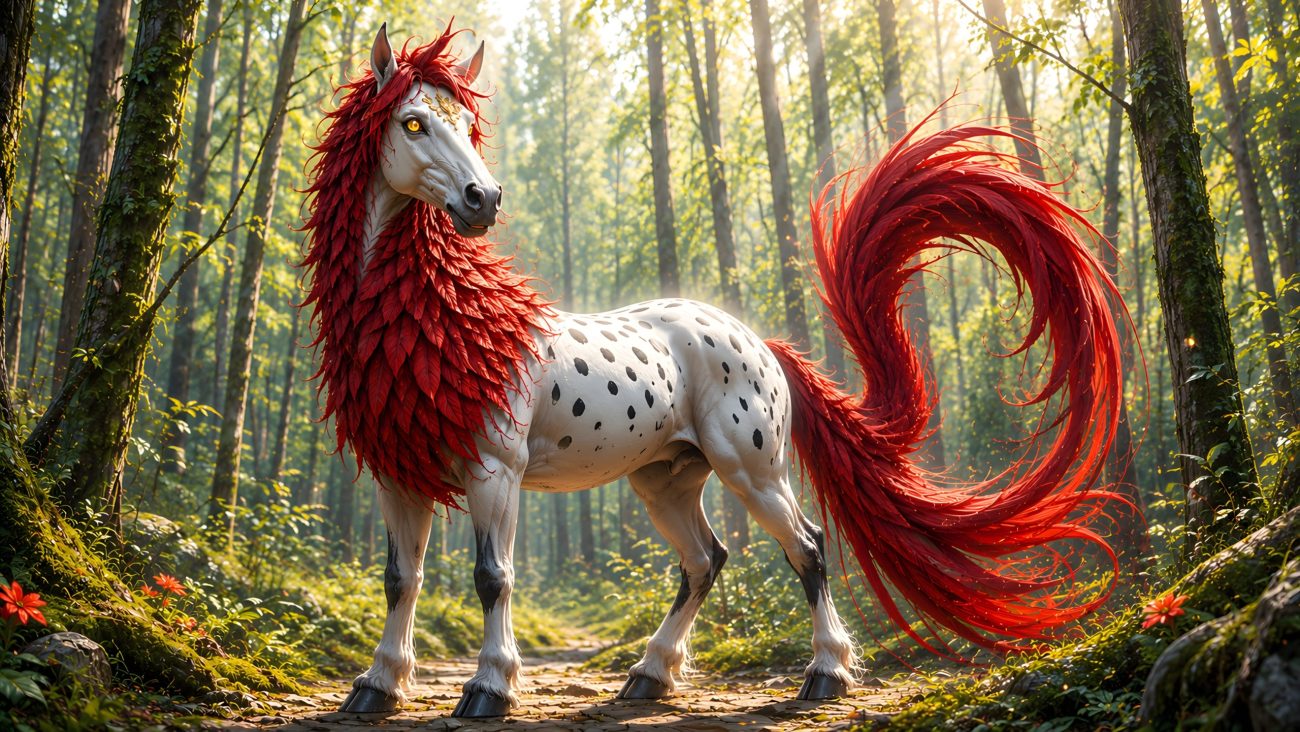
Jiliang is a divine horse described in the Classic of Mountains and Seas. It has a white or spotted white body, a red mane, golden eyes, and a long neck ending in feathers that resemble a rooster’s tail.

The horse is said to live in the Kingdom of Quanfeng. It is regarded as a supernatural steed whose greatest power is the gift of longevity. Anyone who rides Jiliang is granted a lifespan of one thousand years, making it one of the most auspicious mythical horses in Chinese mythology.


Sources

Wikipedia contributors. (n.d.). 吉量. In 维基百科,自由的百科全书. Retrieved June 29, 2026, from https://zh.wikipedia.org/wiki/%E5%90%89%E9%87%8F