Tradition: Chinese mythology
Alternative Names: Zhuyin, Torch Dragon, Torch Shade, Chuolong, Zhuolong
Category: Dragon
The Myth
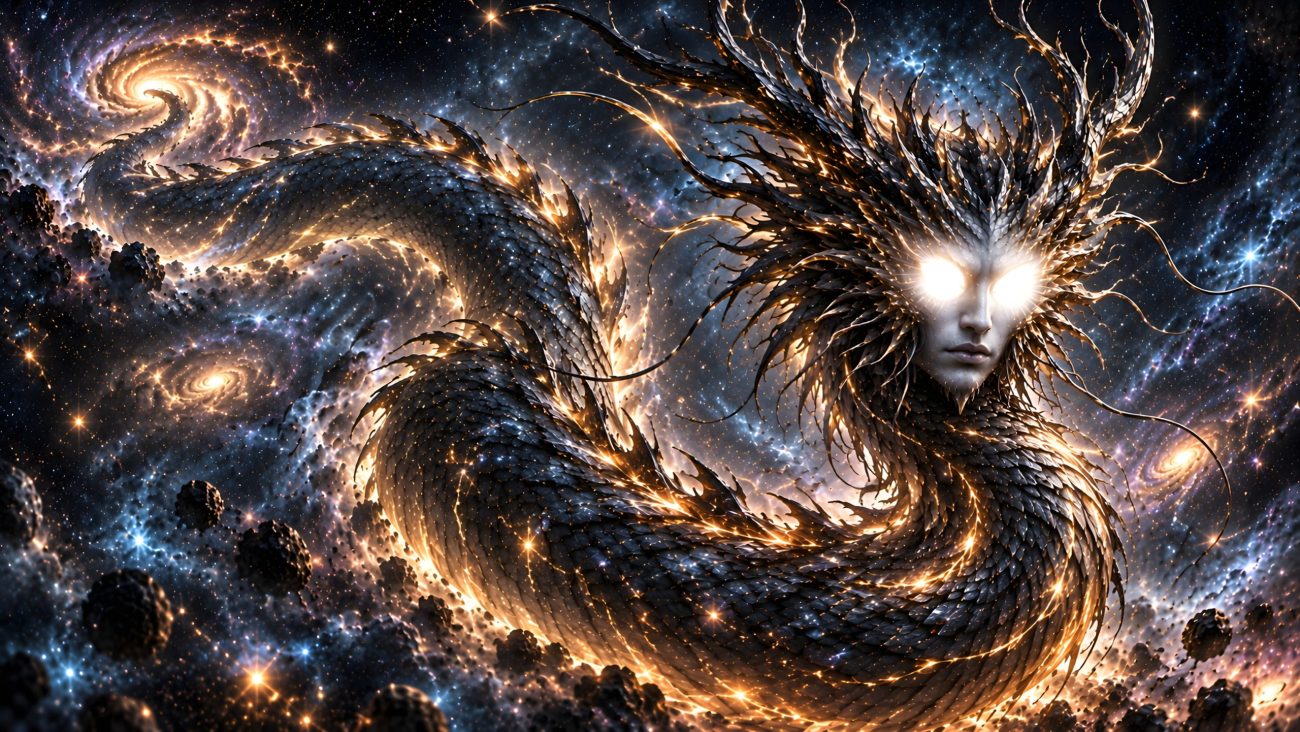
Zhulong, the Torch Dragon, is a gigantic scarlet dragon deity with a human face and a serpent-like body. His enormous body was said to stretch for a thousand leagues, and some traditions describe him with strange vertical eyes that appear as a straight seam when closed. He dwells in the far north, in remote mountains where the sun itself does not reach, and possesses a supernatural torch-like radiance capable of illuminating the darkness.
Zhulong’s most extraordinary power is his control over light and darkness. When he opens his eyes, daylight appears across the world; when he closes them, night falls. His very presence therefore becomes part of the rhythm of day and night. His breath has a similarly cosmic effect. When he blows, winter arrives, while his call brings summer. If he truly breathes, tremendous gales arise, and the wind and rain themselves are said to answer his command.
The ancient traditions place Zhulong in different remote mountains. At Mount Bell, the deity called Torch Shade lives upon the lower slopes, illuminating the surrounding darkness with his supernatural power. He neither eats nor drinks, and in the account he does not normally breathe or sleep. His immense body lies beyond the ordinary human world, associated with the distant regions where darkness dominates.
At Mount Brillianttail, Zhulong appears as a scarlet god-human with a human face and serpent’s body. His strange eyes stand vertically upon his face. When they close, darkness covers the world; when they open, light returns. He is described as shining his torch across the “ninefold darkness,” illuminating the regions untouched by ordinary sunlight. The wind and rain are also under his command, making the dragon not merely a source of light but a cosmic power governing the elements.
An old tradition preserved by Guo Pu explains why the Torch Dragon is necessary. The sky was believed to be incomplete in the northwest, leaving that region without the normal balance of yin and yang. A dragon therefore carried a torch in its mouth to illuminate the heavens. Zhulong’s light becomes a supernatural answer to the places where the sun cannot reach.
The Songs of Chu preserves the same mystery surrounding the Torch Dragon. Its Heavenly Questions asks where the sun does not shine and how the Torch Dragon illuminates that hidden region. Elsewhere, the Torch Dragon is associated with the frozen northern mountains, appearing as a blazing red presence in the darkness.
The Huainanzi places the Torch Dragon even farther beyond the reach of sunlight. He dwells north of Wild Goose Gate and hides within Abandoned Wings Mountain, a place where he never sees the sun. Here his body is described differently: he has a human face and a dragon’s body but no feet. Despite the variations in his physical form, his association with the remote northern darkness and supernatural illumination remains constant.
A later tradition preserves a related image of a gigantic dragon carrying a torch through the darkness of the far north. In this account, the dragon travels to a mountain that neither the sun nor moon illuminates and holds a torch in its jaws, lighting the mountain completely. Strange luminous plants grow there, their glowing stalks serving as torches in the darkness.
Zhulong is therefore far more than a conventional dragon. He is a cosmic being whose body and actions are woven into the structure of the world itself. His opening eyes bring daylight, his closing eyes bring night, his breath summons the seasons and winds, and his torch penetrates the darkness where the sun cannot reach.
Sources
“Zhulong (mythology).” Wikipedia: The Free Encyclopedia. Wikimedia Foundation. Accessed October 3, 2026. https://en.wikipedia.org/wiki/Zhulong_(mythology)