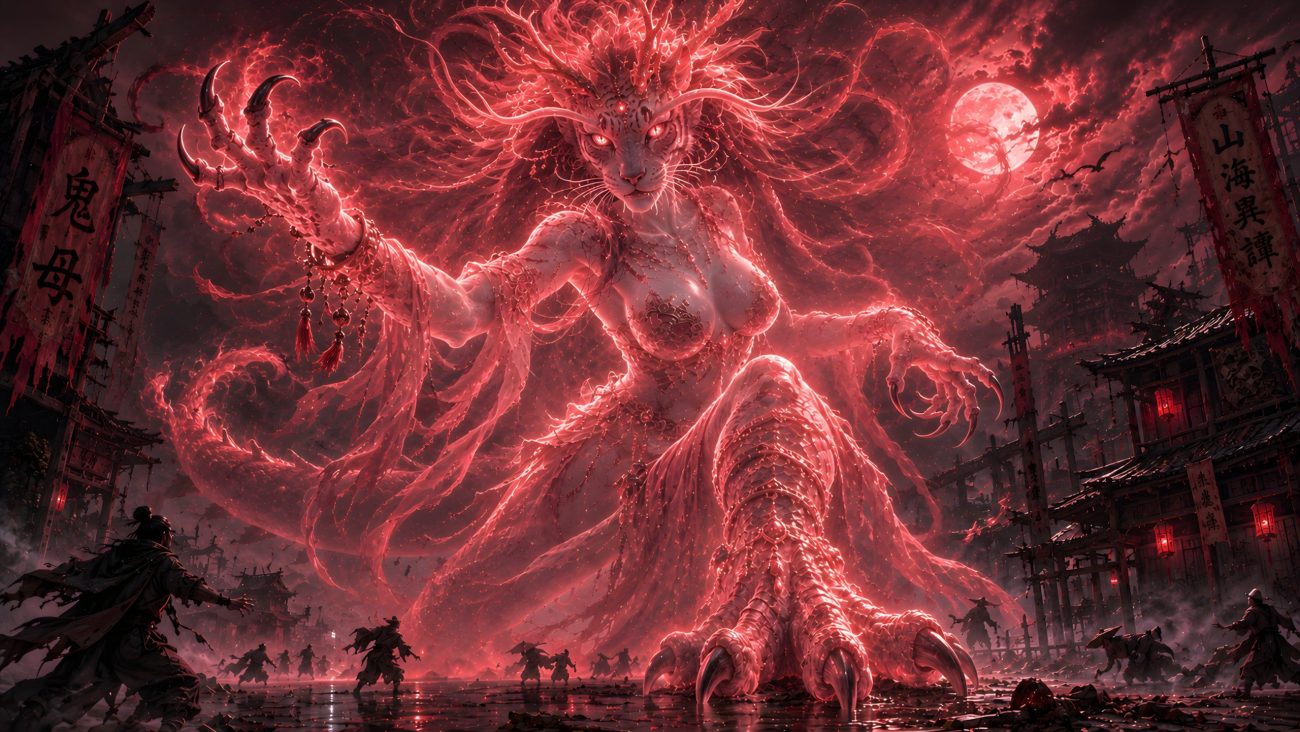
Ghost Mother

Tradition / Region: Chinese Mythology
Alternative names: Ghost Goddess, Tiger-Dragon Foot, Python-Eyed Ghost Mother, Dragon-Browed Ghost Mother
Category: Ghost, Deity, Tiger


The Myth

The Ghost Mother is a powerful supernatural being in Chinese mythology, appearing as both a ghost and a divine figure. She is most famously described in the Shuyi Ji (Records of Strange Things), where she dwells on Xiaoyu Mountain in the South China Sea.

Her appearance is bizarre and monstrous. She is said to possess the head of a tiger, the feet of a dragon, the round eyes of a python, and long dragon-like eyebrows that join together. She possesses extraordinary creative power, being capable of giving birth not only to ghosts but also to heaven and earth themselves. Whenever she gives birth, she produces ten ghosts at once, only to devour them again by nightfall.

The Ghost Mother also appears in Strange Tales from a Chinese Studio, where she serves as the foster mother of Yingning, a fox spirit, raising her despite not being her biological parent.

In the sequel to Journey to the West, the Ghost Mother appears in another form. After Princess Iron Fan attained enlightenment, the Bull Demon King became the Ghost King and resurrected Princess Jade Face as the Rakshasa Ghost Mother. Together they later had a son named Prince Li Zi, also known as Black Boy.

Across these traditions, the Ghost Mother is portrayed as a mysterious maternal figure whose terrifying appearance contrasts with her immense supernatural power, embodying both the creation and destruction of spirits.


Sources

Wikipedia contributors. (n.d.). 鬼母. In 維基百科,自由的百科全書. Retrieved June 27, 2026, from https://zh.wikipedia.org/wiki/%E9%AC%BC%E6%AF%8D
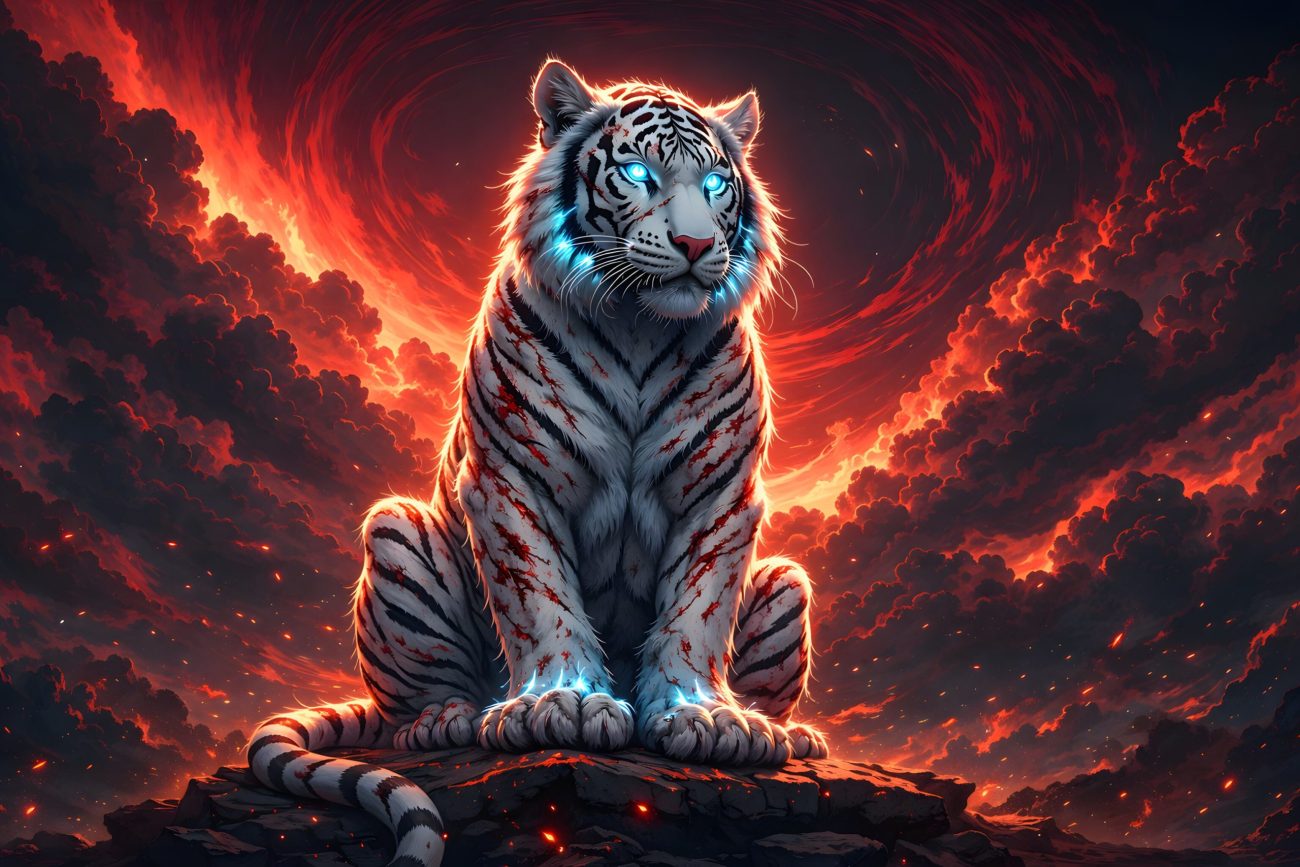

Báihǔ

Tradition / Region: Chinese mythology
Alternative names: –
Category: Tiger, Deity


The Myth

Báihǔ, the White Tiger, is the celestial guardian of the western sky and one of the Four Symbols that structure the cosmos in ancient Chinese thought. More than a constellation, Báihǔ is a living spirit of heaven, born from early star worship and later integrated into Daoist cosmology. In classical texts it is known by many sacred titles—Jianbing, Dijun, Shengjiang, Shenjiang, and Buguijiang—each emphasizing its role as commander, judge, and enforcer of cosmic order.

The White Tiger governs the west, the element of metal, and the season of autumn, embodying discipline, justice, and controlled violence. Its form is mapped across seven constellations—Kui, Lou, Wei, Mao, Bi, Zi, and Shen—which together were understood as a celestial army. These stars did not merely mark time; they represented moral law, hierarchy, and readiness to act when order was threatened.

Báihǔ is revered as a god of war and punishment, overseeing weapons, soldiers, and righteous conflict. It protects those who act with virtue and courage, while striking down evildoers who disrupt harmony. Though fierce and terrifying, the White Tiger is not a force of chaos. It is both shield and blade: capable of averting disasters, granting prosperity, blessing marriages, and guarding the just—yet merciless toward corruption and moral decay.

Its worship flourished during the Han dynasty, when shrines were raised in places such as Weiyang, and specific festival days were dedicated to honoring its power. Long before imperial China, tribes such as the Qiang and Rong venerated the White Tiger, and later peoples—including the Yi, Bai, Buyi, and Tujia—claimed descent from it. In these traditions, Báihǔ descends to earth as a celestial king, fathering seven sons and seven daughters, anchoring human lineages to the heavens.

To behold Báihǔ in the western sky was never a neutral act. It was both reassurance and warning. Its presence affirmed that justice was being watched, that virtue had cosmic backing, and that imbalance would be corrected. Striped across the heavens and mirrored in human conduct, the White Tiger stands as an eternal reminder that order is maintained not only through mercy, but through the disciplined force that defends it.


Sources

Wikipedia contributors. (n.d.). 白虎. In Wikipedia, from https://zh.wikipedia.org/wiki/%E7%99%BD%E8%99%8E