Tradition: Chinese mythology
Alternative Names: Lilyu, Liryo, Black Dragon
Category: Dragon
The Myth
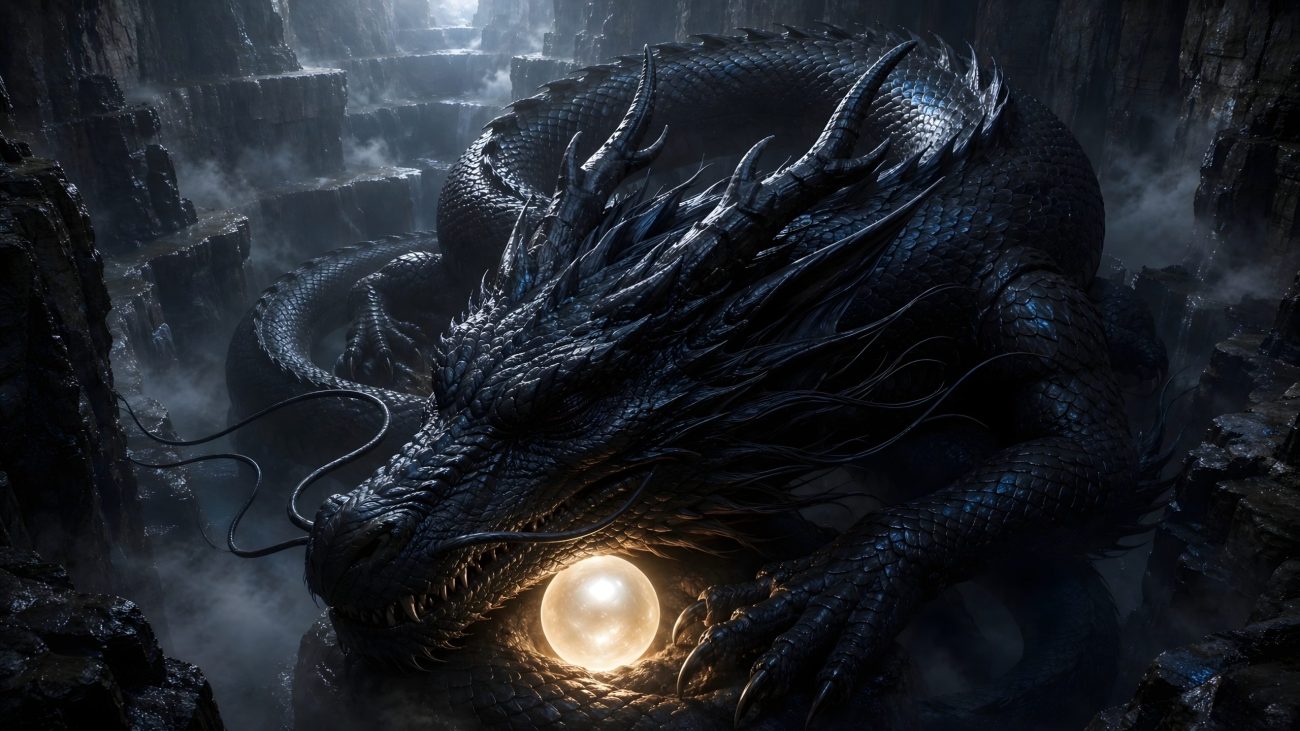
Li Long is a black dragon said to dwell in a nine-layered abyss. It guards precious treasures hidden deep beneath the water, making the dragon’s domain a place of immense danger for anyone seeking its riches.
One famous tale tells of a poor family who made their living weaving grass and catching fish along a river. One day, the family’s son dived into a deep pool and discovered a jewel worth a thousand pieces of gold. When he returned with the treasure, his father was horrified rather than pleased. He told his son to smash the jewel with a stone, explaining that such a priceless jewel must have been lying beneath the jaws of a Li Long in the nine-fold abyss.
The young man had survived only because the dragon happened to be asleep. Had it awakened, the dragon would have devoured him completely. The father used the story as a warning: treasures of extraordinary value can demand extraordinary risks.
The image of the jewel beneath the dragon’s jaw became a famous symbol of something precious that can only be obtained by risking one’s life. To seek such a treasure was compared to taking the pearl from the dragon’s jaws. The dragon’s pearl could therefore represent an almost impossible prize, hidden behind terrible danger.
The dragon was also associated with another dangerous treasure: the precious jewel believed to be contained within the brain of a dragon king. Buddhist traditions likewise spoke of dragon pearls as treasures of extraordinary rarity. Stories and religious performances developed around the image of dragons guarding such jewels, including a medieval Japanese temple performance in which male and female dragons were said to protect the sacred jewel while songs, dances, and music were performed to summon the dragon god and bring prosperity and happiness.
Li Long thus became more than a terrifying guardian of an abyss. Its jaws came to represent the boundary between enormous danger and extraordinary treasure: the greater the prize, the closer one must come to the dragon.
Sources
Takahashi, Toshihiro. “驪龍 [りりゅう] (Riryū).” 新版TYZ 妖怪図鑑 (New TYZ Yokai Encyclopedia). January 6, 2024. https://tyz-yokai.blog.jp/archives/1082940932.html