Tradition: Japanese mythology, Chinese Mythology
Alternative Names: Hakuryū, White Dragon
Category: Dragon
The Myth
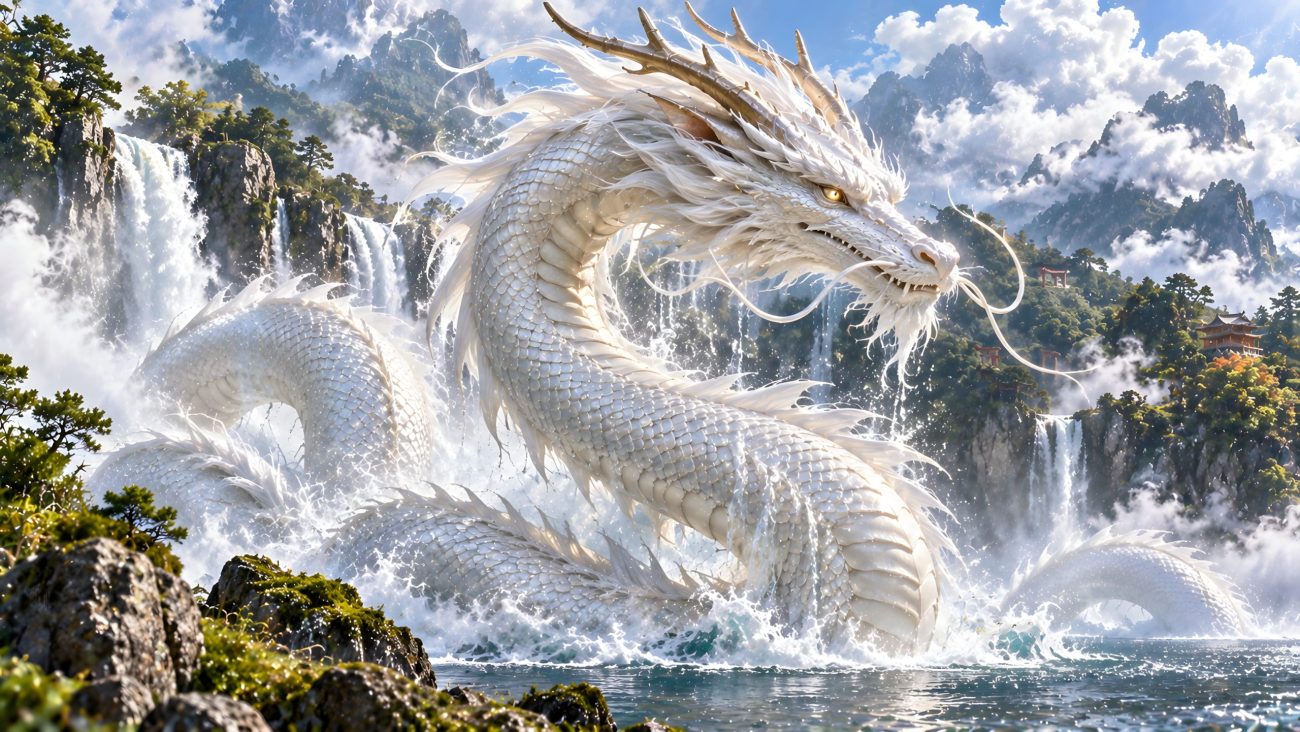
The Hakuryū is a white-bodied dragon, its pale form marking it as an auspicious and noble being. White dragons appear in legends, folktales, and the origin stories of temples and shrines, where they are often regarded as masters or gods of mountains, rivers, and lakes. In traditional dictionary definitions, the white dragon is described as a messenger of the Emperor of Heaven.
One of the oldest stories associated with the Hakuryū tells of a white dragon that descended to the Qingleng Abyss. There, it transformed itself into a fish and swam through the waters. A fisherman named Yu Qie encountered the fish and shot it in the eye.
The wounded dragon fled back to heaven and complained to the Emperor of Heaven about what had happened. But the Emperor rebuked it. Since the dragon had deliberately taken the form of a fish, he argued, it had placed itself among creatures naturally hunted by human beings. If Yu Qie had merely shot a fish, what crime had he committed?
The story was later used by Wu Zixu to warn the King of Wu. He explained that the white dragon was a noble creature of the Emperor of Heaven, while Yu Qie was merely a low-ranking official of the state of Song. Yet by disguising itself as a fish, the dragon had allowed itself to be treated like an ordinary creature. Likewise, if a ruler abandoned the dignity of his position and mingled with common people as though he were one of them, he could expose himself to dangers that would otherwise never reach him. The King of Wu was persuaded by the warning and changed his mind.
From this tale came the expression “white dragon in fish clothes,” describing a person of high status who disguises themselves in humble clothing, as well as the misfortunes that can result from such a disguise.
The Hakuryū could also appear as a terrifying force of nature. In 819, during the tenth year of the Kōnin era, a white dragon was said to have appeared in Kyoto amid a violent storm that damaged houses. White dragons were consequently associated not only with celestial power but with the destructive forces of wind and water.
The name Hakuryū could even be applied to the natural world: white, foaming streams and waterfalls were sometimes described as white dragons rushing through the landscape.
Sources
Takahashi, Toshihiro. “白竜 [はくりゅう] (Hakuryū).” 新版TYZ 妖怪図鑑 (New TYZ Yokai Encyclopedia). October 21, 2024. https://tyz-yokai.blog.jp/archives/1082944130.html