Cat Witch of Heist op den Berg

Tradition / Region: Belgian Mythology
Alternate Names:
Category: Cat, Witch


The Myth

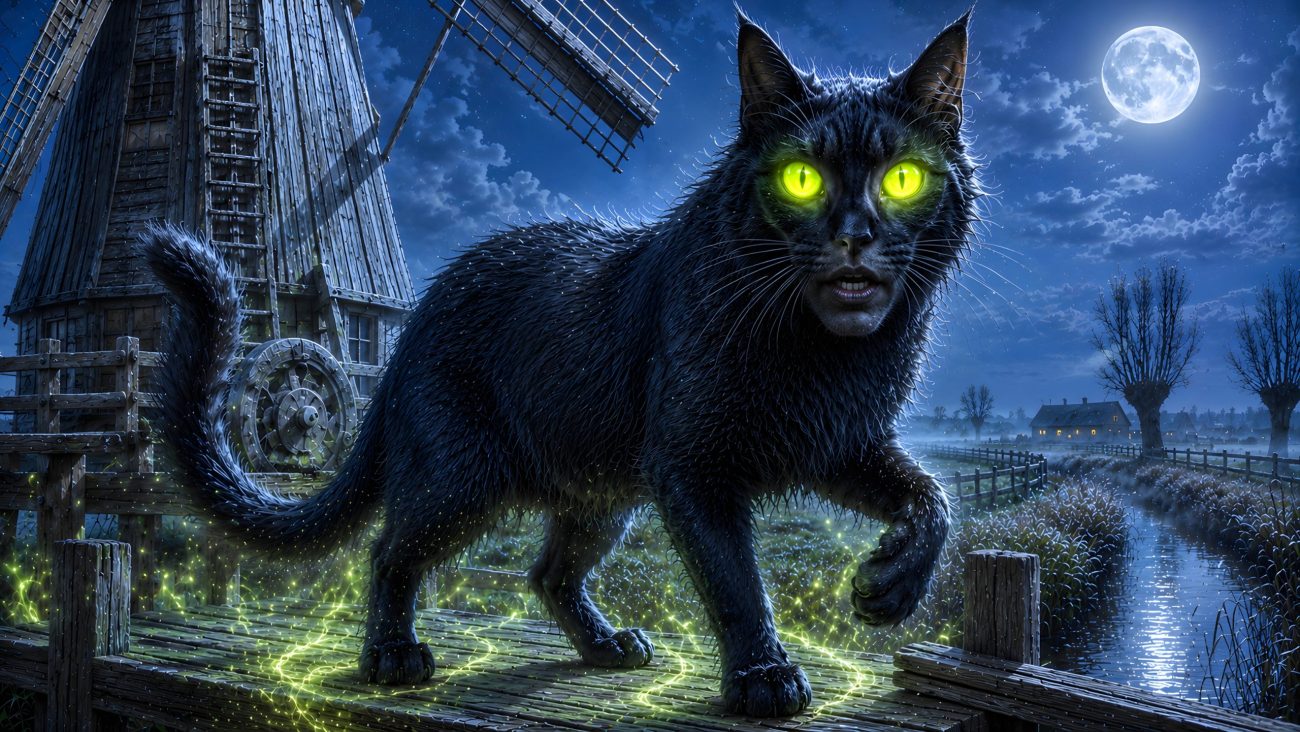
During the time of Napoleon I, a Belgian soldier was returning home from war, passing through a Prussian village.

As he walked through the town, he noticed a woman sitting outside her house. She was smoking a pipe, but something about her seemed wrong—on her backside there was a dark, unnatural stain. The soldier immediately suspected that she was a witch.

Without hesitation, he took his rifle from his shoulder, loaded it with a consecrated bullet, and fired—just grazing her.

He then continued his journey back to Belgium, where he was required to stay for several days.

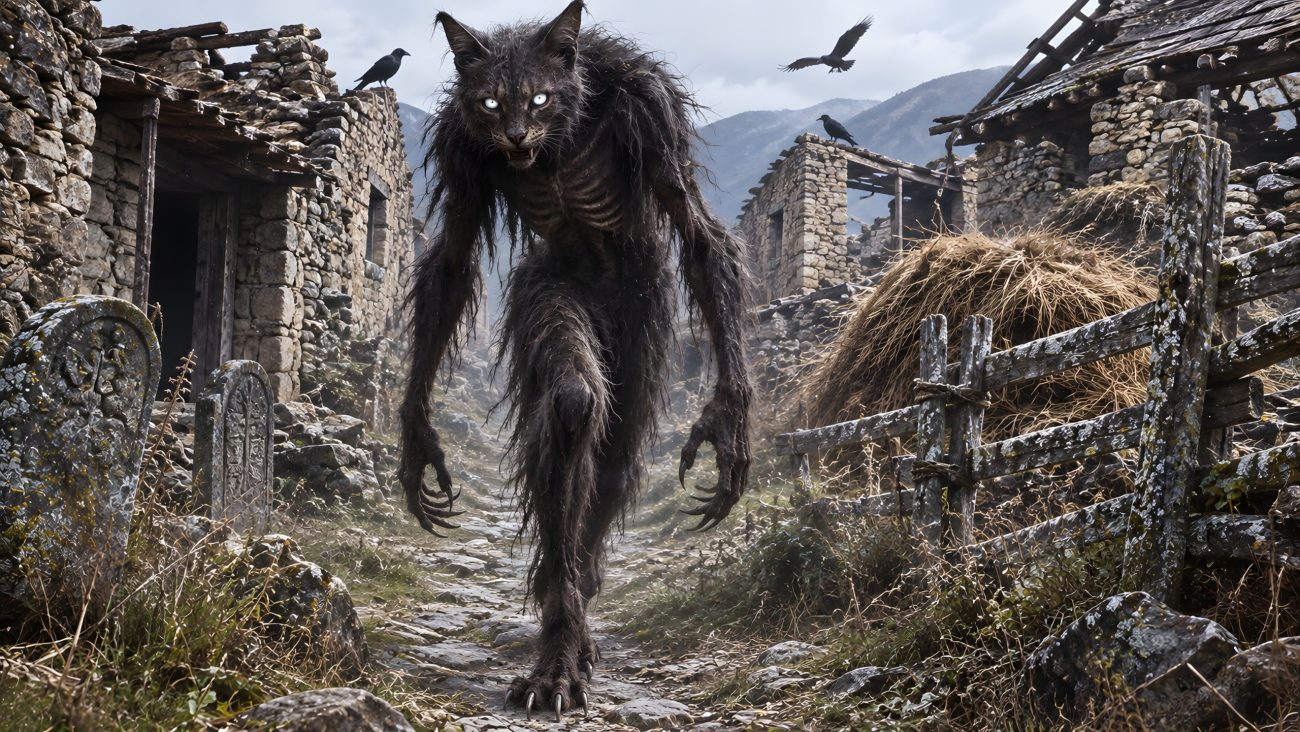
There, he encountered a woman who bore strange signs: she had a black patch at the back of her skirt and a wound on her nose that refused to heal. The injury lingered unnaturally, as if it could not recover.

It became clear that this was the same being he had shot before.

The wound remained open because it had been inflicted by a consecrated bullet—something believed to harm witches in a way that could not be undone.


Sources

de Cock, A. (1921). Vlaamsche sagen uit den volksmond. In Amsterdam: Maatschappij voor goede en goedkoope lectuur, from https://www.dbnl.org/tekst/cock001vlaa01_01/colofon.php p. 37.


Prachatice Cat

Tradition / Region: Czech Mythology
Alternate Names: —
Category: Cat


The Myth

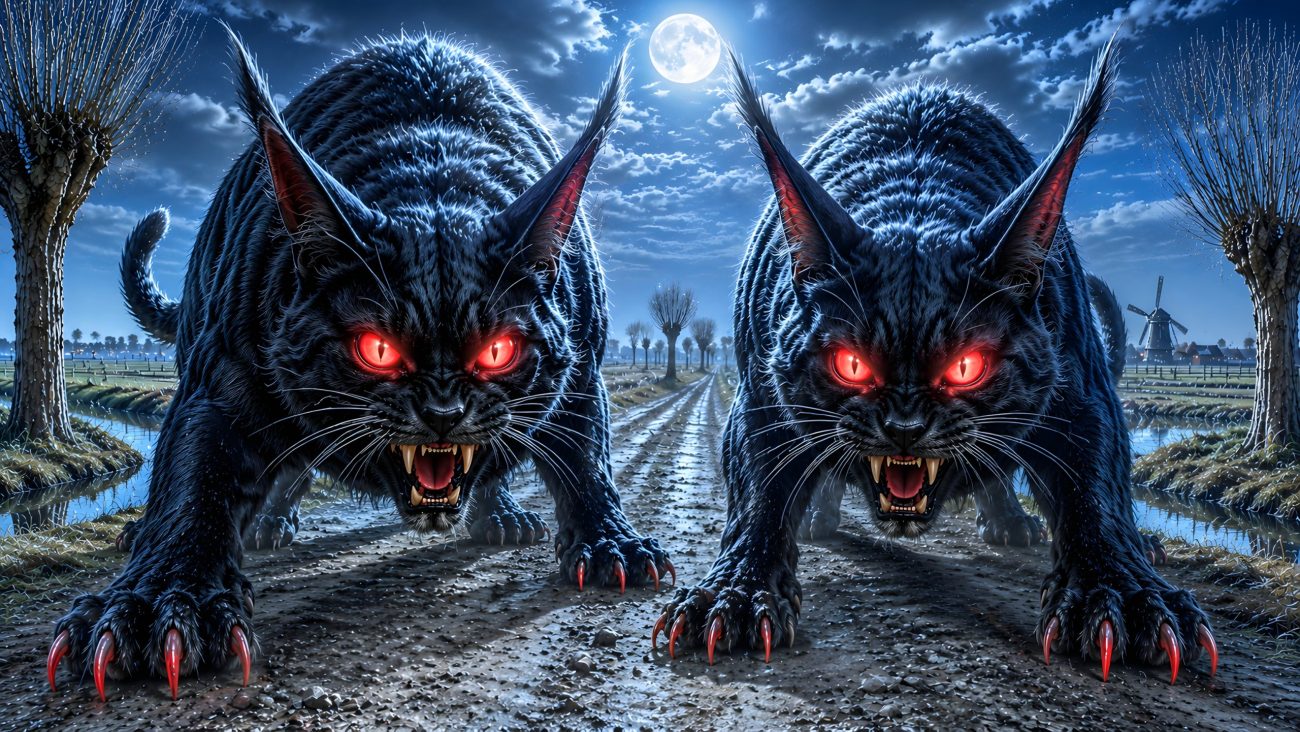
The Prachatice Cat is a sinister manifestation of cats acting under supernatural influence, capable of intelligence, coordination, and deadly intent.

One night, after a village celebration, a drunken farmer stumbled home and heard strange music coming from his barn. Curious, he opened the doors and let the moonlight reveal the scene inside.

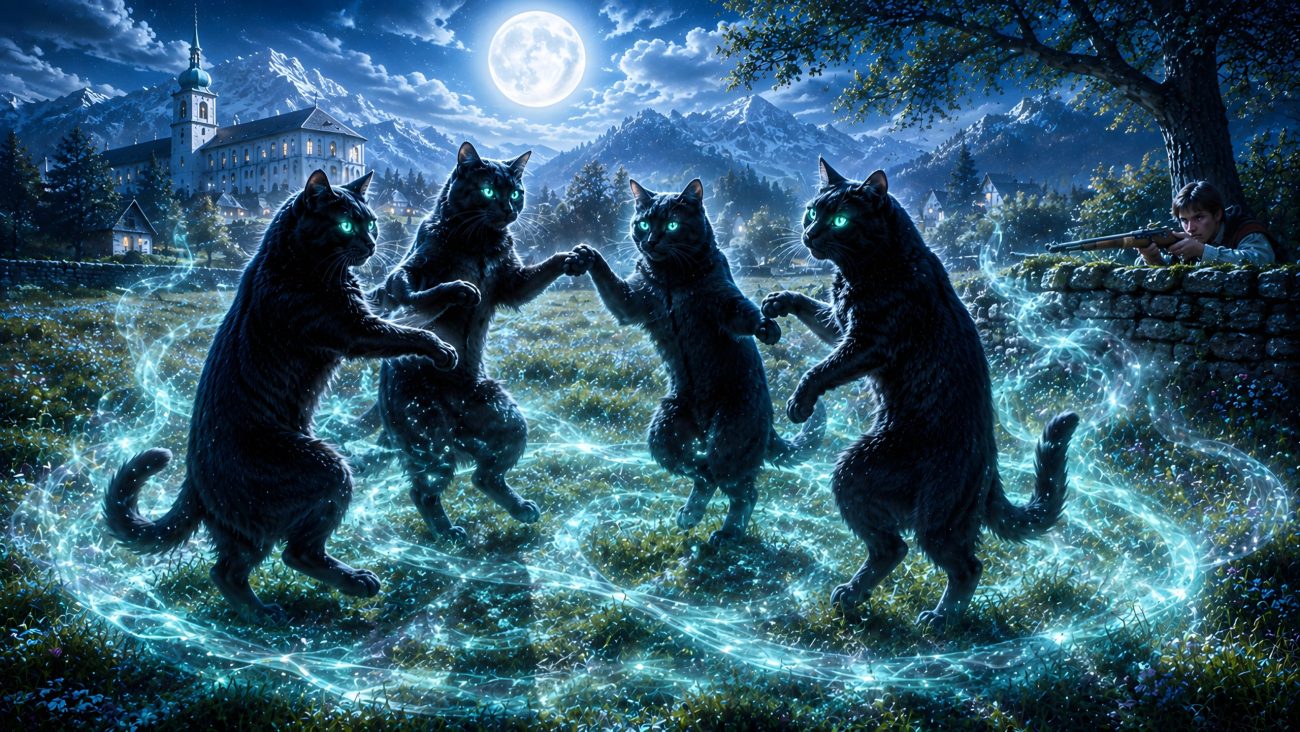
There, a gathering of cats had assembled. They were not behaving like ordinary animals—each cat held its own tail in its mouth and played it like a musical instrument, producing eerie sounds like flutes and pipes. In the center, a dance was taking place: a cat whirled together with the farmer’s own large black tomcat.

The spectacle was unnatural and unsettling, but the farmer reacted with anger rather than fear. He cursed his cat and threatened it, dismissing what he had seen as drunken nonsense. Then he went inside and fell asleep.

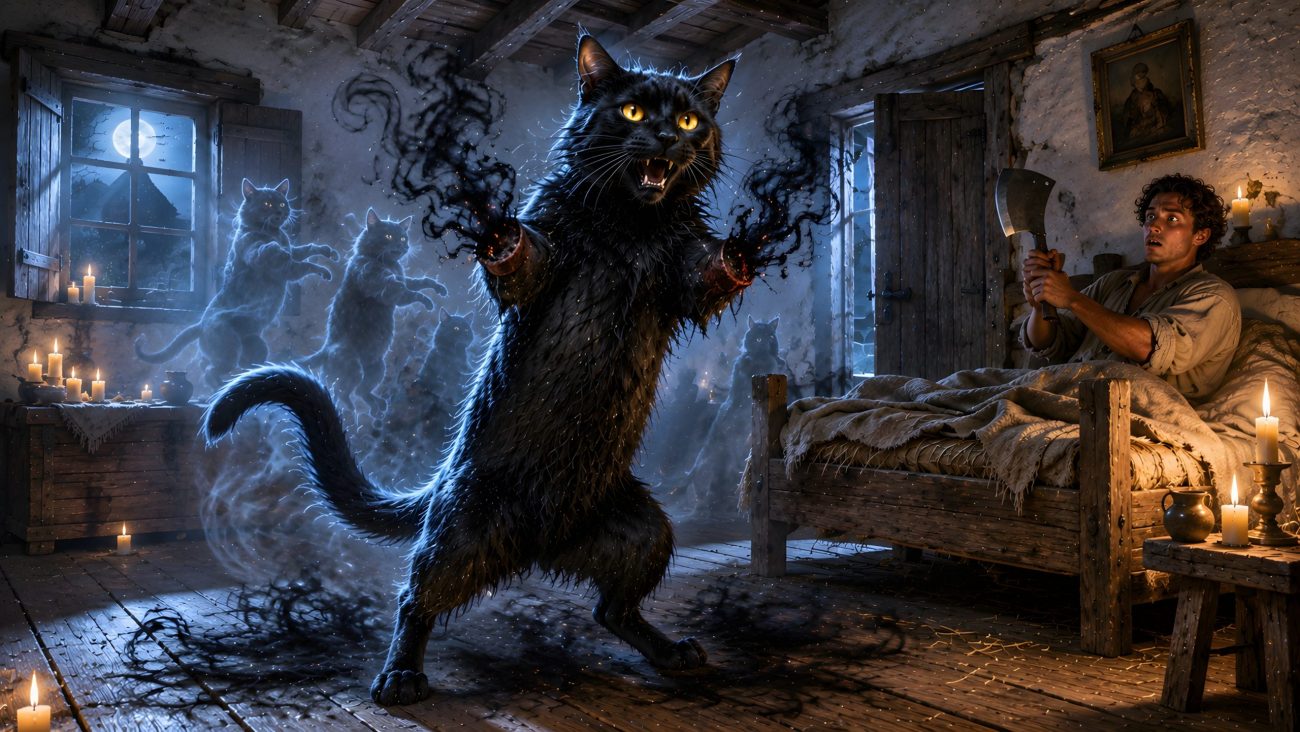
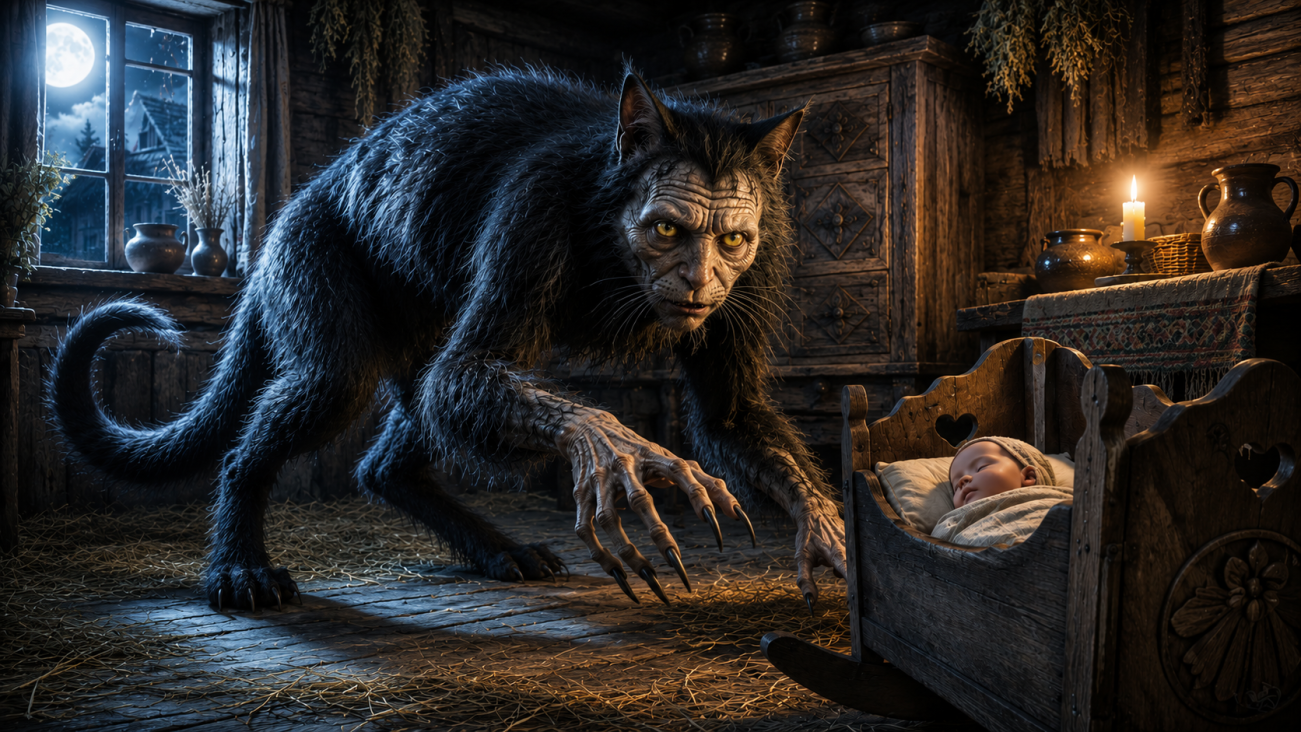
During the night, the black cat entered the house silently. It approached the sleeping man and, in a calculated act of revenge, forced its tail down his throat, suffocating him.

By morning, the farmer was dead.

The story left behind a lasting warning, remembered in local tradition:
cats are not always harmless creatures, and what appears tame may conceal something dangerous.

The Prachatice Cat embodies the idea that animals—especially cats—can serve as vessels of hidden forces, capable of turning against humans when disrespected or provoked.


Sources

sagen.at contributors. (n.d.). Katzenmusik. In sagen.at, from https://www.sagen.at/texte/sagen/tschechien/watzlik/katzenmusik.html


Ghostly Cat

Tradition / Region: Austrian Mythology
Alternate Names: White Cat Spirit
Category: Cat, Ghost


The Myth

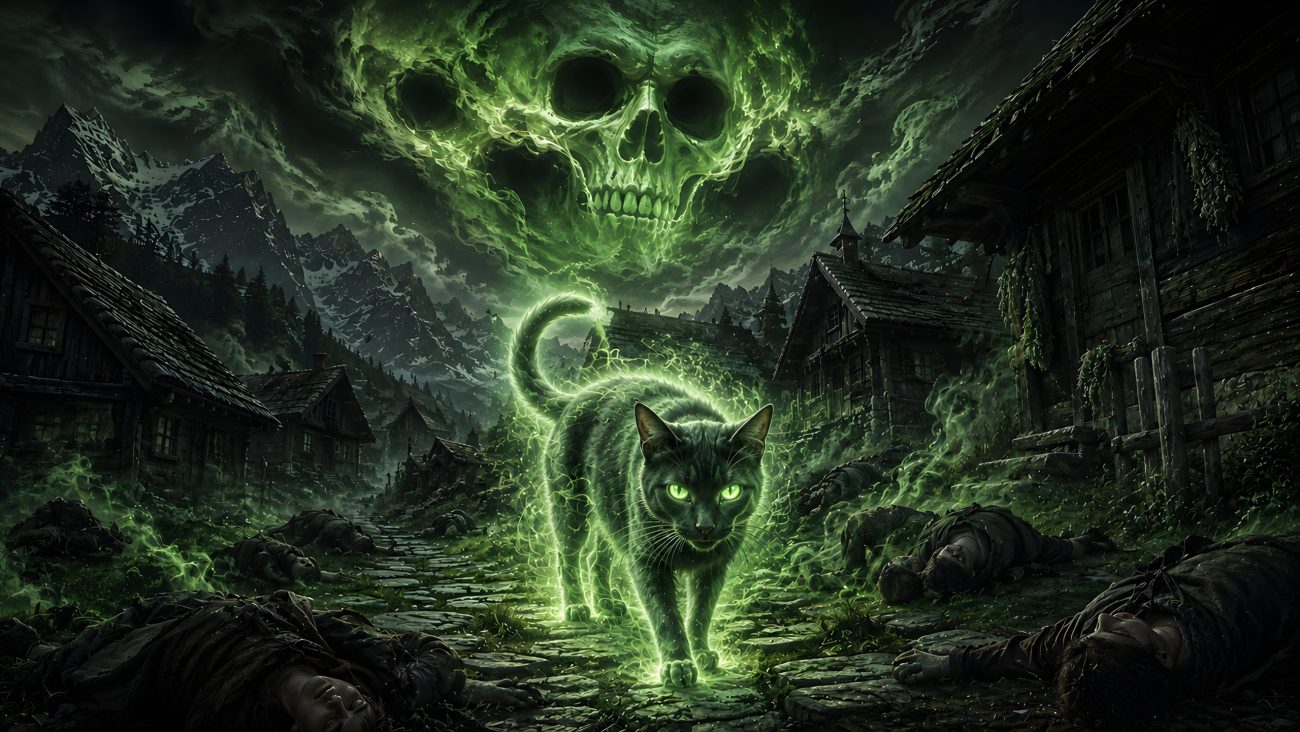
The Ghostly Cat is the spirit of a woman condemned to wander in the form of a large white cat, appearing at night on the rooftops of an old house.

The legend tells of a man who lived a corrupt and immoral life, while his wife endured everything in silence. Eventually, he fell under the influence of another wicked woman, and together they plotted to murder his wife using poisoned food.

However, through a twist of fate, the poison was consumed by the very woman who had prepared it. The effects were unnatural and disturbing. Instead of dying immediately, she began to lose her humanity and believed herself to be a cat.

She crawled on all fours, ran wildly through the house, climbed across the roof, and screamed like an animal. Her madness intensified with time, growing worse by the hour, until finally she fell from the highest point of the roof and broke her neck.

After her death, she did not find rest.

She became a restless spirit, condemned to return as a ghostly white cat, roaming the rooftops at night. Those who come too close to her path risk being attacked, as she lashes out with sharp claws at anyone who dares approach.

The Ghostly Cat represents a punishment tied to guilt, corruption, and unnatural transformation — a human reduced to an animal in life, and bound to that form even after death.


Sources

sagen.at contributors. (n.d.). Die gespenstische Katze. In sagen.at, from https://www.sagen.at/texte/sagen/oesterreich/wien/sagen_legenden_gugitz/katze.html


Kasha

Tradition / Region: Japanese Mythology
Alternate Names:
Category: Cat


The Myth

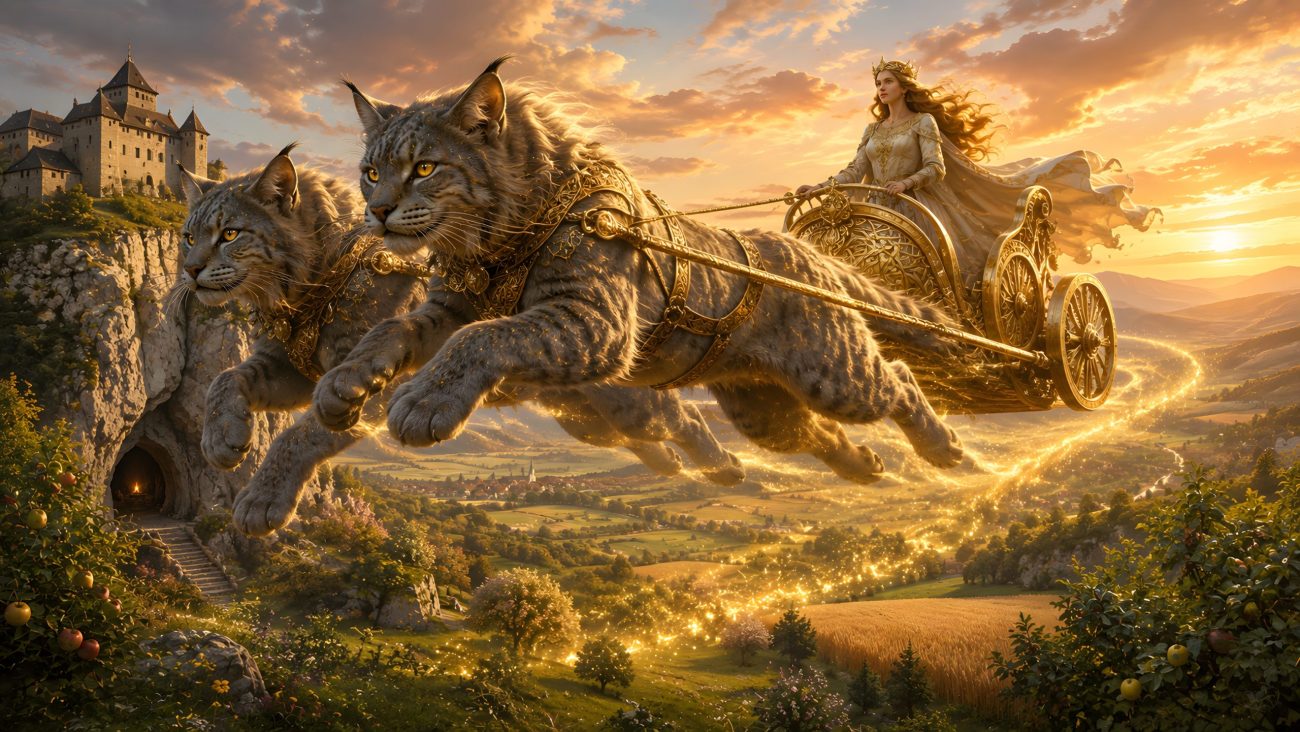
The Kasha is a cat-like yokai associated with death and the punishment of wrongdoers. It is said to carry away the corpses of those who committed crimes, and is often depicted grasping a body while connected to a flaming chariot or fire.

The Kasha appears when a person who has committed wrongdoing dies. It takes the corpse and carries it away, acting as an agent of karmic consequence rather than human judgment. It is portrayed as a cat-like being that may stand upright and seize the body, sometimes shown with a chariot of fire. Images of the Kasha appear in works such as death scrolls and mandalas, where it is shown taking the dead away. Its form varies by region, sometimes more monstrous and sometimes more cat-like, but it is consistently associated with the removal of sinful corpses and the inevitability of moral consequence.


Gallery


Sources

TYZ Yokai Blog. (2014). 火車 (Kasha). From https://tyz-yokai.blog.jp/archives/1010655129.html


Interpretive Lenses

Religious Readings
  • Christian Ascetic Deep Dive
Philosophical Readings
  • Nietzschean Deep Dive
Psychological Readings
  • Jungian Deep Dive
Esoteric Deep Dive
  • Hermetic Deep Dive
Political / Social Readings
  • Marxist Deep Dive

White Cat of the Alzette Bridge

Tradition / Region: Luxembourg Mythology
Alternate Names: New Year’s Water Spirit, Alzette Bridge Cat
Category: Cat


The Myth

Each year on New Year’s Eve, the water spirit of the Alzette River is said to appear in Ettelbrück in the form of a white cat on the bridge.

One year, a man crossing the bridge that night encountered the animal, which followed him through the deep snow. He hurried home, but the strange creature followed him into the house. No matter how often he tried to drive it out, it kept reappearing in the room.

At last he went to bed and tried to sleep, but the cat sat before him and cried out in a pitiful voice. When the clock struck one, the animal suddenly vanished. In the morning, however, the man discovered that his face had been badly scratched.

People said that the water spirit itself had visited him in the form of the white cat.


Gallery


Sources

sagen.at contributors. (n.d.). Die weiße Katze auf der Teichbrücke zu Ettelbrück. In sagen.at, from https://www.sagen.at/texte/sagen/luxemburg/Katze_Ettelbrueck.html


Interpretive Lenses

Religious Readings
  • Christian Ascetic Deep Dive
Philosophical Readings
  • Nietzschean Deep Dive
Psychological Readings
  • Jungian Deep Dive
Esoteric Deep Dive
  • Hermetic Deep Dive
Political / Social Readings
  • Marxist Deep Dive

The White Cat of Budersberg

Tradition / Region: Luxembourg Mythology
Alternate Names: Budersberg White Cat
Category: Cat, Swamp dweller


The Myth

In the meadowlands below the village of Budersberg, a snow-white cat is said to appear on certain nights.

It is sometimes seen where the stream called the Gessel flows into the Brüllchen, but most often it shows itself in the middle of the marsh known as the Fäschtemsmoore. There it moves silently through the darkness and then vanishes again, leaving no trace behind.

Thus the people spoke of the white cat that haunted the meadows and marshes below Budersberg.


Gallery


Sources

sagen.at contributors. (n.d.). Die weiße Katze bei Budersberg. In sagen.at, from https://www.sagen.at/texte/sagen/luxemburg/Katze_Budersberg.html


Interpretive Lenses

Religious Readings
  • Christian Ascetic Deep Dive
Philosophical Readings
  • Nietzschean Deep Dive
Psychological Readings
  • Jungian Deep Dive
Esoteric Deep Dive
  • Hermetic Deep Dive
Political / Social Readings
  • Marxist Deep Dive

Nuegyo

Tradition / Region: Japanese Mythology
Alternate Names: Nue
Category: Fish, Cat


The Myth

Nuegyo is a strange and unsettling fish said to appear in the seas off the coast of Japan. Those who encountered it did not recognize it as any known creature of the ocean, and even experienced fishermen were unable to name it.

The Nuegyo is said to be about the length of a man’s forearm. Its skin is rough, like that of a shark, while its head resembles that of a cat. Atop its head rests a hard, bowl-shaped mass, like stone. Its nose and mouth are also catlike, and from both sides of its jaw protrude sharp, bone-like spines several inches long. A thin spine rises from the top of its head, giving it an even more unnatural appearance.

Its body is shaped somewhat like that of a gurnard, but its fins are long and soft, extending all the way toward the tail. These fins are wide and flexible, like the wings of a bat. When spread open, they form a fan-like shape. It is said that the Nuegyo can use these fins as wings, rising above the surface of the sea and gliding through the air.

Because of its bizarre combination of features—part fish, part beast, and capable of flight—people began to call it Nuegyo, likening it to the legendary Nue, a creature made of mismatched forms. Whether it truly flies or merely skims the waves is unknown, but the Nuegyo is remembered as a sea being that does not fully belong to water or sky, and whose appearance defies ordinary understanding.


Gallery


Sources

TYZ-Yokai Blog contributors. (n.d.). 座敷童子 (Zashiki-warashi). In TYZ-Yokai Blog, from https://tyz-yokai.blog.jp/archives/1010654392.html


Interpretive Lenses

Religious Readings
  • Christian Ascetic Deep Dive
Philosophical Readings
  • Nietzschean Deep Dive
Psychological Readings
  • Jungian Deep Dive
Esoteric Deep Dive
  • Hermetic Deep Dive
Political / Social Readings
  • Marxist Deep Dive
Other
  • How to Invite The Nuegyo

Skogkatt

Tradition / Region: Norwegian mythology
Alternate Names: Forest Cat, Mountain Cat
Category: Cat


The Myth

In the old Norse lands, where mountains rose sharply from forest and stone, people believed that not every path was meant for human feet. Some heights belonged to other beings—watchers who moved where men could not follow. Among them was the Skogkatt, a forest cat spoken of not as an animal, but as a fairy creature shaped by the land itself.

The Skogkatt was said to dwell in the mountains, not in villages or hearth-lit halls. Forests marked its boundary, cliffs its true home. Where rock faces rose sheer and unforgiving, the Skogkatt climbed without hesitation. Places that halted hunters, travelers, and even other animals offered it no resistance. Its movement defied expectation, as though the mountain itself allowed its passage.

This ability was not admired for grace, but respected for its meaning. In Norse belief, skill without purpose was rare. To climb where others could not was not merely strength—it was permission. The Skogkatt did not struggle against the mountain; it belonged to it. It left no tracks, no broken stone, no trail to follow. Where it went, humans were reminded of their limits.

Unlike house cats, the Skogkatt was never tame. It was not kept, trained, or claimed. To encounter one was not ownership, but coincidence—a brief crossing between human movement and something older. It did not linger, and it did not respond to being seen. Its presence was not an invitation, but a warning.

The mountains themselves shaped the creature’s meaning. In Norse thought, high places were realms of endurance, silence, and judgment. Storms gathered there without warning. Paths vanished beneath snow and stone. That the Skogkatt moved freely among these dangers marked it as a being unafraid of isolation, thriving where dependence failed.

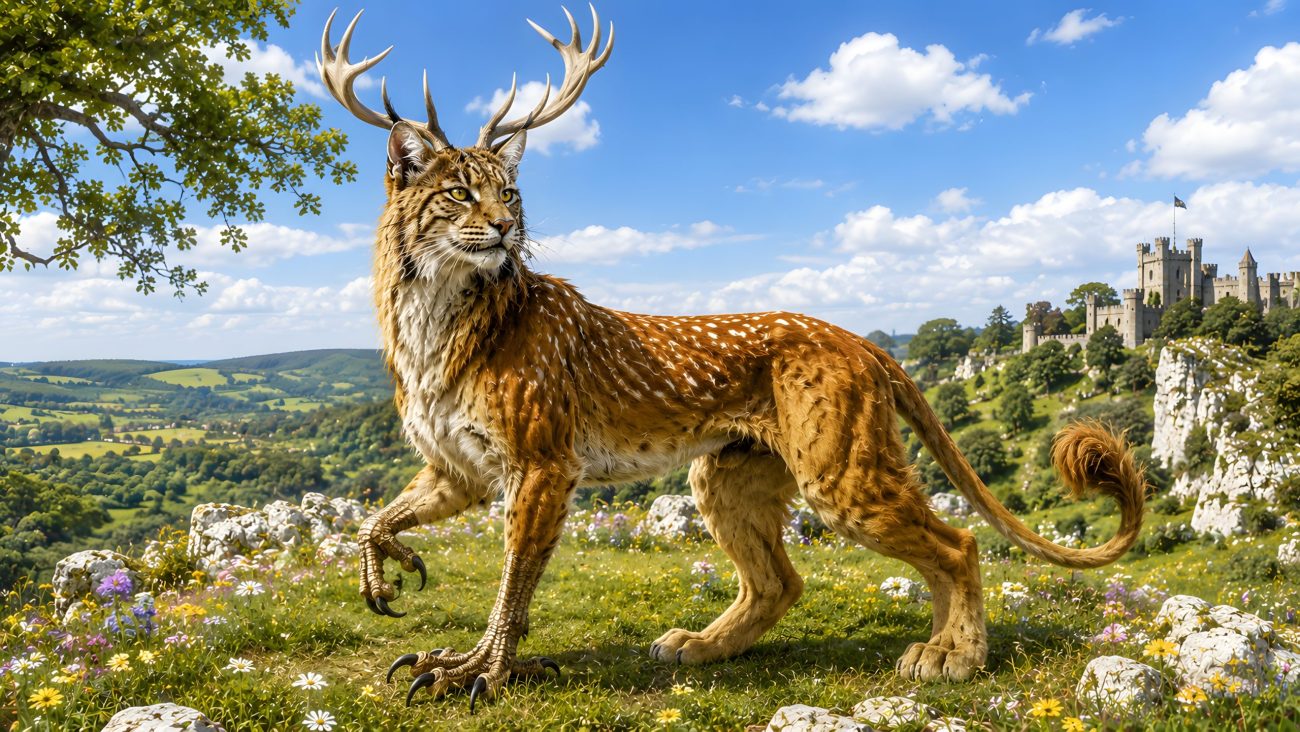
Later generations would wonder whether the Skogkatt lived on in flesh rather than story, embodied in the great forest cats of Norway—powerful climbers with thick coats and unshakable balance. But folklore does not concern itself with proof. What mattered was not whether the Skogkatt endured, but what it taught.

Through the Skogkatt, people learned that the land does not yield itself equally to all. Some beings walk where others must stop. To follow blindly is to fall. Wisdom lies in knowing when a path is not meant for you.

And so the Skogkatt remains where it has always been—high above the treeline, moving along stone faces untouched by human hands. A quiet presence in the mountains, reminding those below that not every height is meant to be conquered, and not every creature is meant to come down.


Sources

Wikipedia contributors. (n.d.). Norwegian Forest Cat. In Wikipedia, The Free Encyclopedia, from https://en.wikipedia.org/wiki/Norwegian_Forest_Cat


Micibichi

Tradition / Region: Algonquian peoples (Great Lakes and surrounding regions, North America)
Alternate Names: Mishibijiw, Mishipeshu
Category: Water panther / lake spirit


The Myth

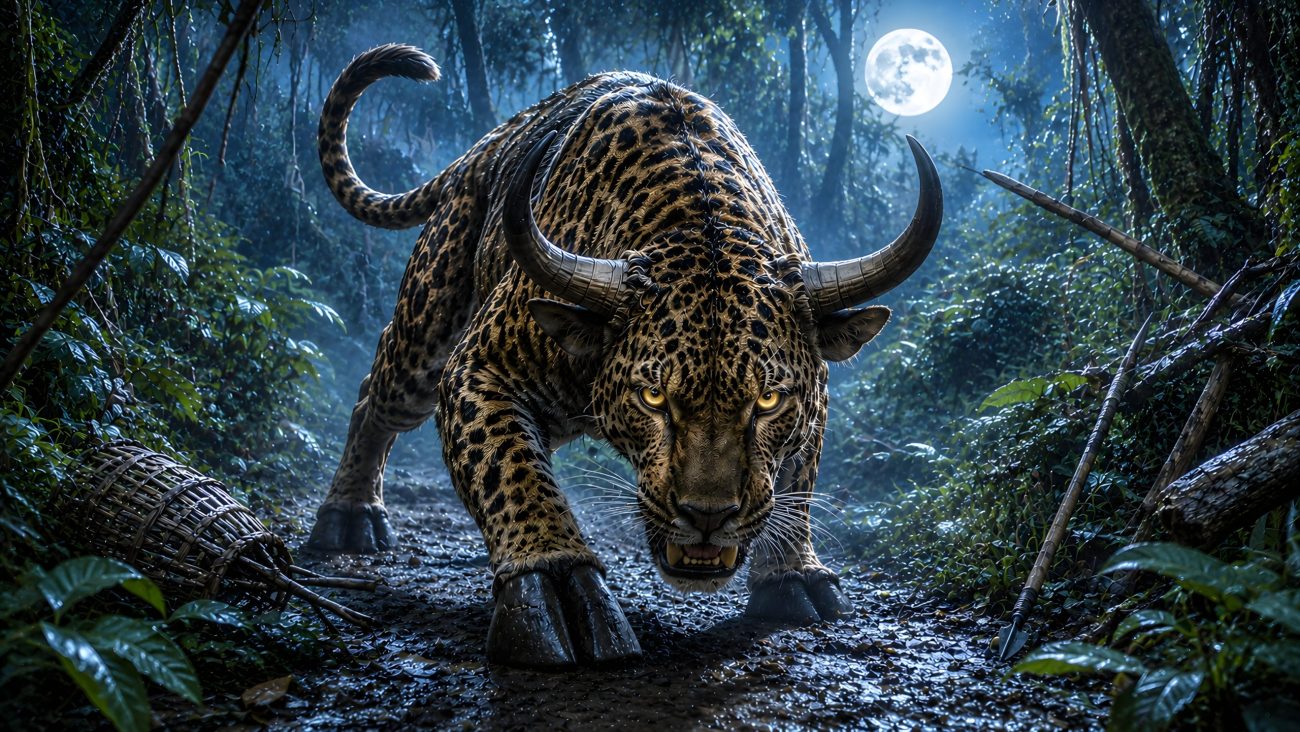
The Micibichi is a powerful being said to dwell in deep lakes, rivers, and underground waters. It is most often described as a great feline, resembling a lynx or panther, but far larger and more dangerous than any ordinary animal. Its body is sleek and muscular, armed with sharp claws, and it moves with sudden speed. Though it is a creature of the water, it also inhabits caves and places beneath the earth.

In many tellings, the Micibichi has a humanoid head, sometimes bearing horns, and its eyes shine with unnatural awareness. It is closely associated with copper and other riches hidden within the earth, and is said to guard these resources fiercely. For this reason, it is both feared and respected as a powerful spirit tied to survival and wealth.

The Micibichi rules liminal places where land, water, and the underground meet. It creates whirlpools, sudden storms, and dangerous currents, and is blamed for drownings and disappearances. Canoes that pass over its domain without proper respect may be overturned, and travelers pulled beneath the surface. Yet the Micibichi is not always hostile. Fishermen and travelers who offer tobacco, food, or other gifts may pass safely, believing the spirit has accepted their acknowledgment.

The creature is said to change in size. At times it may appear no larger than a common lynx; at other times it grows into a monstrous panther capable of crushing canoes and dragging prey into the depths. Its presence is often known before it is seen, through disturbances in the water or unexplained sounds rising from below.

In the wider order of the world, the Micibichi is understood as a counterpart to the great sky beings, dwelling below while others rule above. Its power balances the forces of the heavens, and its actions shape the fate of those who depend on water for travel, food, and life itself.

Thus the Micibichi remains a feared and revered spirit of the deep—guardian of waters and hidden riches, a being that punishes carelessness and rewards respect, and whose domain marks the boundary between the human world and forces far older and stronger than humankind.


Interpretive Lenses

Religious Readings
Philosophical Readings
Psychological Readings
Esoteric Deep Dive
Political / Social Readings
Other