Koshin-yama Yamaneko

Tradition / Region: Japanese mythology
Alternative names: Koshin Mountain Wildcat, Koshinzan Yamaneko
Category: Cat


The Myth

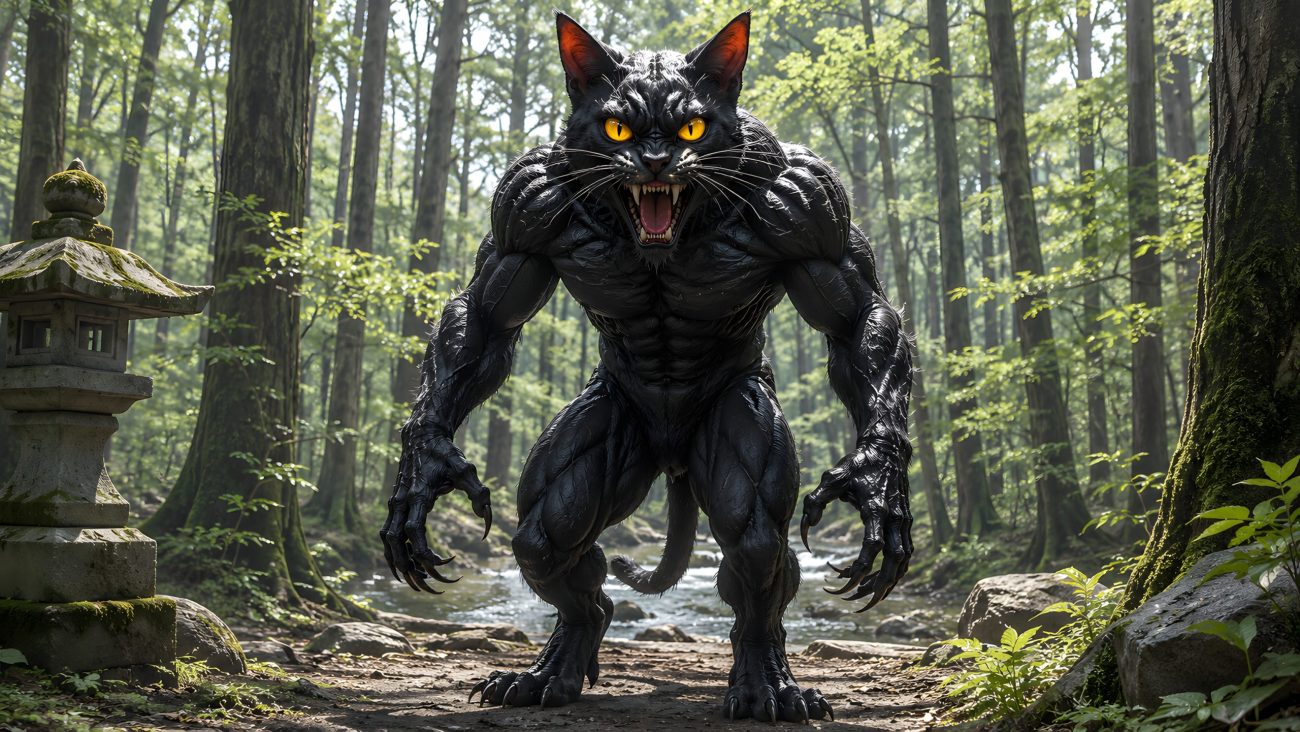
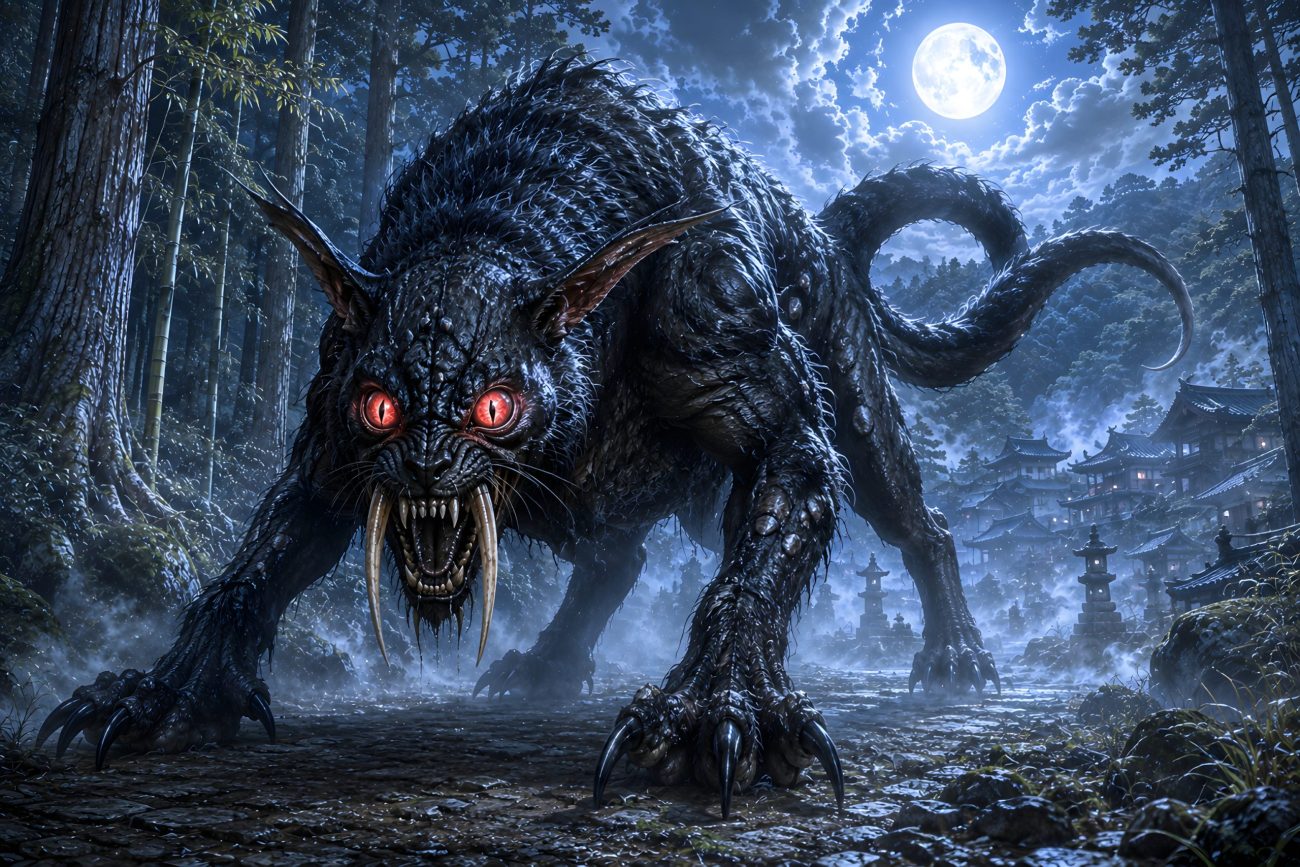
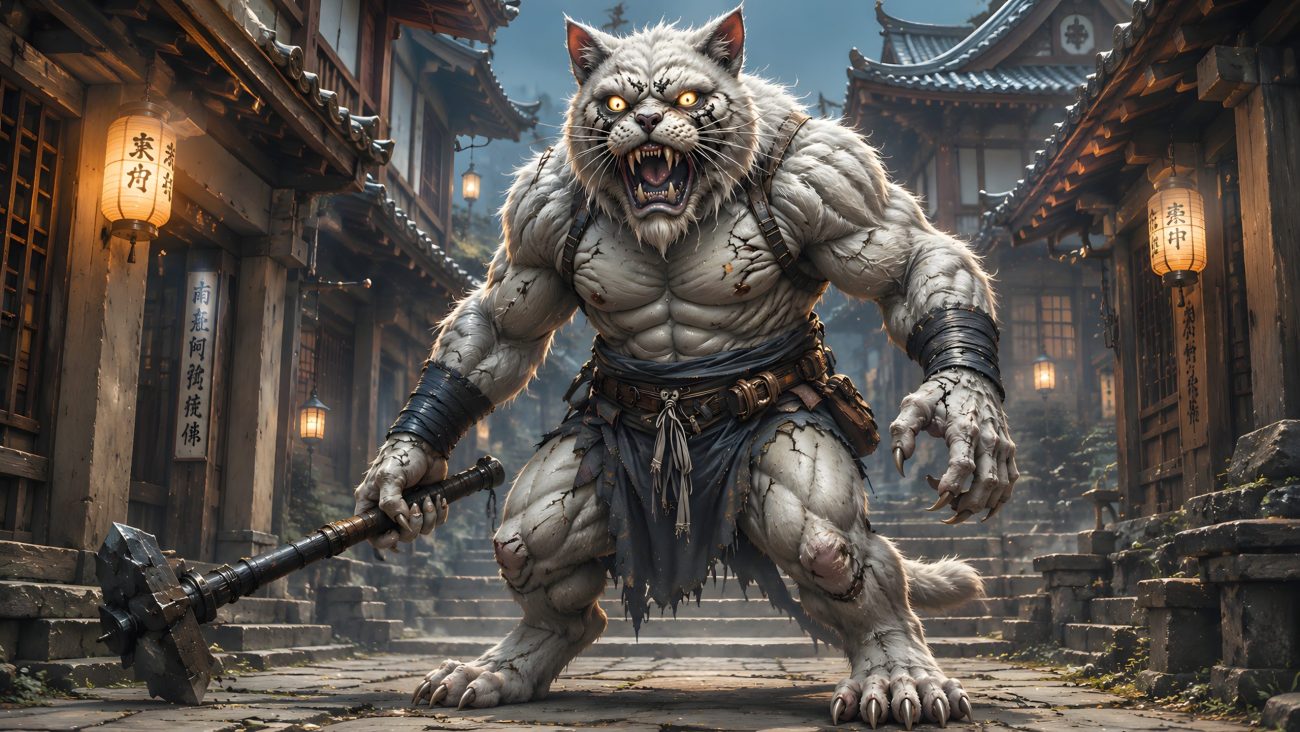
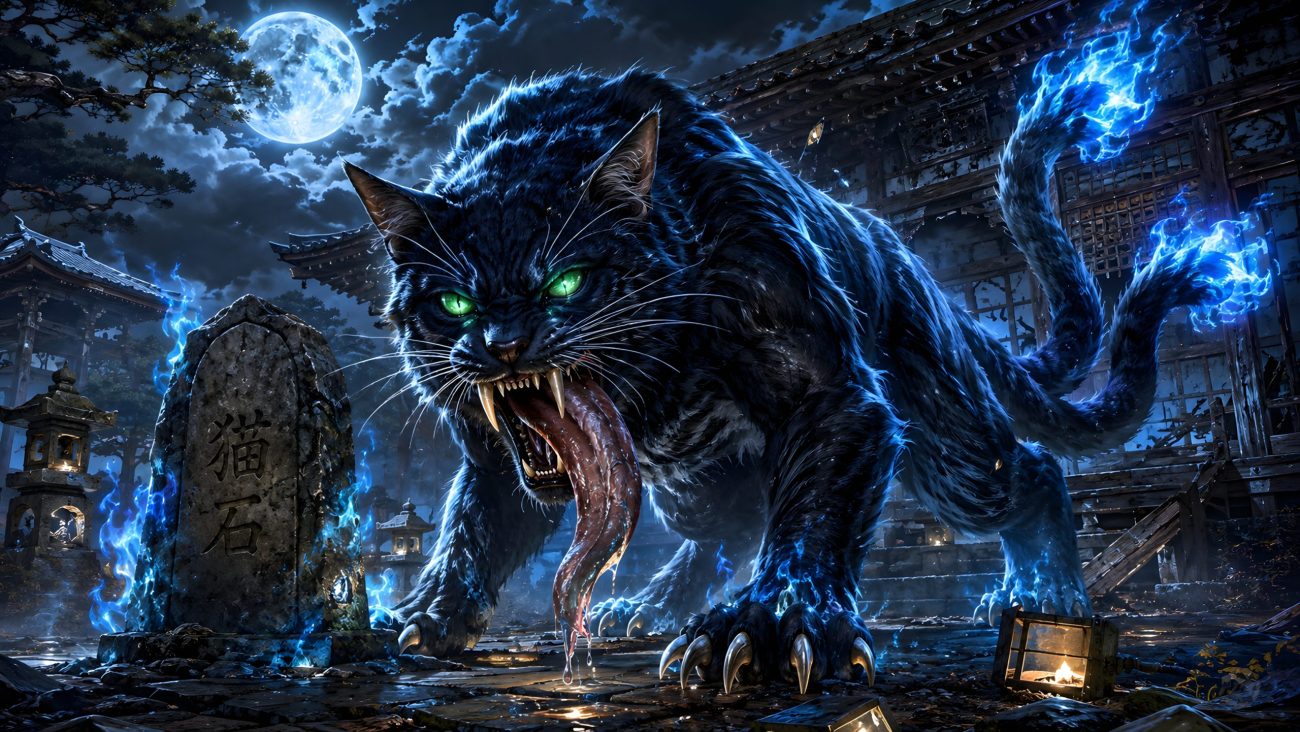
The Koshin-yama Yamaneko was a gigantic wildcat that had lived for hundreds of years, growing to the size of a calf and gaining immense supernatural powers. Its face resembled that of a raging tiger, its mouth stretched to its ears and was redder than blood, its fangs were as white as swords, and although its body was human-like, it rode a grotesque horse formed from an ancient tree spirit. Its eyes shone like torches, and after revealing its true form, they gleamed like mirrors while its whiskers resembled snowy pampas grass. It could command the beasts of the mountain, ride tree spirits as horses, speak human language, and even had the mountain and land gods as its servants.

Seventeen years before the events of the story, the local samurai Akaiwa Ikkaku climbed Mount Koshin to prove his bravery. Unknown to everyone, he was killed and devoured by the monstrous wildcat. The creature stole his clothes, assumed his appearance, and descended from the mountain to live in his place. It sought to possess Ikkaku’s beautiful second wife, Madoi, whose life was eventually drained through sleeping with the disguised monster. The false Ikkaku then continued living among humans, abusing his eldest son Kakutaro while living with the wicked woman Funamushi, whose greedy nature allowed her to remain unaffected by the monster’s supernatural influence.

Years later, the Dog Warrior Inukai Genpachi arrived in the region while searching for his scattered companions. After hearing rumors of a monstrous wildcat living on Mount Koshin, he became lost in the mountain during the night. There he encountered the mysterious horseman whose blazing eyes pierced the darkness. Genpachi fired an arrow that struck the rider’s left eye, forcing the monster and its attendants to flee. Soon afterward, he met the ghost of the real Akaiwa Ikkaku, who revealed the truth about his murder and begged Genpachi to save his son Kakutaro from the impostor.

Genpachi descended the mountain and uncovered the schemes of the false Ikkaku and Funamushi. They falsely accused Kakutaro’s wife Hinaginu and eventually demanded that her unborn child be sacrificed to restore the monster’s wounded eye. Rather than allow others to suffer, Hinaginu stabbed herself in the stomach. At that moment the sacred Jewel of Propriety burst from her body and flew across the room, shattering the chest of the false Ikkaku with divine punishment.

As the battle continued, the false Ikkaku rose again, cast aside his human disguise, and revealed himself as the monstrous wildcat. Declaring that only by tearing apart his enemies, drinking their blood, and devouring their flesh could he preserve his supernatural power, he attacked Kakutaro and Genpachi. After a fierce struggle, Kakutaro severed the monster’s hip, brought it crashing to the ground, and finally pierced its throat, avenging the death of his true father.

Although the monster’s body was burned, strange illnesses and supernatural disasters continued to plague the region. Its ashes were eventually gathered and reburied beneath a cat mound, appeasing the wildcat’s lingering curse. Afterward, peace returned, and it was said that rats no longer came near the surrounding fields.


Sources

Takahashi, Toshihiro. “庚申山の山猫 (Mountain Cat of Mt. Kōshin).” 新版TYZ 妖怪図鑑 (New TYZ Yokai Encyclopedia). August 13, 2018. Accessed July 28, 2026. https://tyz-yokai.blog.jp/archives/1071974070.html
Shusse Neko

Tradition / Region: Japanese mythology
Alternative names: Cat of Success
Category: Cat


The Myth

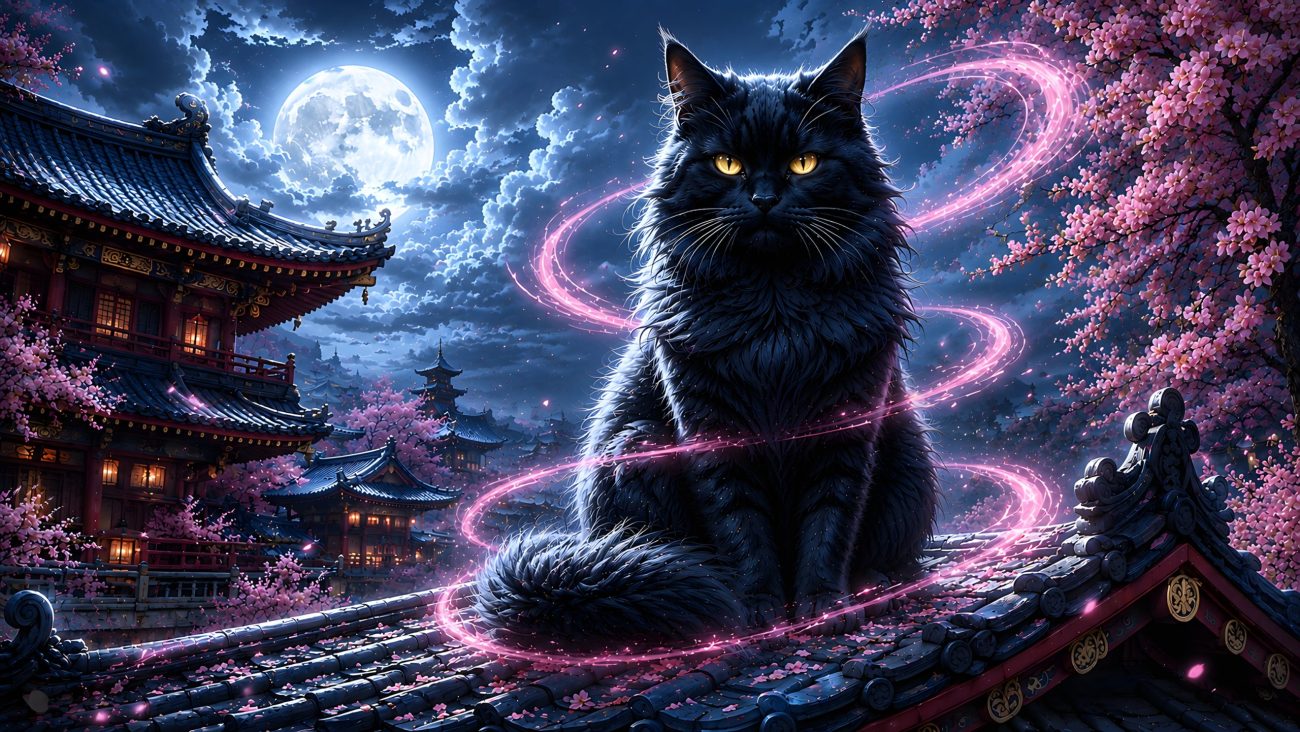
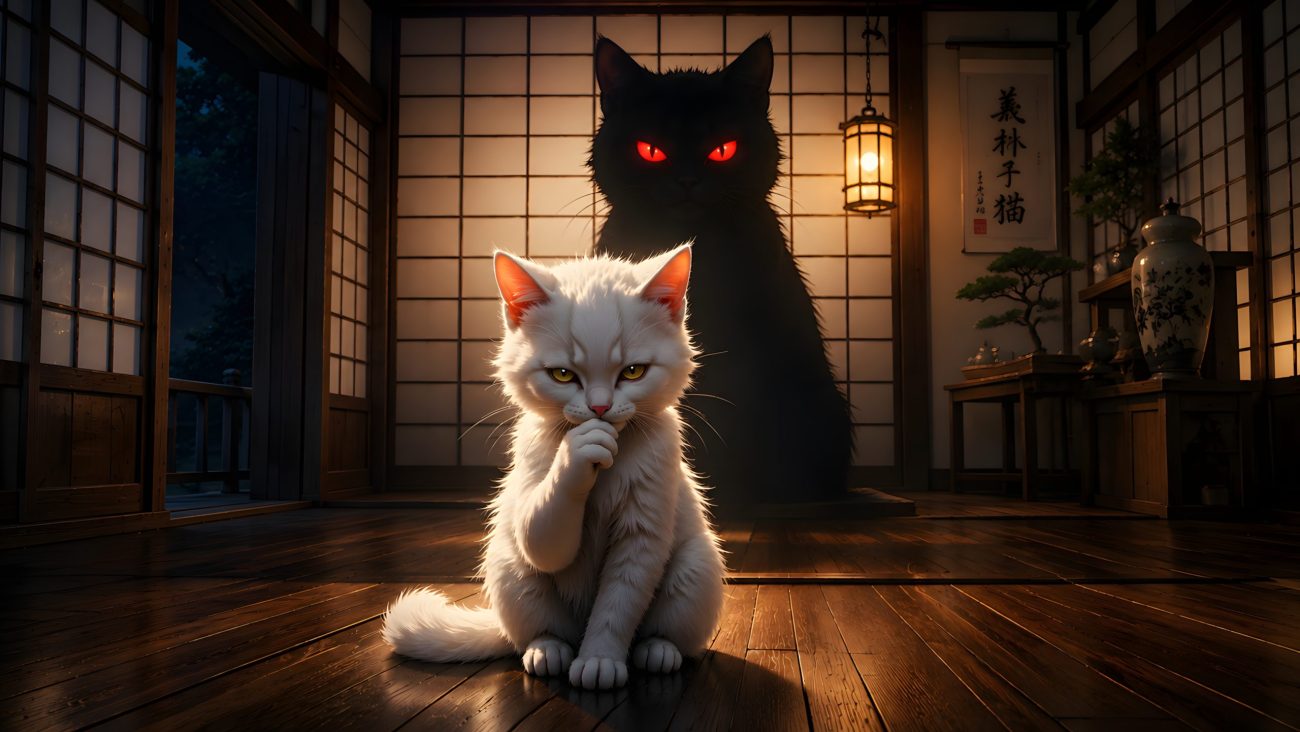
The Shusse Neko was a mysterious black cat said to appear within the Kawachi residence beyond the main gate of Fuchu Castle in Suruga Province. Anyone fortunate enough to see the cat was believed to receive good fortune. Those with great ambitions, who sought to cultivate virtue and achieve fame, were said to inevitably rise in status after encountering it. Because of its ability to bring prosperity and advancement, the mysterious black cat became known as the Cat of Success.


Sources

Takahashi, Toshihiro. “出世猫 (Shusseneko).” 新版TYZ 妖怪図鑑 (New TYZ Yokai Encyclopedia). Accessed July 28, 2026. https://tyz-yokai.blog.jp/archives/1010655155.html


Okazaki-ba-neko

Tradition / Region: Japanese Mythology
Alternative names: Okazaki Cat Monster, Spirit of the Maruko Cat Stone
Category: Cat


The Myth

The Okazaki-ba-neko first appears as an old woman wearing a twelve-layered kimono that had served as a burial shroud. She is accompanied by two pet cats that stand upright and dance, while she extends an unnaturally long tongue to lick oil from a lamp. Later she reveals her true form as a monstrous cat and finally transforms into a Kasha after emerging from the Cat Stone.

Osode traveled with her husband, Nakano Tosuke, and their infant child in search of her elder sister Omatsu, who had sold herself to earn money for their mother’s medicine. Unable to find a place to stay, they were led by their acquaintance Okura to an abandoned temple outside the post town.

Inside the temple, Osode encountered her mother, who was believed to have died of illness. The old woman was actually the monster cat in disguise. Okura witnessed the two pet cats standing on their hind legs and dancing while the old woman licked oil from a lamp with her long tongue. Because Okura had been born in the Year of the Rat, she was devoured by the cat.

At the same time, the ghost of Omatsu appeared before Osode and Fujisuke. It was revealed that Osode had unknowingly cursed her own sister, believing her to be a rival for Fujisuke’s affection. The curse disfigured Omatsu’s face, causing her to wander in search of a buyer before she was eventually murdered by Akahori Mizuemon. After learning the truth, Fujisuke declared he would divorce Osode. Overcome with despair, Osode died on the spot.

A monstrous hand then reached through a shoji screen, dragging away Osode’s body and her infant child. Behind the screen, the old cat-woman devoured them before revealing herself as the combined spirit of the Cat Stone and the ghost of Omatsu, after which she disappeared.

Later, as Omatsu’s body was brought for burial, a violent thunderstorm erupted. The Cat Stone opened its eyes and breathed fire before transforming once more into the old woman. She assumed the form of a monstrous Kasha, seized Omatsu’s corpse, and disappeared into the clouds.


Sources

Takahashi, Toshihiro. “岡崎の化け猫 (Okazaki-ba-neko).” 新版TYZ 妖怪図鑑 (New TYZ Yokai Encyclopedia). Accessed July 28, 2026. https://tyz-yokai.blog.jp/archives/1069769025.html


Neko Oni

Tradition / Region: Japanese Mythology
Alternative names: None recorded
Category: Cat


The Myth

According to a legend from Yoshima in Fukushima Prefecture, there are four ranks of horned cat demons, each possessing different powers. The legend was introduced in the Illustrated Compendium of Mythical Creatures of Japan (2016), which also features photographs of skulls said to belong to these beings.

The lowest rank is the Wild Demon, a one-horned cat that differs little from an ordinary cat and possesses no special supernatural abilities. Its traditional leader bears the title Amenokatsubushi no Mikoto.

Above them are the Ghost Demons, recognizable by their two horns. They understand human language and possess the ability to shapeshift. Their leader is known as Amenomatatabi-no-Mikoto.

The third rank consists of the Sky Demons, which have three horns. They can understand the languages of all animals and plants, shapeshift at will, and command the forces of earth, water, fire, and wind. Their leader is called Amenoshaminen-no-Mikoto.

The highest rank is the Heavenly Demons (Tenki). These beings are considered equal to gods and rarely reveal themselves or harm humans. Unlike the lower ranks, they have no horns and are completely indistinguishable from ordinary cats. No skull of a Heavenly Demon has ever been found. Their leader is traditionally named Nekoterasu-Ōmikami.

A cat demon’s rank is determined at birth and normally cannot change. However, the legend states that through constant training a cat demon may eventually lose its horns and ascend to the rank of a Heavenly Demon, which is why cat demons are said to devote themselves tirelessly to spiritual cultivation.

The legend also describes other horned demon races. Chicken demons are weaker than cat demons and are often hunted by them. Fox demons are stronger than cat demons, while bear demons are the most powerful of all, although they are said to live without conflict with the other races.

A mysterious document known as the “Cat Demon’s Apology Letter” is also associated with the tradition. Written in an unreadable script of strange symbols and accompanied by what appears to be a map, its contents remain undeciphered. The source notes that many aspects of the legend—including the divine names and the four-rank hierarchy—appear to parody elements of Japanese mythology and older folklore, and it remains uncertain whether the legend itself is genuinely ancient or a more recent creation.


Sources

Takahashi, Toshihiro. “猫鬼 (Neko-Oni).” 新版TYZ 妖怪図鑑 (New TYZ Yokai Encyclopedia). Accessed July 28, 2026. https://tyz-yokai.blog.jp/archives/1069861391.html


Nekomata

Tradition / Region: Japanese Mythology
Alternative names: Nekomata, Nekomata (猫跨, older spelling), Cat Fork-Tail
Category: Cat


The Myth

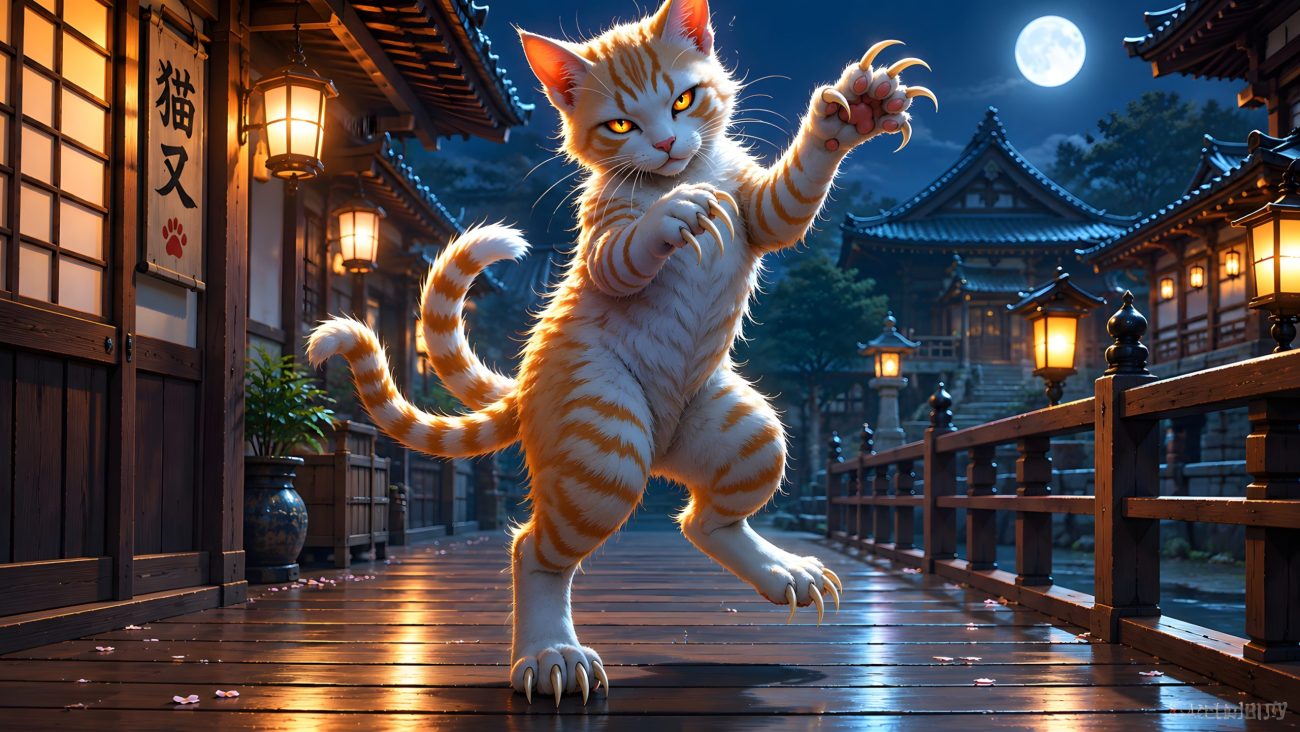
The Nekomata is one of Japan’s best-known cat yōkai. According to folklore and numerous historical texts, an ordinary cat that lives for many years may transform into a Nekomata. Its tail splits into two, and it gains supernatural powers.

Nekomata are said to speak human language, dance like people, transform into humans, and sometimes attack both humans and animals.

One of the earliest recorded accounts appears in the Meigetsuki, which states that in 1233 a Nekomata appeared near Nara, killing seven or eight people in a single night. When the beast was finally slain, it was found to have the eyes of a cat but the body the size of a dog.

The Tsurezuregusa also mentions that deep in the mountains there are Nekomata that devour people.

Later illustrated yōkai scrolls portray the creature differently. In the Hyakkai Zukan, a Nekomata is shown disguised as a woman while playing the shamisen, while Toriyama Sekien’s Gazu Hyakki Yagyō depicts a Nekomata wearing a towel over its head and dancing merrily on the veranda of a house. These portrayals reflect the belief that aged cats could become intelligent supernatural beings capable of human behavior and transformation.


Sources

Takahashi, Toshihiro. “猫又 (Nekomata).” 新版TYZ 妖怪図鑑 (New TYZ Yokai Encyclopedia). Accessed July 28, 2026. https://tyz-yokai.blog.jp/archives/1010653552.html


Neko-bakemono

Tradition / Region: Japanese Mythology
Alternative names: None recorded
Category: Cat


The Myth

The Neko-bakemono is a monster cat introduced as the final yōkai in Hyakki Hirugyō (“Daytime Parade of One Hundred Demons”), a satirical collection published in Illustrated Moral Tales (1916).

It appears as a cat standing upright on two legs, casually stroking its whiskers. The work states that this monster first became infamous through the Nabeshima Incident, one of Japan’s most famous monster cat legends.

Although it meows gently, walks without making a sound, and appears soft and harmless, its true nature is far more dangerous. The text warns readers to look beyond its pleasant appearance and notice its sharp eyes, claws, and teeth. Its sweet voice and gentle behavior are merely a disguise meant to lull people into lowering their guard before it strikes.

The Neko-bakemono is described as an extremely ferocious monster whose poisonous and cruel nature is concealed beneath a friendly exterior. The author explains that most people judge only appearances, making them easy prey for such creatures.

The work further compares the monster to deceptive people in society, stating that many women who hide their true intentions can be likened to cat monsters, and warns young men to remain cautious of outward charm that conceals dangerous motives.


Sources

Takahashi, Toshihiro. “猫化け物 (Neko-bakemono).” 新版TYZ 妖怪図鑑 (New TYZ Yokai Encyclopedia). Accessed July 28, 2026. https://tyz-yokai.blog.jp/archives/1069861234.html


Nabeshima-ba-neko

Tradition / Region: Japanese Mythology
Alternative names: Nabeshima Cat, Nabeshima Cat Incident (鍋島の化け猫), Nabeshima Ghost Cat
Category: Cat


The Myth

The Nabeshima-ba-neko is one of Japan’s Three Great Monster Cat Tales, alongside the monster cats of Okazaki and Arima. The story grew out of rumors surrounding a family dispute in the Saga Domain and later became famous through kabuki plays, storytelling, and numerous films.

The tale begins when Nabeshima Mitsushige, the second lord of the Saga Domain, kills Matashichiro, the blind head of the Ryuzoji family, during a game of Go after becoming enraged at losing. His retainers conceal the murder from the public.

When Matashichiro’s mother, Omasa, learns that Mitsushige was responsible for her son’s disappearance, she is overcome with grief. Before taking her own life, she entrusts her beloved cat Koma (also called Tama) with avenging her family. The cat drinks Omasa’s blood and disappears.

Soon afterward, supernatural events begin to plague Mitsushige and his household. During a cherry blossom viewing at the Nabeshima residence, the monstrous cat appears, murders several ladies-in-waiting, and attacks Mitsushige before being driven away by the retainer Komori Hanzaemon.

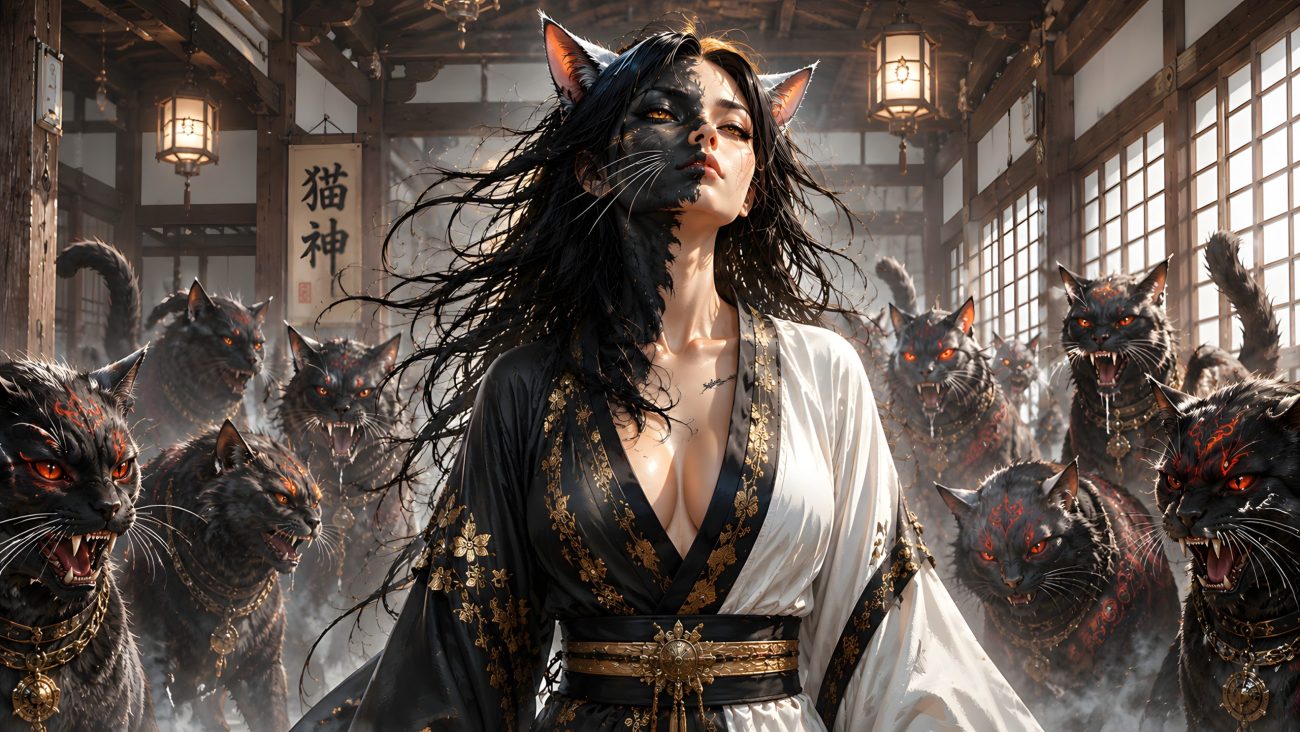
Seeking revenge against Hanzaemon, the cat kills and devours his mother and wife, assuming their appearances in an attempt to murder him. When its disguise is discovered, it escapes on a black cloud.

The curse continues. Mitsushige suffers terrifying hallucinations every night, gradually descending into madness and illness. While his concubine Otoyo-no-kata nurses him, she begins displaying bizarre behavior, secretly eating carp alive from the palace pond and licking oil from lamps during the night.

Suspicious, Hanzaemon follows her and sees her shadow on a paper screen transform into a gigantic cat. The monster has murdered and eaten Otoyo-no-kata, stolen her appearance, and infiltrated Saga Castle. From its hiding place in the Ume Palace, it torments Mitsushige while commanding other monstrous cats disguised as ladies-in-waiting to abduct children from the town for food.

Determined to end the curse, Komori Hanzaemon and Ito Sota confront the monster and its feline followers inside the palace. After the lesser cats are destroyed, the monstrous cat flees to a cave on Mount Hōman. The two warriors pursue it, slay the creature, and finally bring the haunting to an end.

According to the legend, the cat’s body was buried on the mountain, where it was later worshipped as a deity.


Sources

Takahashi, Toshihiro. “鍋島の化け猫 (Nabeshima-ba-neko).” 新版TYZ 妖怪図鑑 (New TYZ Yokai Encyclopedia). Accessed July 28, 2026. https://tyz-yokai.blog.jp/archives/1069592528.html


Motokimura-bakemono

Tradition / Region: Japanese Mythology
Alternative Name:
Category: Cat


The Myth

According to the Chikuzen no Kuni Zoku Fudoki, a mysterious monster began terrorizing Motoki Village around 1680. It visited the village headman’s house almost every night, tormenting the women. Guards assigned to protect the house were overcome by an unnatural drowsiness, allowing the creature to enter unnoticed.

The monster raped and impregnated women in the village, who later gave birth to strange infants that eventually died. Believing foxes or badgers were responsible, the villagers stationed powerful hunting dogs around the village, but the dogs were so terrified that they refused to approach the creature.

The attacks continued for years. In 1685, the local lord sent two exceptionally fierce dogs to guard the village. When the monster finally returned, one of the dogs confronted it in a violent battle. Neither gained the upper hand, and the monster escaped, leaving the dog with a deep, razor-like wound across its nose. After this encounter, the creature was never seen in the village again.

Some time later, a hunter discovered a strange beast in the nearby mountains unlike any known animal—not a boar, fox, badger, or any familiar creature. It was believed to be the same monster that had terrorized Motoki Village.

Some later traditions claim the creature was finally destroyed in 1694, and that its bones were discovered beneath a floor in 1699. A copied report attributed to the village headman included a drawing of the monster’s skull. The Kaikidan Ekotoba also depicts the creature as two black, sharp-fanged beasts of unknown name, alongside an unexplained illustration of a cat wearing a towel with a forked tail.


Sources

Takahashi, Toshihiro. “元木村の化け物 (Motokimura-bakemono).” 新版TYZ 妖怪図鑑 (New TYZ Yokai Encyclopedia). Accessed July 28, 2026. https://tyz-yokai.blog.jp/archives/1045123320.html


Myōki

Tradition / Region: Japanese Mythology
Alternative name: –
Category: Cat


The Myth

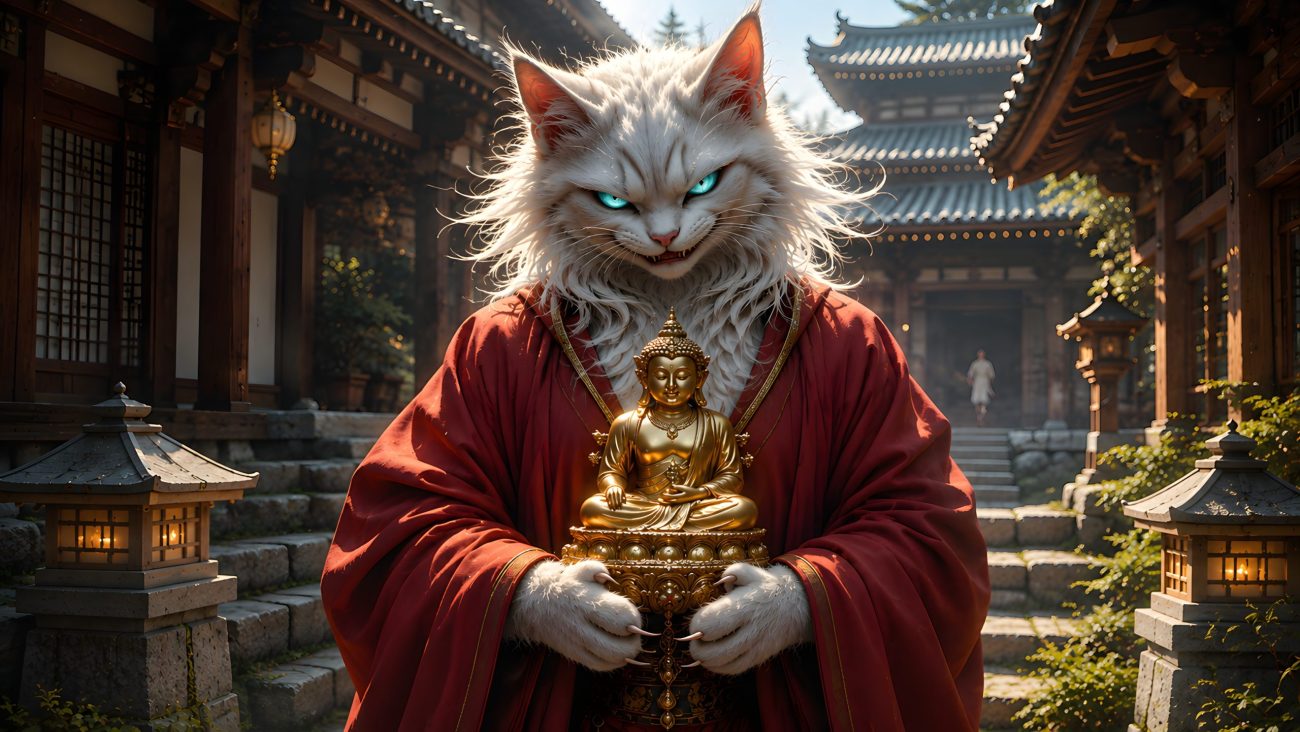
The Myōki is a cat-headed disease demon believed to bring illness. It is mentioned in medieval Japanese texts such as the Denshibyō Kanjinshō.

According to descriptions in Denshibyō Shujuji and Keiran Shūyōshū, the Myōki has the head of a cat and the body of a human, and wears red robes. It holds Hyakkō Henshō-Ō (Dainichi Nyorai / Mahāvairocana) in its left hand while striking the chest of sick people with its right hand, causing disease.

Illustrations matching this description are preserved in manuscripts of Denshibyō Shujuji, including copies kept at Kinzan-ji Temple in Okayama.


Sources

Takahashi, Toshihiro. “猫鬼 (Myōki).” 新版TYZ 妖怪図鑑 (New TYZ Yokai Encyclopedia). Accessed July 28, 2026. https://tyz-yokai.blog.jp/archives/1077741575.html


Gotoku Neko

Tradition / Region: Japanese Mythology
Alternative names: Trivet Cat
Category: Cat


The Myth

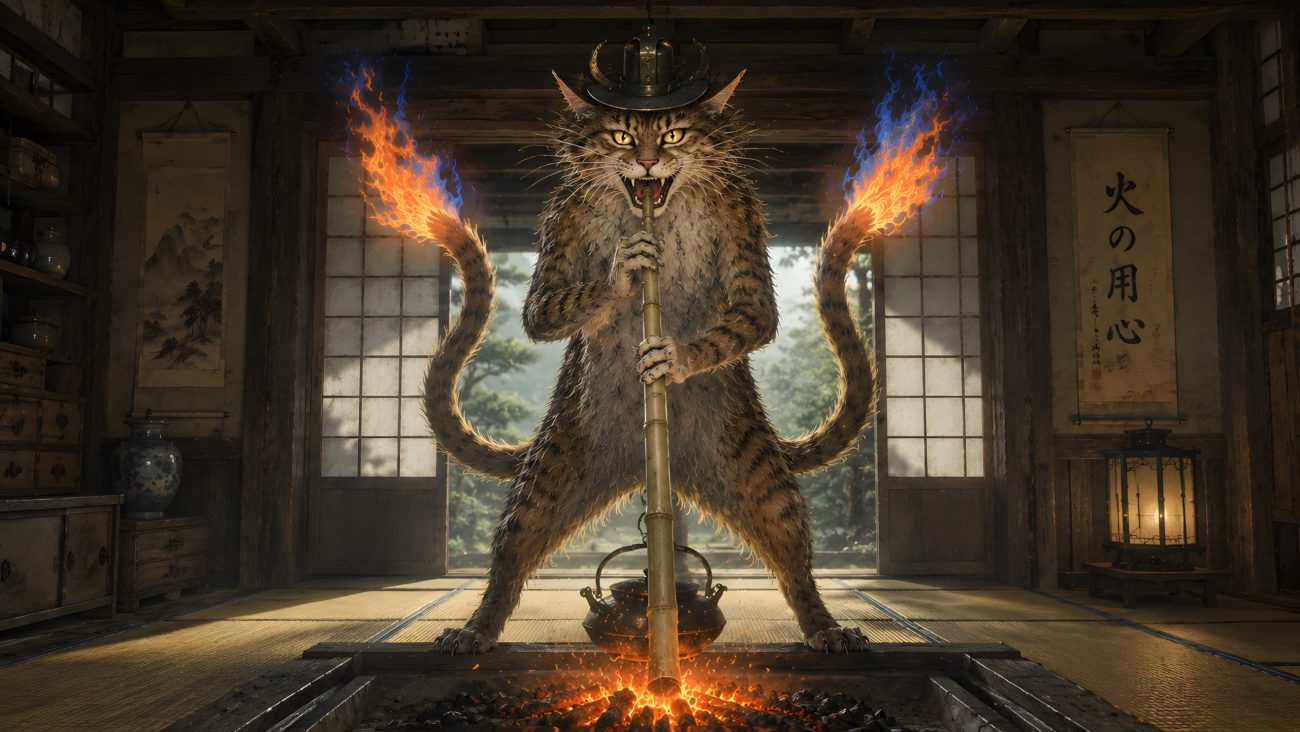
The Gotoku Neko is a type of nekomata, a supernatural two-tailed cat. It is recognized by the upside-down iron trivet it wears on its head like a hat, while the tips of its twin tails burn with bright flames.

Like ordinary cats, Gotoku Neko are drawn to the warmth of fireplaces. They linger around the hearth, using bamboo pipes to blow air onto the fire and keep the flames burning.

According to its creator, Toriyama Sekien, the Gotoku Neko is also remarkably forgetful. This trait comes from a humorous wordplay connecting the creature’s name with a story about a nobleman who forgot two of the seven virtues during a ceremonial dance and became known for performing only the “five virtues” (gotoku).

The fiery tails of the Gotoku Neko also reflect an old Japanese superstition that allowing a cat to sleep too close to the hearth could bring disaster. Sparks might ignite the cat’s tail, causing the frightened animal to run through the house and accidentally set the entire building ablaze.


Sources

Meyer, Matthew. “Gotoku Neko.” Yokai.com: The Illustrated Database of Japanese Folklore. Accessed July 28, 2026. https://yokai.com/gotokuneko/