Wildmannli

Tradition / Region: Liechtenstein Mythology
Alternative names: Wild Men / Wild Folk
Category: Cave Dweller


The Myth

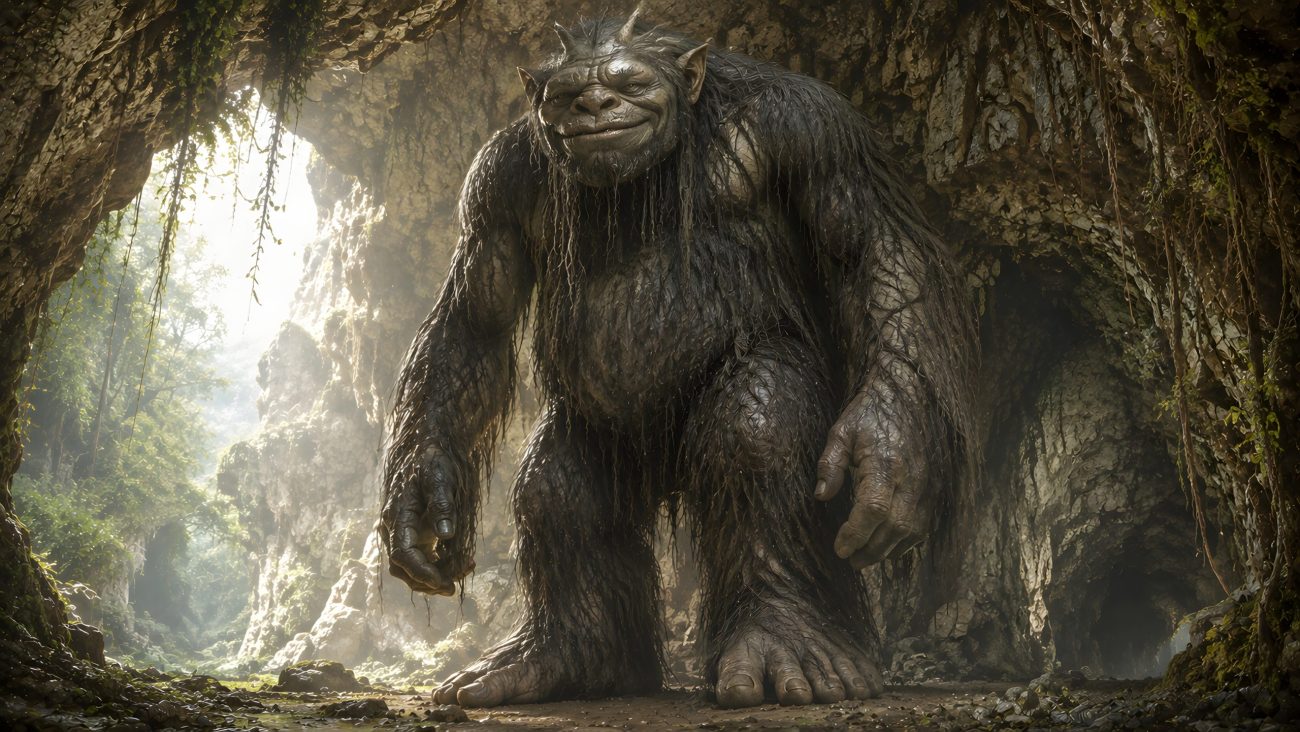
The Wildmannli were mysterious mountain beings said to live in caves high in the Alps around the Nenzing Valley and the alpine pastures of Seris. Their homes were stone caves called “Kasten,” hidden among the mountains and cliffs.

They appeared as small wild people completely covered in thick hair like bears. They wore no clothing and lived apart from ordinary humans in remote valleys and forests.

Despite their strange appearance, the Wildmannli often helped the mountain farmers. They came to the alpine meadows of Malbun and Steg and secretly cared for the cattle, feeding and watching over the animals while the herders remained below in the villages. Farmers trusted them so much that they sometimes stayed away from the high pastures for days, believing the Wildmannli would protect the livestock.

The Wildmannli, however, avoided violent weather, especially the warm alpine wind known as the Föhn. One autumn, while the wind raged high in the mountains, the farmers remained in the valley harvesting potatoes, assuming the Wildmannli would still tend the cattle. After several days, they finally climbed back into the Alps and found the animals nearly starving, because the Wildmannli had stayed hidden in their caves during the storm.

Another story tells how the Wildmannli summoned a midwife from Triesenberg to help a woman give birth deep in the mountains. After the child was born, the midwife was paid with an apron full of charcoal. Angry and disappointed, she threw away pieces of coal along the road home.

An invisible Wildmannli followed behind her, picking up the discarded coals and repeating: “The more you throw away, the less you will have.”

When the woman finally returned home, only a few pieces remained in her apron. But when she emptied them onto the stove, the charcoal had turned into shining silver coins. She rushed back to recover the discarded pieces, but they had vanished completely.

In later years, a Wildmannli was heard crying from the heights of the Ochsenkopf mountain: “Bitzi and Batzi have died!” After that night, the Wildmannli disappeared forever and were never seen again.

One cave near the mountain is still known as the Wildmannskirchle — the Little Church of the Wild Men.


Sources

SAGEN.at. (n.d.). Die Wildmannli. In SAGEN.at – Traditionelle Sagen. Retrieved May 23, 2026, from https://www.sagen.at/texte/sagen/liechtenstein/seger/wildmannli.html


Habetrot

Tradition / Region: English Mythology, Scottish Mythology
Alternate Names: Habitrot, Habtrot, Habbitrot
Category: Cave dweller


The Myth

Habetrot is an ancient and mysterious figure tied to spinning, cloth-making, and the hidden world beneath the earth. She is described as an old, deformed woman who lives underground, surrounded by other spinsters like herself—women whose bodies have been twisted and marked by endless years of spinning thread.

These women bear the physical cost of their craft. Some have flattened thumbs, others misshapen feet, and many have long, distorted lips from constantly wetting thread as they worked. Their appearance reflects both dedication and burden—beings shaped by labor to the point of becoming something almost inhuman.

Despite this unsettling form, Habetrot is not malevolent.

In the most well-known tale, she comes to the aid of a young woman who refuses or is unable to spin—an essential skill expected of women. Instead of punishing her, Habetrot secretly spins the yarn for her. When the girl later marries, Habetrot reveals herself (or is revealed) to the husband, showing the consequences of a life spent spinning.

Seeing the deformities of Habetrot and her companions, the husband is horrified and declares that his wife must never spin, sparing her from the same fate. In this way, Habetrot acts as both helper and warning—protecting the girl while embodying the extreme outcome of relentless labor.

Beyond this tale, Habetrot’s name appears in darker beliefs.

In border folklore, there were fears tied to stepping on “unchristened ground,” places where unbaptized or stillborn children were buried. Those who did were said to fall ill with a strange affliction—burning skin, trembling limbs, and difficulty breathing. This condition could not be cured by ordinary means.

The only remedy required an object of great purity and effort: a linen garment made under strict conditions—grown, spun, and crafted through a chain of honest and untouched processes. Crucially, the thread itself had to be spun by Habetrot.

This suggests that her work carried a special, almost sacred quality. Though she lived in darkness and appeared deformed, the products of her labor held protective and healing power.

Habetrot exists at the intersection of hardship and necessity. She is both a relic of relentless work and a quiet guardian who intervenes when needed—never fully kind, never truly cruel, but bound to the rhythms of labor, fate, and tradition.


Sources

Wikipedia contributors. (n.d.). Habetrot. In Wikipedia, from https://en.wikipedia.org/wiki/Habetrot


Wulver

Tradition / Region: Scottish Mythology
Alternate Names: Wullver
Category: Wolf, Cave dweller


The Myth

The Wulver is a strange being said to dwell in the Shetland Islands. Unlike many wolf-creatures of legend, it is not remembered as savage, but as solitary and oddly kind.

The Wulver is described as having the body of a man covered in short brown hair, with the head of a wolf. It lives alone in a cave dug into the side of a hill, keeping to itself and rarely approaching human settlements.

Though fearsome in appearance, the Wulver is not known to attack people without cause. Instead it spends its time fishing along the shore. It is said to sit for hours upon a rock in deep water, catching fish with patience and skill.

In many stories, the Wulver shows quiet generosity. After a successful catch, it sometimes leaves fish on the windowsills of poor families, slipping away unseen before anyone can thank it. Because of this, locals came to regard it not as a monster but as a strange neighbor — a creature of the wild who could be respected if left in peace.

The Wulver remains a figure of solitude rather than terror: a wolf-headed being who lives apart from mankind, neither fully beast nor fully human, sharing the land without seeking to rule it.


Gallery


Sources

Wikipedia contributors. (n.d.). Wulver. In Wikipedia, from https://en.wikipedia.org/wiki/Wulver


Interpretive Lenses

Religious Readings
  • Christian Ascetic Deep Dive
Philosophical Readings
  • Nietzschean Deep Dive
Psychological Readings
  • Jungian Deep Dive
Esoteric Deep Dive
  • Hermetic Deep Dive
Political / Social Readings
  • Marxist Deep Dive

Wölfraleh Woman of Beringen

Tradition / Region: Luxembourg Mythology
Alternate Names: Wölfra, Wild Woman of Wölfraleh
Category: Cave dweller, Spinner


The Myth

In the Beringer Forest stands a high rock known as Wölfraleh, the Rock of the Wild Woman. It is hollowed out into a roughly square chamber with one side open, and a narrow stairway leads up from below.

According to the old stories, a wild woman once lived there, alone in the stone chamber. Others say that it was not a spirit but a lonely, childless couple who once made their dwelling in the rock, cut off from the rest of the world.

A similar tale is told of another hollow rock near Mersch, where a woman once lived entirely by herself. She did nothing but spin and lived in such isolation that people called her Wölfra, the solitary one.

Thus the rocks of the region were remembered as the homes of a lone woman who lived apart from all others, spinning in her stone dwelling.


Gallery


Sources

sagen.at contributors. (n.d.). Die Wölfraleh bei Beringen. In sagen.at, from https://www.sagen.at/texte/sagen/luxemburg/woelfraleh.html


Interpretive Lenses

Religious Readings
  • Christian Ascetic Deep Dive
Philosophical Readings
  • Nietzschean Deep Dive
Psychological Readings
  • Jungian Deep Dive
Esoteric Deep Dive
  • Hermetic Deep Dive
Political / Social Readings
  • Marxist Deep Dive

Wild Woman of La Sauvage

Tradition / Region: Luxembourg Mythology
Alternate Names: Wild Woman of the Val de la Sauvage Femme
Category: Cave dweller


The Myth

Before the ironworks of La Sauvage were built in the early seventeenth century, the valley was uninhabited and known as the Valley of the Wild Woman. The name came from a fearsome being said to live in a cave in the rock of La Cronnière.

She was said to feed on raw meat. Thick hair covered her entire body and hung down to her feet, serving as her only clothing. Her eyes, red-rimmed and buried deep beneath her hair, glowed like coals. From her wide mouth protruded double rows of teeth, and her voice sounded like the hooting of an owl. Her fingers ended in sharp claws with which she tore apart the game she hunted or the sheep she seized from the fields.

When the wild woman died, the tale says she was refused entry to Hell because she was mistaken for the female of a wild animal. Forced back to the earth, she returned as a dreadful ghost and wandered the valley by night, spreading terror throughout the surrounding region.

At last a pious hermit from the Selomon Forest drove her spirit away across the sea. He did so by invoking Saint Donatus and Our Lady of Luxembourg, and in remembrance of this deliverance, their holy images were placed upon the rock of La Cronnière.


Gallery


Sources

sagen.at contributors. (n.d.). Die wilde Frau zu La Sauvage. In sagen.at, from https://www.sagen.at/texte/sagen/luxemburg/Wilde_Frau_La_Sauvage.html


Interpretive Lenses

Religious Readings
  • Christian Ascetic Deep Dive
Philosophical Readings
  • Nietzschean Deep Dive
Psychological Readings
  • Jungian Deep Dive
Esoteric Deep Dive
  • Hermetic Deep Dive
Political / Social Readings
  • Marxist Deep Dive

Wild Woman of the Wôbâch

Tradition / Region: Luxembourg Mythology
Alternate Names: Wild Woman of Wölfragrond
Category: Cave dweller


The Myth

In the valley of the Wôbâch, a small stream that flows into the Eisch between Simmern and Heckenhof, there once lived a wild woman in a cave. Because of her, the place came to be called Wölfragrond.

She was said to be completely covered in hair from head to foot. By day she hid in her cave, but as soon as night fell she came out and walked along the banks of the Eisch. There she attacked and strangled whatever she could seize, whether human or animal. Because of this, no one dared to pass through the place at night.

At last a knight from Simmer Castle set out to rid the region of the creature. Whether he ambushed her or met her by chance, he took the silver cross from his rosary, hammered it into a ball, and loaded it into his rifle. With this bullet he shot and killed the wild woman, and the valley was freed from her terror.


Gallery


Sources

sagen.at contributors. (n.d.). Die wilde Frau in der Wôbâch. In sagen.at, from https://www.sagen.at/texte/sagen/luxemburg/Wilde_Frau_Wobach.html


Interpretive Lenses

Religious Readings
  • Christian Ascetic Deep Dive
Philosophical Readings
  • Nietzschean Deep Dive
Psychological Readings
  • Jungian Deep Dive
Esoteric Deep Dive
  • Hermetic Deep Dive
Political / Social Readings
  • Marxist Deep Dive

Gnome of Dondelange

Tradition / Region: Luxembourg Mythology
Alternate Names: Dondelange Gnomes, Fäsch Gnomes, Family of Frau Holle
Category: Gnome, Cave dweller


The Myth

In a place called Fäsch near Dondelange, there stands a high rock that contains a large cave. This cave was said to have once been the dwelling of a family of gnomes, whose mother was known as Frau Holle.

One day, a farmer named Michel Wagner was plowing a field not far from the rock. Around ten o’clock he stopped to rest and smoke his pipe. As he sat there, he heard voices coming from within the rock, calling out: “Bake me a Pflamb! Me too, a Pflamb! Me too, a Pflamb!”

Amused, the farmer called back jokingly, “Me too, a Pflamb!”

When he returned to his work and later in the afternoon prepared to leave, he found that a fine cake was hanging from his plow. It was said to be so delicious that even the best confectioner of the time could not have baked a better one.


Gallery


Sources

sagen.at contributors. (n.d.). Die Wichtelcher zu Dondelingen. In sagen.at, from https://www.sagen.at/texte/sagen/luxemburg/Wichtlein_Dondelingen.html


Interpretive Lenses

Religious Readings
  • Christian Ascetic Deep Dive
Philosophical Readings
  • Nietzschean Deep Dive
Psychological Readings
  • Jungian Deep Dive
Esoteric Deep Dive
  • Hermetic Deep Dive
Political / Social Readings
  • Marxist Deep Dive
Other
  • How to Invite The Gnome of Dondelange

Skarbnik

Tradition / Region: Polish Mythology, Ukranian Mythology, Belarusian Mythology
Alternate Names: Kladenets; Dzedka
Category: Cave dweller


The Myth

Deep beneath the earth, in the winding tunnels of mines and forgotten shafts, dwells the Skarbnik—the Treasurer of the underworld. He is the unseen guardian of gems, crystals, and precious metals, watching over the hidden wealth buried in stone.

Miners speak of him in hushed voices. To those who work honestly and show respect, Skarbnik is a silent protector. When tunnels groan and timbers strain, he may guide a worthy miner away from danger. When a man loses his path in the dark labyrinth underground, a whisper, a faint glow, or the echo of a step may lead him safely back. At times, Skarbnik rewards diligence by revealing a rich vein of ore, leading the faithful straight to silver, coal, or gold.

But Skarbnik is not gentle with the wicked.

Those who curse in the tunnels, mock the spirit, or treat the mine with arrogance soon feel his wrath. It is forbidden to whistle underground, to hurl stones in anger, or to cover one’s head in disrespect. Such acts insult the Treasurer. First comes a warning—a sudden shower of loose soil striking the offender, small clods thrown from unseen hands. If the warning is ignored, harsher punishment follows. Tunnels collapse without mercy. Dark chasms open beneath careless feet. Stones fall from above with deadly aim.

To the greedy and cruel, Skarbnik is a relentless judge. To the humble and respectful, he is a guardian and guide.

Thus the miners say that no one truly works alone beneath the earth. The Treasurer watches always, weighing the hearts of men as carefully as the ore they seek.


Sources

Wikipedia contributors. (n.d.). Karzełek. In Wikipedia, The Free Encyclopedia. Retrieved February 13, 2026, from https://en.wikipedia.org/wiki/Karze%C5%82ek


Viy

Tradition / Region: Ukrainian Mythology
Alternate Names:
Category: Gnome, Cave dweller


The Myth

Viy is the master of what lives beneath the earth.

He is said to be the chief of the gnomes and underground beings, an ancient creature so heavy with age and power that his body can scarcely move. His most terrible feature is his eyes. Their eyelids are so vast, thick, and heavy that they drag upon the ground, and Viy himself cannot lift them. When he wishes to see, his servants must raise the lids with iron hooks.

But when his eyes are opened, nothing can hide.

Walls, prayers, circles of protection — all are useless before his gaze. Whatever Viy looks upon is exposed, stripped of concealment, and marked for death. His sight penetrates earth, flesh, and soul alike.

In the tale, Viy is summoned when lesser demons and spirits fail. They call upon him as a final authority, a being whose vision cannot be deceived. When he appears, the ground trembles under his weight. His voice is slow and crushing, and the air grows heavy in his presence.

When Viy’s eyes are lifted and he sees his victim, the victim is doomed. Terror itself seems to answer his gaze, and death follows as a certainty, not as a struggle.

Viy does not chase, does not rage, does not strike. He merely sees.

And that is enough.

He remains a figure of the deep earth and the dark boundary between life and death — a lord not of speed or violence, but of inescapable truth, whose opened eyes end all illusion.


Sources

Wikipedia contributors. (n.d.). Viy (story). In Wikipedia, The Free Encyclopedia, from https://en.wikipedia.org/wiki/Viy_(story)


Acalica

Tradition / Region: Bolivian Mythology
Alternate Names:
Category: Gnome, Cave dweller


The Myth

High in the Bolivian mountains, where clouds cling to stone and storms rise without warning, people speak of the Acalica. They are said to dwell deep within caves hidden in cliffs and ravines, places where thunder echoes long after the sky has cleared. These beings are rarely seen, and most who believe in them know them only through the sudden turning of the weather.

The Acalica are small, wizened men when they choose to appear, bent like ancient roots, their faces lined as though carved by wind and rain. But they do not often show themselves. Instead, their presence is felt when calm skies darken, when hail falls unexpectedly, or when drought ends with sudden rain. Shepherds and travelers say that storms do not come by chance in the mountains — they are sent.

It is believed that the Acalica govern rain, wind, and frost from their rocky shelters. When angered, they unleash violent weather that can ruin crops or make mountain paths deadly. When appeased, they bring gentle rains that nourish the fields. Because of this, people once spoke softly near caves and avoided disturbing stones or entrances in the highlands, fearing they might offend the hidden masters of the sky.

Though few claim to have seen them directly, the Acalica remain part of the living landscape — not creatures of open legend, but of whispered caution — reminders that in the Andes, the weather itself may be listening.


Sources

Wikipedia contributors. (n.d.). Acalica. In Wikipedia, The Free Encyclopedia, from https://en.wikipedia.org/wiki/Acalica