Tradition / Region: English Mythology, Scottish Mythology
Alternate Names: Habitrot, Habtrot, Habbitrot
Category: Cave dweller
The Myth
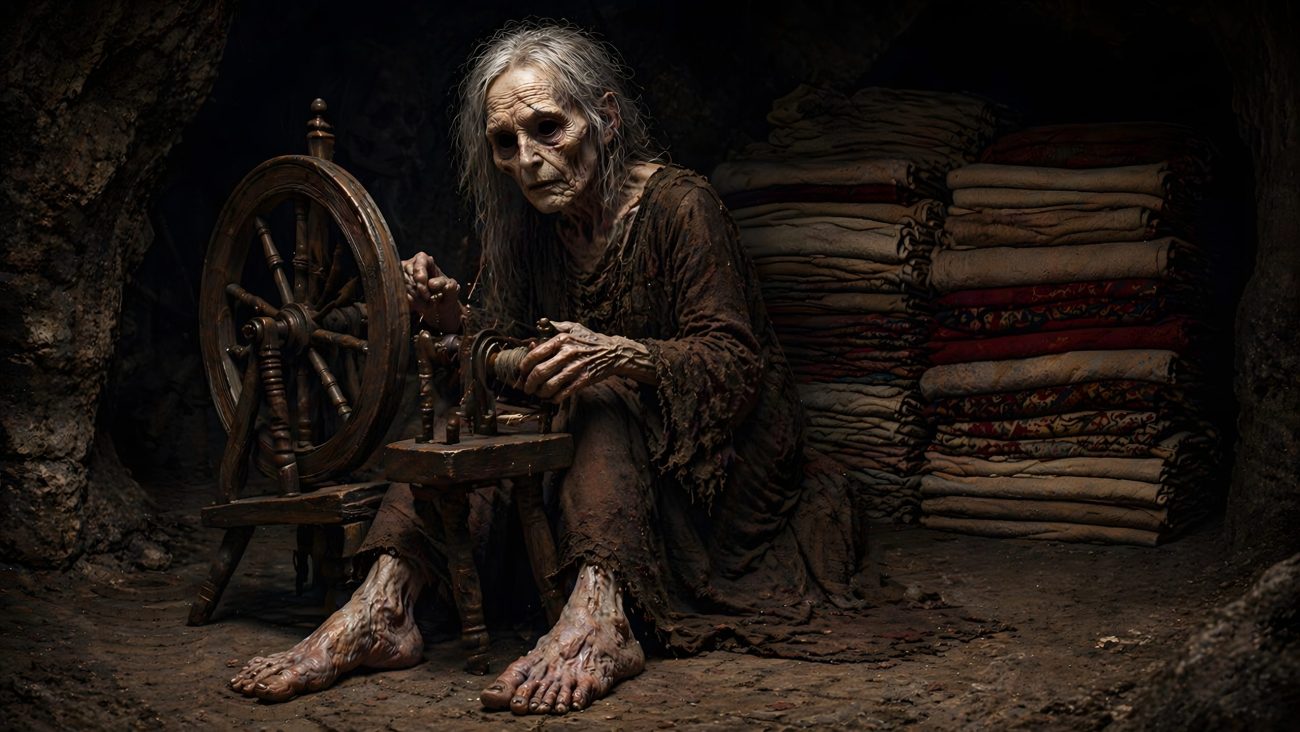
Habetrot is an ancient and mysterious figure tied to spinning, cloth-making, and the hidden world beneath the earth. She is described as an old, deformed woman who lives underground, surrounded by other spinsters like herself—women whose bodies have been twisted and marked by endless years of spinning thread.
These women bear the physical cost of their craft. Some have flattened thumbs, others misshapen feet, and many have long, distorted lips from constantly wetting thread as they worked. Their appearance reflects both dedication and burden—beings shaped by labor to the point of becoming something almost inhuman.
Despite this unsettling form, Habetrot is not malevolent.
In the most well-known tale, she comes to the aid of a young woman who refuses or is unable to spin—an essential skill expected of women. Instead of punishing her, Habetrot secretly spins the yarn for her. When the girl later marries, Habetrot reveals herself (or is revealed) to the husband, showing the consequences of a life spent spinning.
Seeing the deformities of Habetrot and her companions, the husband is horrified and declares that his wife must never spin, sparing her from the same fate. In this way, Habetrot acts as both helper and warning—protecting the girl while embodying the extreme outcome of relentless labor.
Beyond this tale, Habetrot’s name appears in darker beliefs.
In border folklore, there were fears tied to stepping on “unchristened ground,” places where unbaptized or stillborn children were buried. Those who did were said to fall ill with a strange affliction—burning skin, trembling limbs, and difficulty breathing. This condition could not be cured by ordinary means.
The only remedy required an object of great purity and effort: a linen garment made under strict conditions—grown, spun, and crafted through a chain of honest and untouched processes. Crucially, the thread itself had to be spun by Habetrot.
This suggests that her work carried a special, almost sacred quality. Though she lived in darkness and appeared deformed, the products of her labor held protective and healing power.
Habetrot exists at the intersection of hardship and necessity. She is both a relic of relentless work and a quiet guardian who intervenes when needed—never fully kind, never truly cruel, but bound to the rhythms of labor, fate, and tradition.
Sources
Wikipedia contributors. (n.d.). Habetrot. In Wikipedia, from https://en.wikipedia.org/wiki/Habetrot