Tradition: Sardinian Mythology, Italian Mythology
Alternative Names: Musca Manchèdda da Mancu; Fly of the Left Hand
Category: Insect
The Myth
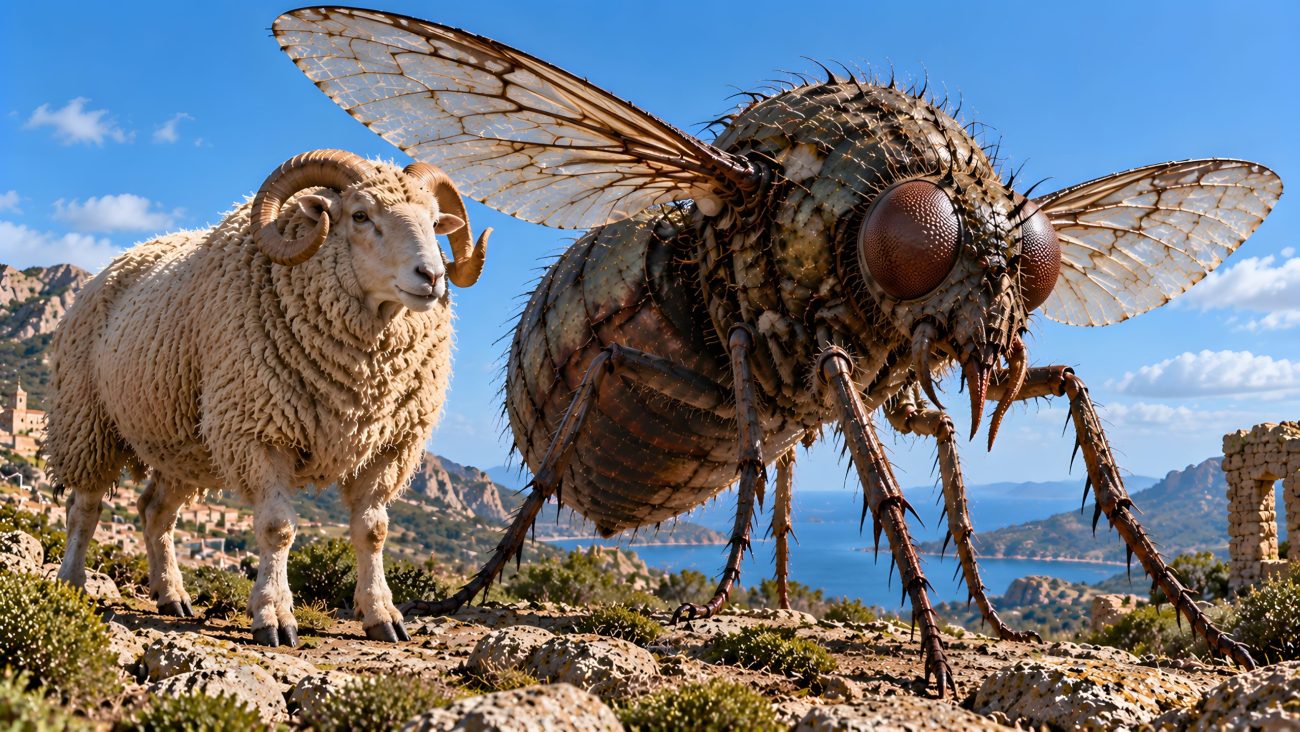
The Musca Macedda is a monstrous fly from Sardinian folklore, resembling an ordinary fly but growing to an enormous size. Some accounts describe it as being as large as a sheep, while the specimen reported at Nuchis was said to have been as big as an ox’s head. It possesses powerful wings and a gigantic, deadly stinger. Its infernal buzzing can supposedly be heard in places where these creatures lie buried, warning people of the terrible danger beneath the ground.
The Musca Macedda is associated with destruction, slaughter, and the devastation of entire communities. According to Sardinian legends, a terrible treasure lies hidden in many locations across the island. It consists of two identical barrels: one contains unimaginable riches, while the other holds deadly flies. Anyone who opens the wrong barrel unleashes the Musca Macedda, bringing death not only upon themselves but also threatening the destruction of the entire world. The treasure is said to exist in numerous places, including near Alghero, Esterzili, Sorgono, and the Church of Valenza, yet nobody has dared to open the barrels.
The creature’s name is associated with massacre and slaughter. It is also called the musca manchèdda da mancu, meaning the fly of the left hand. This name reflects the belief that the right hand belongs to God, while the left belongs to the Devil, linking the fly to demonic forces and destruction.
Local legends tell of entire settlements devastated by these monstrous insects. At Iglesias, a holy man was said to have delivered the country from demonic flies that had already destroyed towns and villages, including Galte in Nuorese, Ilani near Orotelli, Oddini, and Thiddorai. Another Musca Macedda ravaged the region around Nuchis before finally dying between the Church of San Cosimo and the Parish of the Holy Spirit, near two black volcanic boulders.
The Musca Macedda may represent an ancient fear of epidemics and widespread disease. Some traditions connect the flies with the Spanish invasion of Sardinia, and one story claims that they emerged from the tomb of a Spanish saint. Another interpretation sees them as personifications of the devastating illnesses that repeatedly afflicted the island. Whatever their origin, these legends portray the Musca Macedda as a demonic force whose release could bring death and ruin on an immense scale.
Sources
“Musca Macedda.” A Book of Creatures, May 4, 2020. https://abookofcreatures.com/2020/05/04/musca-macedda/