Tradition: Greek Mythology, Indian Mythology
Alternative Names: Indian Gold-Digging Ants; Myrmekes
Category: Insect
The Myth
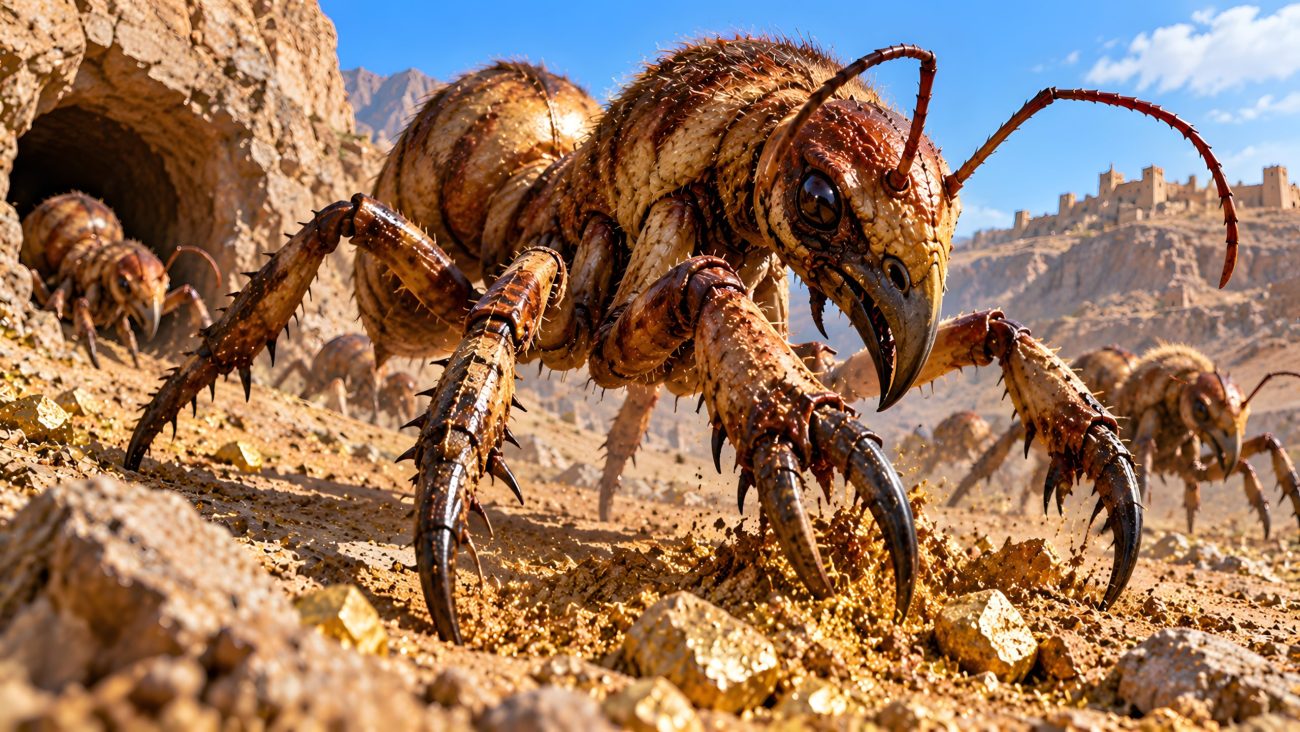
Gold-digging ants are enormous, powerful creatures said to inhabit gold-rich deserts in distant lands. Herodotus placed them in the sandy deserts of the Dards in India, within the Persian Empire, while later accounts, including the Ortus Sanitatis, relocated them to Ethiopia. Despite the differences in their supposed homeland, the stories describe creatures that dig up precious gold and fiercely defend their territory.
These creatures are smaller than dogs but larger than foxes. Pliny compared their size to that of an Ethiopian wolf and described their colour as resembling a cat. Skins attributed to the ants and presented before Alexander the Great were said to resemble panther skins. In the Ortus Sanitatis, however, the gold-digging ant looks unlike any ordinary ant or familiar animal. It has a rounded, bird-like head and four legs equipped with long talons. Whatever their appearance, the creatures are described as exceptionally swift, strong, and dangerous.
Gold-digging ants excavate their nests in areas rich in gold dust. As they dig underground, they bring sand containing the precious metal to the surface. This makes their nests tempting targets for treasure seekers, but the ants guard their riches aggressively. Anyone who attempts to steal their gold risks being caught and torn apart by the creatures.
Treasure hunters use camel caravans to raid the nests during hot summer mornings, when the ants remain underground. They rapidly collect the gold-bearing sand and load it into bags before the creatures detect their presence. However, the ants soon catch the scent of the intruders and rush to the surface. The camels must have a substantial head start, because the pursuing creatures are said to be fast enough to catch them and dismember them if they fail to escape.
The true identity of the gold-digging ants remains uncertain. Various explanations have suggested that they were not insects at all, but mammals whose digging habits and ferocity inspired the stories. Proposed candidates include hyenas, whose Persian name may have resembled the Greek word for ant, and Siberian foxes, which are known for digging and fierce behaviour. Another theory identifies the creatures as Himalayan marmots, whose extensive burrowing could bring gold-bearing material to the surface. According to this explanation, the Greek word murmex, meaning ant, may have contributed to confusion between ants and marmots.
Sources
“Gold-Digging Ant.” A Book of Creatures, August 22, 2016. https://abookofcreatures.com/2016/08/22/gold-digging-ant/