Tradition: Greek Mythology, Indian Mythology
Alternative Names: Worms of the Indus
Category: Insect
The Myth
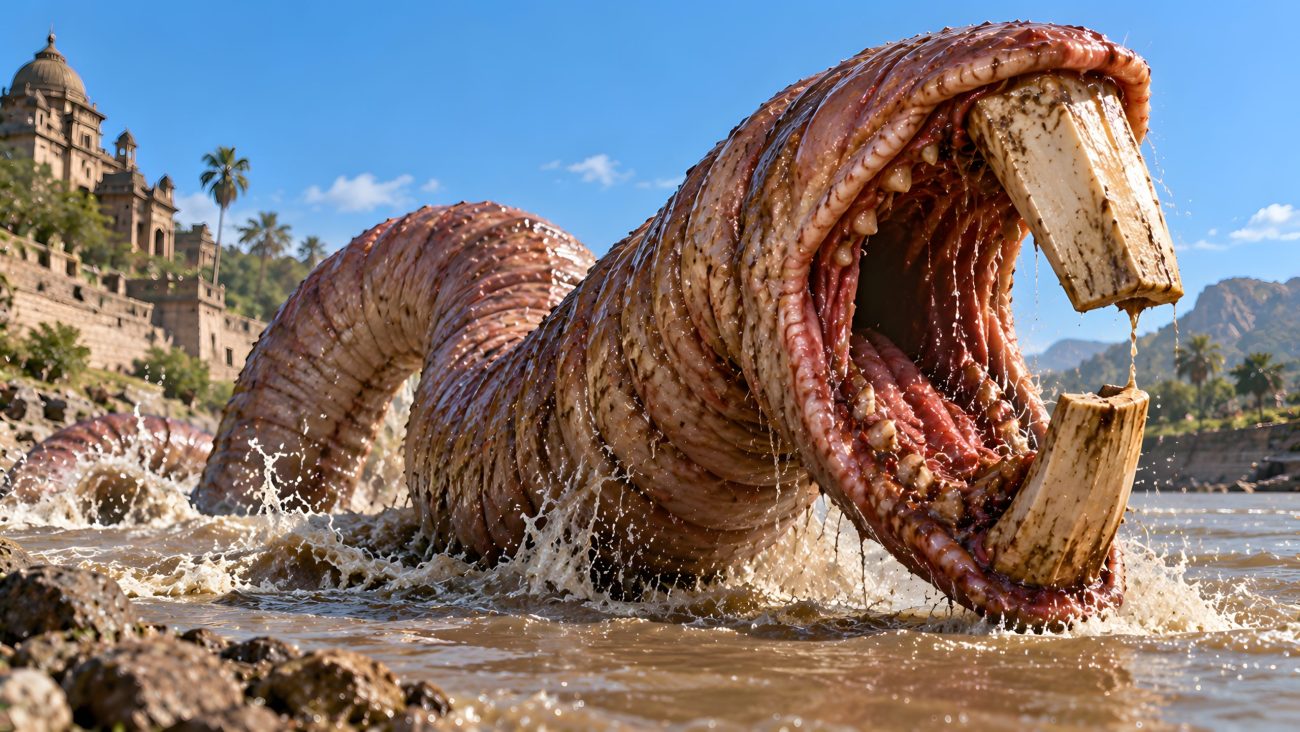
The Indus worm is a gigantic aquatic predator said to inhabit the Indus River in India. It resembles the worms found in figs or rotten wood, but grows to an enormous size, measuring around seven cubits, or more than three metres, in length. Its body is so thick that a ten-year-old boy could barely wrap his arms around it, and its skin is approximately two fingers thick. Its most terrifying features are two enormous, square teeth, one in its upper jaw and one in its lower jaw, each measuring about eighteen inches long.
During the day, the worms remain submerged in the river, wallowing in the mud. At night, they emerge to hunt animals as large as cows and camels. They seize their prey, drag it into the water, and devour it at leisure, crushing flesh, bone, and even stone with their immense teeth. Only the animal’s paunch is left uneaten. There are also accounts of hungry worms attacking drinking camels and oxen in broad daylight, grabbing them by the nose and dragging them beneath the water.
Despite their terrifying nature, the Indus worms are prized for the oil contained within their bodies. This oil is extraordinarily flammable and can consume wood and animals alike. Fires started with it are said to be almost impossible to extinguish, requiring large quantities of clay and rubbish to smother the flames. Because the oil is so rare and valuable, only the king of India is permitted to possess it, and it is stored in clay vessels for use as a devastating weapon during sieges.
Obtaining the oil requires a dangerous expedition. Hunters capture a worm using a hook baited with a lamb or kid chained to it. Once the creature is hauled ashore, it is killed with javelins, swords, and clubs. The carcass is then suspended for thirty days, with vessels placed beneath it to collect the oil that slowly drips from its body. A single worm yields approximately five pints of oil before its remains are discarded and the precious substance is sent to the king.
The Indus worm has sometimes been compared to the Odontotyrannus, another legendary creature associated with India. Both are described as dangerous predators connected with aquatic environments, although their other characteristics differ.
Sources
“Indus Worm.” A Book of Creatures, October 3, 2016. https://abookofcreatures.com/2016/10/03/indus-worm/