Tradition: Japanese Mythology
Alternative Names: Gejigeji no Bakemono, Geji Monster
Category: Insect
The Myth
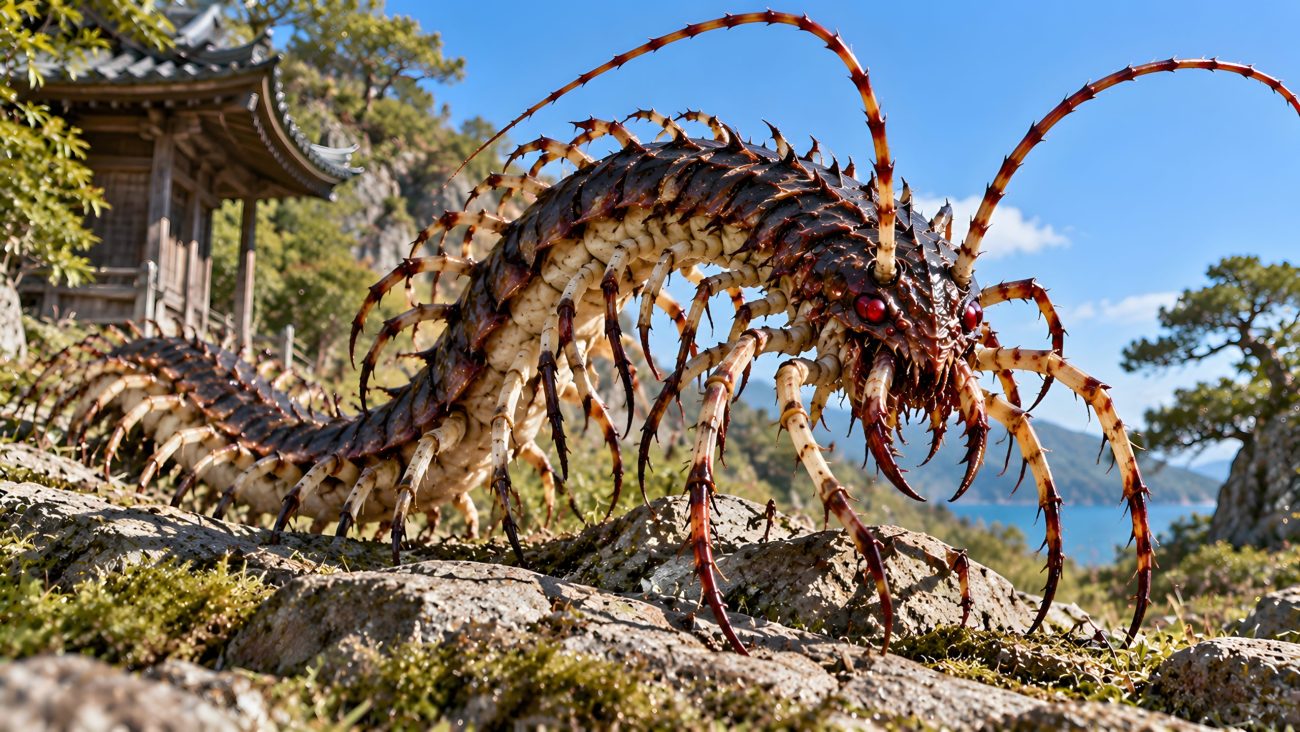
Gejigeji no Bakemono is a strange monster associated with the geji, a many-legged creature known for its unsettling appearance. Like centipedes and spiders, these creatures were sometimes hated as pests or regarded as ominous beings. Its unusual form made it a natural subject for supernatural imagery in Japanese folklore.
During the Edo period, a set of playing cards featuring yōkai included a card called Gejigeji no Bakemono, meaning the Gejigeji Monster. The creature depicted on this card later became the model for the centipede illustration used by the renowned manga artist Shigeru Mizuki, helping spread this particular monster’s appearance to a wider audience.
A widespread folk belief held that anyone licked by a gejigeji would lose their hair. This strange superstition was recorded in different parts of Japan, but its origins were disputed. The scholar Yamazaki Yoshinari, writing in Seji Hyakudan, argued that the belief originally concerned not an insect but a demonic spirit known as Gejiki (下食).
According to this explanation, Gejiki was a demon or divine spirit associated with a day when the essence of the Tengu star was believed to descend to the human world in search of food. Drawing on the Gōke Shidai, Yamazaki described a belief that bathing on this day could cause a demon to lick a person’s head, resulting in hair loss. He connected this tradition with the Chinese disease known as Kiteitō (鬼舐頭), also associated with hair loss caused by a demon licking the head.
Yamazaki therefore proposed that the name geji originated as an abbreviation of Gejiki, and that the supposed insect responsible for hair loss had become confused with an older supernatural belief. The Gejigeji Monster thus occupies an unusual place in Japanese folklore, where fear of a real many-legged creature became intertwined with traditions about demons, misfortune, and mysterious hair loss.
Sources
“Gejigeji.” 新版TYZ 妖怪図鑑 (New TYZ Yokai Encyclopedia). https://tyz-yokai.blog.jp/archives/1010654300.html