Flying Dragon of Lower Bavaria

Tradition: German Mythology
Alternative Names: Drack, Drache, Flying Dragon
Category: Dragon


The Myth

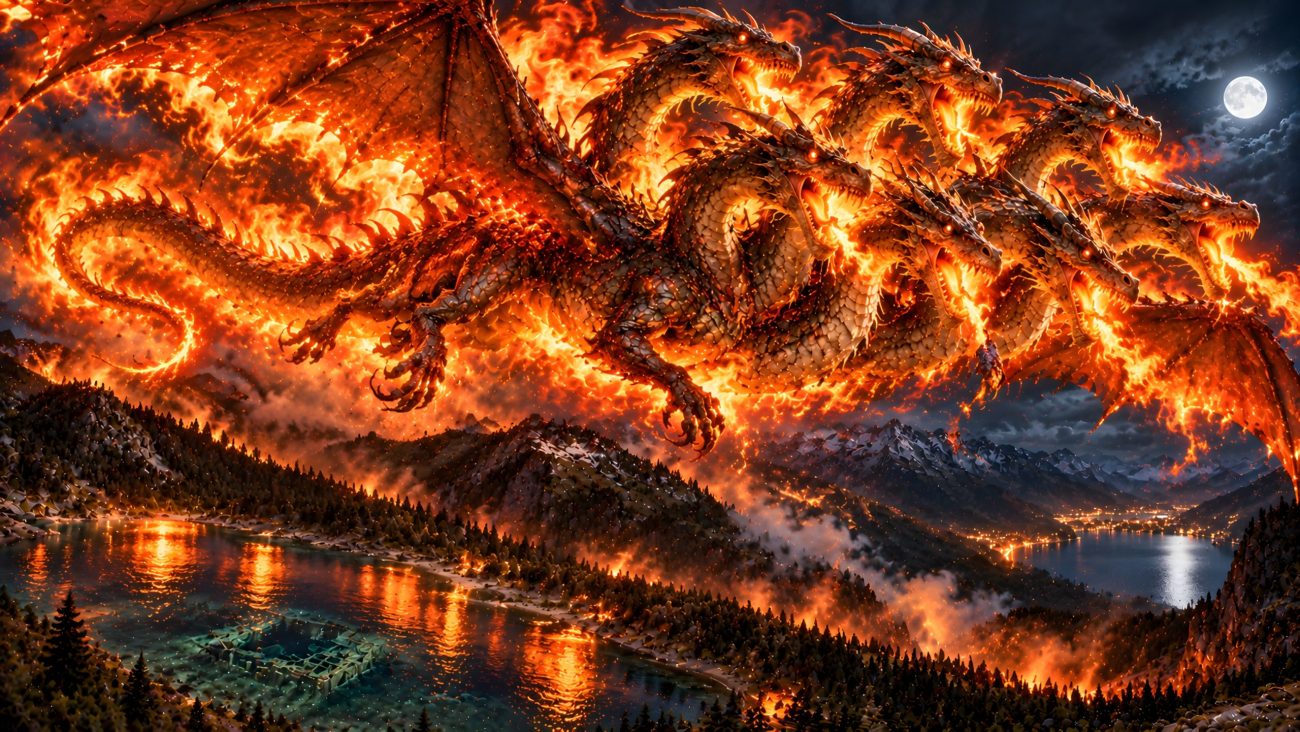
The dragons of old Bavarian stories were terrifying, fire-breathing creatures that flew through the night sky. Although belief in such monsters had largely faded, their memory survived in the regional insult “Drack,” used for someone who had behaved maliciously or played a nasty trick.

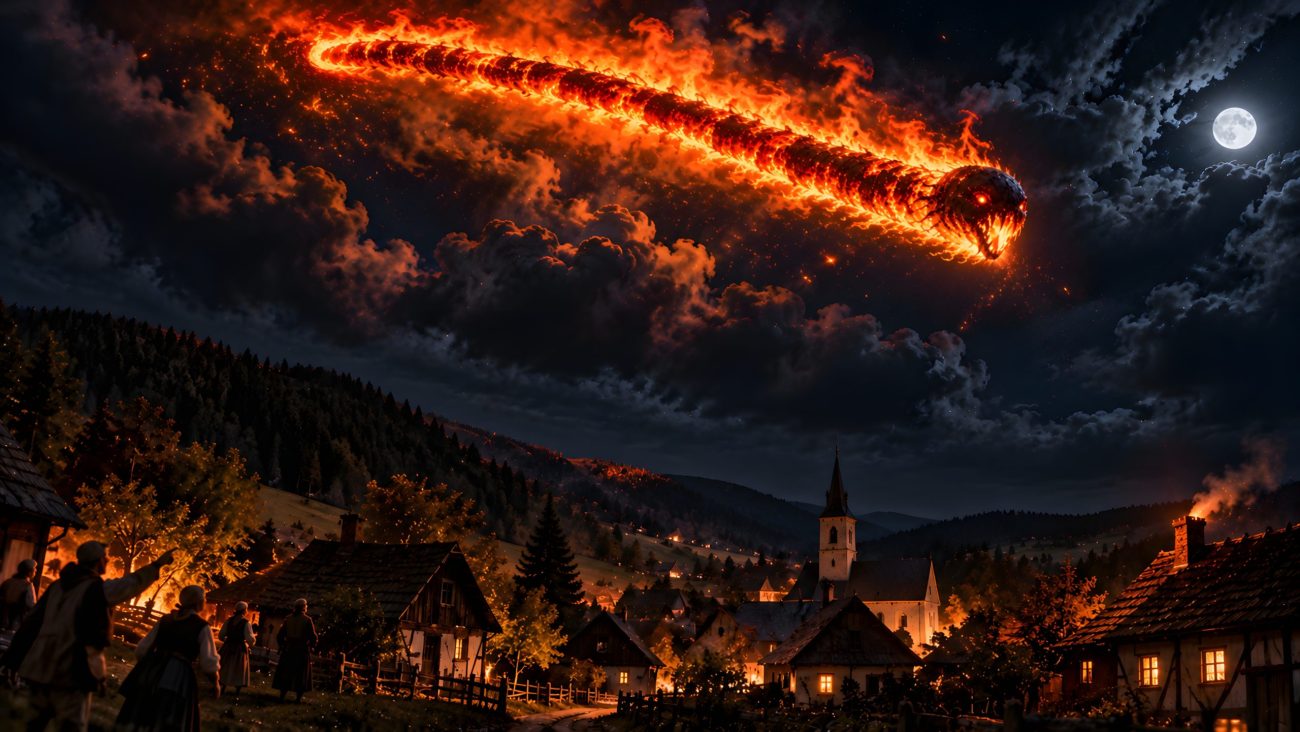
Yet people in the region continued to tell stories of having actually seen dragons. One woman recalled that around forty years earlier, when she was six years old, she had been sitting on a table one evening and looking out of the window. Suddenly the sky became illuminated, and something resembling a burning Wiesbaum—a long wooden pole or beam used in the countryside—flew over the village. Its front portion, however, was completely black.

The fiery object crossed the road near her family’s house while her mother watched it as well and called out that something was flying outside. The strange creature then disappeared into a neighbour’s chimney. From inside the neighbouring house came only a brief crashing noise, after which everything became quiet again.

The dragon was also repeatedly seen at Fahrnbach near Bischofsmais. During flax-breaking work, people reportedly saw it after eleven o’clock at night. There it appeared as a burning Wiesbaum with a black, spherical head, rushing through the darkness before disappearing over the forest.

Greising was another place where the dragon was said to appear repeatedly. Its final reported appearance occurred around the time the schoolhouse burned down, around 1904.

In Viechtach, the creature was given an even darker interpretation. People said that the Devil himself had flown through the air in the form of a Wiesbaum before disappearing down a chimney.

The Bavarian dragon therefore survives in these stories not as a single clearly defined monster, but as a strange fiery apparition racing through the night sky: sometimes a burning wooden beam with a black head, sometimes an object entering a chimney, and sometimes understood as the Devil himself.


Sources

“Von den Drachen.” SAGEN.at – Traditionelle Sagen aus Deutschland (Bayern). Reproduced by SAGEN.at.
https://www.sagen.at/texte/sagen/deutschland/bayern/waltinger/vondendrachen.html


Dragon of Kempten

Tradition: German Mythology
Alternative Names: Dragon of Kempten
Category: Dragon


The Myth

Long ago, a dragon was said to have been associated with a house near the Rathaus in Kempten. The creature was so closely connected with the building that a depiction of a dragon was once painted or carved upon the wall as a sign commemorating the strange event that had taken place there.

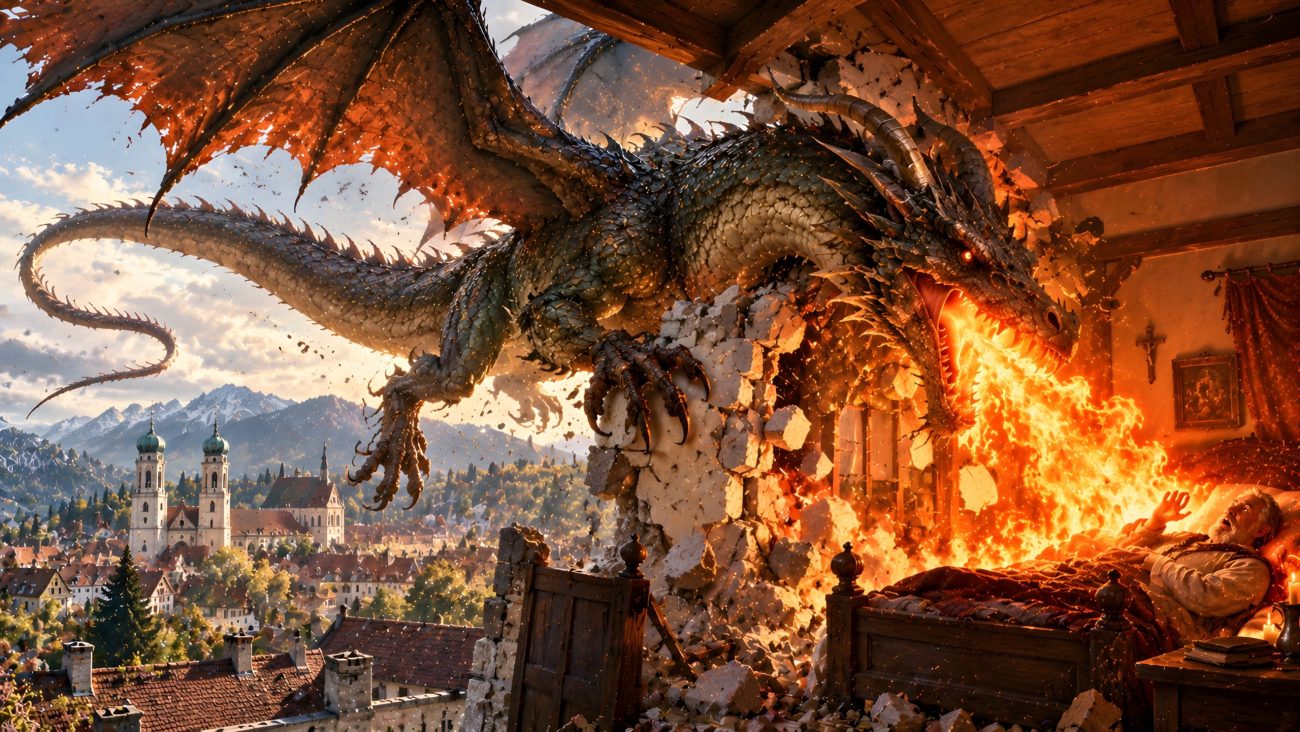
The house was once inhabited by a merchant who cheated and exploited the people around him. When his life finally came to an end and he lay dying in his room, a dragon suddenly came flying through the air. It pierced straight through the wall of the room and breathed fire before the dying man’s bed.

After the man’s death, the dragon crawled back through the hole it had made in the wall and remained there until the dead man’s body was carried away. The hole proved impossible to repair. Whenever the inhabitants tried to seal it, it would mysteriously reopen during the night.

The strange opening therefore remained for many years, and a representation of the dragon was eventually placed upon the house as a memorial to the event.

A darker telling gives the story a slightly different meaning. The house had once been an inn, where a foreign traveller arrived after having lived a wicked and godless life. Because of his sins, he was believed to have been promised to the Devil. When his appointed time finally came, the Devil appeared in the form of a dragon and carried the condemned man away through the closed walls of the building, leaving the mysterious hole behind.

In either telling, the dragon appears at the moment of death, breaking through the boundary between the ordinary world and the supernatural realm to claim the dying man.


Sources

“Der Drache.” SAGEN.at – Traditionelle Sagen aus Deutschland (Bayern, Allgäu). Reproduced by SAGEN.at.
https://www.sagen.at/texte/sagen/deutschland/bayern/allgaeu/drache_2.html


Dragon of Geißalpsee

Tradition: German Mythology
Alternative Names: Dragon of Geißalpsee
Category: Dragon


The Myth

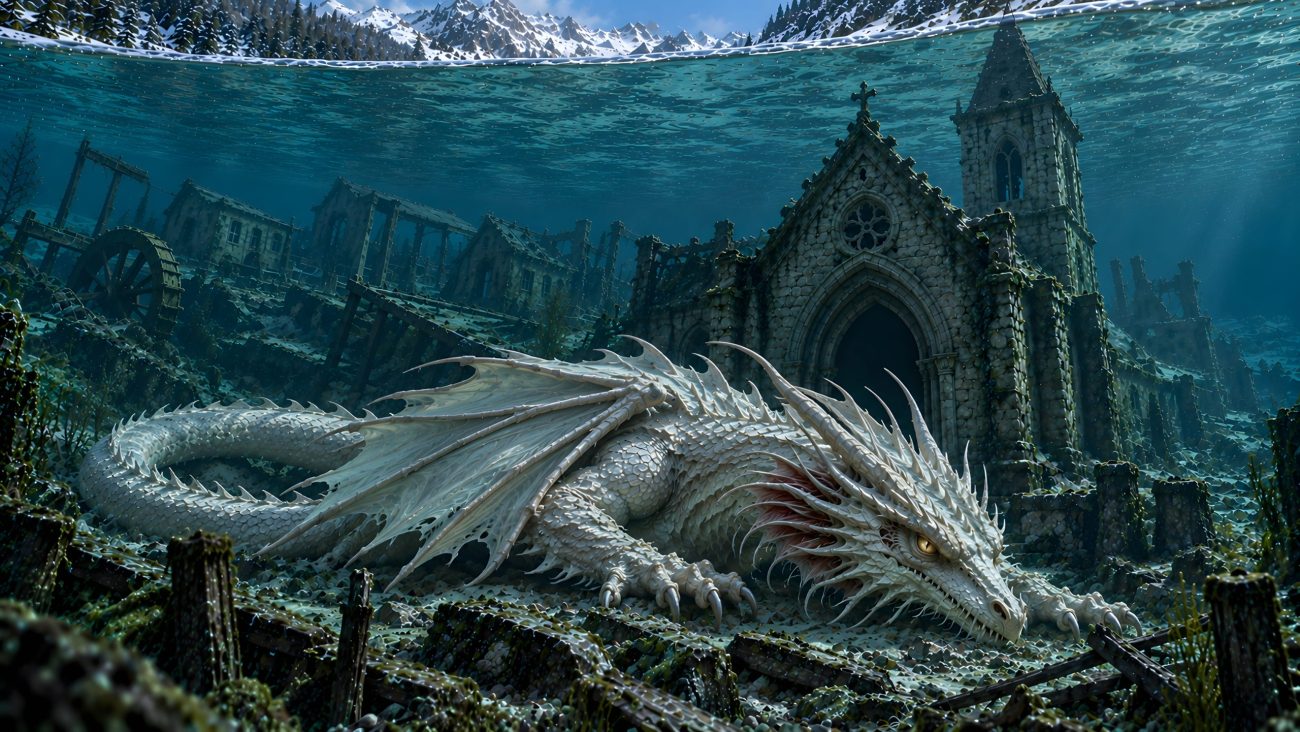
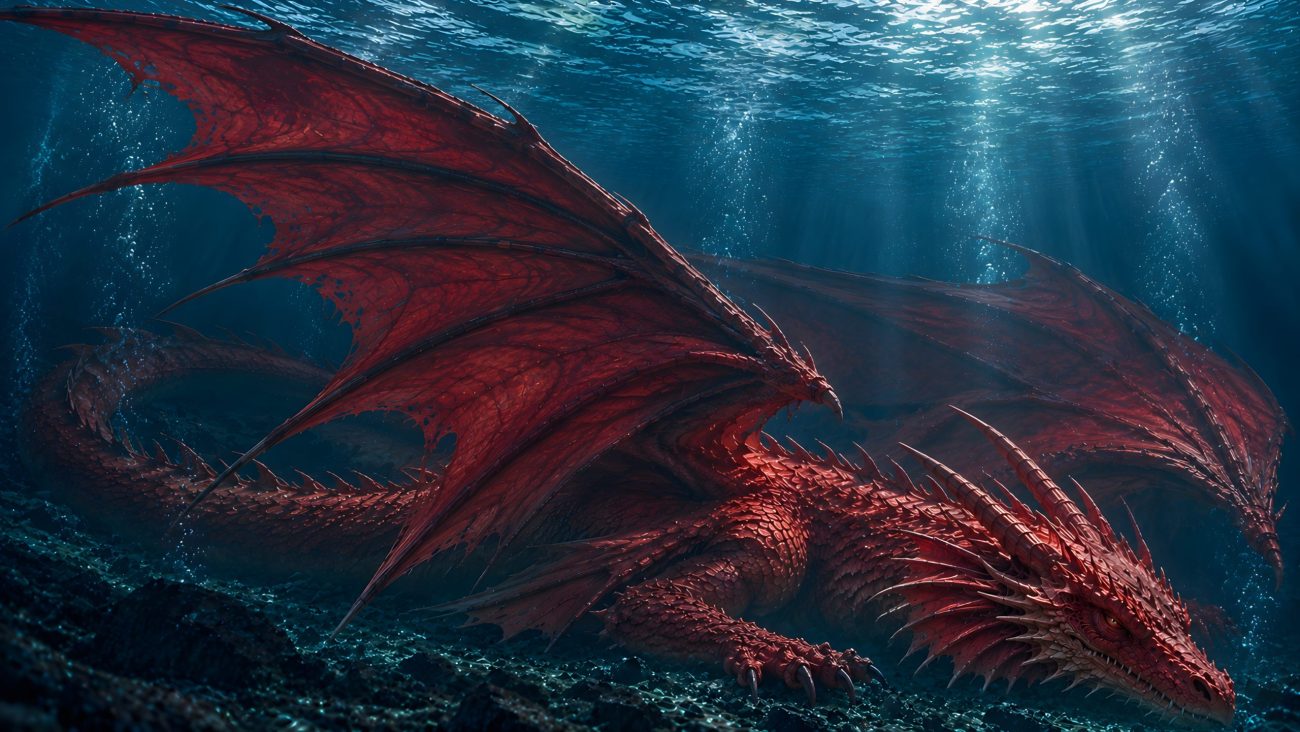
High in the mountains above Reichenbach and Häuser lies the Geißalpsee, a remote alpine lake in whose depths a dragon lies sleeping.

The creature remains hidden beneath the waters, but its eventual awakening is feared. If the dragon ever “flies out” from the lake, the waters of the Geißalpsee will burst forth in a catastrophic flood.

The flood is said to bring destruction upon Fischen, leaving the surrounding land in ruins. The devastation will continue until a miraculous sign appears: willow branches will grow upon the high altar of the parish church at Weiden.

Until that impossible growth takes place, the ruined land will remain desolate. The dragon therefore sleeps beneath the mountain lake as a dormant threat, and its departure would unleash a flood whose consequences would last until the fulfillment of the strange prophecy.


Sources

“Der Geißalpsee.” SAGEN.at – Traditionelle Sagen aus Deutschland (Bayern, Allgäu). Reproduced by SAGEN.at.
https://www.sagen.at/texte/sagen/deutschland/bayern/allgaeu/geissalpsee.html


Dragon of Drachensee

Tradition: German Mythology
Alternative Names: Drachensee, Aschauersee
Category: Dragon


The Myth

Where the Drachensee now lies, there was once a mountain mine. According to the legend, Saint Magnus of Füssen opened the mine by offering a loaf of bread to anyone from the surrounding area who would dig for treasure. The poor pagan people living nearby eagerly accepted the offer, for they had never known bread before.

As the mining continued, one family became particularly wealthy from the treasures they discovered. Their newfound riches, however, made them immensely proud. They built themselves a house directly above the mine and even constructed their own church beside it, refusing to worship alongside the other people in the local church.

Then disaster came. The house, the church, and the entire mine suddenly sank into the earth. Where they had once stood, the waters of the Drachensee appeared.

Yet the buried settlement has never completely disappeared. Every year on Christmas Day, the sunken mine, the house, and the church can supposedly be seen beneath the lake. Within the submerged church, the doomed family can be heard praying, while a terrifying dragon stands guard outside the church door, preventing anyone from approaching them.

The local church at Russen still bears the name St. Magenkirch, or St. Magnus Church, preserving the memory of Saint Magnus who is said to have opened the ancient mine. The lake is also known as the Aschauersee.


Sources

Theodor Vernaleken. “Der Drachensee.” In Kinder- und Hausmärchen in den Alpenländern. Vienna, 1863. Reproduced by SAGEN.at. https://www.sagen.at/texte/sagen/vernaleken/drachensee.html


Dragon of Gsäßtobel

Tradition: German Mythology
Alternative Names: Dragon of Gsäßtobel
Category: Dragon


The Myth

In ancient times, a terrifying dragon lived in the Gsäßtobel above Sigiswang. The creature was a menace to the entire surrounding countryside and caused great harm, becoming a source of fear for the local people.

At that time, a mysterious little man from Venice frequently visited Bolsterlang. He usually stayed overnight in a local house and always carried a remarkable mirror with him. Anyone who looked into the mirror could supposedly see the exact places where hidden treasures lay buried.

On one of his visits, the Venetian little man allowed several people to look into his mirror. Three hidden treasures appeared within it: one near Maiselstein, another at Sonderdorf, and a third on the Spek, a hill near Bolsterlang.

But the little man had no intention of searching for these treasures. He revealed that he had something far more dangerous to accomplish. He was going to the Gsäßtobel above Sigiswang to deal with the dragon.

The Venetian believed that if he succeeded in “carrying away” or removing the dragon, he would have enough wealth to last him for the rest of his life. He announced that he would undertake the attempt at noon, at twelve o’clock, and promised to give a sign if everything went successfully.

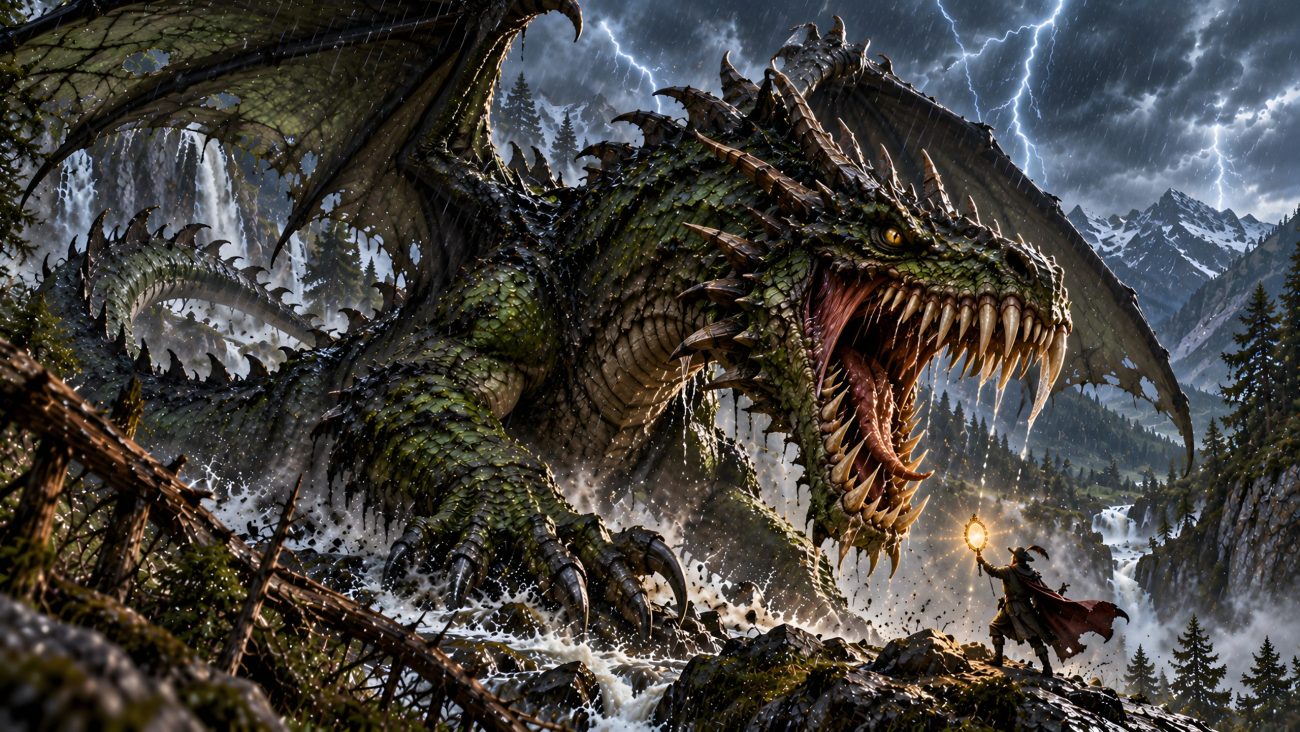
When the appointed hour arrived, a terrible storm suddenly broke over Sigiswang. Lightning flashed and thunder roared while violent winds tore through the countryside. The storm became so fierce that it seemed as though the entire village might be destroyed.

Then, just as suddenly, the storm began to subside. A strange apparition appeared in the sky, as though something had passed through the air, with what looked like a hand visible within it. This was taken as the promised sign that the Venetian’s dangerous undertaking had succeeded.

The little man never returned to Bolsterlang after that day. But the terrifying dragon of Gsäßtobel was gone, and the people of the surrounding countryside were finally free from the creature that had brought them so much fear and destruction.


Sources

“Der Drache.” SAGEN.at – Traditionelle Sagen aus Deutschland (Bayern, Allgäu). Reproduced by SAGEN.at.
https://www.sagen.at/texte/sagen/deutschland/bayern/allgaeu/drache.html


Dragon of Urisee

Tradition: German Mythology
Alternative Names: Dragon of Urisee
Category: Dragon


The Myth

In the mountains near Reutte lie two lakes. Urisee rests above the Mühl on a projection of the Dürrenberg, while across the valley, on a projection of the Gernspitze, lies Frauensee. A terrible dragon dwells in Urisee.

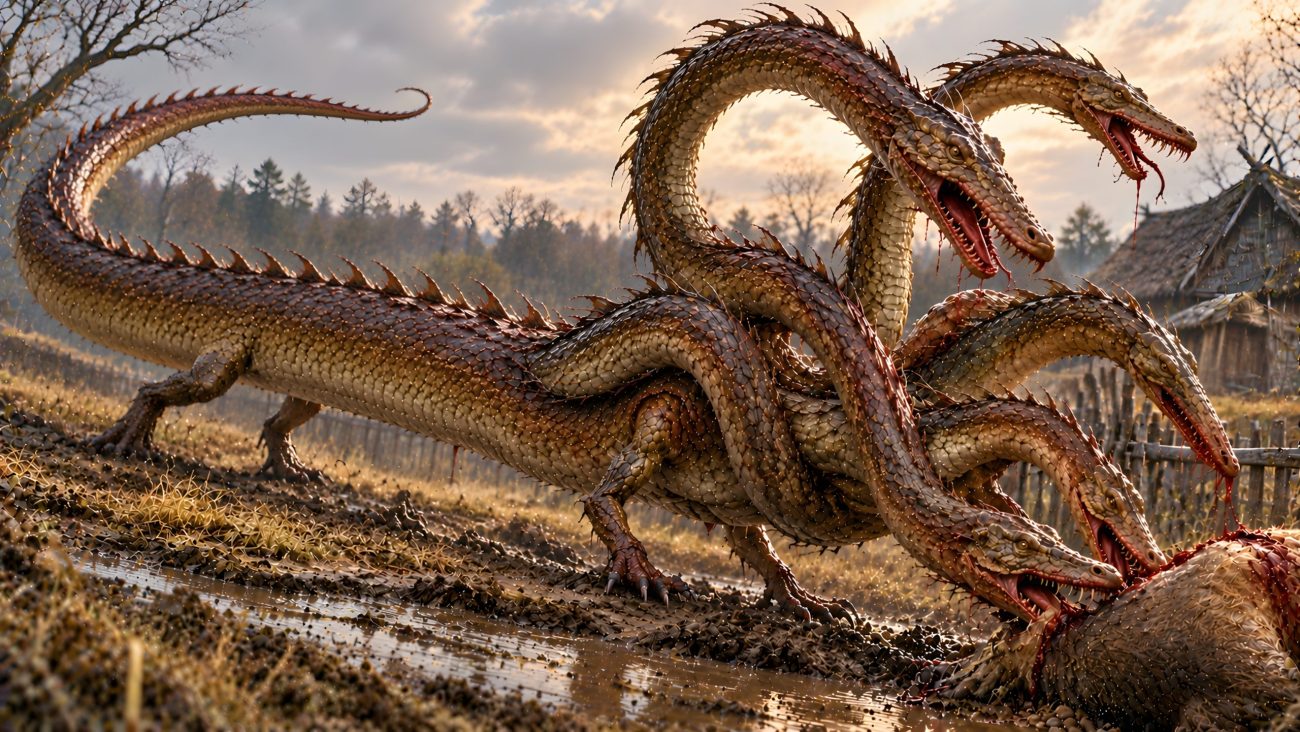
At night, the dragon is sometimes seen flying through the air in flames from Urisee across the valley to Frauensee. Some people claim that it has seven heads and that it occasionally comes ashore to bask on the sandy banks of the lake. Others who have seen the creature say that it looked strangely like a horse that had been skinned.

Long ago, the place where Urisee now lies was occupied by a forge. The forge prospered and brought its owner a good income, but the blacksmith’s wife was a serpent and was utterly without reverence for God.

One day, their little son fell into the dirt in the street. Instead of cleaning him with a cloth or sponge, the woman took a piece of freshly baked bread and used it to wipe the filth from the child. This profane act enraged Heaven.

As punishment, the forge sank into the earth, and the waters of Urisee rose where it had once stood. The blacksmith’s wife was transformed into the dragon that now inhabits the lake, condemned to suffer her punishment and torment there.


Sources

“Der Drache im Urisee.” SAGEN.at – Traditionelle Sagen aus Deutschland (Bayern, Allgäu). Reproduced by SAGEN.at.
https://www.sagen.at/texte/sagen/deutschland/bayern/allgaeu/drache_urisee.html


Dragon of Mountain Spring

Tradition: German Mythology
Alternative Names: Dragon of the Mountain Spring
Category: Dragon


The Myth

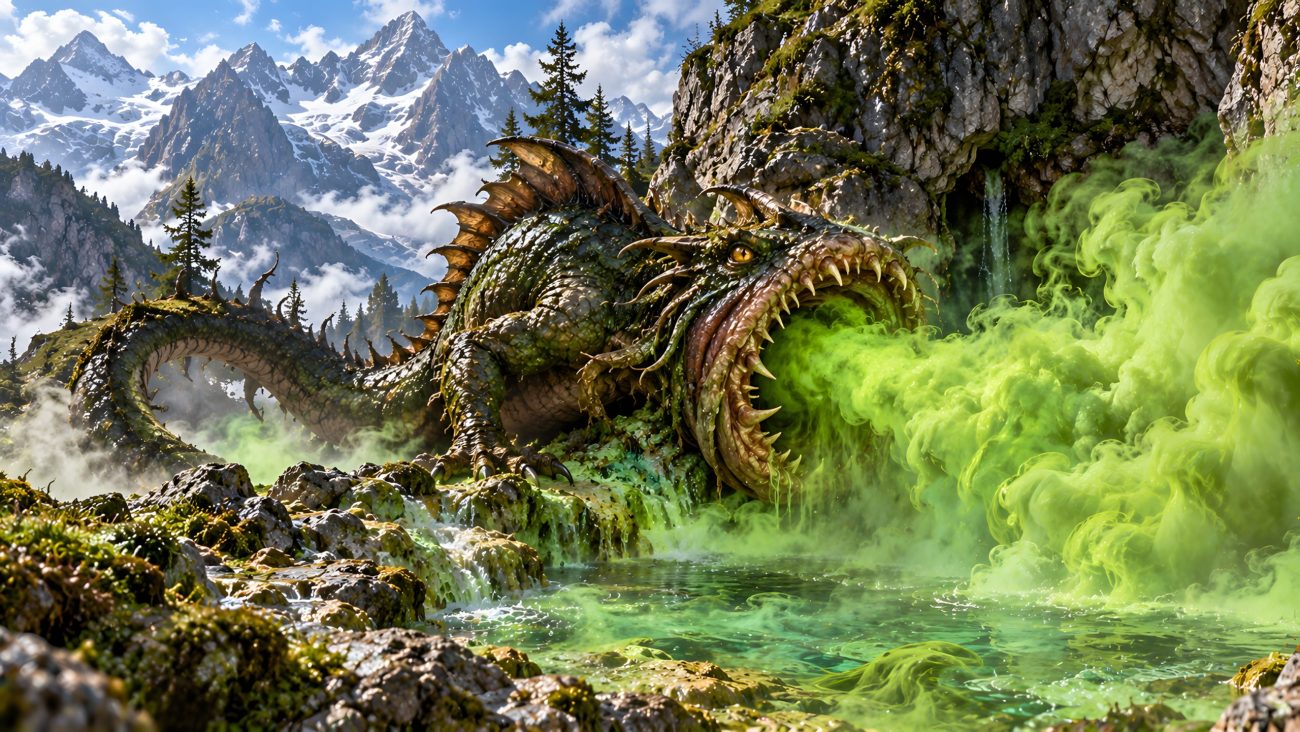
High in the Alpine mountains there was a spring whose water no human or animal could safely drink. A terrible dragon lived beside it, and its poisonous breath was deadly to anyone who approached the spring. The creature’s presence had made the water useless to the people of the surrounding region.

When Saint Narcissus, the holy bishop of Girona, came to Augsburg, the Devil approached him and demanded a soul—a living being whose body he could kill and whose soul he could take for himself. Narcissus agreed, but only after making the Devil swear that he would immediately kill whoever was placed in his power.

The bishop then sent the Devil into the high Alpine mountains. There, he told him, he would find a spring from which nobody could drink because a terrible dragon guarded it. The monster’s poisonous breathing killed all who came near the water. Narcissus commanded the Devil to kill the dragon and seize its soul.

The Devil was horrified by the command. He cried out with the terrible voice of a fierce lion, lamenting that the bishop had trapped him by his own oath. He had sworn to kill the creature given into his power, and if he refused, the bishop’s terms would condemn him to the depths of Hell.

Bound by his oath, the Devil went to the mountain spring and killed the dragon. With the monster dead, the deadly spring was freed from its curse and its water became available for the benefit of humanity, remaining so thereafter.


Sources

“Der Teufel und der Drache.” SAGEN.at – Traditionelle Sagen aus Deutschland (Bayern). Reproduced by SAGEN.at.
https://www.sagen.at/texte/sagen/deutschland/bayern/teufel_drachen.htm


Lambton Worm

Tradition: English Mythology
Alternative Names: Lambton Worm, Lambton Worm of the River Wear
Category: Dragon


The Myth

The Lambton Worm was a monstrous worm that grew to enormous size after being thrown into a well by the young heir of the Lambton family. At first it was a small and seemingly insignificant creature, but after being cast into the well it remained there until it had grown so large that its dwelling could no longer contain it.

The young Lambton heir had lived a careless and profane life and had even gone fishing in the River Wear on the Sabbath. One day, after experiencing little success with his fishing, he felt a sudden tug on his line. He pulled with great force and was convinced that he had caught a magnificent fish. Instead, he found a strange little worm. Disgusted by his catch, he threw the creature into a nearby well.

The worm remained unnoticed in the well for some time. Eventually it grew so enormous that it outgrew its underground dwelling and emerged into the world. It made its way down to the river and then crawled toward a nearby hill. As it continued to grow, it became so large that it could encircle the hill three times. The hill itself became known as Worm Hill, and depressions surrounding it were traditionally said to mark the tracks left behind by the enormous creature.

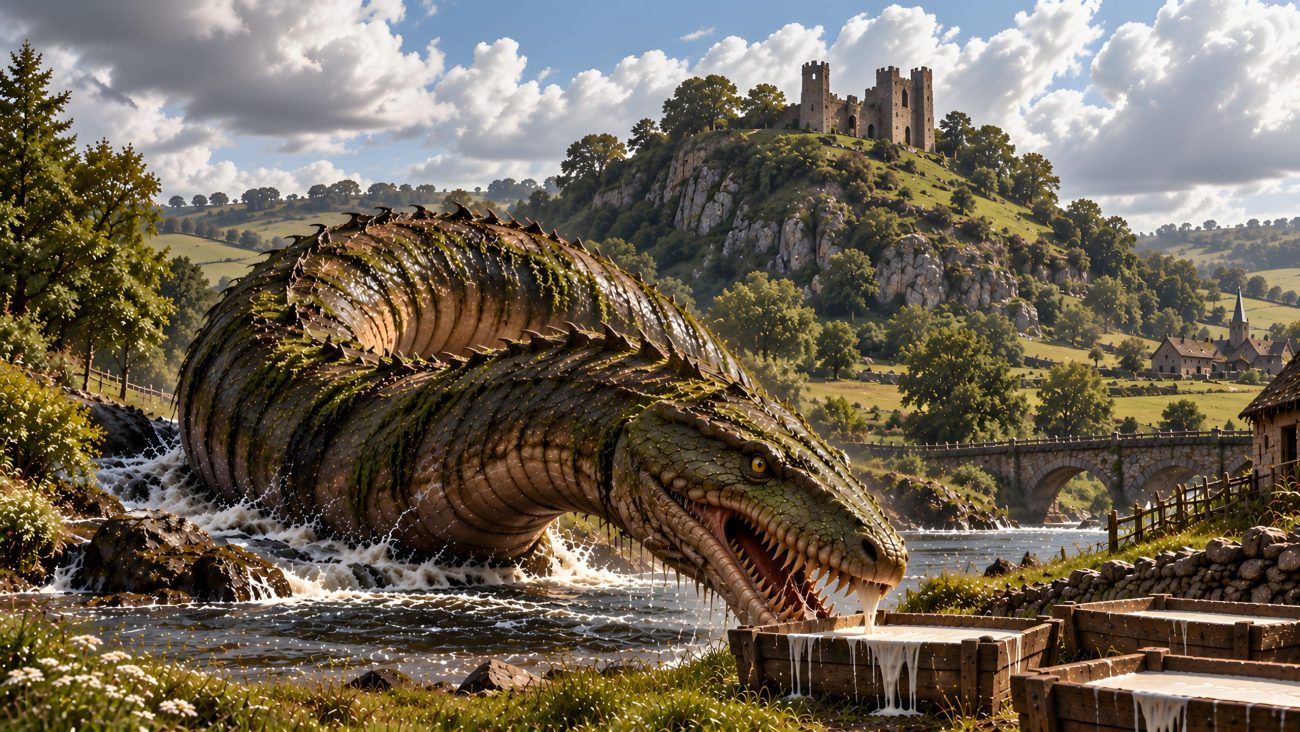
The Worm soon became the terror of the surrounding countryside. It sucked the milk from cows, tormented cattle, consumed the land, and laid waste to the countryside. Meanwhile, the Lambton heir had come to regret his former life and had travelled to the Holy Land to fight against the Saracens. His father remained behind in the old castle, while the Worm continued to threaten the people.

The creature became so troublesome that the only way the villagers could appease it was to provide it with milk. Nine cows were milked, and their milk was poured into a trough for the monster. The Worm would drink the milk and, having been satisfied, curl itself around its favourite hill. This became the grim routine that allowed the people to survive its presence.

After seven years, the young heir returned from the wars and learned of the terrible state into which his homeland had fallen. He resolved to confront the monster. Before he went into battle, his lady prepared him carefully. She had him wear his finest suit of armour and studded it with sharpened spearheads. He was to meet the Worm beside the river, near the place where it spent the day.

But she gave him a terrible warning. If he returned victorious, the first living creature he encountered on his journey home had to be killed. If he failed to fulfil this vow, no Lord of Lambton would die in his bed for nine generations.

The heir went boldly to the river and took his position upon a rock, drawing his sword. In due course the Worm came to attack him. It struck him a heavy blow upon the head with its tail and then attempted to crush him within its coils. But as the monster tightened its grip, its enormous body was forced against the sharpened spearheads covering the knight’s armour. The more tightly it coiled around him, the more severely it cut itself.

Eventually the Worm’s strength diminished enough for the knight to cut the monster in two. The severed half was swept away by the river, while the Worm attempted to reunite its divided body. Before it could do so, the current carried the severed portion away, and the monster was finally destroyed.

Meanwhile, old Lord Lambton had been waiting anxiously in the castle for news of his son’s battle. When he saw his victorious son approaching, he rushed out to meet him. The young heir could not kill his own father, and the ancient warning therefore went unfulfilled.

The victory over the Worm consequently did not free the Lambton family from its curse. For nine generations, it was said, no Lord of Lambton would die peacefully in his bed. The exact date of the original events was uncertain, but the story remained deeply associated with the Lambton family and the surrounding countryside.

The legend later gained further life from events involving the Lambtons themselves. In 1761, Henry Lambton, a member of Parliament, died when his carriage was crossing the new Lambton Bridge. Local people interpreted his death as another fulfilment of the ancient curse.

The Lambton Worm thus became one of County Durham’s most famous monsters: a tiny worm born from a careless act, transformed into a gigantic river creature that terrorized the countryside, and finally destroyed by the very man whose earlier actions had brought it into existence.


Sources

University of North Carolina at Chapel Hill. Folklore Council. North Carolina Folklore. Vols. 1–8. Chapel Hill, N.C.: North Carolina Folklore Society, 1948–1960.
Kasny

Tradition: Polish Mythology
Alternative Names: Kasny
Category: Snake


The Myth

Kasny were disgusting, serpent-like creatures that fed upon the blood of their victims. Alone they were relatively harmless, but when they attacked in groups they became deadly. A whole swarm would throw itself upon a person from every direction, biting relentlessly and fastening onto every part of the body like leeches.

Once they began feeding, the Kasny would fall into a frenzy. They attacked with savage determination, sucking up their victim’s blood while paying no attention to the wounds inflicted upon them in the struggle. Their hunger was so intense that they continued attacking even when seriously injured.

Sometimes a Kasny became so swollen with the blood it had consumed that it died together with its victim. Only the strongest individuals were capable of surviving such an attack and retreating once again into their hiding places.

This suicidal manner of feeding fortunately meant that Kasny remained extremely rare creatures. Their greatest danger came not from a single creature, but from the sudden appearance of an entire swarm, descending upon a victim and overwhelming them through sheer numbers.


Sources

Zych, Paweł, and Witold Vargas. Bestiariusz słowiański. Część pierwsza i druga. Warsaw: Bosz, 2017.


Mo-o

Tradition: Hawaiian mythology, American Mythology
Alternative Names: Mo-o god, Dragon-god
Category: Dragon


The Myth

The Mo-o was a ferocious dragon-god associated with the forests and valleys of Hawaiʻi. These beings could appear in human form, but beneath this appearance they remained dragons, always ready to transform back into their true form. They watched for prey and were feared by travellers, who could be destroyed if they encountered one. The Mo-o described in this tale dwelled in a forested side valley where great koa trees grew, trees prized for making canoes.

When priests came to this forest to cut a great koa tree for the high chief, the Mo-o god descended to watch them. He observed the ceremonies and listened to the incantations spoken while the men worked. But he did everything within his power to prevent them from completing the canoe. He sent powerful winds sweeping down the valley against the workers, covered the sky with black clouds, and drove heavy rain upon them. He produced discouraging omens and signs that seemed to foretell failure, hoping that the priests and canoe-makers would abandon their work.

The priests persevered. Eventually the great tree fell, and they accepted it as suitable for the canoe. Its branches were quickly removed, the trunk was roughly shaped, and part of the interior was hollowed out. Cocoanut ropes and vines were then fastened around the massive log, and the people began dragging it down the valley toward the harbor of Kou, in Honolulu.

Their first great obstacle came when they tried to pull the canoe over the rough lava ridges along the side of the valley. The log refused to descend. Instead, it seemed to move uphill. The Mo-o had seized one end and was pulling against the men. They gathered their strength and made another tremendous effort, causing the canoe and the dragon-god to slide over the stones and partly down the hillside. The Mo-o braced himself again and made the canoe extraordinarily heavy, trying to hold it in place.

The god could not stop them completely, however, and the canoe eventually came down to the men. Pulling it through the forest and thickets proved extremely difficult, so they dragged it into the rough, rocky bed of the Nuuanu River. They hoped that the flowing water would help carry the canoe while the slippery stones made it harder for the Mo-o to resist them.

The struggle continued down the river. Eventually the Mo-o realized that the contest there was becoming hopeless. He released the canoe and turned his attention to the river itself.

The mountain stream was fed by springs and numerous waterfalls and cascades that carried water down from the mountains into the valley. The dragon-god rushed along the watercourse, stopping the springs and diverting the smaller streams until the riverbed was left dry. He then hurried back, seized the canoe once more, and pulled against the exhausted canoe-makers.

The struggle became increasingly wearying. Night fell while the people were still some distance from the sea. They eventually reached a place called Ka-ho-okane, in the heart of what is now Honolulu. There the route became especially difficult, with sharp turns, steep banks, and enormous stones. The Mo-o fought hardest there, finally wedging the great canoe firmly among the rocks.

By then the task had become almost impossible, and darkness had fallen. The high chief finally allowed his priests to call the people away, leaving the unfinished canoe where the last struggle had taken place. It was regarded as a gift to the Mo-o and became known as the Canoe of the Dragon-God.

According to the tradition, the canoe remained there forever, transformed into stone and trapped among the enormous rocks through which the mountain waters continued to flow, a monument to the dragon-god’s victory over the canoe-makers.


Sources

Westervelt, W. D. Legends of Old Honolulu (Mythology). Boston: Ellis Press, 1916. 277 pp.