Lindworm of Altenburg

Tradition: German Mythology
Alternative Names: Altenburg Lindworm
Category: Dragon


The Myth

In ancient times, a terrible Lindworm lived on the Kanzel of Altenburg near Nebra. Each year, the beast chose one of the maidens of Nebra and carried her away.

On a particular day each year, the maidens were required to dress in white and adorn themselves for their grim procession to Altenburg. There, one of them would be claimed by the Lindworm.

Eventually, a courageous knight offered to fight the monster. After a fierce battle, he succeeded in killing the Lindworm and freed the maiden from her terrible fate.


Sources

“Die Sage von Altenburg.” SAGEN.at – Traditionelle Sagen aus Deutschland (Sachsen-Anhalt). Reproduced by SAGEN.at.
https://www.sagen.at/texte/sagen/deutschland/sachsen_anhalt/altenburg.html


Dragon of Nebra

Tradition: German Mythology
Alternative Names: Dragon of Nebra
Category: Dragon


The Myth

A terrible dragon lived in a cave near the spring below Nebra Castle, guarding the source of water that the besieged defenders desperately needed. During a siege, the enemy seized the spring outside the castle walls, leaving the defenders trapped inside without water. The heat and drought became unbearable, and with no rain in sight, the men began to despair.

Knowing that the spring was their only hope, a young noblewoman from the castle secretly slipped out during the night and made her way down to the spring at the foot of the castle hill. As she bent down to collect the precious water, a hideous dragon suddenly burst from a nearby cave and threatened to kill her.

Before the dragon could strike, however, Saint George rode in from the direction of Wendelstein with a company of armed men. The knight charged the enormous beast with his lance. He drove the sharp steel deep into the dragon’s poisonous throat and entrails, causing the creature to rear violently before collapsing dead upon the earth.

Saint George had not only rescued the young woman but also freed the castle’s defenders from their desperate situation. With the dragon dead, the spring was once again accessible, allowing the besieged soldiers to drink their fill and regain their strength.

The memory of the battle lives on in the coat of arms of Nebra, where Saint George is depicted fighting the dragon.


Sources

“St. Georg und der Drache.” SAGEN.at – Traditionelle Sagen aus Deutschland (Sachsen-Anhalt). Reproduced by SAGEN.at.
https://www.sagen.at/texte/sagen/deutschland/sachsen_anhalt/georg_drache.html


Dragon of Drachenwinkel

Tradition: German Mythology
Alternative Names: Drachenwinkel Dragon
Category: Dragon


The Myth

Near Laucha, in a narrow gorge, there once lived a wicked dragon. Humans and livestock were constantly taken by the monster, and there seemed to be no way to stop it. The western part of the gorge became known as Kummerberg, the “Mountain of Sorrow,” while the gorge itself was called the Drachenwinkel, the “Dragon’s Corner,” because this was where the dragon dragged its victims.

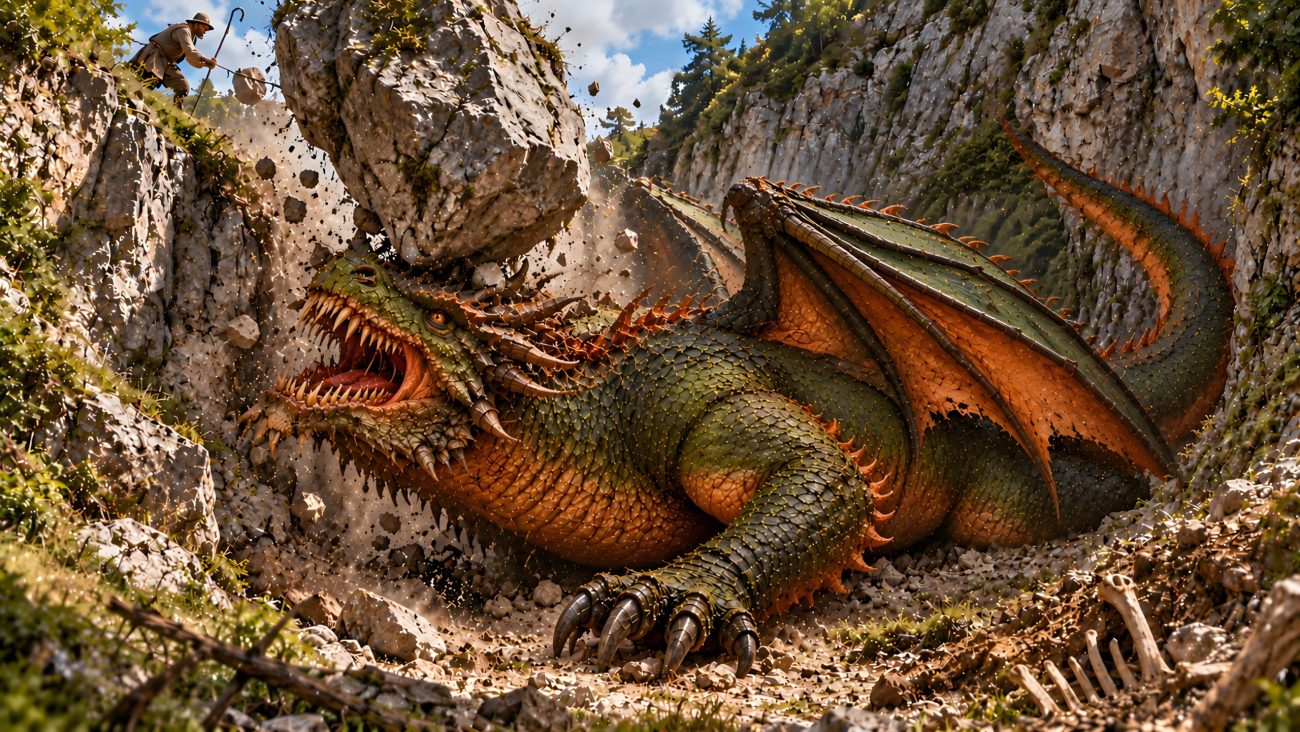
Among those who suffered was a shepherd from Hirschroda whose beloved had been taken and devoured by the dragon. Determined to avenge her, he secretly prepared an enormous boulder, laboriously dragging it into position above the gorge.

One day, when the dragon had settled down within the ravine, the shepherd released the great stone. It came crashing down upon the monster and smashed its skull, killing the dragon.

From that day onward, the terrible creature was never seen again.

But the legend acquired a strange postscript. Toward the end of the nineteenth century, enormous skeletal remains were discovered near the gorge during earthworks. Whether these bones belonged to the dragon killed by the shepherd was left as a mystery.


Sources

“Der Drachenwinkel.” SAGEN.at – Traditionelle Sagen aus Deutschland (Sachsen-Anhalt). Reproduced by SAGEN.at.
https://www.sagen.at/texte/sagen/deutschland/sachsen_anhalt/drachenwinkel.html


Nußdorf Lindworm

Tradition: German Mythology
Alternative Names: Lindwurm of the Legendary Lake
Category: Dragon


The Myth

In ancient times, a great lake was said to have occupied the broad hollow stretching west of Grainbach on the Samerberg toward Nußdorf am Inn. Remains of its supposed shores could still be recognized in the landscape, where enormous stones with holes running through their centers were found. These stones were believed to have been used for fastening the boats of fishermen who once sailed across the vanished lake.

Within its waters lived a terrifying Lindwurm. With its enormous tail, the monster smashed fishing boats and dragged the unfortunate fishermen down into the depths, where they disappeared forever. Again and again, courageous men attempted to destroy the creature.

Armed men would ride up from Nußdorf to hunt the dragon, but none ever managed to pass the place known as the Reiterstiegl. There, along the Grainbacher Achen, a small stream suddenly becomes very deep. The monster regularly blocked its enemies there.

The Lindwurm would open its enormous jaws and breathe fire and smoke toward the approaching warriors. Then it would beat its gigantic bat-like wings, creating such a violent storm that the men could go no farther. Those who had come to kill the monster were forced to turn back, while others were seized by the dreadful creature and torn apart, crushed, or devoured.

Although every attempt ended in failure, people continued to disturb the dragon in its lake. Eventually the constant attacks enraged it so greatly that it began thrashing about in the water. In its fury, it tore apart the shore toward Mühltal, weakening the banks until the day came when the lake finally broke through above Nußdorf.

The waters burst forth with a terrible roar, rushing down toward the village in a foaming torrent. Half of Nußdorf was swept away, carrying away everything and everyone caught in its path.

The flood reached even the heights where Castle Clammenstein then stood. The rocks supporting the castle walls were so severely undermined by the rushing water that the entire fortress collapsed. The once-proud and formidable Castle Clammenstein was utterly destroyed, with not a single stone left upon another.

Thus the Lindwurm that had once terrorized the fishermen became the force behind an even greater catastrophe: enraged by the people who repeatedly sought to kill it, the dragon tore open its own lake and unleashed its waters upon the valley.


Sources

“Der Lindwurm.” SAGEN.at – Traditionelle Sagen aus Deutschland (Bayern, Inntal). Reproduced by SAGEN.at.
https://www.sagen.at/texte/sagen/deutschland/bayern/inntal/lindwurm.html


Dragon of Trettach

Tradition: German Mythology
Alternative Names: Dragon of Trettach
Category: Dragon


The Myth

In ancient times, a terrible dragon lived in the Trettach region south of Oberstdorf. The creature caused great harm throughout the surrounding countryside and spread terrible fear among the inhabitants.

One day, a wandering scholar, known as a “fahrender Schuelar,” arrived in the region. When he heard about the terrifying monster, he voluntarily offered to free the local people from the dragon.

He told those who wished to witness the deed to gather at noon at the Zwink Bridge in Dietersberg. There, he promised, they would see him ride upon the dragon.

At the appointed hour, the wandering scholar appeared beneath the bridge. He was indeed riding upon the dragon—but the creature was beneath the water, so that nobody could see its body. Only a single hand could be seen protruding above the surface of the water.

From that moment onward, the dragon was gone, and the people of the region were finally freed from the creature that had terrorized them.


Sources

“Der Drache.” SAGEN.at – Traditionelle Sagen aus Deutschland (Bayern, Allgäu). Reproduced by SAGEN.at.
https://www.sagen.at/texte/sagen/deutschland/bayern/allgaeu/drache_2.html


Flying Dragon of Lower Bavaria

Tradition: German Mythology
Alternative Names: Drack, Drache, Flying Dragon
Category: Dragon


The Myth

The dragons of old Bavarian stories were terrifying, fire-breathing creatures that flew through the night sky. Although belief in such monsters had largely faded, their memory survived in the regional insult “Drack,” used for someone who had behaved maliciously or played a nasty trick.

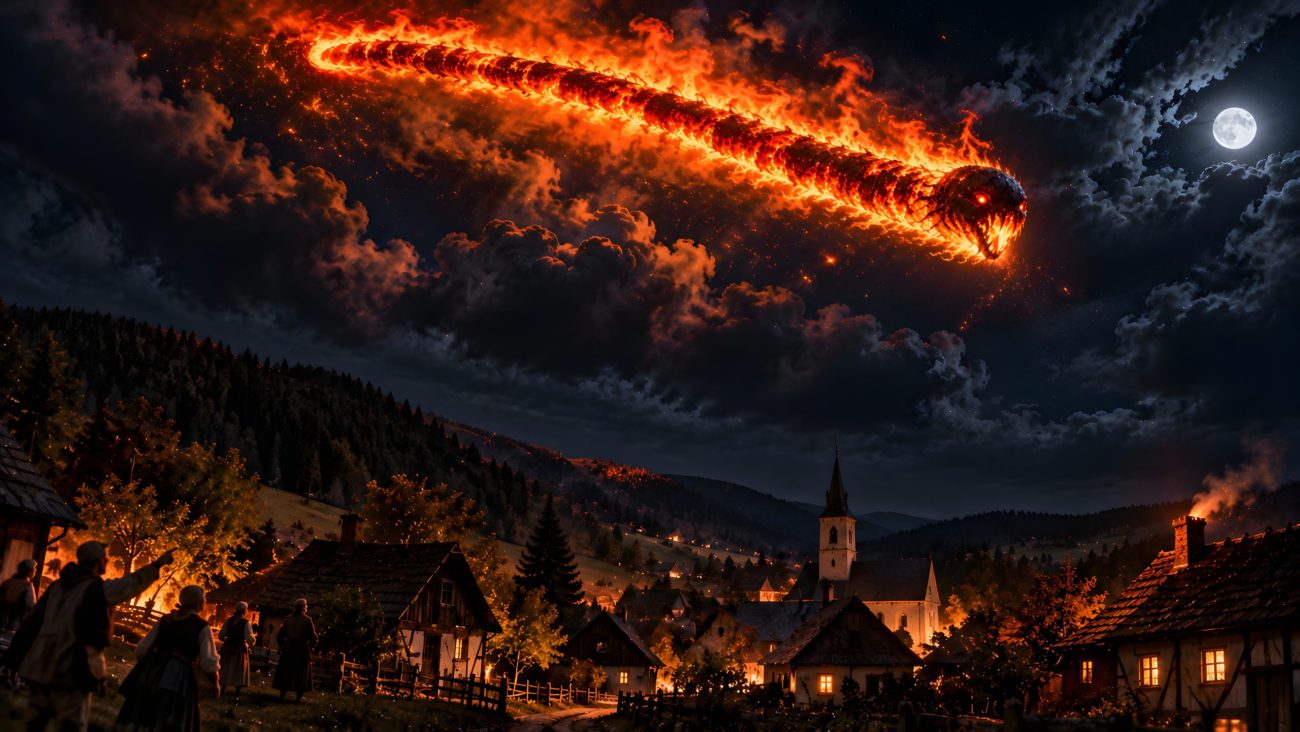
Yet people in the region continued to tell stories of having actually seen dragons. One woman recalled that around forty years earlier, when she was six years old, she had been sitting on a table one evening and looking out of the window. Suddenly the sky became illuminated, and something resembling a burning Wiesbaum—a long wooden pole or beam used in the countryside—flew over the village. Its front portion, however, was completely black.

The fiery object crossed the road near her family’s house while her mother watched it as well and called out that something was flying outside. The strange creature then disappeared into a neighbour’s chimney. From inside the neighbouring house came only a brief crashing noise, after which everything became quiet again.

The dragon was also repeatedly seen at Fahrnbach near Bischofsmais. During flax-breaking work, people reportedly saw it after eleven o’clock at night. There it appeared as a burning Wiesbaum with a black, spherical head, rushing through the darkness before disappearing over the forest.

Greising was another place where the dragon was said to appear repeatedly. Its final reported appearance occurred around the time the schoolhouse burned down, around 1904.

In Viechtach, the creature was given an even darker interpretation. People said that the Devil himself had flown through the air in the form of a Wiesbaum before disappearing down a chimney.

The Bavarian dragon therefore survives in these stories not as a single clearly defined monster, but as a strange fiery apparition racing through the night sky: sometimes a burning wooden beam with a black head, sometimes an object entering a chimney, and sometimes understood as the Devil himself.


Sources

“Von den Drachen.” SAGEN.at – Traditionelle Sagen aus Deutschland (Bayern). Reproduced by SAGEN.at.
https://www.sagen.at/texte/sagen/deutschland/bayern/waltinger/vondendrachen.html


Dragon of Kempten

Tradition: German Mythology
Alternative Names: Dragon of Kempten
Category: Dragon


The Myth

Long ago, a dragon was said to have been associated with a house near the Rathaus in Kempten. The creature was so closely connected with the building that a depiction of a dragon was once painted or carved upon the wall as a sign commemorating the strange event that had taken place there.

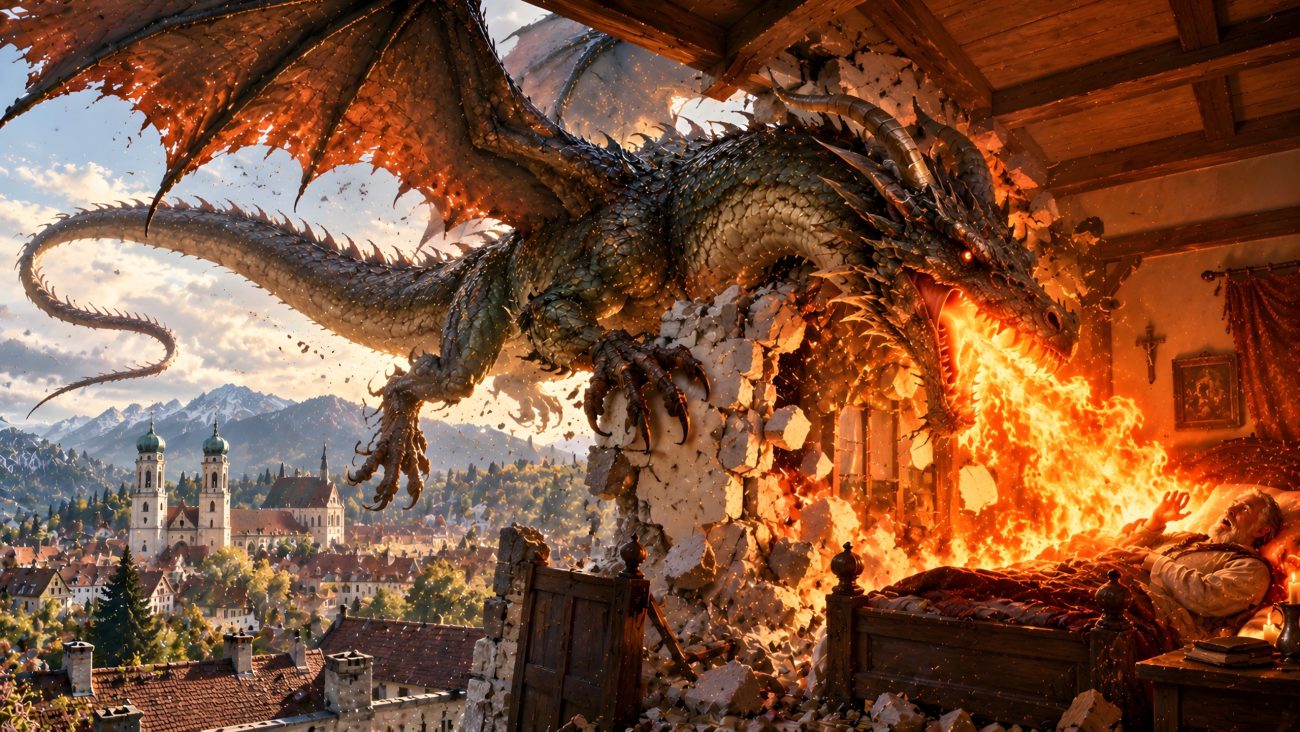
The house was once inhabited by a merchant who cheated and exploited the people around him. When his life finally came to an end and he lay dying in his room, a dragon suddenly came flying through the air. It pierced straight through the wall of the room and breathed fire before the dying man’s bed.

After the man’s death, the dragon crawled back through the hole it had made in the wall and remained there until the dead man’s body was carried away. The hole proved impossible to repair. Whenever the inhabitants tried to seal it, it would mysteriously reopen during the night.

The strange opening therefore remained for many years, and a representation of the dragon was eventually placed upon the house as a memorial to the event.

A darker telling gives the story a slightly different meaning. The house had once been an inn, where a foreign traveller arrived after having lived a wicked and godless life. Because of his sins, he was believed to have been promised to the Devil. When his appointed time finally came, the Devil appeared in the form of a dragon and carried the condemned man away through the closed walls of the building, leaving the mysterious hole behind.

In either telling, the dragon appears at the moment of death, breaking through the boundary between the ordinary world and the supernatural realm to claim the dying man.


Sources

“Der Drache.” SAGEN.at – Traditionelle Sagen aus Deutschland (Bayern, Allgäu). Reproduced by SAGEN.at.
https://www.sagen.at/texte/sagen/deutschland/bayern/allgaeu/drache_2.html


Dragon of Geißalpsee

Tradition: German Mythology
Alternative Names: Dragon of Geißalpsee
Category: Dragon


The Myth

High in the mountains above Reichenbach and Häuser lies the Geißalpsee, a remote alpine lake in whose depths a dragon lies sleeping.

The creature remains hidden beneath the waters, but its eventual awakening is feared. If the dragon ever “flies out” from the lake, the waters of the Geißalpsee will burst forth in a catastrophic flood.

The flood is said to bring destruction upon Fischen, leaving the surrounding land in ruins. The devastation will continue until a miraculous sign appears: willow branches will grow upon the high altar of the parish church at Weiden.

Until that impossible growth takes place, the ruined land will remain desolate. The dragon therefore sleeps beneath the mountain lake as a dormant threat, and its departure would unleash a flood whose consequences would last until the fulfillment of the strange prophecy.


Sources

“Der Geißalpsee.” SAGEN.at – Traditionelle Sagen aus Deutschland (Bayern, Allgäu). Reproduced by SAGEN.at.
https://www.sagen.at/texte/sagen/deutschland/bayern/allgaeu/geissalpsee.html


Dragon of Drachensee

Tradition: German Mythology
Alternative Names: Drachensee, Aschauersee
Category: Dragon


The Myth

Where the Drachensee now lies, there was once a mountain mine. According to the legend, Saint Magnus of Füssen opened the mine by offering a loaf of bread to anyone from the surrounding area who would dig for treasure. The poor pagan people living nearby eagerly accepted the offer, for they had never known bread before.

As the mining continued, one family became particularly wealthy from the treasures they discovered. Their newfound riches, however, made them immensely proud. They built themselves a house directly above the mine and even constructed their own church beside it, refusing to worship alongside the other people in the local church.

Then disaster came. The house, the church, and the entire mine suddenly sank into the earth. Where they had once stood, the waters of the Drachensee appeared.

Yet the buried settlement has never completely disappeared. Every year on Christmas Day, the sunken mine, the house, and the church can supposedly be seen beneath the lake. Within the submerged church, the doomed family can be heard praying, while a terrifying dragon stands guard outside the church door, preventing anyone from approaching them.

The local church at Russen still bears the name St. Magenkirch, or St. Magnus Church, preserving the memory of Saint Magnus who is said to have opened the ancient mine. The lake is also known as the Aschauersee.


Sources

Theodor Vernaleken. “Der Drachensee.” In Kinder- und Hausmärchen in den Alpenländern. Vienna, 1863. Reproduced by SAGEN.at. https://www.sagen.at/texte/sagen/vernaleken/drachensee.html


Dragon of Gsäßtobel

Tradition: German Mythology
Alternative Names: Dragon of Gsäßtobel
Category: Dragon


The Myth

In ancient times, a terrifying dragon lived in the Gsäßtobel above Sigiswang. The creature was a menace to the entire surrounding countryside and caused great harm, becoming a source of fear for the local people.

At that time, a mysterious little man from Venice frequently visited Bolsterlang. He usually stayed overnight in a local house and always carried a remarkable mirror with him. Anyone who looked into the mirror could supposedly see the exact places where hidden treasures lay buried.

On one of his visits, the Venetian little man allowed several people to look into his mirror. Three hidden treasures appeared within it: one near Maiselstein, another at Sonderdorf, and a third on the Spek, a hill near Bolsterlang.

But the little man had no intention of searching for these treasures. He revealed that he had something far more dangerous to accomplish. He was going to the Gsäßtobel above Sigiswang to deal with the dragon.

The Venetian believed that if he succeeded in “carrying away” or removing the dragon, he would have enough wealth to last him for the rest of his life. He announced that he would undertake the attempt at noon, at twelve o’clock, and promised to give a sign if everything went successfully.

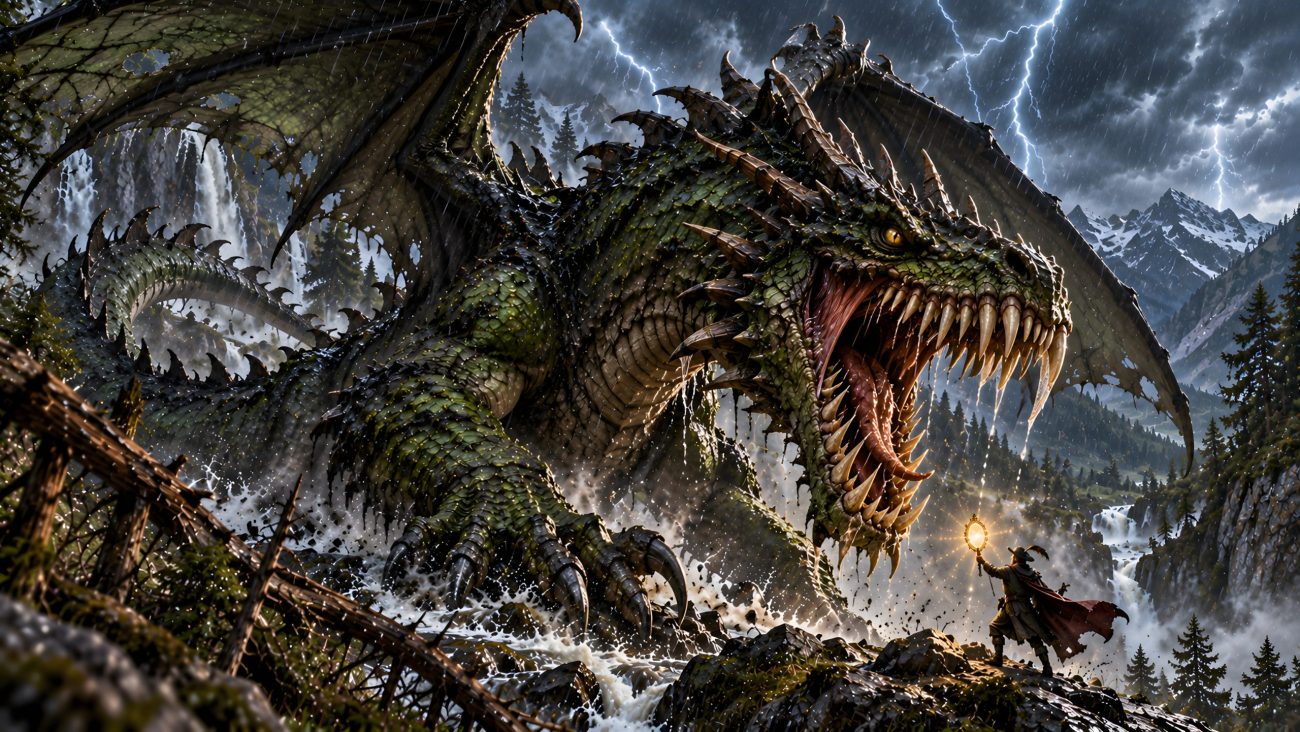
When the appointed hour arrived, a terrible storm suddenly broke over Sigiswang. Lightning flashed and thunder roared while violent winds tore through the countryside. The storm became so fierce that it seemed as though the entire village might be destroyed.

Then, just as suddenly, the storm began to subside. A strange apparition appeared in the sky, as though something had passed through the air, with what looked like a hand visible within it. This was taken as the promised sign that the Venetian’s dangerous undertaking had succeeded.

The little man never returned to Bolsterlang after that day. But the terrifying dragon of Gsäßtobel was gone, and the people of the surrounding countryside were finally free from the creature that had brought them so much fear and destruction.


Sources

“Der Drache.” SAGEN.at – Traditionelle Sagen aus Deutschland (Bayern, Allgäu). Reproduced by SAGEN.at.
https://www.sagen.at/texte/sagen/deutschland/bayern/allgaeu/drache.html