Nis Puk

Tradition / Region: Danish Mythology, German Mythology
Alternate Names: Nis; Niß; Puk; Nispuk; Niskepuk; Nisebuk; Hauspuk
Category: Gnome


The Myth

The Nis Puk is a small kobold-like household spirit combining traits of the Nordic nisse and the Germanic puck. It appears as a child-sized figure with a large head, long arms, bright eyes, and typically wears a red cap, red stockings, and simple work clothes.

It dwells in farms, barns, lofts, or within the wooden structure of a house, often hiding in beams, corners, or small cavities. Its presence is strongly tied to prosperity: where a Nis Puk lives, livestock thrive, chores are completed overnight, and the household flourishes.

The Nis Puk performs domestic labor such as feeding animals, preparing grain, cleaning, and maintaining the farm. It may also protect property, but often acquires resources by stealing from neighboring farms. Some versions describe it as bringing wealth or goods, while others portray a darker aspect, where it behaves like an infernal spirit bound to its owner.

Its behavior depends on how it is treated. If respected and rewarded—typically with porridge, milk, or butter—it remains helpful. If neglected, mocked, or overworked, it becomes aggressive, disturbing the household, tormenting its owner, or sabotaging work.

In some traditions, the Nis Puk is bound to a person or property and cannot easily be rid of. More dangerous variants demand the owner’s soul after death, especially if acquired through unnatural means. Its presence can thus be both a blessing and a long-term curse.


Sources

Wikipedia contributors. (n.d.). Nis Puk. In Wikipedia. Retrieved March 1, 2026, from https://en.wikipedia.org/wiki/Nis_Puk.


Klabautermann

Tradition / Region: German Mythology, Dutch Mythology
Alternate Names: Kalfater; Klabautermännchen; Kaboutermanneken
Category: Gnome


The Myth

The Klabautermann is a water kobold associated with ships, appearing as a small humanlike figure or sometimes as a ship’s carpenter. It is linked to the wood of the vessel and is rarely seen, as its appearance is considered an ill omen.

The Klabautermann lives within the wood of a ship and assists sailors and fishermen with their duties. It may pump water from the hold, arrange cargo, repair damage, and work at night to fix broken objects. It is often said to sit beneath the capstan. Its presence protects the ship from danger such as illness, fire, or attack, and ensures the vessel remains seaworthy.

It appears only rarely to humans, and seeing it is considered bad luck. It may be seen as a small figure with a pipe, wearing a sailor’s cap and a red or grey jacket, though descriptions vary. It can also appear in the form of the ship’s carpenter.

The spirit reacts to the behavior of the crew. If treated with respect, it continues its helpful work. If angered, it creates disturbances, tangles ropes, makes noise, and damages objects. When the ship is beyond saving, the Klabautermann becomes restless, making loud sounds, running through the ship, or leaving it. Its departure signals that the vessel is doomed to sink.


Sources

Wikipedia contributors. (n.d.). Klabautermann. In Wikipedia. Retrieved March 1, 2026, from https://en.wikipedia.org/wiki/Klabautermann.


The Calf-Bleater of Sufferloh

Tradition / Region: German Mythology
Alternate Names: The Calf Spirit; The Bleating Steward; The Hoofprint Ghost
Category: Cow, Ghost


The Myth

In the free village of Sufferloh, the people once lived under the protection of Tegernsee Abbey. Each year, out of their own goodwill, they brought a calf to the prelate as a sign of respect. The offering was freely given and caused no resentment among the farmers.

But in time a new monastery steward was appointed. When another year passed, he declared that the gift would no longer be voluntary. From then on, he demanded the first-born calf from the farmers as a fixed obligation. The people obeyed, but bitterness settled in their hearts.

After the steward died, strange happenings began in the monastery passage. At night, a loud bleating echoed through the corridors — the unmistakable cry of a calf. The sound returned again and again, filling the monks with dread.

Not long after, a calf’s hoofprint appeared in the stone floor of the passage. No matter what was done, the mark would not vanish. Even when the tiles were removed, the imprint could still be seen beneath them.

The monks finally sealed the passage in hopes of ending the disturbance. Yet the bleating continued night after night, and peace did not return until the monastery itself was dissolved.

People later said the spirit of the unjust steward had been condemned to wander, crying forever like the calf he once demanded without mercy. Some claimed the ghost was driven first to the Ringspitze, and later, by order of the Pope, to roam the Unnütz mountain with other restless spirits, doomed to bleat through the darkness for all time.


Sources

SAGEN.at contributors. (n.d.). Kalbplärrer. In SAGEN.at – Traditionelle Sagen aus Deutschland: Bayern–Isarwinkel, from https://www.sagen.at/texte/sagen/deutschland/bayern/isarwinkel/kalbplaerrer.html


Nixie

Tradition / Region: German Mythology
Alternate Names: Nix, Näck, Nøkk, Nykur, Näkki, Neck, Nicker
Category: Mermaid


The Myth

In the rivers, lakes, and waterfalls of the northern lands lives a spirit known by many names—the Nixie. It is a being of the water, ancient and changeable, sometimes seen as a man, sometimes as a creature, and sometimes not seen at all until it is too late.

Most often the Nixie appears as a beautiful young man seated beside a brook or on a rock in the rapids. There he plays music—usually on a violin, though sometimes on a flute or horn. The melody is so enchanting that anyone who hears it feels compelled to follow. Women, children, and wandering travelers drift closer to the sound, stepping into the water without realizing it, until the river closes over them and they vanish beneath the surface.

At times the spirit is not cruel, only lonely. Some stories tell of people who approached him with offerings—drops of blood, drink, or tobacco—and in return he taught them music so powerful that trees swayed and waterfalls seemed to pause. Yet even in such tales, the Nixie never leaves the water for long, and sooner or later he returns to the stream that is his true home.

Because the Nixie is a shapeshifter, he does not always appear as a man. He may become a horse standing beside a stream, inviting riders onto his back before plunging into the water with them. He may appear as floating treasure, driftwood, or some harmless animal near the bank. In all these forms he draws people closer to the water’s edge.

There are also tales in which he takes a human lover, living for a time among people. But these unions never last. The Nixie cannot live long away from flowing water, and he always returns to the river, leaving the human world behind.

In some regions it is said that before a drowning occurs, the Nixie cries out at the place where it will happen. Those who hear the call know that the water is about to claim a life.

Thus the Nixie remains in the folklore of the north:
a musician in the rapids,
a shadow beneath the lake’s surface,
and the unseen hand that waits in deep water.


Sources

Wikipedia contributors. (n.d.). Nixie (folklore). In Wikipedia, The Free Encyclopedia. Retrieved February 14, 2026, from https://en.wikipedia.org/wiki/Nixie_(folklore)


Heinzelmännchen

Tradition / Region: German Mythology
Alternate Names: Heizemännche, Heizemänncher, Hänneschen
Category: House dweller, Gnome


The Myth

Long ago in the city of Cologne, the people lived with remarkable ease. Bakers slept late, tailors lounged on benches, and craftsmen moved through their days unburdened by toil. This was because, every night while the city slept, the Heinzelmännchen came.

They were small, naked little men who appeared silently after darkness fell. No one ever saw them arrive. They crept into kitchens, workshops, and storerooms, baking bread, washing clothes, mending tools, sweeping floors, and finishing every task left undone. By dawn, all work was complete. When the citizens awoke, they found their chores finished as if by magic.

So long as no one tried to see them, the Heinzelmännchen remained faithful helpers. But curiosity is hard to restrain.

One night, a tailor’s wife grew determined to discover who truly labored in her workshop. Before going to bed, she scattered dried peas across the floor and hid herself nearby. When the Heinzelmännchen arrived and began their work, they slipped on the peas, tumbled over one another, and fell in a noisy heap.

Realizing they had been spied upon and mocked, the Heinzelmännchen were furious. Without a word, they gathered themselves and vanished into the night.

They never returned.

From that day forward, the people of Cologne were forced to rise early and work with their own hands. Bread had to be baked, floors scrubbed, and tools repaired by human effort alone. And so the city learned a lasting lesson: unseen help must be respected, and some mysteries are better left undiscovered.

To this day, the story is told at Christmastime, when quiet houses and winter nights still seem to whisper of the little men who once worked while all Cologne slept.


Sources

Wikipedia contributors. (n.d.). Heinzelmännchen. In Wikipedia, The Free Encyclopedia (German), from https://de.wikipedia.org/wiki/Heinzelm%C3%A4nnchen


Little Peterman

Tradition / Region: German mythology
Alternate Names: Petermännchen
Category: House dweller, Gnome


The Myth

Deep within the halls, vaults, and tunnels of Schwerin Palace lives Little Peterman, a small but vigilant household spirit who has guarded the castle for centuries. He is only a few feet tall and is most often seen carrying a heavy ring of keys, which jangle softly as he wanders through locked doors and hidden passages beneath the palace. Some say he also bears a lantern to light his way, and at times a sword or dagger, marking him as both watchman and protector.

Little Peterman is good-natured toward the honest. He rewards loyalty and upright behavior, and he is especially known for watching over the castle’s guards. Soldiers who fell asleep during night watch were sometimes shaken awake by an unseen hand or startled by sudden noises—saving them from severe punishment or disgrace. In this way, Peterman acted not as an enforcer of discipline, but as a quiet guardian of those who tried to do their duty.

Thieves and intruders, however, receive no such kindness. To them, Little Peterman becomes a tormentor. He bangs on doors, crashes through corridors, rattles chains, and plays relentless pranks until the unwelcome guest flees the castle in terror. His noises echo through the night, reminding all that the palace is never truly unguarded.

One old legend says that when Christianity came to the region, the pagan god once worshipped on the site of Schwerin Castle fled, taking his servants with him. Only one remained behind: Little Peterman, who refused to abandon his post. Another tale claims he once worked as a blacksmith in the underground tunnels, forging tools or weapons long forgotten, and that his spirit remained after death to protect the place he knew best.

Little Peterman does not have a single fixed appearance. Some have seen him as a small old man with a long white beard flowing to his waist. Others describe him as a jaunty cavalier with a feathered hat, curled moustache, waistcoat, and riding boots with spurs. Whatever his form, he is always unmistakably at home in the castle.

To this day, Little Peterman is remembered as the faithful spirit of Schwerin Palace: loyal, watchful, playful, and stern by turns—a reminder that even stone walls and locked doors may have a living memory that refuses to leave.


Sources

Wikipedia contributors. (n.d.). Petermännchen. In Wikipedia, The Free Encyclopedia, from https://en.wikipedia.org/wiki/Peterm%C3%A4nnchen


Błudnik

Tradition / Region: Sorbian Mythology, Polish Mythology, German Mythology
Alternate Names:
Category: Swamp dweller, Flame, Spirit


The Myth

In Sorbian tales, the Błudnik appears at night in places where the land itself is uncertain: bogs, marshes, wetlands, dark forests, and damp meadows. Travelers speak of strange lights drifting low over the ground—flickering, swaying, and always just out of reach. To follow them is dangerous.

The Błudnik is not merely a light, but a being with intent. It lures wanderers from safe paths, drawing them deeper into swamps or endless forest loops. Those who follow its glow find themselves hopelessly lost, walking in circles until exhaustion, fear, or the land itself overcomes them. In some stories, travelers vanish forever after chasing the light.

The spirit delights in confusion. It does not attack openly, nor does it speak. Instead, it misleads with false hope—appearing like a guiding flame, a lantern, or a sign of human presence. Only when it is too late does the victim realize the truth.

Elders warned that the Błudnik appears especially to the careless, the proud, or those who wander at night without respect for the land. To protect oneself, one must ignore strange lights, turn clothing inside out, pray, or mark a cross in the earth—anything to break the spell of deception.

In this way, the Błudnik stands as a reminder that not all light leads to safety, and that the night has its own will.


Sources

Wikipedia contributors. (n.d.). Błudnik. In Wikipedia, The Free Encyclopedia (Lower Sorbian), from https://dsb.wikipedia.org/wiki/B%C5%82udnik


Buntcow

Tradition / Region: German mythology
Alternate Names:
Category: Cow


The Myth

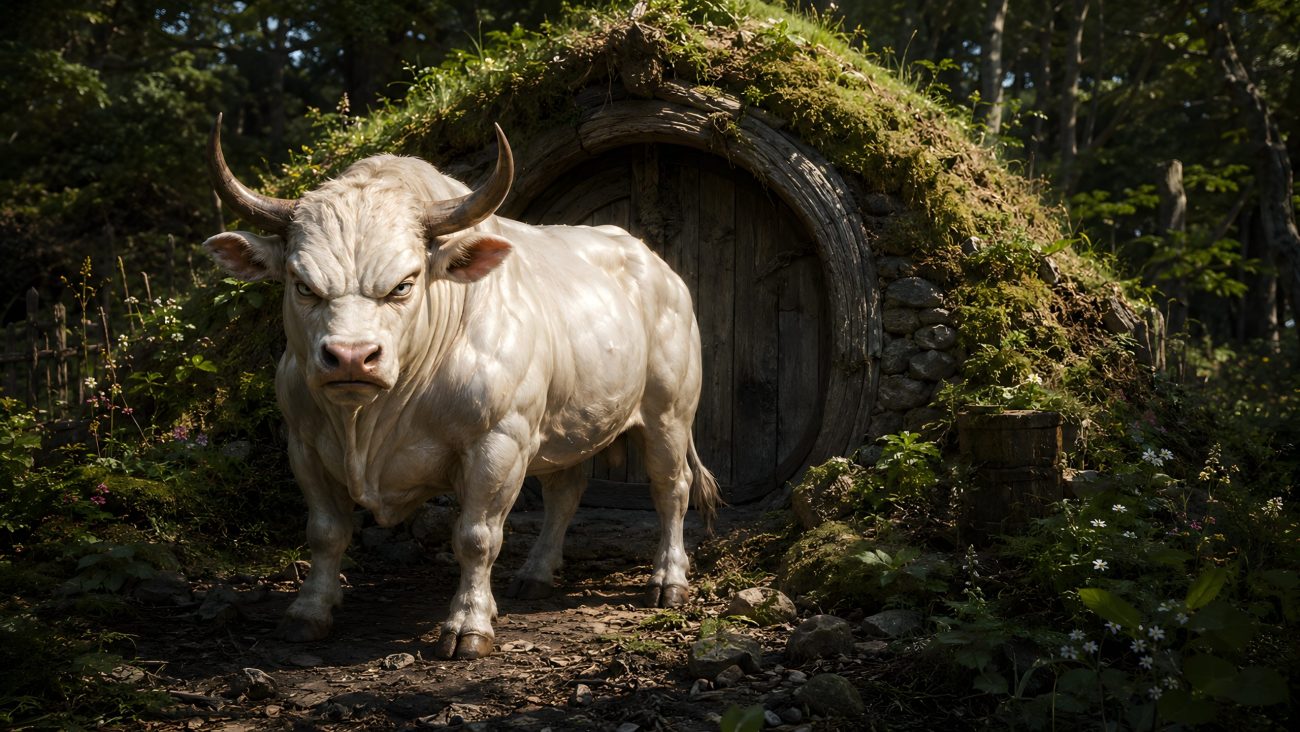
Long ago, there were two herders whose ways shaped their cattle as much as their hands ever could. One was called Rohrdommel, the Bittern, and the other Wiedehopf, the Hoopoe. Both tended cows with care, yet each chose a very different path.

Rohrdommel led his herd into wide meadows rich with flowers and grass. The land was fertile but not heavy, and the cows that grazed there grew lively and bold. They leapt and ran, full of restless joy. When evening came and it was time to return home, Rohrdommel called out to them, crying, “Bunt, herüm!” — “Colorful cow, come around!” But the cows ignored him, dancing and scattering through the fields, unwilling to be gathered.

Wiedehopf, meanwhile, drove his cattle into high, barren hills where the wind blew sand across the ground and food was scarce. There his cows grew thin and weak. When he called to them, urging them to rise and follow, they could not. They lay where they had fallen, too exhausted to stand, no matter how loudly he cried, “Up, up, up!”

So it was said that Rohrdommel’s cows became spirited and wild, while Wiedehopf’s remained frail and helpless, each herd reflecting the land and care chosen for them. In time, the herders themselves vanished from the world of people and were transformed into birds.

Even now, their voices remain. Over the meadows, the Bittern still cries “Bunt, herüm!”, and across the hills the Hoopoe answers “Up, up, up!”—echoes of a time when cattle danced or lay still, and when herders shaped the fate of their herds by the paths they chose.


Sources


Bull of Bardowick

Tradition / Region: German mythology
Alternate Names:
Category: Cow


The Myth

In the time when Bardowick was a rich and powerful city, its people rose in pride and defied their lord, Duke Henry the Lion of Brunswick, refusing him entry through their gates. Enraged by this insult, the duke laid siege to the city. For two days his forces pressed against Bardowick’s defenses, yet made no progress.

During the siege, a bull wandered calmly into the ducal camp. The soldiers soon realized that it was the town bull of Bardowick, a familiar animal that roamed freely and knew every path and crossing of its home. Seeing opportunity, Duke Henry ordered the bull released and commanded his men to follow it quietly.

The bull, untroubled and unaware, returned toward the city. It moved along the outer defenses, crossed a shallow ford, and passed through a narrow, crumbling opening in the stonework—a place long overlooked and poorly guarded. By instinct alone, the bull revealed the city’s hidden weakness.

That same night, the duke’s soldiers followed the path the bull had taken. They crossed the ford, slipped through the broken stone, and poured into Bardowick. The city was taken and destroyed. Many were slain, others fled, and Bardowick was reduced to ruins. Only the cathedral was spared from the devastation.

Though the city never regained its former glory, the memory of the bull endured. It was remembered not as an innocent creature, but as the animal whose unwitting loyalty betrayed its home and led the enemy inside. Even generations later, the tale remained sharp with shame. It is said that one should never ask the people of Bardowick about the bull, for the memory of the beast that led destruction home still stirs anger in every heart.


Sources


Boxed Calf

Tradition / Region: German mythology
Alternate Names:
Category: Cow, Familiar


The Myth

It was said that those who wished to possess a brood penny—a coin that multiplied itself each night—had to make a bargain with the devil. On Christmas Eve, while church bells rang for Mass, they went alone to a crossroads. There they laid thirty coins in a circle and counted them forward and backward without a single mistake. If their tongue slipped, their neck would be twisted. If they succeeded, the devil added a thirty-first coin, and the cursed wealth was secured.

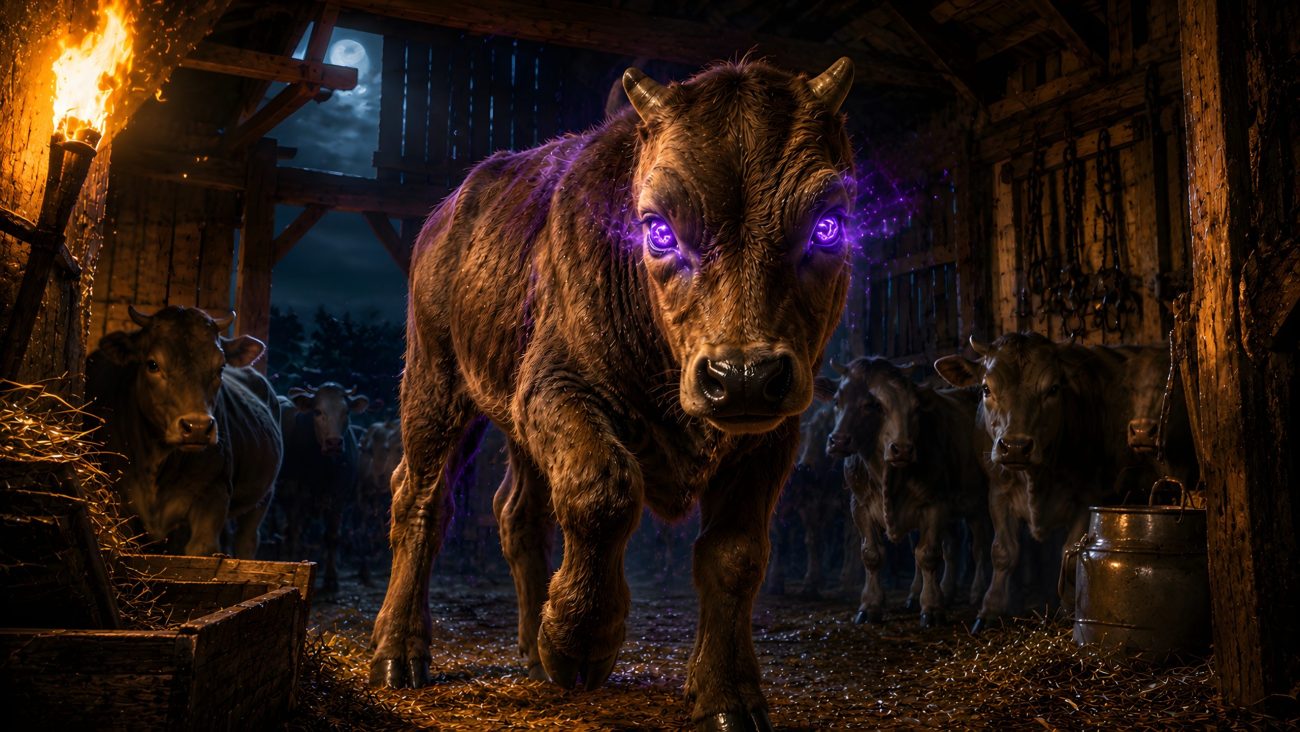
Near Wittenberg, a peasant woman was believed to own such a coin. In her house stood a box she guarded closely. One evening, she ordered her maid to boil the milk from the very first cow she milked, pour it over white bread, and place it in the box before doing anything else.

The maid delayed. She milked all the cows first, then boiled the milk and carried the pot to the box.

When she opened it, she saw a small calf inside—pitch black, cramped within the chest, its mouth stretched wide as if waiting to be fed. Terrified, the maid poured the boiling milk straight into its mouth.

At once the calf sprang from the box and raced through the house. Flames erupted in its wake, and the house was set ablaze.

Soon after, the woman was arrested and confessed. From that time on, brood pennies were seized wherever they were found and locked away in public treasuries, so that no boxed calf would ever again be secretly fed in the dark.


Sources

AGEN.at contributors. (n.d.). Der Brutpfennig. In SAGEN.at – Grimms Märchen & Sagen, from https://www.sagen.at/texte/sagen/grimm/derbrutpfennig.html