Tradition: German Mythology
Alternative Names: Klagemuhme, Klagmutter, Klagemutter, Klagefrau, Winselmutter
Category: Spirit
The Myth
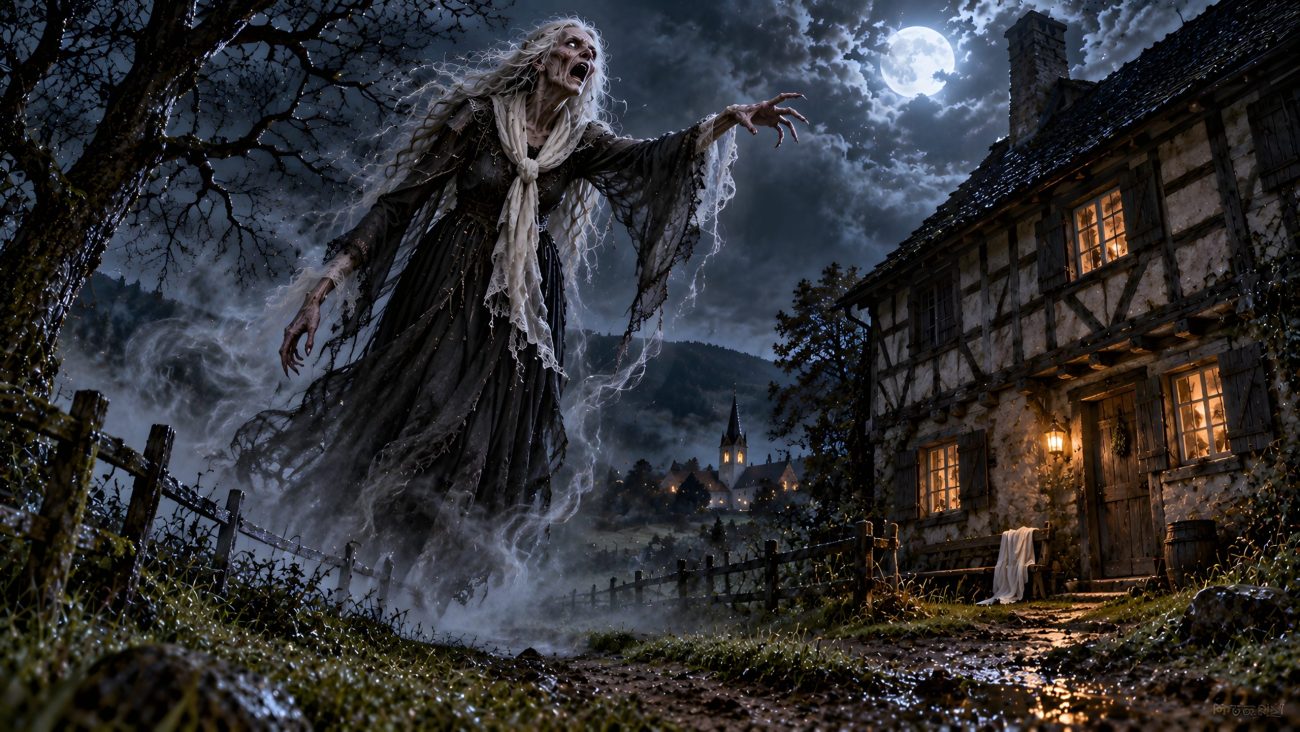
The Klagmuhme, or Wailing Aunt, was a frightening female spirit whose mournful cries announced approaching death and disaster. She was usually active around midnight and often remained invisible as she approached a house, floating above it without ever entering. Her presence could sometimes be recognized only by her eerie whining, described as a repeated “u-u-u” sound. In other traditions she appeared in many different forms: as a long-haired black dog, a white goose, a dove sitting in the eaves, a large gray cat with a scarf around its head, a white or three-legged sheep, an eerie bird, a fiery toad, or a red-eyed calf. Her human form could be that of an old woman dressed in black with a white scarf, a tiny woman with a cobweb-covered face and three-cornered hat, or a gigantic pale figure in a flowing burial robe with glowing or hollow eyes. She could even appear as a distorted black figure or a tangled ball of blue material throwing off sparks.
The Klagmuhme’s wailing was a warning that death was near. If she appeared outside a house where someone was seriously ill, clothing belonging to the sick person could be thrown outside. If the Klagmuhme carried the clothing away, the person was believed certain to die; if she left it behind, recovery was expected. In another tradition, she stretched her long, bony arm over a house during a stormy night, foretelling that someone inside would be dead before the moon completed its cycle. Hearing her cries could itself cause such terror that a person became physically ill. Yet she was not always considered actively malicious, and she normally did not enter the houses or deliberately harm those who heard her.
The Klagmuhme was also connected with the souls of the dead and with other supernatural processions. In Austria, the Klage was believed to be the soul of a deceased person, while in Saxony she was remembered as the spirit of an unfortunate mother searching for her drowned son. In the Allgäu, ghostly wailing women or men carrying a coffin could appear in a midnight procession, while in Carinthia and Switzerland the Klagmuhme was associated with the Wild Hunt. In the Fichtel Mountains she was instead regarded as a female forest spirit. Across these traditions, her mournful appearance and terrible voice remained a warning of death, making her a supernatural embodiment of grief and impending loss.
Sources
“Klagmuhme.” Wikipedia: The Free Encyclopedia. Wikimedia Foundation. Accessed October 5, 2026.
https://en.wikipedia.org/wiki/Klagmuhme