Hemann

Tradition: German Mythology
Alternative Names: Emann, Homann, Hoymann, Hoimann, Jochhoimann, Hejkadlo, Hehmann, Ropenkerl
Category: Ghost


The Myth

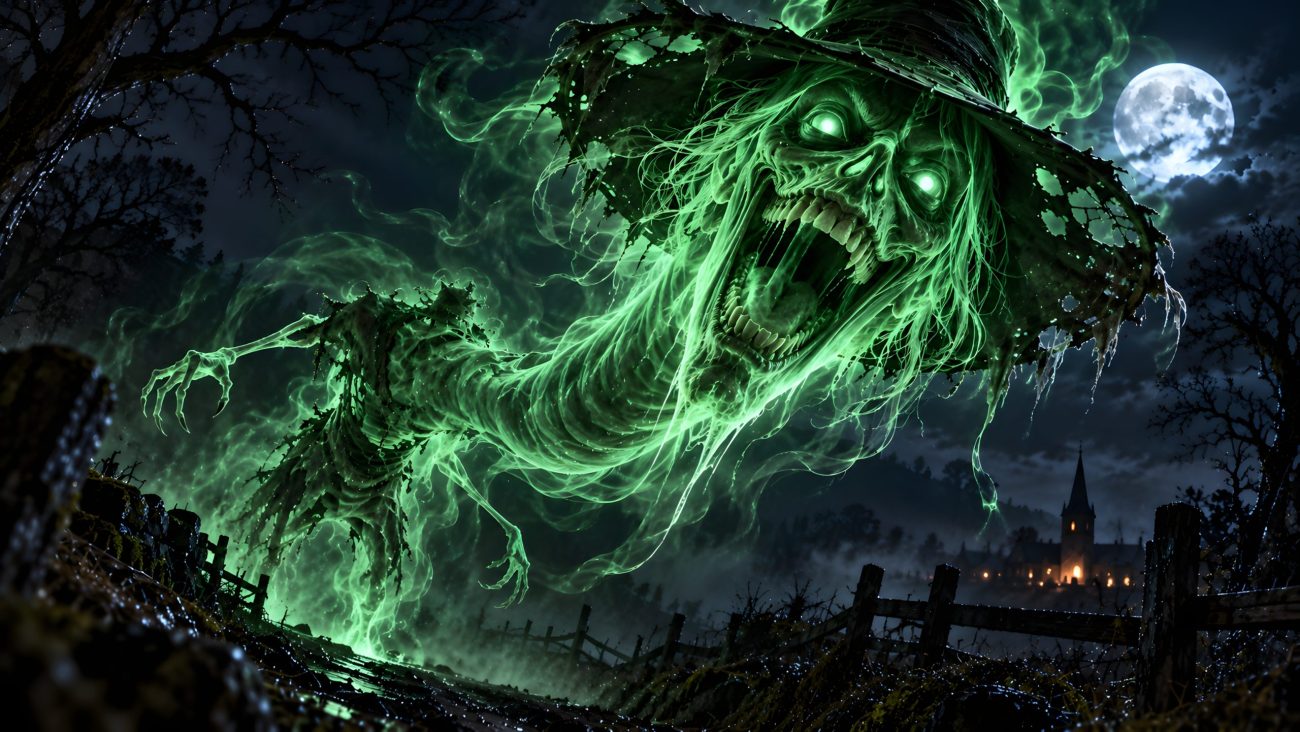
The Hemann is a mysterious spirit from German folklore known primarily for its frightening cries, which echo through the darkness and terrify people who hear them. Usually invisible, it announces its presence with strange shouts such as “he he,” “he helfts,” or other distinctive calls that vary between regions. The creature is recorded in traditions from former German-speaking areas of Bohemia and Silesia, as well as the Upper Palatinate, the Fichtel Mountains, the Vogtland, Westphalia, and parts of Baden-Württemberg. In Bohemia, it is also known by the Czech name Hejkadlo.

The Hemann often pursues people with its cries, seemingly chasing them without ever quite catching up. However, anyone who dares to imitate its call risks a much more dangerous encounter. The spirit may leap onto the person’s back, forcing them to carry it, a supernatural attack known in German tradition as aufhocken. Depending on the regional version, it may also lead people astray or strike them in the face. The Hemann is not always understood as the same kind of being: it may be the ghost of a sinner condemned to haunt a boundary that they unlawfully moved during life, a field spirit associated with the final sheaf of the harvest, or occasionally a household spirit. Some accounts connect its cries to the calls of owls, eagle owls, hoopoes, nightjars, and ravens.

Regional traditions give the Hemann a variety of appearances and behaviors. In the Upper Palatinate, the related Hoymann or Hoimann haunts mountain forests, where its rough, manlike voice or owl-like cry can be heard from a considerable distance. Although it is usually invisible, it may appear as a tall hunter wearing a broad-brimmed hat, a giant reaching toward the clouds, or a figure dressed in a smock-frock. It is sometimes identified as a restless soul or even the Devil. The Hoymann punishes those who steal wood from the forest, and it is also associated with the Wild Hunt. In Lower Lusatia, the Homann cries at noon, serving as a natural time signal for local people. In Northern Bohemia, the Hehmann hides in cornfields and leaps onto anyone who imitates its shrill call.

Other related figures appear in neighboring traditions. In Switzerland, the invisible Egelsee-Hüper cries “hüp hüp” around midnight near Lake Egelsee. In Westphalia, the Ropenkerl’s cry is considered an omen of bad weather. The Heitmännchen appears as a small blue flame, punishes those who imitate its voice, but may help with the harvest if offered a sandwich. The Homännchen briefly appears as a tiny man in a grey camisole among a herd of cattle before vanishing. In the Lechrain region, the Hojemännlein are tiny green kobolds inhabiting forests and abandoned farms. During Advent, they shout “hoje,” perform somersaults, and play mischievous tricks. Their cries sound like sorrowful weeping, and although they can behave playfully, they punish anyone who imitates their calls. Across these regional variations, the Hemann tradition combines eerie nocturnal cries, warnings against trespassing or theft, and the danger of answering supernatural voices.


Sources

“Hemann.” Wikipedia: The Free Encyclopedia. Wikimedia Foundation. Accessed October 16, 2026. https://en.wikipedia.org/wiki/Hemann

Villinger Thalfräule

Tradition: German Mythology
Alternative Names: Villingen Valley Maiden, Villinger Thalfräulein
Category: Ghost


The Myth

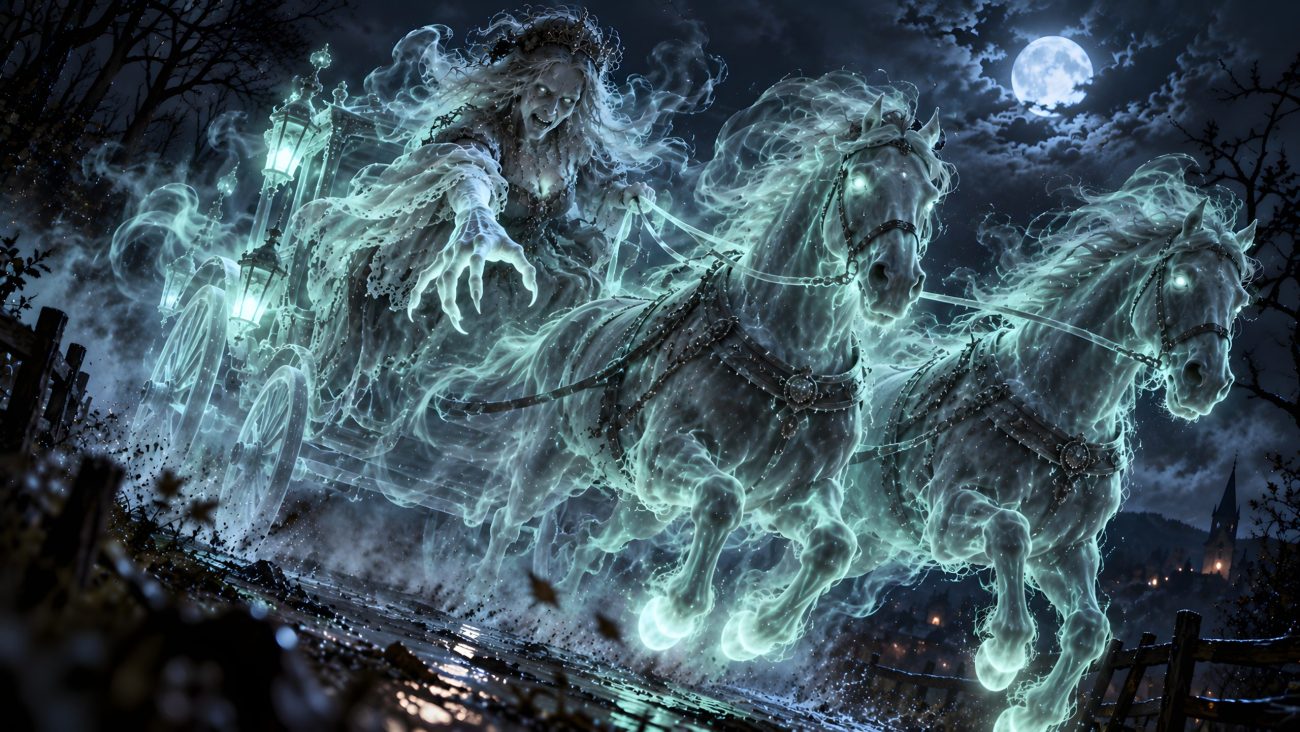
The Villinger Thalfräule is a haunting spirit said to wander the Villingen Valley between Mergentheim and Wachbach in Baden-Württemberg, Germany. According to local legend, she was once a countess of Wachbach, associated with the noble family whose residence later belonged to the von Adelsheim family. During her lifetime, she was infamous for her mercilessness, greed, and cruelty toward ordinary people. She owned magnificent horses that her servants washed with wine every day, yet she denied those same servants even a drop to drink. She also cheated the poor by selling them heavily diluted milk, justifying the deception with the saying, “Three pints of milk, one pint of water, makes a Maß.”

The countess’s cruelty extended to human life itself. One day, as she travelled through the valley in her sleigh, her servant noticed a man lying in the path and stopped the horses. The countess, concerned only with her fine animals and impatient to continue her journey, repeatedly ordered the servant to drive on. The man was run over and killed. The countess died soon afterward, but her wickedness condemned her to wander the earth as a restless spirit.

The Villinger Thalfräule is often heard calling out at night, “Go away, go away!” She is said to lure people and even entire wagons into the Villingerthälisbach stream, where a deep pool can drown them. She appears as a medium-sized, very old woman dressed in old-fashioned clothing and remains silent when encountered. In the Villinger Thalwald forest, she also misleads travelers and plays tricks on them, sometimes carrying away their bundles of firewood. Her haunting serves as a supernatural punishment for a life defined by greed, callousness, and contempt for the suffering of others.


Sources

“Das Thalfraeule.” SAGEN.at – Deutsche Sagen aus Baden-Württemberg. Reproduced by SAGEN.at. https://www.sagen.at/texte/sagen/deutschland/baden_wuerttemberg/thalfraeule.html


Poltergeist

Tradition: German Mythology
Alternative Names: Poltergeist, Rumbling Ghost, Noisy Spirit
Category: Ghost


The Myth

A poltergeist, whose name comes from the German words for “rumbling” and “spirit,” is a noisy and disruptive supernatural being in German folklore and ghostlore. Unlike ghosts that merely appear as apparitions, poltergeists are associated with physical disturbances in the places they haunt. They announce their presence through loud crashes, unexplained knocking, and other noises, while seemingly invisible forces move, overturn, or destroy objects around them.

Poltergeists are also said to torment people directly. They may pinch, bite, hit, or trip those who encounter them, while furniture and smaller objects such as cutlery can move or even levitate without an apparent cause. Other manifestations include foul smells, spontaneous fires, and electrical disturbances such as flickering lights. Their activity is often chaotic and destructive, making them particularly unsettling spirits in stories of haunted houses and unexplained disturbances.

Accounts of poltergeist-like phenomena occur across many cultures, including Brazil, Australia, the United States, Japan, and numerous European countries. Reports of such disturbances date back to at least the first century. Although traditionally understood as the work of ghosts or spirits, skeptical interpretations attribute these events to human trickery, sometimes involving young pranksters deceiving adults.


Sources

“Poltergeist.” Wikipedia: The Free Encyclopedia. Wikimedia Foundation. Accessed October 16, 2026. https://en.wikipedia.org/wiki/Poltergeist


Ewiger Jäger

Tradition: German Mythology
Alternative Names: Der ewige Jäger, Wilder Jäger, Weltsjäger, Weltschjägerle, Ruprecht, Hans, Riesenjäger
Category: Ghost


The Myth

The Ewiger Jäger, meaning “Eternal Hunter,” is a supernatural huntsman found in German folklore and related traditions in Belgium and the United States. He is a ghostly figure condemned to hunt eternally, often appearing as a mysterious hunter pursuing his quarry through forests or racing through the night accompanied by dogs. His punishment is associated with an excessive passion for hunting, the violation of religious prohibitions, or acts of sacrilege. In Swabian tradition, he is also known as the Weltsjäger or Weltschjägerle, names reflecting his endless obligation to run and hunt throughout the world.

According to a legend recorded by the Brothers Grimm, Count Eberhard of Württemberg encountered the Ewiger Jäger while hunting in the woods. Hearing a loud rushing sound and the noises of a huntsman, the count dismounted and asked the ghost whether it intended to harm him. The apparition replied that it was once a human lord who had loved hunting so passionately that he begged God to allow him to continue hunting until Judgement Day. His wish was granted, but became an eternal punishment: for five and a half centuries, he had been chasing the same deer. The hunter told the count that his former identity and noble status remained undisclosed. When Eberhard asked to see his face, the ghost revealed a tiny, withered visage, no larger than a fist and wrinkled like a mushroom. The apparition then resumed its endless pursuit, leaving the horrified count to return home and abandon hunting. Ludwig Bechstein recorded a similar version, describing the hunter as a gnarled little man dressed in green. In this account, his eternal punishment resulted from hunting on a Sunday and violating the sacred day of rest.

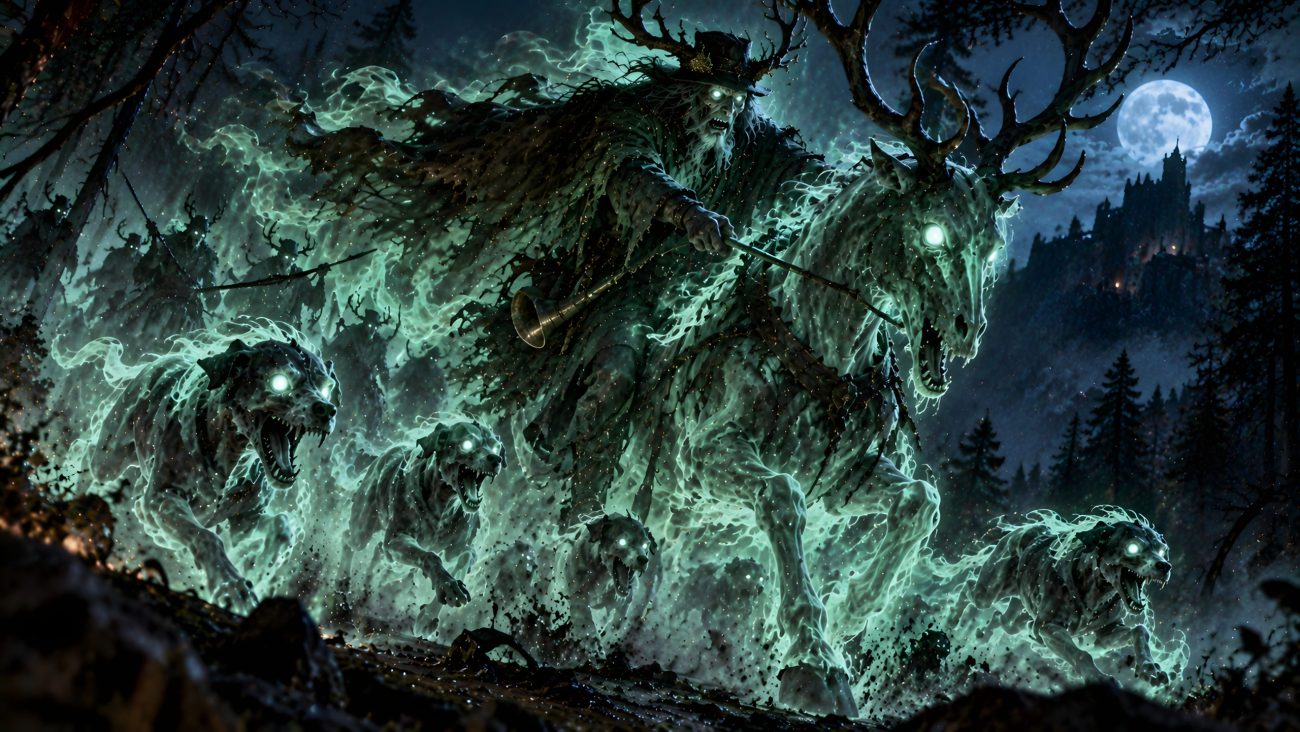
Other regional legends describe different origins and appearances for the Eternal Hunter. In one Swabian tradition, he carries a hammer with which he strikes trees, producing a peculiar high-pitched sound. In another, he is a Freischütz, a marksman who sought unfailing magical bullets by shooting at the sun in the Devil’s name on Christmas Eve and Good Friday. For this sacrilege, he was condemned to hunt eternally at night, accompanied by barking dogs. A related hunter named Neck delighted in killing poachers and was cursed with eternal life after shooting five men on a Sunday. One of the dying poachers, himself armed with magical bullets, shot Neck through the heart. Since then, the cursed hunter has ridden through the woods on a stag, urging on little white dogs with cries of “Hu dock dock dock!” Other names associated with the Ewiger Jäger include Ruprecht, Hans, and Riesenjäger, meaning “Giant Hunter,” a title connected with accounts of his enormous stature. In Swabian tradition, he is also compared with the Wandering Jew, another figure condemned to travel endlessly around the world.


Sources

“Ewiger Jäger.” Wikipedia: The Free Encyclopedia. Wikimedia Foundation. Accessed October 16, 2026. https://en.wikipedia.org/wiki/Ewiger_J%C3%A4ger


The Calf-Bleater of Sufferloh

Tradition / Region: German Mythology
Alternate Names: The Calf Spirit; The Bleating Steward; The Hoofprint Ghost
Category: Cow, Ghost


The Myth

In the free village of Sufferloh, the people once lived under the protection of Tegernsee Abbey. Each year, out of their own goodwill, they brought a calf to the prelate as a sign of respect. The offering was freely given and caused no resentment among the farmers.

But in time a new monastery steward was appointed. When another year passed, he declared that the gift would no longer be voluntary. From then on, he demanded the first-born calf from the farmers as a fixed obligation. The people obeyed, but bitterness settled in their hearts.

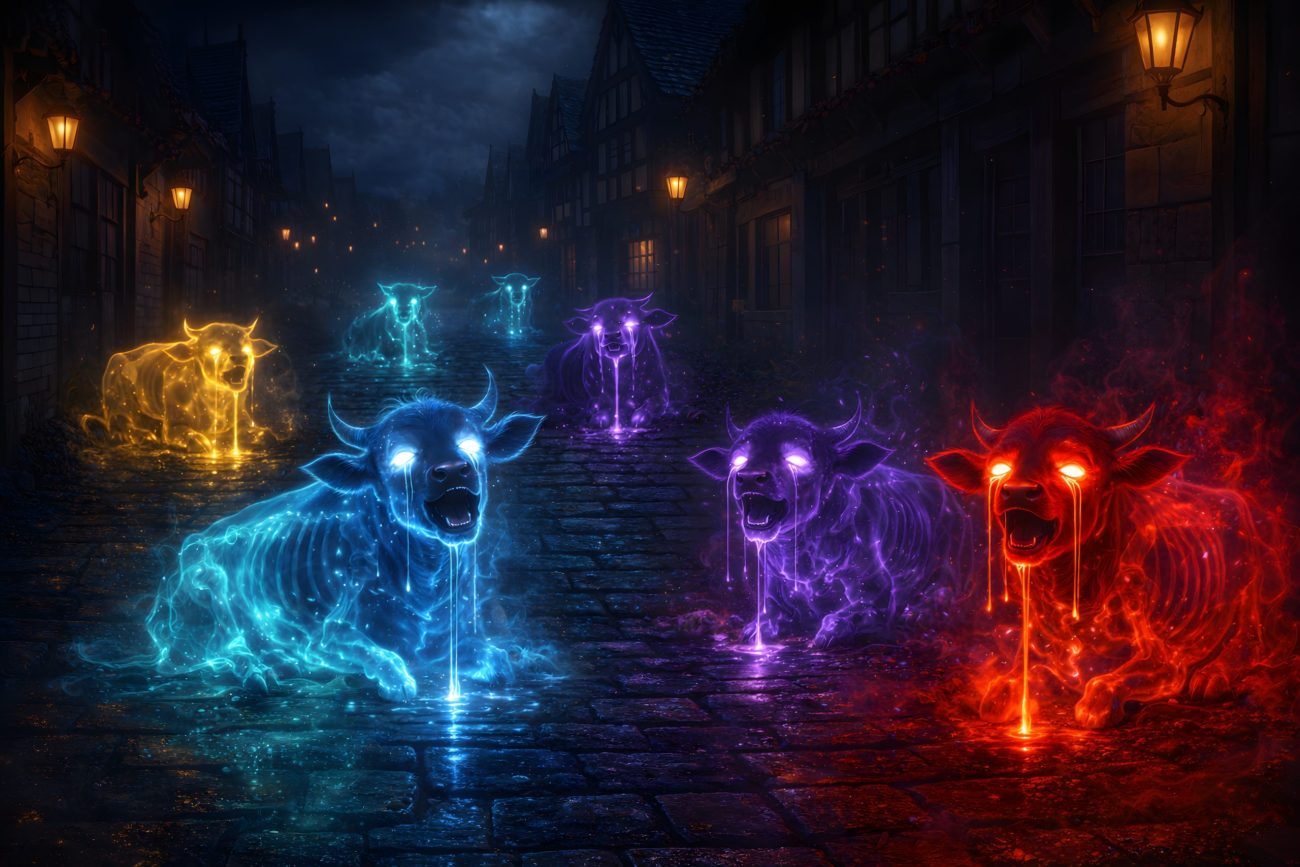
After the steward died, strange happenings began in the monastery passage. At night, a loud bleating echoed through the corridors — the unmistakable cry of a calf. The sound returned again and again, filling the monks with dread.

Not long after, a calf’s hoofprint appeared in the stone floor of the passage. No matter what was done, the mark would not vanish. Even when the tiles were removed, the imprint could still be seen beneath them.

The monks finally sealed the passage in hopes of ending the disturbance. Yet the bleating continued night after night, and peace did not return until the monastery itself was dissolved.

People later said the spirit of the unjust steward had been condemned to wander, crying forever like the calf he once demanded without mercy. Some claimed the ghost was driven first to the Ringspitze, and later, by order of the Pope, to roam the Unnütz mountain with other restless spirits, doomed to bleat through the darkness for all time.


Sources

SAGEN.at contributors. (n.d.). Kalbplärrer. In SAGEN.at – Traditionelle Sagen aus Deutschland: Bayern–Isarwinkel, from https://www.sagen.at/texte/sagen/deutschland/bayern/isarwinkel/kalbplaerrer.html