Tradition: English Mythology
Alternative Names: Lambton Worm, Lambton Worm of the River Wear
Category: Dragon
The Myth
The Lambton Worm was a monstrous worm that grew to enormous size after being thrown into a well by the young heir of the Lambton family. At first it was a small and seemingly insignificant creature, but after being cast into the well it remained there until it had grown so large that its dwelling could no longer contain it.
The young Lambton heir had lived a careless and profane life and had even gone fishing in the River Wear on the Sabbath. One day, after experiencing little success with his fishing, he felt a sudden tug on his line. He pulled with great force and was convinced that he had caught a magnificent fish. Instead, he found a strange little worm. Disgusted by his catch, he threw the creature into a nearby well.
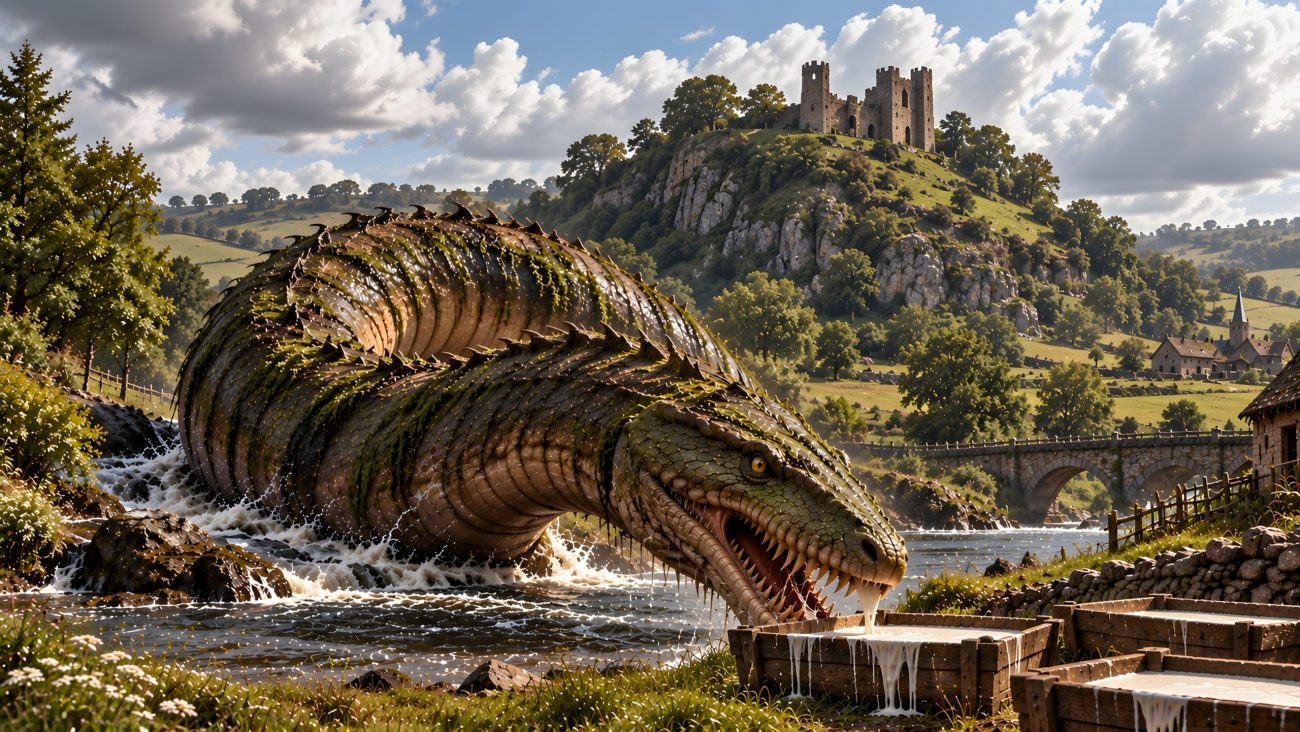
The worm remained unnoticed in the well for some time. Eventually it grew so enormous that it outgrew its underground dwelling and emerged into the world. It made its way down to the river and then crawled toward a nearby hill. As it continued to grow, it became so large that it could encircle the hill three times. The hill itself became known as Worm Hill, and depressions surrounding it were traditionally said to mark the tracks left behind by the enormous creature.
The Worm soon became the terror of the surrounding countryside. It sucked the milk from cows, tormented cattle, consumed the land, and laid waste to the countryside. Meanwhile, the Lambton heir had come to regret his former life and had travelled to the Holy Land to fight against the Saracens. His father remained behind in the old castle, while the Worm continued to threaten the people.
The creature became so troublesome that the only way the villagers could appease it was to provide it with milk. Nine cows were milked, and their milk was poured into a trough for the monster. The Worm would drink the milk and, having been satisfied, curl itself around its favourite hill. This became the grim routine that allowed the people to survive its presence.
After seven years, the young heir returned from the wars and learned of the terrible state into which his homeland had fallen. He resolved to confront the monster. Before he went into battle, his lady prepared him carefully. She had him wear his finest suit of armour and studded it with sharpened spearheads. He was to meet the Worm beside the river, near the place where it spent the day.
But she gave him a terrible warning. If he returned victorious, the first living creature he encountered on his journey home had to be killed. If he failed to fulfil this vow, no Lord of Lambton would die in his bed for nine generations.
The heir went boldly to the river and took his position upon a rock, drawing his sword. In due course the Worm came to attack him. It struck him a heavy blow upon the head with its tail and then attempted to crush him within its coils. But as the monster tightened its grip, its enormous body was forced against the sharpened spearheads covering the knight’s armour. The more tightly it coiled around him, the more severely it cut itself.
Eventually the Worm’s strength diminished enough for the knight to cut the monster in two. The severed half was swept away by the river, while the Worm attempted to reunite its divided body. Before it could do so, the current carried the severed portion away, and the monster was finally destroyed.
Meanwhile, old Lord Lambton had been waiting anxiously in the castle for news of his son’s battle. When he saw his victorious son approaching, he rushed out to meet him. The young heir could not kill his own father, and the ancient warning therefore went unfulfilled.
The victory over the Worm consequently did not free the Lambton family from its curse. For nine generations, it was said, no Lord of Lambton would die peacefully in his bed. The exact date of the original events was uncertain, but the story remained deeply associated with the Lambton family and the surrounding countryside.
The legend later gained further life from events involving the Lambtons themselves. In 1761, Henry Lambton, a member of Parliament, died when his carriage was crossing the new Lambton Bridge. Local people interpreted his death as another fulfilment of the ancient curse.
The Lambton Worm thus became one of County Durham’s most famous monsters: a tiny worm born from a careless act, transformed into a gigantic river creature that terrorized the countryside, and finally destroyed by the very man whose earlier actions had brought it into existence.
Sources
University of North Carolina at Chapel Hill. Folklore Council. North Carolina Folklore. Vols. 1–8. Chapel Hill, N.C.: North Carolina Folklore Society, 1948–1960.