Barcädžy Calh

Tradition: Ossetian Mythology, Russian Mythology
Alternative Names: Wheel of Balsæg, Cutting Wheel, Barsæg, Marsug
Category: Flame


The Myth

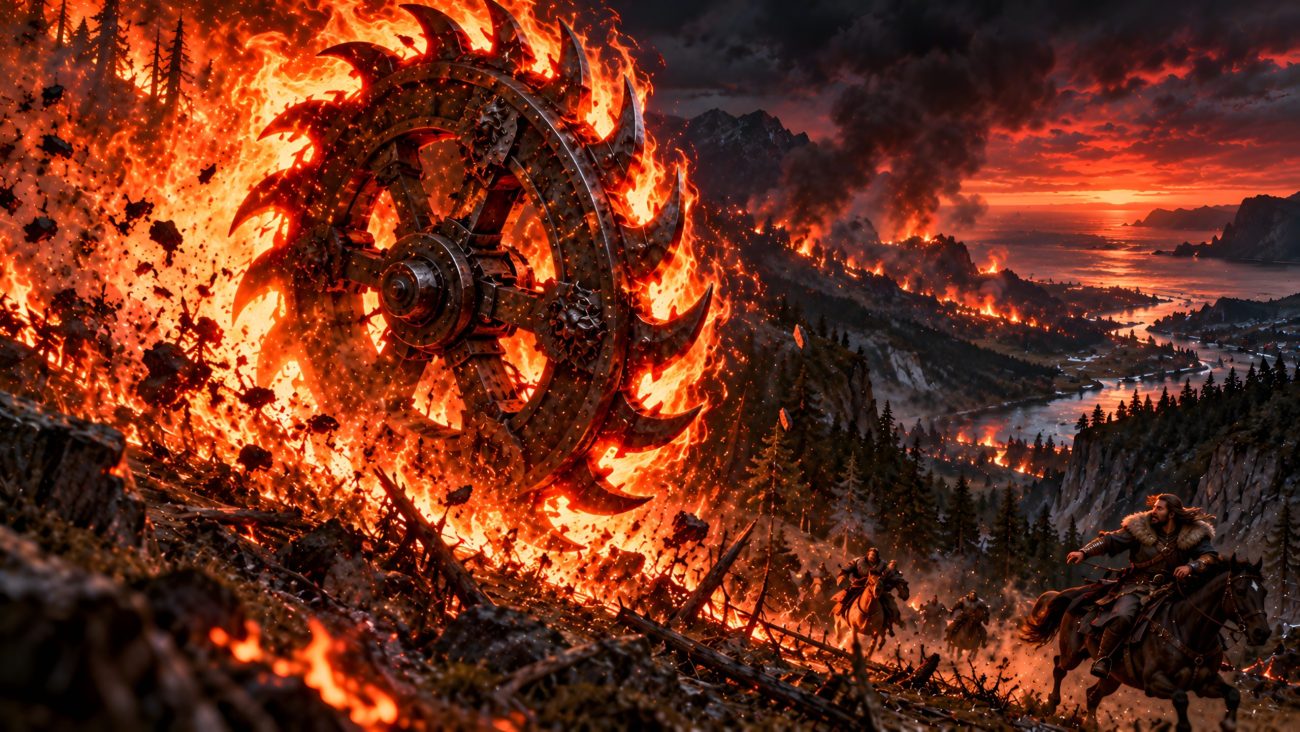
Barcädžy Calh, the Wheel of Balsæg, is a terrifying supernatural weapon in the form of a razor-sharp metal wheel covered in steel teeth, with flames bursting from its surface. It is an intelligent and malevolent automaton capable of moving by itself. When unleashed, the blazing wheel rolls down from the heavens and races across the earth, setting plains and forests ablaze as it charges toward the Black Sea. Only birch trees escape its fiery destruction.

The Wheel plays a central role in the death of Soslan, also known as Sosryko, one of the greatest Nart heroes. After Soslan’s horse is brought down by arrows striking the vulnerable undersides of its hooves, the jealous Syrdon calls upon the Wheel to destroy the hero. Soslan pursues the fiery machine and manages to capture it, but it breaks free and rushes at him, slicing through his knees—the one vulnerable part of his otherwise invulnerable body. Mortally wounded, Soslan is left to die. His sons pursue the Wheel into the Black Sea, but they cannot save their father. Before his death, Soslan takes revenge on Syrdon from beyond the grave, while his nephew later avenges him by breaking the Wheel in half.

The Wheel’s ownership varies between tellings. In some stories, it is sent by the Daughter of the Sun; in others, it belongs to Father Ojnon, identified with John the Baptist. Its master, Balsæg, remains mysterious, and the Wheel itself sometimes appears in simplified versions of the tale as a deadly training discus. Whatever its origin, the blazing Wheel remains a fearsome force of destruction, combining supernatural intelligence, razor-sharp steel, and a trail of fire.


Sources

Barcadzy Calh.” A Book of Creatures. November 9, 2015. https://abookofcreatures.com/2015/11/09/barcadzy-calh/


Wiła

Tradition: Ukrainian Mythology, Russian Mythology, Belarusian Mythology
Alternative Names: Samowiła, Samodiva, Vila, Wila
Category: Fairy


The Myth

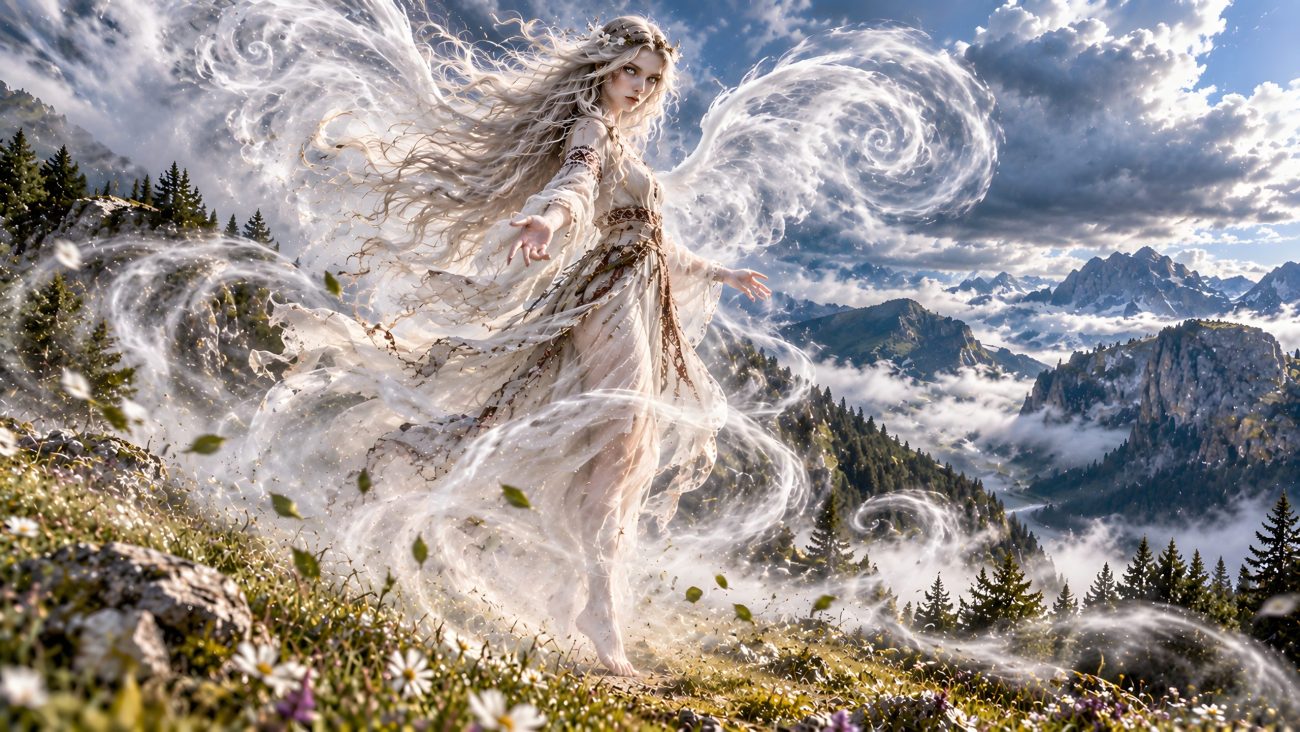
The Wiły were beautiful supernatural spirits associated with the wild places of the natural world. They were believed to originate from the souls of young women who died, and could inhabit forests, mountains, rivers, lakes, and even clouds. Forest Wiły were called samowily, while others were associated with mountains, waters, or clouds. They could appear as beautiful winged girls with pale, almost transparent bodies, usually naked or lightly clothed, but were also able to take the forms of horses, swans, falcons, and wolves. They could transform themselves into whirlwinds and were sometimes associated with serpent-like forms. In groups, they moved through the wilderness and could even ride upon clouds or move them simply by fixing their gaze upon them.

The Wiły were capricious toward humans and could be either helpful or dangerous. They might assist young men in finding wives, warn people of approaching hailstorms, help farmers in need, or reveal knowledge of the future. Their favor could therefore bring protection and prosperity, but their anger was feared. When offended, they could unleash hail, powerful winds, or drought upon fields, destroying crops and bringing hardship to entire communities. They were especially dangerous to people who encountered them directly, as they could dance with men until they died, blind them, drive them mad, or fill them with overwhelming and impossible desires.

In Western Slavic tradition the Wiła could eventually become associated with a more sinister kind of supernatural being, particularly one that brought madness to humans. The old meaning of the word itself became connected with madness, reflecting the belief that encountering these spirits could drive a person out of his senses. Their nature therefore stood between the beautiful and the terrifying: they were alluring spirits of forests, mountains, waters, and storms who could aid mortals when treated well, but whose supernatural beauty concealed a dangerous and unpredictable power.


Sources

“Wiła.” Wikipedia, wolna encyklopedia (Polish Wikipedia). Wikimedia Foundation. Accessed October 5, 2026.
https://pl.wikipedia.org/wiki/Wi%C5%82a


Sheka

Tradition: Russian Mythology, Turkish Mythology
Alternative Names: Шекә
Category: Dwarf


The Myth

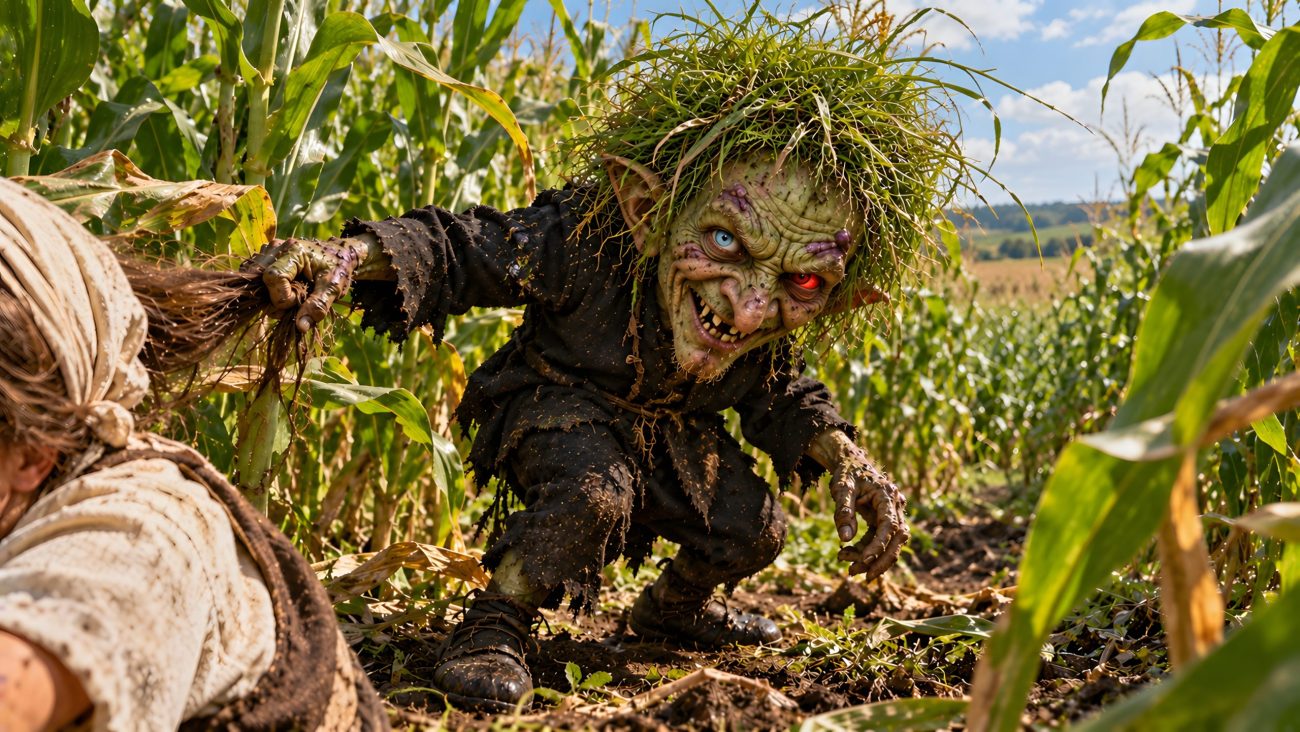
Sheka is a dwarf-like being associated with forests, abandoned houses, and fields. In Turkic tradition, Sheka is said to live among forests or in derelict houses and often appears in strange or comical situations. In Slavic pagan tradition, however, Sheka takes on a much darker form as a field spirit. It appears as a deformed dwarf with differently colored eyes and grass growing in place of hair. It may be dressed entirely in black or entirely in white and is most often encountered around noon or at sunset.

The field Sheka is a dangerous spirit for anyone wandering or working in the countryside. It can deliberately lead travelers astray among the fields, cause illness, and even ride over sleeping people with horses. Peasants working beneath the midday sun must beware of it, for Sheka enjoys sneaking up on them and pulling their hair. Children are especially vulnerable, as the spirit is said to make them lose their way among the tall cornfields.

When Sheka catches a person, it can force its victim to sing for hours without allowing them to stop. Its strange behavior makes it both a frightening and mischievous presence of the fields, turning ordinary places of work and travel into places where a small, deformed spirit might suddenly appear, confuse travelers, torment peasants, or carry away unsuspecting children.


Sources

“Sheka (mythology).” Wikipedia: The Free Encyclopedia. Wikimedia Foundation. Accessed October 4, 2026. https://en.wikipedia.org/wiki/Sheka_(mythology)


Anshikh Sisva Pyalta

Tradition: Mansi Mythology, Russian Mythology
Alternative Names: Anshikh Sisva Pyalt; Anshikh Sisva Pyalta; The Old Man as Long as a Hare
Category: Dwarf


The Myth

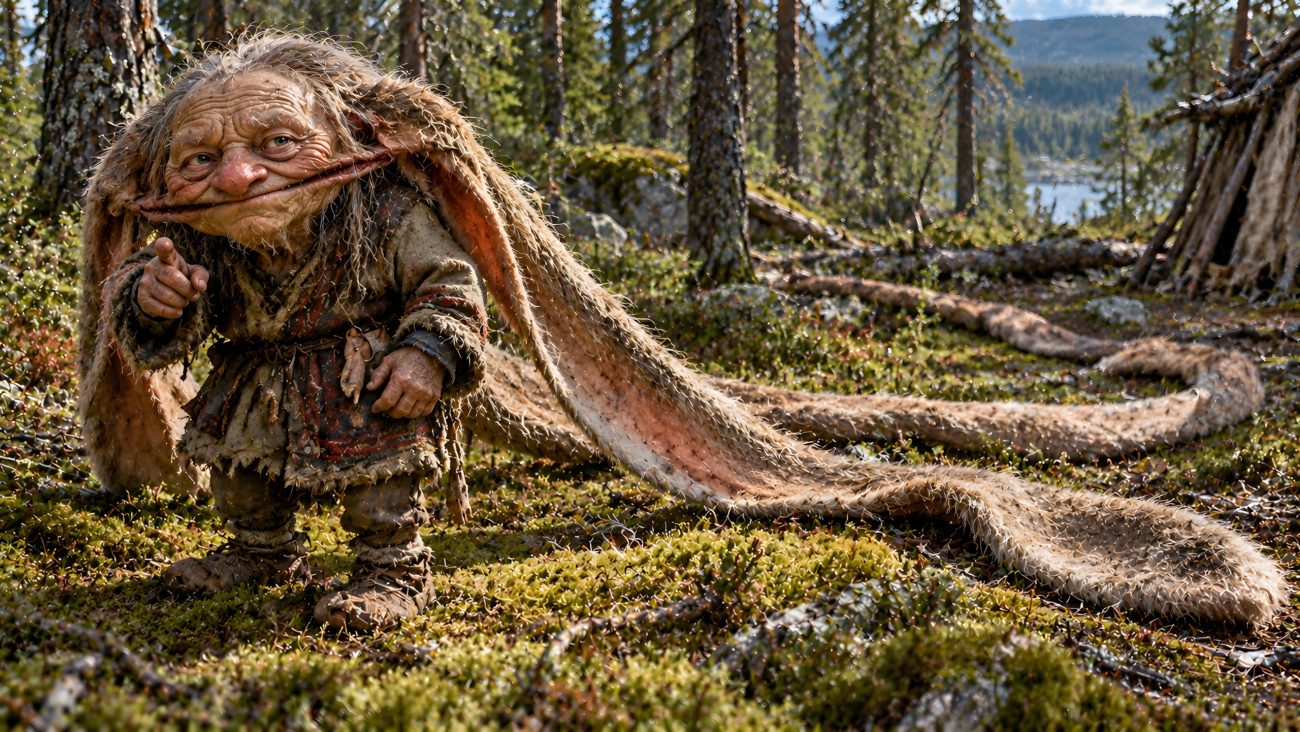
Anshikh Sisva Pyalta is a strange dwarf with incredibly long ears that trail behind him along the ground. He also has a harelip, giving him a peculiar and unsettling appearance.

In the Mansi fairy tale The Son with the Deer Ear, a woman hears someone at the door and finds the little old man standing outside. He has already stepped onto the seventh floor of the house, yet his enormous ears are still lying across the threshold. The Old Man as Long as a Hare sits down at the table, grabs his ears, and throws them onto the bench beside him.

He whispers that the creature is an unclean spirit and asks what kind of being he is. The old man then stretches out one of his ears, telling her to look at its length. He grabs a sharp tooth and sinks it into the upper part of his ear. The ear stretches even farther, reaching two-thirds of the way across the room. He pulls the other ear toward him in the same manner, making it stretch in the opposite direction.

The old man then swallows his head, ears and all, and kicks his legs up from beneath his enormous ears. He jumps and leaps about, shouting and dancing. The strings begin to sound like singing spring birds, while the woman’s head spins and the old man carries her away in a dance.


Sources

“Anshhih Sisva Pjalt.” New Bestiary (Bestiary.us). Accessed October 4, 2026.
https://www.bestiary.us/anshhih-sisva-pjalt


Zmei

Tradition: Russian Mythology
Alternative Names: Zmey, Zmeya, Zmiy, Zmeyevich
Category: Dragon


The Myth

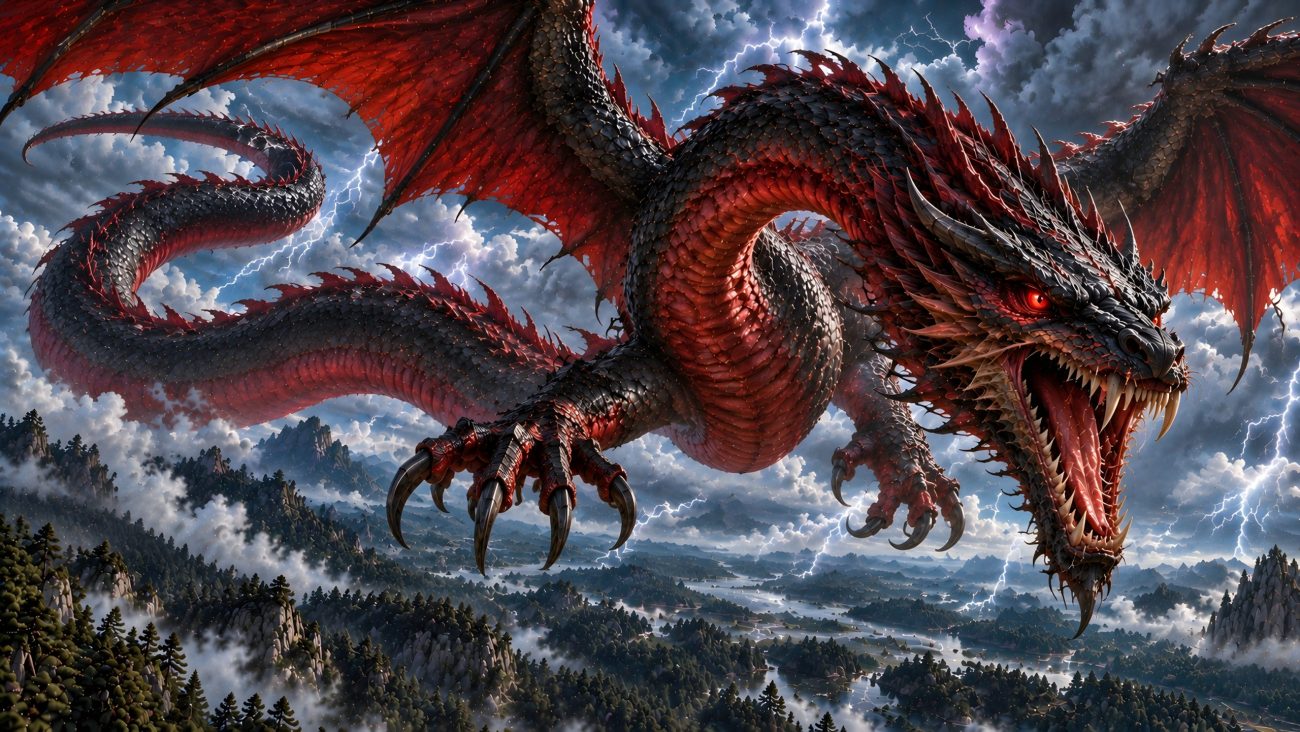
The Zmei is a flying dragon-serpent of Russian folklore, although its appearance can vary considerably. Later descriptions portray it covered in green or red scales with iron claws, while many Zmei are monstrous creatures with multiple heads. They may possess three, six, nine, or twelve heads, and some are capable of breathing fire. The name itself simply means “serpent,” but when used for a dragon it generally implies a flying serpent. Female dragons are called Zmeya, and while male dragons are more common in prose folktales, female dragons appear frequently in epic poetry.

The Zmei is not always purely beast-like. It can move between the forms of serpent, dragon, and human, sometimes appearing as a handsome young man capable of enchanting or seducing women. In the tale of The Milk of Wild Beasts, a Zmei takes the form of a beautiful youth and becomes involved with the family of Ivan Tsarevich. The creature’s shapeshifting can become extraordinarily elaborate: it may disguise itself as ordinary household objects such as a broom, a mop, or an oven fork, attempting to remain hidden from those searching for it. Ivan’s loyal animals, however, are able to recognize the supernatural intruder. In The Crystal Mountain, a Zmei even assumes the form of a golden goat.

The most terrifying Zmei are those with many heads. In Ivan the Peasant’s Son and the Little Man the Size of a Finger, dragons with three, six, nine, and twelve heads appear in succession, each becoming a greater challenge for the hero. The twelve-headed dragon is so difficult to destroy that even after Ivan cuts away almost all of its heads, the final head requires the strength of six men supplied by the Tsar.

Closely related creatures appear in the form of the Chudo-Iudo, monstrous humanlike beings who ride horses and possess several heads. Their heads can even grow back after being cut off, making them extraordinarily difficult to kill. Their supernatural nature blurs the boundary between human warrior and dragon, a characteristic that appears throughout Zmei folklore.

The Zmei can also take on a more human character. The famous Tugarin Zmeyevich is a serpent-like hero and monster who can ride a horse as a human warrior would. He confronts the bogatyr Alyosha Popovich and is eventually slain. Tugarin possesses the enormous appetite associated with a dragon, even swallowing an entire swan and spitting out its bones. He is also described with wings, although some songs rationalize these as artificial paper wings attached to his horse. His character combines the appearance and powers of a dragon with the behavior of a human warrior and pagan adversary.

Another celebrated Zmei is Zmei Gorynych, the “Serpent Gorynych,” a distinctly dragon-like creature associated with water, fire, and numerous heads. He may possess anywhere from three to twelve heads and is capable of breathing fire. Yet even Gorynych is not always a purely monstrous beast and can appear in human form. In Russian heroic tradition, Zmei Gorynych and similar Zmei frequently become adversaries of the bogatyri, including heroes such as Dobrynya Nikitich.

The epic ballad Dobrynya and the Zmei tells of a dragon dwelling around the Puchai River and the caves of the Saracen Mountains. The creature raises its young there and keeps captives within its lair. Possessing the power of flight, it can travel great distances, and one such Zmei flies all the way to Kiev to abduct a princess. Dobrynya eventually confronts and destroys the creature.

The Zmei’s ability to appear as a human also gives it a darker role as a supernatural lover. In The Milk of Wild Beasts, a Zmei takes the form of a handsome young man and seduces the sister of Ivan Tsarevich. She then pretends to be ill and sends Ivan on a dangerous quest to obtain the milk of a wolf, a bear, and a lioness. When Ivan is eventually separated from his magical animal companions, the Zmei reveals its true nature and prepares to devour him. A closely related tale replaces the princess with Ivan’s unfaithful wife and features Zmei Zmeyevich, the “Serpent, Son of Serpent.”

The Zmei can also appear in tales as the lover of the sorceress Marinka. Zmei Gorynych or Tugarin Zmeyevich enters the story as her supernatural lover, although their roles are brief and they are swiftly killed. In some traditions, Zmei Zmeyevich even appears as a tsar, showing how far the creature can move between the forms of monster, warrior, lover, and ruler.

Among the most famous enemies of the Zmei are the Russian bogatyri, whose battles with these creatures turn the dragon-serpent into a symbol of the supernatural adversary standing against the heroic warrior. Across Russian wonder tales and epic poetry, the Zmei therefore occupies an unusual space: it may be an enormous many-headed dragon, a flying serpent, a fire-breathing beast, a seductive young man, or a nearly human warrior bearing the blood and nature of a serpent.


Sources

“Zmei (Russian folklore).” Wikipedia: The Free Encyclopedia. Wikimedia Foundation. Accessed October 3, 2026. https://en.wikipedia.org/wiki/Zmei_(Russian_folklore)
Kafkhyŭndar

Tradition: Ossetian mythology, Russian Mythology
Alternative Names: Kafkhyŭndar, Kæfkhyŭndar
Category: Dragon


The Myth

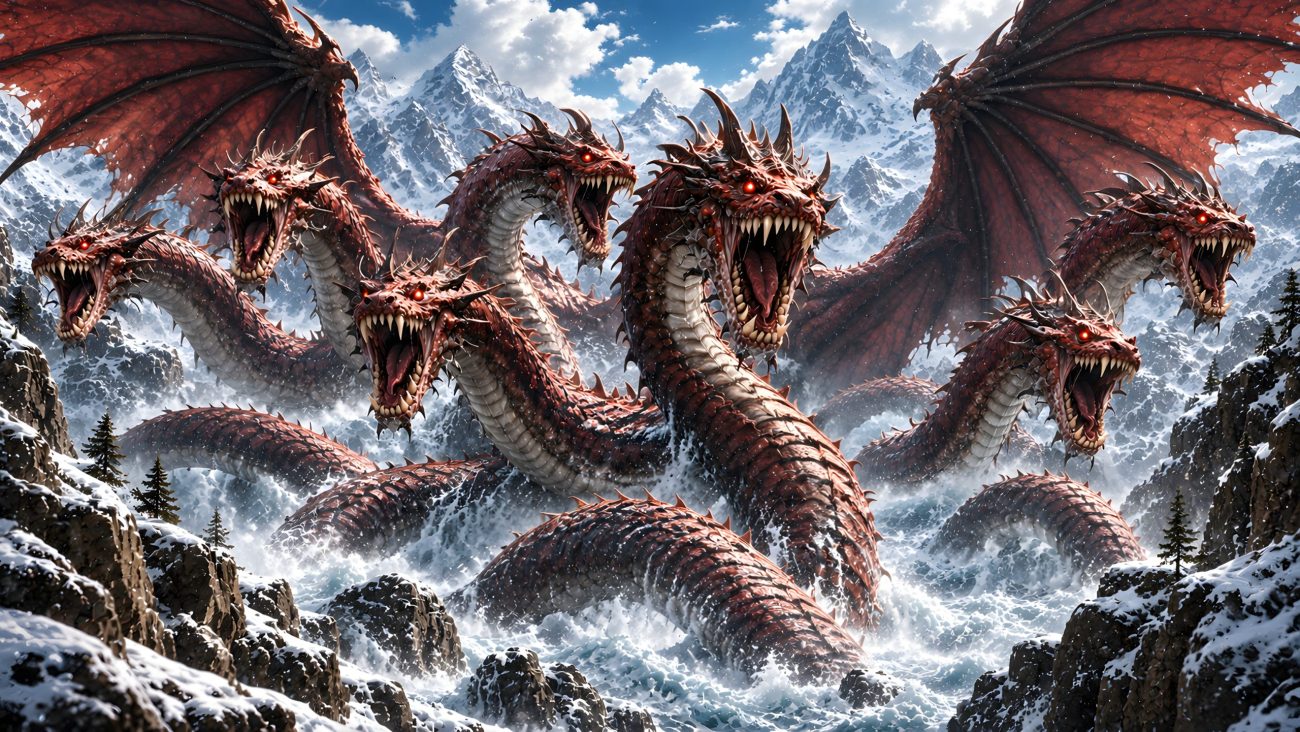
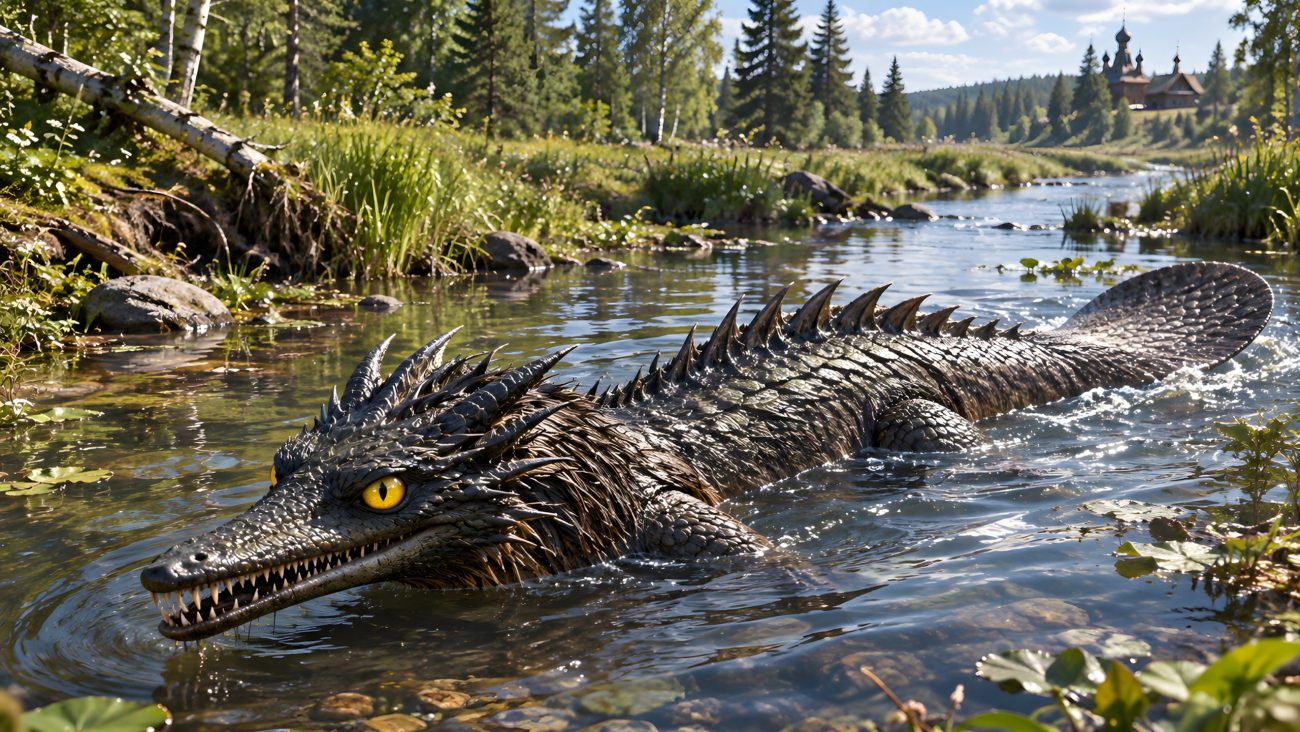
Kafkhyŭndar is a terrifying seven-headed dragon that controls the water supply of the land. It cuts off water from people, animals, and plants until beautiful maidens are offered to it as tribute. Its name in modern Ossetian literally means “crocodile.”

In the tales of Ossetian mythology, the monster is eventually confronted by a brave young man who manages to cut off seven of its heads. Yet another tradition gives the creature a more unusual fate. A beautiful young woman realizes that Kafkhyŭndar can only be destroyed through a voluntary sacrifice, and she throws herself directly into the monster’s mouth.

By sacrificing herself willingly, the girl destroys the dragon and saves the people from its control over the water supply.


Sources

“Kafkhuyndar.” New Bestiary (Bestiary.us). Accessed September 26, 2026. https://www.bestiary.us/kafkhuyndar


Chudo-Yudo

Tradition: Russian Mythology
Alternative Names: Chudo-Yudo, Chudo-Iudo, Чудо-Юдо, Chuda-Yuda
Category: Dragon


The Myth

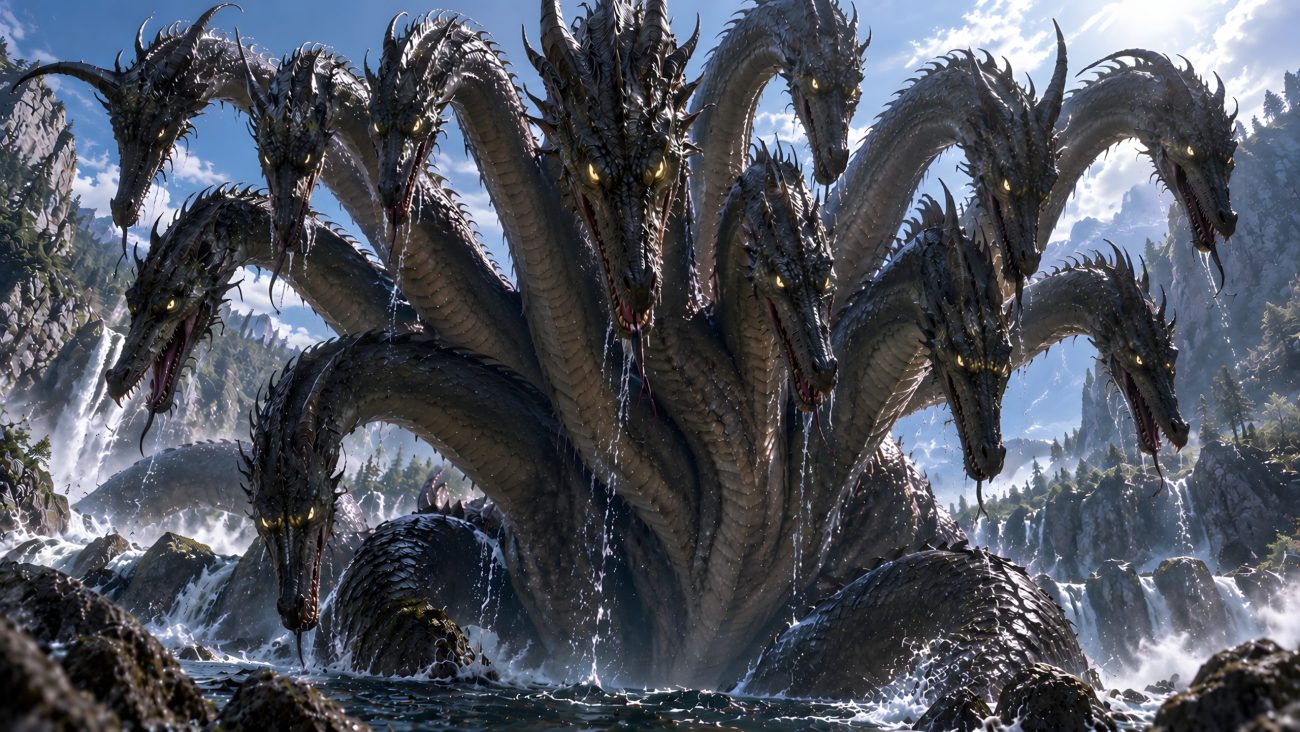
The Chudo-Yudo is a monstrous, many-headed dragon that dwells in or beyond the waters. It can take on human-like forms, speak like a person, and even ride a horse. Some tales portray it as the brother of Koschei the Deathless, born from Baba Yaga, while others present the creature as a monstrous embodiment of Baba Yaga herself.

The Chudo-Yudo is associated with the Water of Life and Death and may guard these magical waters. Its name was traditionally invoked during times of drought, when people sought relief from the absence of rain.

The creature appears with different numbers of heads, most famously six, nine, or twelve. In tales of Ivan Bykovich and the Storm-Bogatyr, these many-headed dragons emerge from the Black Sea and confront the heroes. They are monstrous serpents that must be fought and destroyed.

Yet cutting off the heads of a Chudo-Yudo is not enough. Even a severed head can be picked up and restored to the body. In one tale, the creature simply touches the severed head with a fiery finger and it becomes attached again, allowing the monster to continue fighting as though nothing had happened.

The Chuda-Yuda are sometimes encountered beyond the River Smorodina, a foul-smelling river that separates the world of the living from the realm of the dead. To reach their domain, a hero must cross the Kalinov Bridge, the White-Hot Bridge spanning the boundary between worlds.


Sources

“Slavic dragon.” Wikipedia: The Free Encyclopedia. Wikimedia Foundation. Accessed September 20, 2026. https://en.wikipedia.org/wiki/Slavic_dragon


Brosno Dragon

Tradition: Russian Mythology
Alternative Names: Brosnya, Бросня
Category: Dragon


The Myth

The Brosno Dragon, known as Brosnya, is a mysterious dragon-like creature said to dwell in the depths of Lake Brosno in western Russia. It is said to be an enormous lake monster, rarely seen and feared by those living around the lake.

During the eighteenth and nineteenth centuries, people told of a gigantic creature that would rise from the depths in the evening. Whenever anyone approached the shore or came too close, it would immediately disappear beneath the water again.

The creature also became the subject of darker tales. During the Second World War, it was said that Brosnya rose from the lake and swallowed a German airplane whole.

Some believe the monster may still lurk beneath Lake Brosno, although its existence remains uncertain. Explanations for sightings have included ordinary animals such as beavers or an exceptionally large pike.


Sources

“Brosno dragon.” Wikipedia: The Free Encyclopedia. Wikimedia Foundation. Accessed September 20, 2026. https://en.wikipedia.org/wiki/Brosno_dragon


Zilant

Tradition: Tatar and Russian Mythology
Alternative Names: Zilant, Zilant the Flying Serpent
Category: Dragon, Cow


The Myth

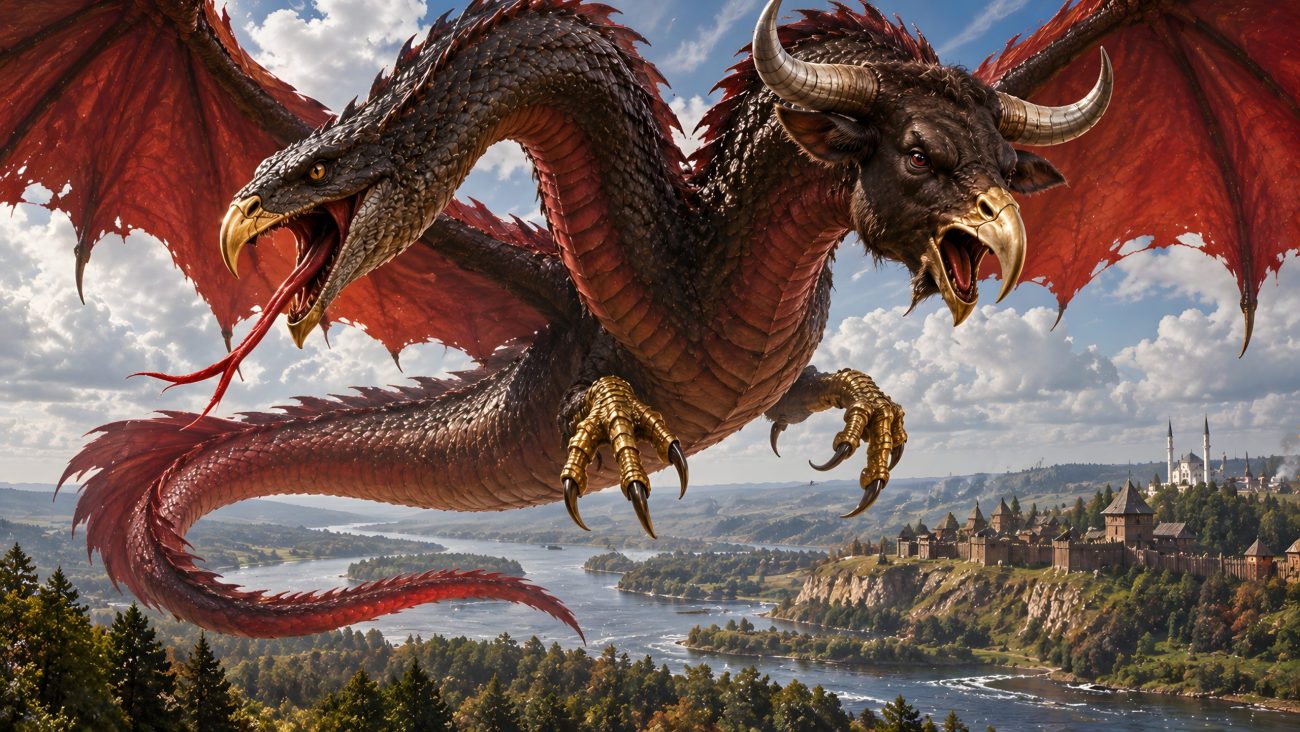
Zilant was a two-headed flying serpent. One head was that of a snake, while the other was that of an ox. With the snake’s head, it devoured young horses and beautiful maidens brought to it as sacrifices. With the ox’s head, it ate grass.

According to legend, the site of Kazan was once inhabited by countless snakes, each as thick as a log. Zilant was their leader. The snakes became such a danger that the people sought a way to destroy them.

The Khan consulted the sorcerer Hakim, who advised him to cut down the surrounding forest and brush and gather it into a great pile of straw. In spring, when everything had dried and the snakes had crawled out from beneath the ground, the straw was to be burned.

The plan was carried out. The snakes were surrounded by the blazing fire and burned alive. The flames and smoke were so intense that people, horses, and camels died from them.

After the destruction of the snakes, the Khan placed Zilant on his coat of arms to commemorate the event.

The image of Zilant later became associated with Kazan and was depicted as a black winged dragon with scarlet wings and tail, a golden beak and claws, and a scarlet tongue. The creature became an enduring symbol of the city.


Sources

“Ostrovetskii Tsmok.” New Bestiary (Bestiary.us). Accessed September 19, 2026. https://www.bestiary.us/ostrovetskii-tsmok


Bies

Tradition: Bosnian mythology, Croatian Mythology, Russian Mythology, Ukranian Mythology, Polish Mythology
Alternative Names: Bies, Bes, Bijes, Bisy, Chort, Czort
Category: Demon


The Myth

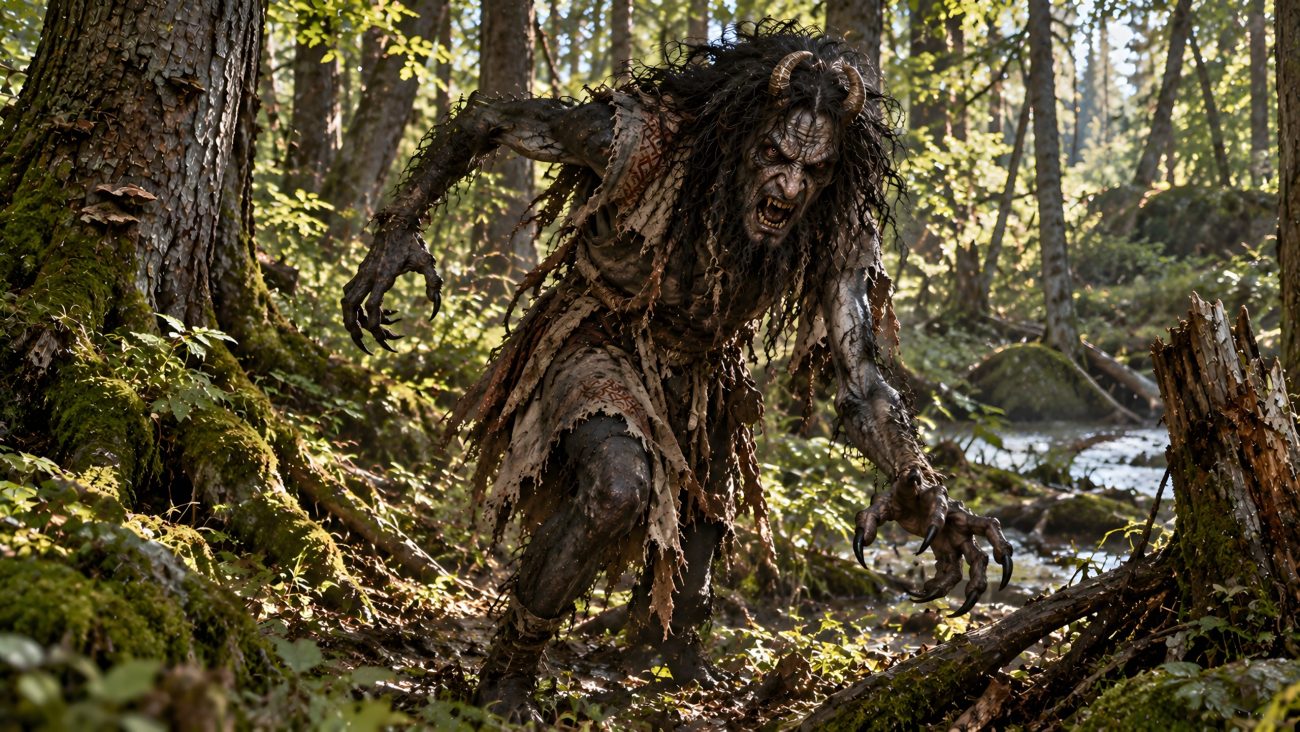
Bies is an evil spirit or demon in Slavic mythology. The word bies is associated with an evil supernatural being and, following the Christianization of Slavic peoples, became closely identified with the Devil and with the demon known as Chort or Czort.

In Christian-influenced tradition, Bies came to represent the Devil or other demonic beings. The plural biesy was used in Russian translations of the New Testament for the devils that possessed the swine in the Gospel of Mark. Related Slavic words also developed meanings associated with madness and uncontrolled behavior. In Slovenian, Croatian, and Serbian, the related forms bes and bijes mean “rage” or “fury.”

A separate being called bès is found among the Jah Hut people of Malaysia. These bès are dangerous spirits inhabiting the jungle. They can attack people and cause illness through spirit possession.

The Jah Hut can attempt to tame and contain a bès by carving a small wooden figure called a sepili, representing the particular spirit causing trouble. If the spirit approves of the figure, it may enter it, allowing the people to trap the spirit inside through a special ritual. The sepili must then be taken far away from the village because the bès may become angry when it eventually escapes. Traditionally, the figures were buried deep in the jungle.


Sources

“Bies.” Wikipedia: The Free Encyclopedia. Wikimedia Foundation. Accessed September 10, 2026. https://en.wikipedia.org/wiki/Bies