Shokera

Tradition / Region: Japanese Mythology
Alternate Names: Shokira
Category: Demon, Dog


The Myth

Shokera is a strange creature known from monster scrolls such as the Hyakkai Zukan and the Gazu Hyakki Yagyō. In some depictions it appears as a pale, dog-like being that walks on two legs, while in others it is shown as an oni-like figure peering down into houses through skylights.

Its presence is tied to the night of Kōshin, a day that comes once every sixty days. On this night, people believed that the sanshi—three spirit-insects living inside the human body—would leave their host while they slept and ascend to Heaven to report the person’s sins to the Heavenly Emperor. If the report was unfavorable, the Emperor would shorten that person’s lifespan.

To prevent this, people held Kōshin-machi, gatherings where they stayed awake all night in strict discipline so the insects could not escape.

It was said that if someone fell asleep on this night, the demon Shokera would appear. The creature would bring sickness, misfortune, and a shortening of life to those who failed to remain vigilant. To protect themselves, people sometimes recited special chants meant to ward Shokera away until dawn.

Thus the Shokera became a warning figure: a watcher in the darkness, said to visit the careless, and a reminder that on certain nights, sleep itself could invite disaster.


Gallery


Sources

Tyz-Yokai Blog. (n.d.). Shokera. Retrieved March 1, 2026, from https://tyz-yokai.blog.jp/archives/1010653518.html


Interpretive Lenses

Religious Readings
  • Christian Ascetic Deep Dive
Philosophical Readings
  • Nietzschean Deep Dive
Psychological Readings
  • Jungian Deep Dive
Esoteric Deep Dive
  • Hermetic Deep Dive
Political / Social Readings
  • Marxist Deep Dive

Anchanchu

Tradition / Region: Bolivan Mythology
Alternate Names: Janchanchu, Anchancho
Category: Dog, Demon


The Myth

Anchanchu is a feared spirit in Aymara tradition, associated with caves, rivers, mines, and lonely places. He is regarded as a dangerous supernatural being that appears during the night, particularly between one and three in the morning, when encounters with him are considered most likely.

He is said to manifest as a red dog, though in other descriptions he may appear as a bald, heavy-set old man, showing his ability to take multiple forms. Because of this, people in some regions, such as Huancané, traditionally warn against wandering outside late at night.

Anchanchu is also believed to hold authority over underground resources. In this role he acts as a guardian of minerals and hidden wealth, controlling access to the riches of the earth. Those who wish to extract precious materials must ritually acknowledge him, sometimes through ceremonial practices such as the Dance of the Horns, which symbolically negotiates with the spirit for permission.

Thus Anchanchu occupies a dual role: a night-haunting demon who endangers travelers, and a powerful chthonic being tied to the wealth of the land beneath the ground.


Gallery


Sources

Wikipedia contributors. (n.d.). Anchanchu. In Wikipedia, from https://en.wikipedia.org/wiki/Anchanchu


Interpretive Lenses

Religious Readings
  • Christian Ascetic Deep Dive
Philosophical Readings
  • Nietzschean Deep Dive
Psychological Readings
  • Jungian Deep Dive
Esoteric Deep Dive
  • Hermetic Deep Dive
Political / Social Readings
  • Marxist Deep Dive

Stommelstaart

Tradition / Region: Dutch Mythology
Alternate Names:
Category: Dog, Devil, Demon


The Myth

Stommelstaart is a name used in Dutch folklore for the Devil when he appears in the form of a dog.

He is described specifically as a large black poodle — an unsettling shape that looks almost ordinary at first, but is recognized as something far more sinister. The name itself suggests something heavy, dragging, or awkward in movement, fitting the eerie presence attributed to the creature.

Like many Dutch tales of the Devil in animal form, this appearance serves as a warning figure: a dark, dog-shaped manifestation of evil wandering the night or appearing to those who stray too far from the right path.


Gallery


Sources

Abe de Verteller. (n.d.). Van aardmannetje tot zwarte juffer: Een lijst van Nederlandse en Vlaamse elfen en geesten. From https://abedeverteller.nl/van-aardmannetje-tot-zwarte-juffer-een-lijst-van-nederlandse-en-vlaamse-elfen-en-geesten/


Interpretive Lenses

Religious Readings
  • Christian Ascetic Deep Dive
Philosophical Readings
  • Nietzschean Deep Dive
Psychological Readings
  • Jungian Deep Dive
Esoteric Deep Dive
  • Hermetic Deep Dive
Political / Social Readings
  • Marxist Deep Dive

Uridimmu

Tradition / Region: Mesopotamian Mythology
Alternate Names: Mad Dog, Gruesome Hound
Category: Dog, Demon


The Myth

Uridimmu was a strange and powerful being known in the myths and rituals of ancient Mesopotamia.

He was depicted as a creature with the body of a dog standing upright like a man, but with a human head. He often wore a horned crown and carried a staff tipped with a crescent, marking him as a being connected to divine power. His name was associated with the idea of a raging or rabid dog, suggesting both ferocity and danger.

In the stories of the gods, Uridimmu was counted among the monstrous beings born from Tiamat during the great battle between chaos and order. When Marduk defeated these creatures, their forms were later used as protective symbols. Images of Uridimmu were set on doorways and buildings so that his frightening presence would drive away evil.

Over time he was no longer remembered only as a defeated monster but also as a guardian spirit. Figures of him were placed in temples and homes as protection. In ritual tradition he appeared among the attendants of the sun god Shamash and was called upon in ceremonies connected with healing and divine aid.

Thus Uridimmu was remembered both as a creature of chaos and as a protector — a human-headed dog spirit whose image guarded doorways and whose presence was meant to keep harm away.


Gallery


Sources

Wikipedia contributors. (n.d.). Uridimmu. In Wikipedia, from https://en.wikipedia.org/wiki/Uridimmu


Interpretive Lenses

Religious Readings
  • Christian Ascetic Deep Dive
Philosophical Readings
  • Nietzschean Deep Dive
Psychological Readings
  • Jungian Deep Dive
Esoteric Deep Dive
  • Hermetic Deep Dive
Political / Social Readings
  • Marxist Deep Dive

Psoglav

Tradition / Region: Bosnian Mythology, Montenegrin Mythology
Alternate Names: Psoglavac, Psoglavec
Category: Dog, Demon


The Myth

The Psoglav was a terrifying being spoken of in Balkan tales, especially in regions of Bosnia, Montenegro, and the Istrian lands.

It was described as a monstrous creature with the body of a man but the legs of a horse. Its head was that of a dog, armed with iron teeth, and in the middle of its forehead it bore a single eye. The creature’s appearance marked it as something unnatural, neither beast nor human but a thing of dread.

Psoglavs were said to dwell in caves or in a distant dark land where the sun never shone. That place was believed to be filled with precious stones, yet empty of warmth and light, a realm suited to such creatures.

They were feared for their hunger. Stories claimed they devoured human flesh, attacking travelers and villagers, and even dug up graves to feed on the dead. Because of this, their name became associated with horror and the threat of being taken into the darkness.

Thus the Psoglav was remembered as a dog-headed demon of the shadowed lands — a cave-dwelling devourer with iron jaws and a single eye, feared wherever its legends were told.


Gallery


Sources

Wikipedia contributors. (n.d.). Psoglav. In Wikipedia, from https://en.wikipedia.org/wiki/Psoglav


Interpretive Lenses

Religious Readings
  • Christian Ascetic Deep Dive
Philosophical Readings
  • Nietzschean Deep Dive
Psychological Readings
  • Jungian Deep Dive
Esoteric Deep Dive
  • Hermetic Deep Dive
Political / Social Readings
  • Marxist Deep Dive

Zobutsu Daijoou

Tradition / Region: Japanese religious folklore
Alternate Names: Kuriekisu, Great Queen of Creation
Category: Demon


The Myth

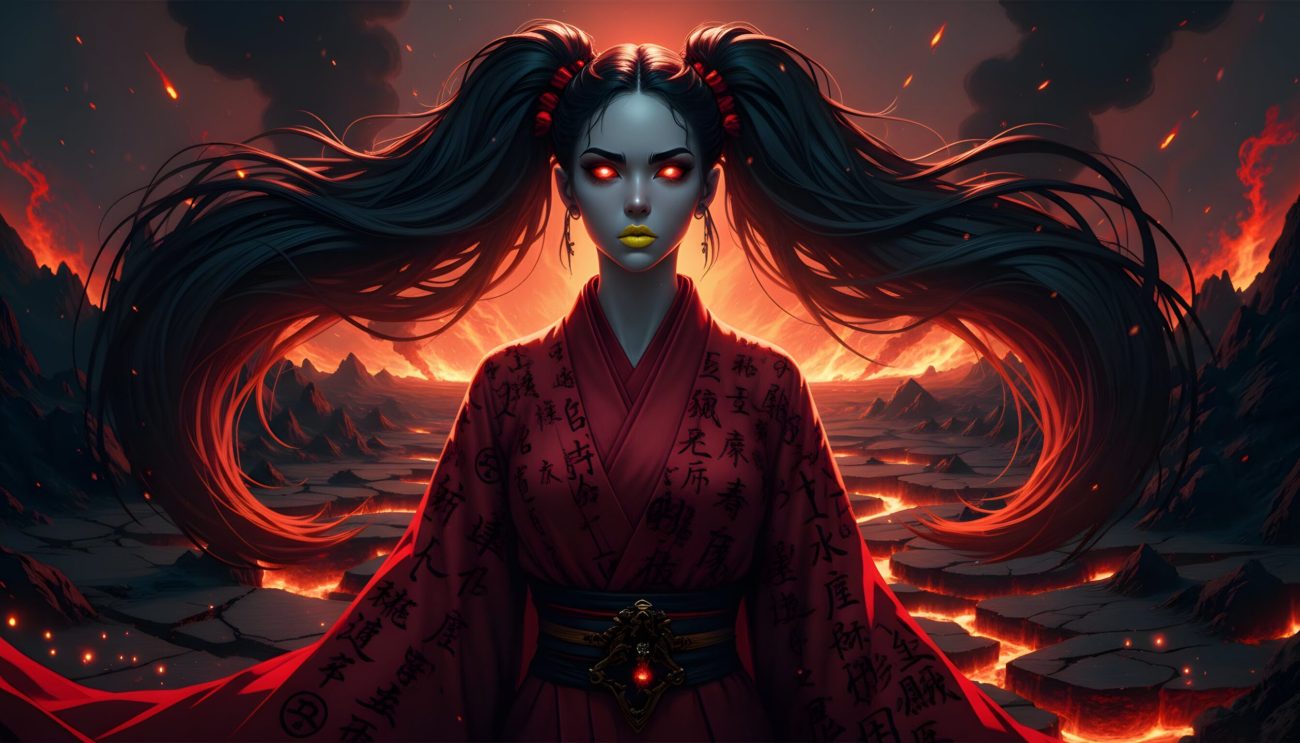
Zobutsu Daijoou is the highest-ranking of the twelve great demon kings described in a religious account of the demon realm. She is said to possess power one hundred times greater than that of an average god and is considered so terrifying that even powerful spiritual masters warned against approaching her. She has a white face, thin black eyebrows, yellow lips, and stands about three feet tall. Her hair rises two feet upward, bends backward, and divides into three sections that fall to her waist. She was said to have come into being when the accumulated shadows at the creation of the world condensed into evil energy.

Among the hundreds of demon leaders said to inhabit the demon realm, twelve hold the highest rank, and Zobutsu Daijoou stands above them all. Each of these demon kings rules a separate domain with their own followers and may bring disaster upon the human world. Alongside her in special distinction is the Queen of the Bottomless Sea, and together they are set apart from the rest.

On the night of July 19, 1880, a procession of these demon kings was said to pass across the sky. Their names were identified as they appeared, with Zobutsu Daijoou recognized as the foremost among them.


Gallery


Sources

TYZ Yokai Blog. (2018). 祖仏大王 (Zobutsu Daijōō). From https://tyz-yokai.blog.jp/archives/1034642738.html


Interpretive Lenses

Religious Readings
  • Christian Ascetic Deep Dive
Philosophical Readings
  • Nietzschean Deep Dive
Psychological Readings
  • Jungian Deep Dive
Esoteric Deep Dive
  • Hermetic Deep Dive
Political / Social Readings
  • Marxist Deep Dive

Alzen Bridge Devil

Tradition / Region: Romanian Mythology
Alternate Names:
Category: Demon


The Myth

Many years ago, the pastor of Alzen had the habit of visiting the casino in Leschkirch twice each week. At midnight his coachman was sent to fetch him home. This duty troubled the servant greatly, for he had to drive alone across the Altmühl bridge at that lonely and haunted hour.

It was the custom to halt on the far side of the bridge so the horses could rest. Whether the coachman wished it or not, the animals were trained to stop there, and no urging could make them do otherwise.

One cold, bright night, under a clear moon, the coachman drove out as usual. The pastor’s coat lay folded on the back seat for the journey home. When the carriage reached the far side of the bridge, the horses halted of their own accord.

At that moment the coachman saw, in the pale light, a silent figure detach itself from the shadow of the bridge. Hat in hand, it climbed lightly onto the back seat and put on the priest’s coat.

The coachman trembled with fear. He thought he had glimpsed two horns upon the stranger’s head. His hands shook so violently he could scarcely hold the reins, and he dared not turn around again. The horses, as if driven by some unseen force, sped onward at a furious pace until they reached the appointed place.

Only then did the coachman gather the courage to look back. The seat was empty. The coat lay exactly where he had left it, untouched, and there was no sign of the strange passenger.

In the days that followed, people in every tavern spoke of the event. It was said that the pastor’s servant had unwittingly driven the Devil himself, and that he nearly left his master’s service rather than face such a night again.


Gallery


Sources

sagen.at contributors. (n.d.). Alzener Pfarrersknecht als des Teufels Fuhrmann. In sagen.at, from https://www.sagen.at/texte/sagen/rumaenien/siebenbuergen/alzenerpfarrersknecht.html


Interpretive Lenses

Religious Readings
  • Christian Ascetic Deep Dive
Philosophical Readings
  • Nietzschean Deep Dive
Psychological Readings
  • Jungian Deep Dive
Esoteric Deep Dive
  • Hermetic Deep Dive
Political / Social Readings
  • Marxist Deep Dive

Kidoku

Tradition / Region: Japanese Mythology
Alternate Names: Oni-doku
Category: Mountain dweller, Demon


The Myth

On the thirteenth day of the eighth month in the second year of Kan’en (1749), a strange and terrifying event took place in Soma County of Hitachi Province.

Atop Mount Masakado stood an ancient pine tree. It was said to have grown there since the days of Taira no Masakado, its roots gripping the mountain for generations. But that year, long and relentless rains soaked the land. The mountain soil eroded, and floodwaters rushed down its slopes, exposing the roots of the old pine. Then a fierce wind arose and toppled the great tree from its base.

When the pine fell, something was revealed beneath its roots.

Buried in the earth lay a monstrous being—what people called a “Kidoku,” a Demon Slayer, though no one knew its true nature. As the rain beat down upon it, the creature awoke and began to scream.

Its cries echoed across the castle town below. The sound was so dreadful that men, women, and children alike were seized with terror. Some collapsed where they stood. Others fled indoors, covering their ears. The wailing did not cease.

The castle’s commander gathered a rifle squad and marched to the mountain. The creature, fully exposed now, writhed and shrieked beneath the fallen pine. It was immense—said to be the size of eight tatami mats laid side by side.

Those who saw it described a form like a monstrous ogre mixed with a crab. Its eyes were round and bowl-like, shining with an eerie light. The top of its head was sunken inward. Crimson hair, stiff and sharp like palm leaves, bristled from its scalp, and beneath its chin grew spiky strands like thorns. Its teeth were bared in rage.

The riflemen fired again and again. After several shots, the monster finally fell silent.

Thus the Kidoku was slain, and the mountain returned to stillness. But people long remembered the day when the ancient pine fell, and a screaming demon rose from the earth beneath its roots.


Gallery


Sources

tyz-yokai.blog.jp contributors. (n.d.). Kidoku. In tyz-yokai.blog.jp, from https://tyz-yokai.blog.jp/archives/1077741605.html


Interpretive Lenses

Religious Readings
  • Christian Ascetic Deep Dive
Philosophical Readings
  • Nietzschean Deep Dive
Psychological Readings
  • Jungian Deep Dive
Esoteric Deep Dive
  • Hermetic Deep Dive
Political / Social Readings
  • Marxist Deep Dive
Other
  • How to Invite The Kidoku

Mouryō

Tradition / Region: Chinese mythology
Alternate Names: Hōryō, Hōliang, Hōxiang, Hongliang, Mizuha
Category: Mountain dweller, Zombie, Demon


The Myth

In the deep places of the world—where mountains rise thick with trees and rivers slip silently through stone—there dwell beings known as the mouryō. They are not born as humans are, but arise from the spirit of the land itself: from forests, streams, roots, and shadows beneath the earth.

Ancient texts say that the mouryō appear like small children, no taller than three-year-olds, yet their forms are unsettling. Their skin is dark and reddish, their eyes glow red, their ears are long, and their hair is strangely beautiful. Though they resemble children, they are not innocent. They linger near graves, riverbanks, and old pine trees, places where the boundary between life and death is thin.

At night, the mouryō creep from the roots of trees or from wet earth. They dig into burial grounds and feast upon the livers of corpses, sustaining themselves on the remains of the dead. Because of this, people once feared them greatly, believing that graves left unguarded would invite these beings. Some said that when a corpse vanished, carried away in the night, it was not the work of hellfire or demons from below, but the mouryō dragging the body back into the forest.

In later tales, the mouryō became confused with other corpse-stealing monsters. Some claimed they were the same as the fiery kasha, while others insisted they were water spirits, haunting rivers and marshes. Still others said they were kin to the kappa, born of stagnant waters and rot. No matter the explanation, the fear remained the same: the mouryō were creatures that thrived where decay met neglect.

Travelers avoided old trees at night, and families guarded their dead, for it was said that once a mouryō had tasted a corpse, it would return again and again. Silent, patient, and hungry, the mouryō endured as a reminder that the land itself remembers death—and that some spirits feed upon what humans leave behind.


Gallery


Sources

TYZ-Yokai Blog contributors. (n.d.). 魍魎 (Mouryō). In TYZ-Yokai Blog, from https://tyz-yokai.blog.jp/archives/1072334859.html


Interpretive Lenses

Religious Readings
  • Christian Ascetic Deep Dive
Philosophical Readings
  • Nietzschean Deep Dive
Psychological Readings
  • Jungian Deep Dive
Esoteric Deep Dive
  • Hermetic Deep Dive
Political / Social Readings
  • Marxist Deep Dive
Other
  • How to Invite The Mouryō

Devil Boruta

Tradition / Region: Polish mythology
Alternate Names: Boruta, Błotnik, Borowiec
Category: Demon, Swamp dweller, Shapeshifter


The Myth

In the forests, swamps, and muddy roads of Poland, people long spoke of Devil Boruta, a spirit who delighted in confusing travelers and leading them astray at night. When carts became stuck in the mud or paths vanished in the dark, it was Boruta who was blamed—lurking unseen, laughing as people wandered in circles through marsh and woodland.

Boruta was not always imagined as a horned demon. In older folk belief, he was closer note a wild forest spirit, a remnant of pre-Christian beings who ruled untamed places. After Christianization, this spirit was reshaped into a devil, though he retained his connection to bogs, dams, forests, and muddy crossings. He could appear suddenly as a black dog, slip through reeds as a shadow, or remain unseen while his presence was felt through fear and confusion.

Later stories—especially those popularized in books—portrayed Boruta as a devil dressed like a nobleman, tempting the upper classes with pride, corruption, and excess. Yet among common folk, Boruta was far less refined. He was a błotnik, a swamp devil, called upon when wagons sank into mud or when travelers lost their way. Peasants did not fear him as a tempter of souls so much as a malicious spirit of difficult terrain, a force of nature that punished arrogance and carelessness.

Boruta did not rule hell, nor did he demand worship. He belonged to the borderlands—between forest and field, road and swamp, safety and danger. To meet him was not always fatal, but it was humiliating, exhausting, and frightening. Those who mocked him or wandered carelessly risked being lost until dawn.

In this way, Devil Boruta stands as a shadow of older pagan spirits: no grand lord of evil, but a sly, muddy trickster who reminds humans that the wild places do not belong to them.


Gallery


Sources

Wikipedia contributors. (n.d.). Devil Boruta. In Wikipedia, The Free Encyclopedia, from https://en.wikipedia.org/wiki/Devil_Boruta


Interpretive Lenses

Religious Readings
  • Christian Ascetic Deep Dive
Philosophical Readings
  • Nietzschean Deep Dive
Psychological Readings
  • Jungian Deep Dive
Esoteric Deep Dive
  • Hermetic Deep Dive
Political / Social Readings
  • Marxist Deep Dive
Other
  • How to Invite The Devil Boruta