Jusuheru

Tradition: Japanese Mythology
Alternative Names: Jusuheru, Jusher, Djosferatu
Category: Demon


The Myth

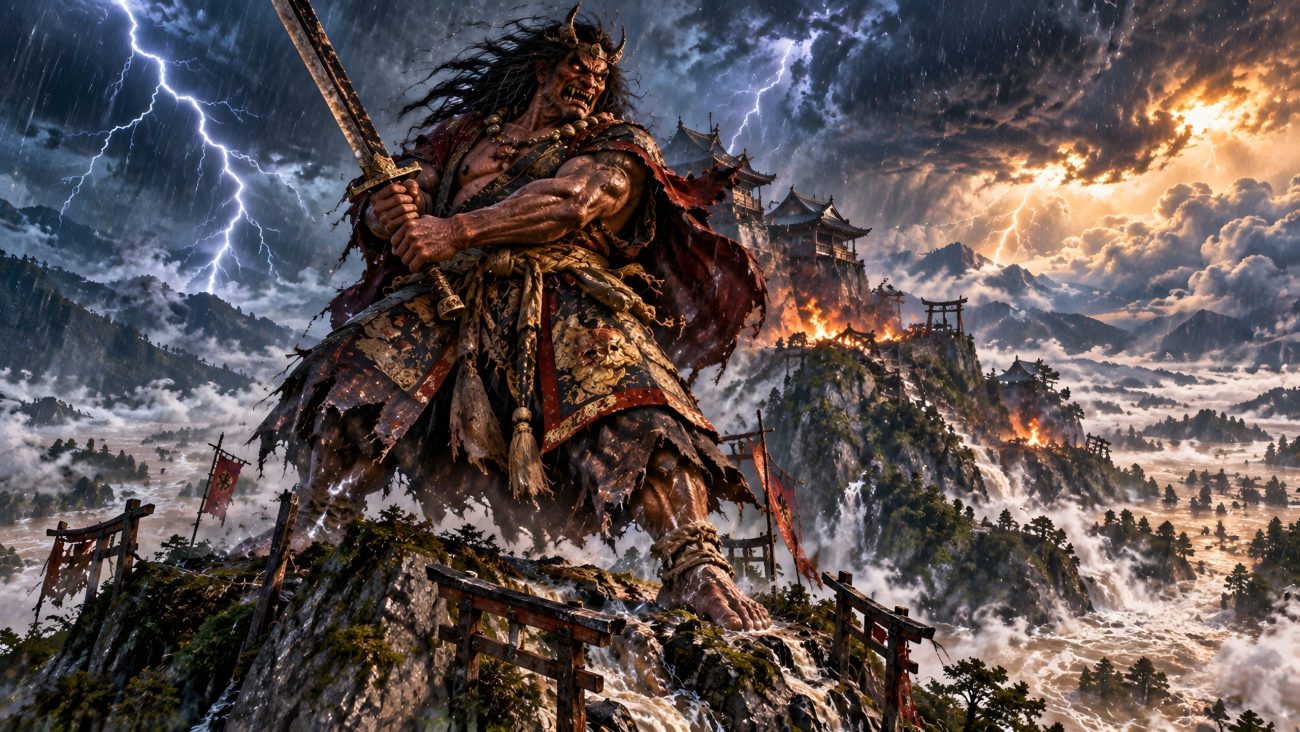
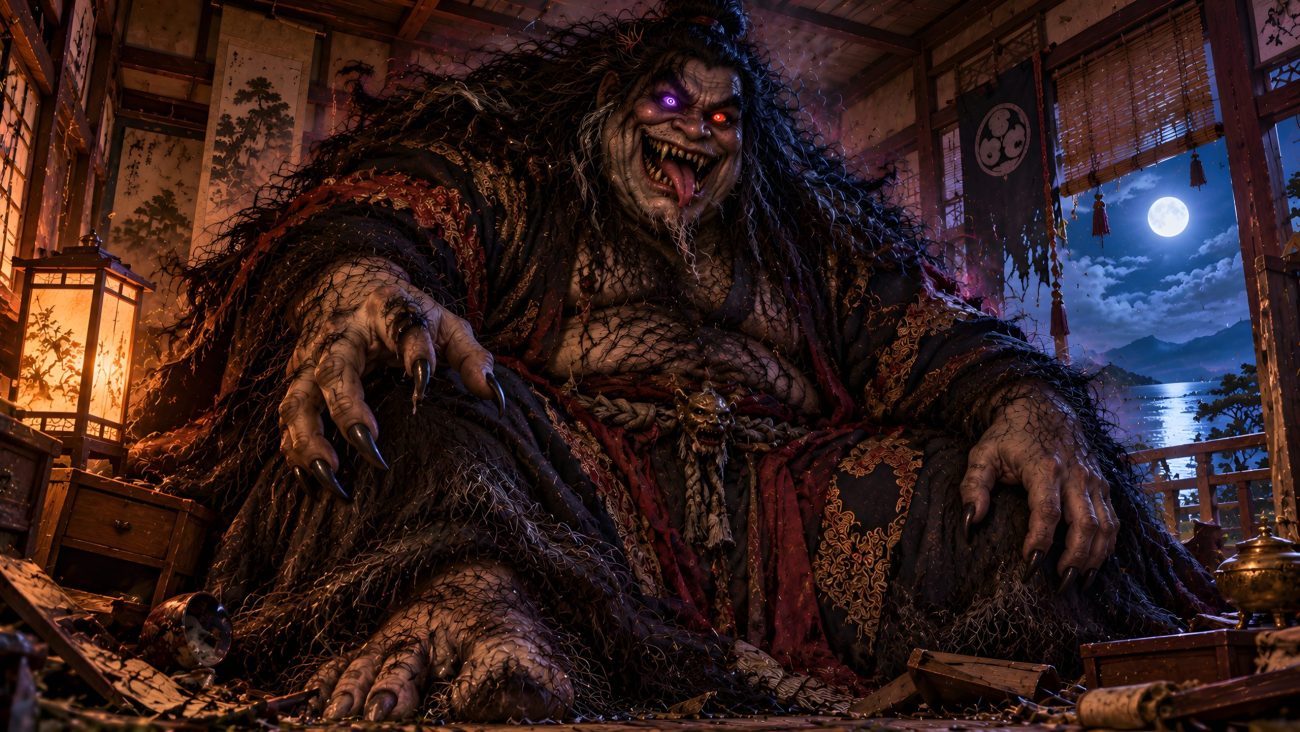
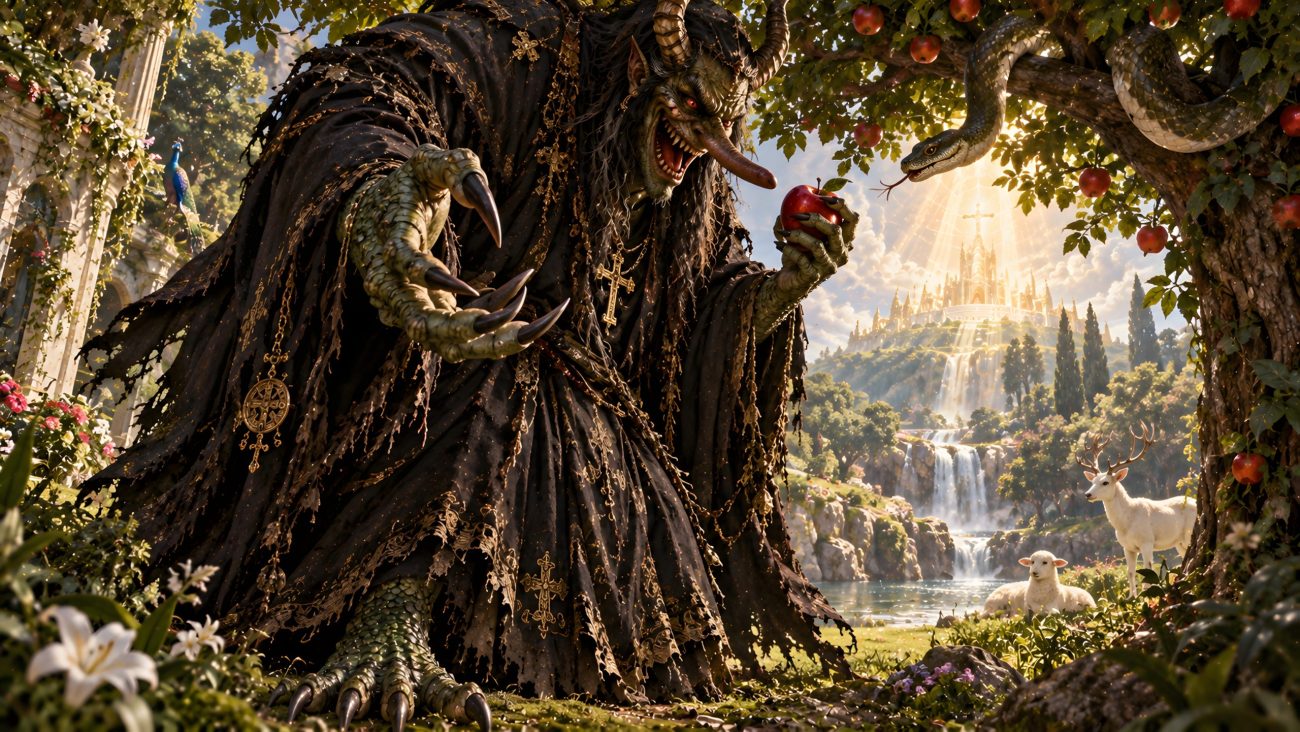
Jusuheru was one of the seven leaders of the tens of thousands of angels created by Deus, the God of Heaven. He possessed a rank of 100 marks and an appearance of 32 marks. Jusuheru had a long nose, a wide mouth, scales on his hands and feet, and horns, giving him a terrifying appearance.

Deus created heaven and earth, the twelve heavens, the sun, moon, and stars, and summoned tens of thousands of angels. He later created the first humans, Domeigosu no Adan and Domeigosu no Ewa, from earth, water, fire, wind, tide, oil, and his own bones and flesh. Adam and Eve lived in Koroteru, the mortal world, but went to Baraiso, heaven, each day to worship Deus. They had two children, Chikoro and Tanho.

One day, while Deus was away, Jusuheru gathered the tens of thousands of angels and declared that he was equal to the Emperor of Heaven and that they should worship him instead. The angels began to worship Jusuheru. When Adam and Eve were asked to worship him as well, they refused, insisting that they worshipped Deus.

When Deus returned, Adam, Eve, and the angels bowed before him. Their remorse over what had happened became the origin of the orasho called “Koukai Konchirisan.” Deus warned Adam and Eve that although they might bow before Jusuheru, they must never eat the fruit of the Masan tree.

Jusuheru then descended to Koroteru to deceive them. He took fruit from the Masan tree and went to Adam and Eve. Adam was absent, serving at the gate of Baraiso, so Jusuheru approached Eve alone. He claimed to be a messenger from Deus and showed her the fruit.

Eve recognized it as the forbidden fruit and asked whether she was really allowed to eat it. Jusuheru deceived her, saying that the nuts belonged to both God and himself, and that eating them would make them like God. Eve accepted the nuts and ate them. When Adam returned, she told him what had happened and gave him the nuts. Although suspicious, Adam also ate them.

Jusuheru pretended to leave but remained nearby, watching them from the shadows. Soon Deus revealed to Adam that the nuts were evil. Adam tried to spit them out, but the nuts became stuck in his throat. As a result, Adam and Eve lost the pleasures of heaven.

The couple cried out toward heaven and fell to the ground, shedding tears of blood and deeply regretting what they had done. Their lamentation became the beginning of the “Ka no Orassho.” They begged Deus to allow them to experience heavenly pleasure once more, but Deus told them that if they did so, they would regret their actions for more than 400 years.

Adam and Eve’s descendants therefore remained in the mortal world. They ate animals, worshipped the moon and stars, and lived with the memory and regret of their fall.

Jusuheru himself then bowed before Deus and begged to experience heavenly pleasure again. He claimed that his evil heart had caused his terrible condition and feared what would happen to him. His plea was rejected, and he was banished from heaven.

Because Eve’s descendants were now living in the mortal world, Jusuheru was given a rank of ten marks and descended to the middle heaven, where he became the god of thunder. The angels who had worshipped him were likewise cast down and became tengu.

Later, as Eve’s descendants multiplied, three evil beings appeared: Unyoku, representing the desire for fortune, Greed, and Selfishness. They stole the food of good people. Deus became angry and bound the three together. They became a terrifying creature with three faces, each bearing horns, but continued their wickedness. Deus eventually kicked them to the bottom of the sea and commanded them to become tengu.

Their monstrous transformation was believed to have been caused by Jusuheru.


Sources

Takahashi, Toshihiro. “じゅすへる (Jusuheru).” 新版TYZ 妖怪図鑑 (New TYZ Yokai Encyclopedia). December 13, 2014. https://tyz-yokai.blog.jp/archives/1015477601.html
Muteikai Daiinjo-o

Tradition: Japanese Mythology
Alternative Names: Muteikai Daiinjo-o, Bottomless Sea Great Yin Queen, Hiesto
Category: Demon


The Myth

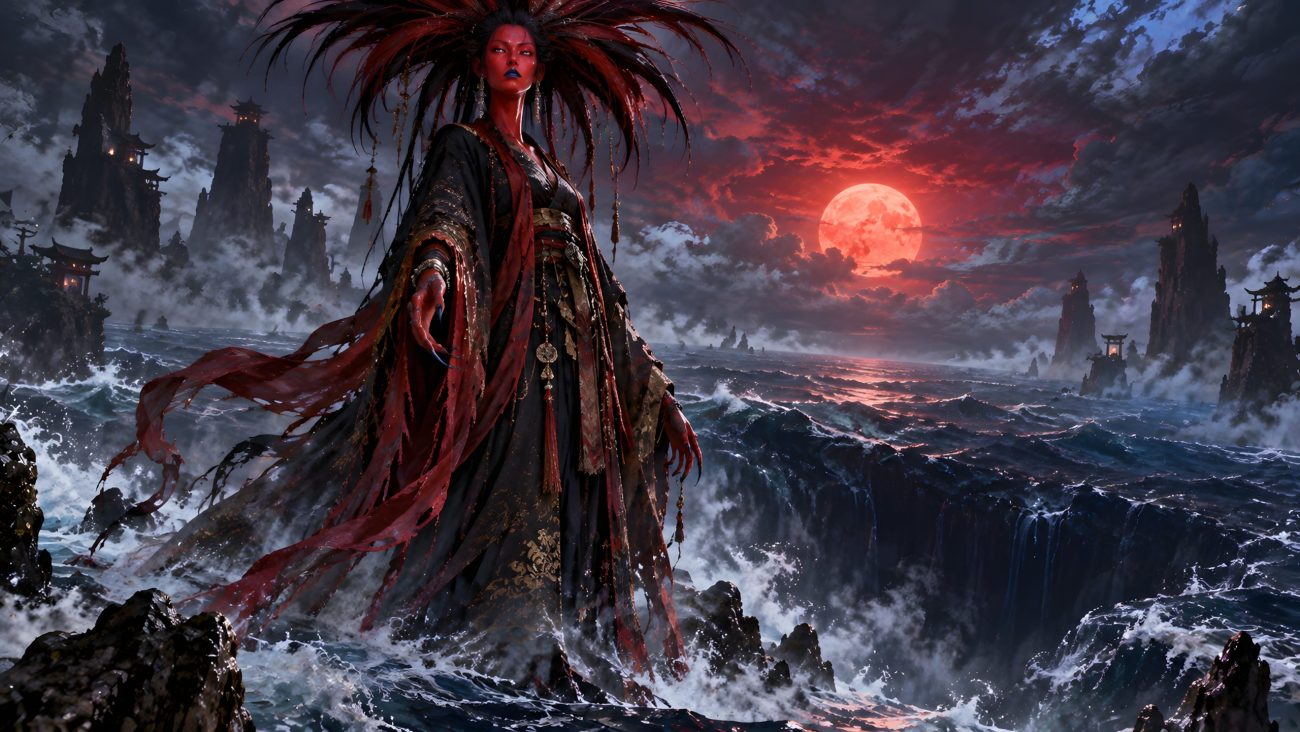
Muteikai Daiinjo-o, the Bottomless Sea Great Yin Queen, is a demon queen of the demon world. She has a red face, blue lips, reddish-black hair resembling a palm tree, and a tall, thin body approximately seven feet in height.

She is one of the demon kings mentioned in Memorandum of Other Worlds. She appears after the first demon king, the Great Creator Queen.

Muteikai Daiinjo-o is also known as Hiesto. According to the hermit Kawatan, who was the teacher of the author, she possesses roughly one hundred times the power of an ordinary god. Her power is said to be comparable to that of the Great Creator Queen.


Sources

Takahashi, Toshihiro. “無底海大陰女王 [むていかいだいいんじょおう] (Muteikai Daiinjo-o).” 新版TYZ 妖怪図鑑 (New TYZ Yokai Encyclopedia). December 2, 2017. https://tyz-yokai.blog.jp/archives/1068700857.html


Hitotsumebō

Tradition: Japanese Mythology
Alternative Names: Hitotsumebō, One-Eyed Monk
Category: Demon


The Myth

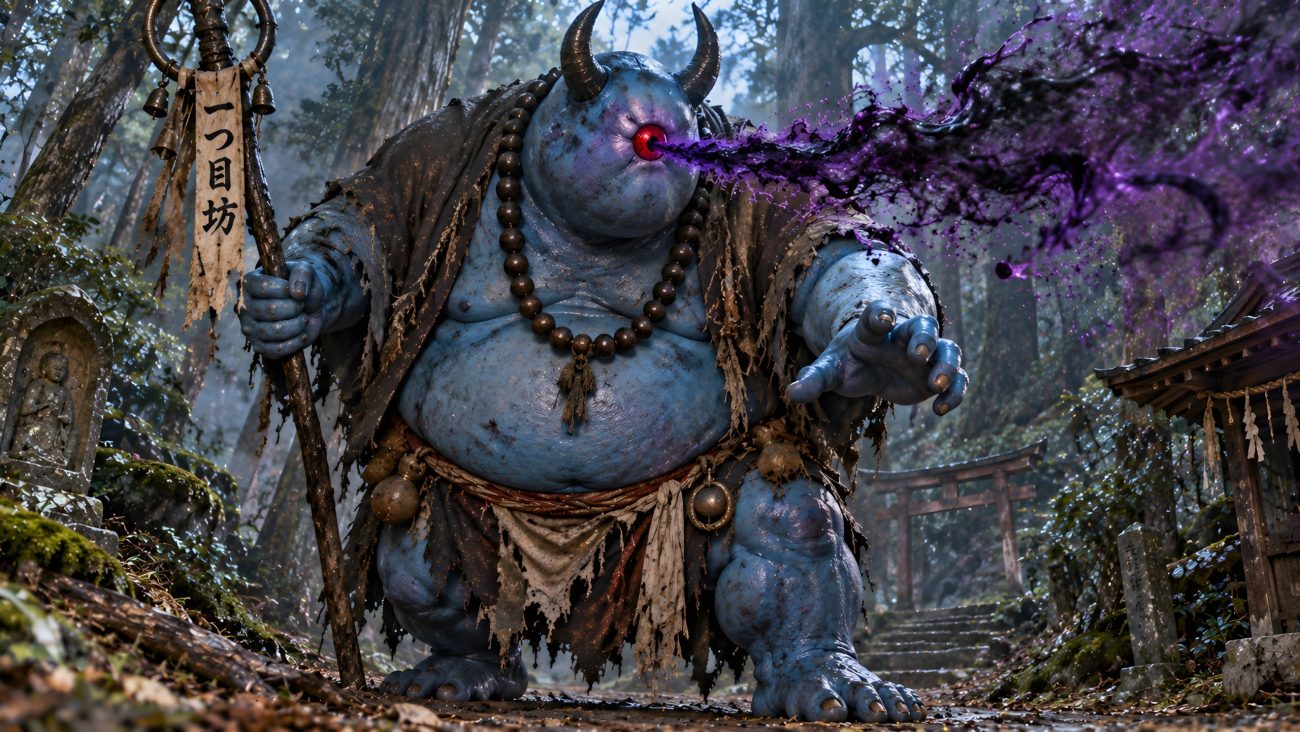
Hitotsumebō is a one-eyed yōkai with a single eye on its forehead. From the small opening on its forehead, it spews something outward.

No further legend or story is given for Hitotsumebō.


Sources

Takahashi, Toshihiro. “一つ目坊 [ひと‐めぼう] (Hitotsumebō).” 新版TYZ 妖怪図鑑 (New TYZ Yokai Encyclopedia). June 10, 2009. https://tyz-yokai.blog.jp/archives/1010652586.html


Mujō Daiki

Tradition: Japanese Mythology
Alternative Names: Mujō Daiki, Great Impermanence Demon
Category: Demon


The Myth

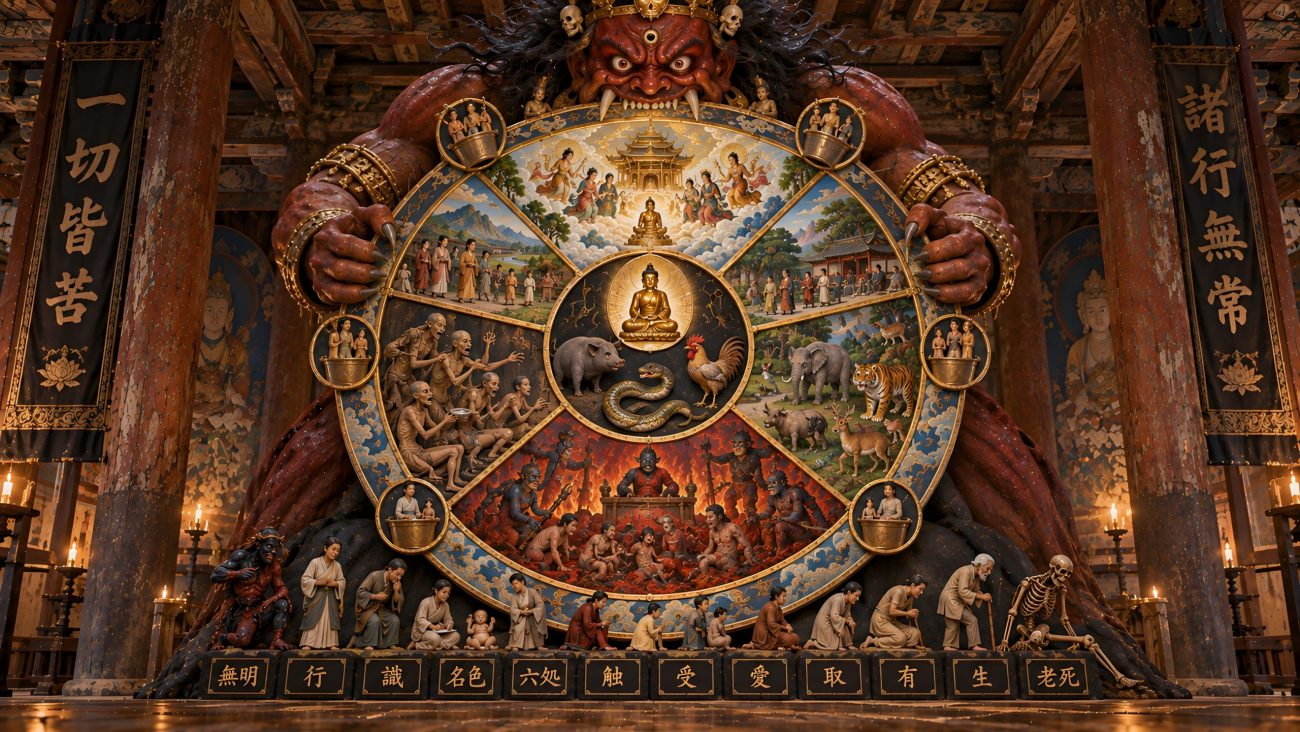
Mujō Daiki is a fearsome demon who holds a great wheel representing the five realms of rebirth. He symbolizes impermanence and the unavoidable cycle of life, death, and rebirth.

All living beings within the five realms are trapped by the Great Demon of Impermanence, with no escape from him. He is also associated with the King of Death, or what is commonly called the Grim Reaper. No living being is said to be free from his grasp.

The wheel held by Mujō Daiki represents the cycle of existence. At its center is an image of Buddha, surrounded by a pig, a snake, and a dove, representing the three poisons of greed, hatred, and delusion.

Below the center of the wheel is Hell, while the realms of hungry ghosts and animals appear on either side. The realms of humans and heaven are positioned above them.

Around the outer edge of the wheel are five pairs of buckets containing people. The buckets represent life and death, constantly being filled and emptied like water being drawn up and poured away. They symbolize the endless continuation of rebirth through successive lives and deaths.

Outside the wheel, at the feet of Mujō Daiki, eighteen characteristics are shown. They begin with ignorance in the form of a demon and continue through the twelve links of dependent origination: volition, consciousness, name and form, the six sense bases, contact, feeling, craving, clinging, being, birth, old age, and death.


Sources

Takahashi, Toshihiro. “無常大鬼 [むじょうだいき] (Mujō Daiki).” 新版TYZ 妖怪図鑑 (New TYZ Yokai Encyclopedia). March 10, 2019. https://tyz-yokai.blog.jp/archives/1074019646.html


Tontari Maō

Tradition: Japanese Mythology
Alternative Names: Tontari Maō, Greedy Demon King
Category: Demon


The Myth

No physical appearance is given for Tontari Maō in the surviving account.

After Emperor Jimmu had pacified the barbarian enemies of Japan, the country was governed peacefully for generations. A demon king who coveted Japan was unable to invade and was forced to live in solitude off the coast of Chiguraka, at the boundary between China and Japan.

Eventually, however, disorder began to spread throughout the country. Seeing his opportunity, the Demon King invaded Japan with tens of thousands of demons and evil gods. He defeated the Kongo God and occupied the renowned Mount Kongo, declaring himself the Greedy Demon King. He then began transforming the land into a realm of demons. Clouds and fog covered the sky, storms caused the mountains and rivers to overflow, floods devastated the country, and plague spread throughout the land.

Amida Buddha of the Pure Land saw the suffering of living beings and decided to subdue the demons. He constructed a magnificent jade ship shaped like a phoenix, raised brocade sails, and departed from paradise accompanied by countless Buddhas and gods. The ship traveled through the western countries and then through China, where it gathered holy figures including Emperor Wenchang and King Wenxuan. It crossed the Milky Way and passed through the heavenly realms before reaching Takamagahara. There, accompanied by Amaterasu and the other gods, it descended upon Mount Kongo.

When the Greedy Demon King saw the Buddhas descending, he summoned clouds, mist, wind, and rain and turned the mountain into a fortress. The Three Treasures God, protector of the Buddhas, appeared at the summit and unleashed lightning, setting the vegetation on fire. The demons attempted to extinguish the flames with rain, but failed, and even the Demon King’s mansion was burned down.

The Demon King’s army fled toward the river. The Three Treasures God dammed the river mouths on all four sides, while water poured down from the Milky Way until the mountain was transformed into a sea. Unable to withstand the raging waters, the Demon King returned to the mountaintop.

Tontari Maō and the Three Treasures God then fought each other with sacred swords. Marishiten, Bishamonten, and Fudō Myōō came to the aid of the Three Treasures God, while the Demon King’s allies joined the battle. The Gale Demon King attacked Fudō Myōō, the Fierce Lion Demon King attacked Bishamonten with an axe, and the Heavenly Dragon Demon King struck Marishiten with an iron club.

After a fierce battle, all of the Demon Kings except Tontari Maō were defeated and disappeared. The Three Treasures God’s eight-directional sword flashed like lightning and cut down the remaining demons one after another. The surviving demons fled, but billions of treasure arrows fired from a thousand-pound divine bow struck them, wounding tens of thousands and forcing them toward the open sea.

Tontari Maō, however, turned back toward the mountains with tens of thousands of his followers. He bowed before the Three Treasures God, confessed his former wrongdoing, and vowed from that moment onward to change his ways and obey the Buddha and the gods.

The Three Treasures God accepted their repentance and instructed them not to hesitate to correct their mistakes, but instead to change their ways and accumulate good deeds. He promised to report their repentance to Amida Buddha, have their sins removed, and make them his followers.

The repentant demons were overcome with emotion and chanted “Namu Amida Butsu” together. Amida Buddha then descended in the phoenix-shaped ship, accompanied by numerous Buddhas and gods. The light of Buddha illuminated the entire land, and Tontari Maō attained enlightenment through the virtue of Buddha.

He then vowed to bestow blessings upon devout practitioners even while naked and became the “Original God of Poverty.” The place where this deity stood was thereafter called Naked Forest.

Mount Kongo, meanwhile, came to be called Kojin-yama after Sanbō Kojin, and eventually Funagata-yama because of the arrival of the phoenix-shaped ship.


Sources

Takahashi, Toshihiro. “貪多利魔王 [とんたりまおう] (Tontari Maō).” 新版TYZ 妖怪図鑑 (New TYZ Yokai Encyclopedia). December 8, 2018. https://tyz-yokai.blog.jp/archives/1073154559.html


Akiya Akuzaemon

Tradition: Japanese Mythology
Alternative Names: Akiya Akuzaemon, Akuzaemon
Category: Demon


The Myth

Akiya Akuzaemon is a hulking demon with thick eyebrows and round eyes. He wears a plain kimono with a white collar and plain hakama worn high around the waist. His voice seems to echo from deep within the earth.

Akuzaemon appears in Izumi Kyōka’s 1908 novel Kusa Meikyū (Grass Labyrinth). He is an Akuzaemon, a type of demon said to dwell in “the blink of an eye of a human.” Several Akuzaemons haunt Akiya Residence, a mansion feared because five people connected to the Tsuruya family had died there one after another.

A wandering ascetic monk named Kojiro Hoshi stays at the abandoned mansion to pray for the dead. At the same time, a young man named Akira Hagoshi has taken refuge there while searching for a childhood hand-clapping song once sung by his deceased mother. Strange phenomena repeatedly occur around him: tatami mats jump by themselves, knives disappear, lanterns float in the air, loud crashes echo through the house, and even eggplants in a bowl make strange noises.

The Akuzaemons are responsible for these disturbances. They attempt to frighten Akira into leaving the mansion, even causing him to dream that he has poisoned Kojiro Hoshi. In the dream, however, Akira repents and attempts to take his own life, causing their plan to fail.

Akuzaemon eventually appears before Kojiro Hoshi and introduces himself as the Akuzaemon of Akiya. He has been protecting a young woman named Ayame, who has been possessed by a demon and has been staying within the mansion. Ayame decides to leave and asks Akuzaemon to arrange one final meeting with the monk.

Ayame appears before Kojiro Hoshi and sings the childhood temari ball song that Akira has desperately wanted to hear. She explains that she cannot meet Akira directly because doing so would draw him into the same supernatural situation that has overtaken her. She also says that Akira’s mother, who is in heaven, continues to worry about him and pray for him from among the clouds.

After singing, Ayame prepares to leave before Akira awakens from his dream. She is accompanied by a young girl with a rabbit’s face and a lady-in-waiting with a dog’s face. When Akira awakens and tries to cling to Ayame, Akuzaemon reappears and shouts for them to be allowed through. The yokai board a boat that suddenly appears in the garden.

Ayame disappears behind the boat’s curtain. With Akuzaemon’s sleeve serving as a sail, the boat is carried away by the wind and disappears from Akiya Residence.


Sources

Takahashi, Toshihiro. “秋谷悪左衛門 [あきやあくざえもん] (Akiya Akuzaemon).” 新版TYZ 妖怪図鑑 (New TYZ Yokai Encyclopedia). July 25, 2015. https://tyz-yokai.blog.jp/archives/1034642612.html


Ouma

Tradition: Japanese Mythology
Alternative Names: Ouma, King Demon
Category: Demon


The Myth

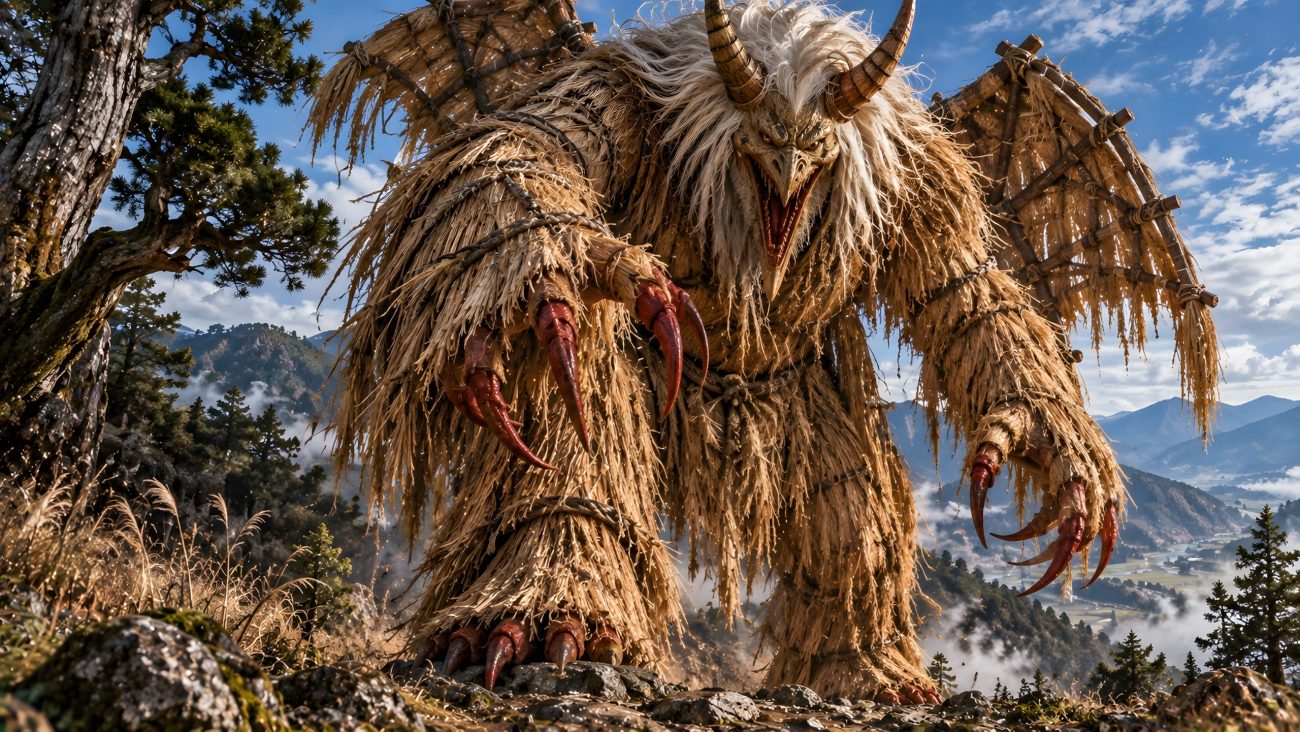
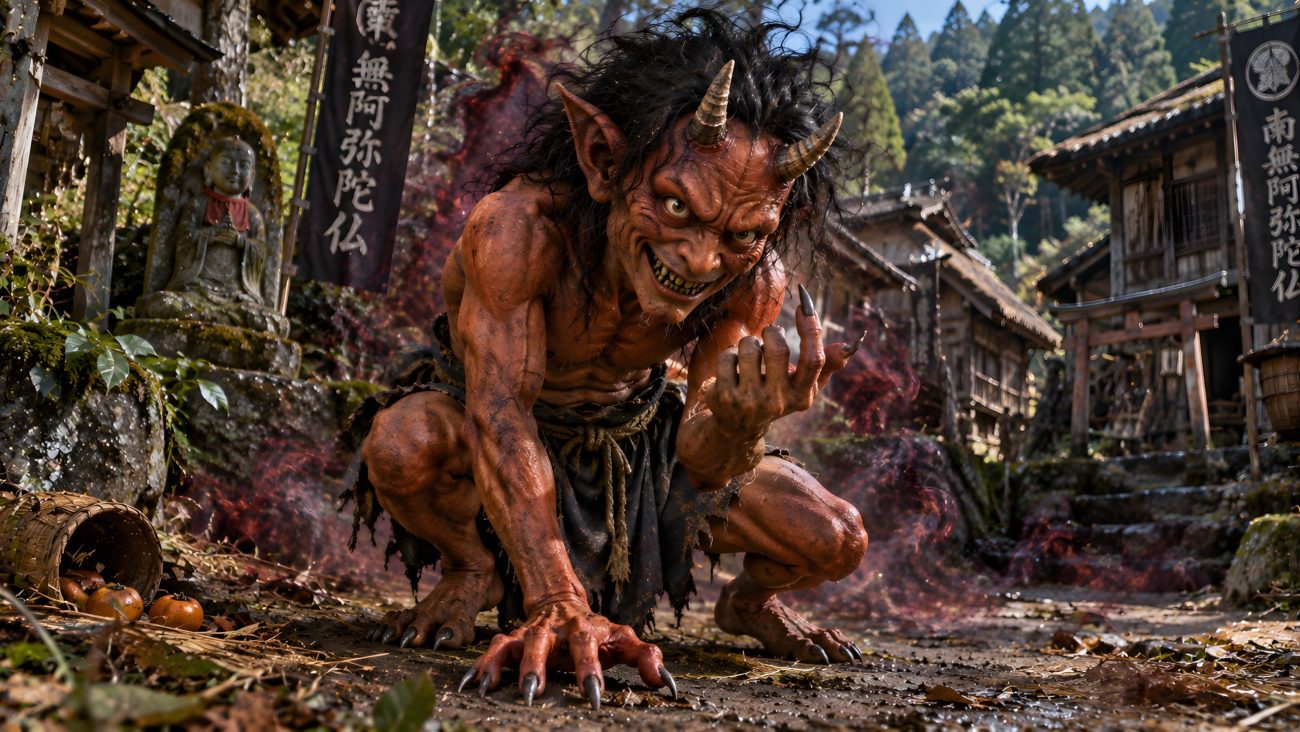
Ouma is a demon-like yokai whose entire body is covered in a substance resembling neither a straw cloak nor fur. It has two horns on its head, white hair, a pointed mouth, and long red claws. Something resembling wings extends from its back.

Ouma is a type of yokai sometimes depicted in Japanese picture scrolls of various monsters. It is particularly known from the Hyakuyōzu, a picture scroll produced around the end of the Edo period that depicts forty-eight types of yokai.


Sources

Takahashi, Toshihiro. “王魔 [おうま] (Ōma).” 新版TYZ 妖怪図鑑 (New TYZ Yokai Encyclopedia). August 1, 2016. https://tyz-yokai.blog.jp/archives/1059827009.html


Oni Hitokuchi

Tradition: Japanese Mythology
Alternative Names: Oni Hitokuchi, Kamikakushi
Category: Demon


The Myth

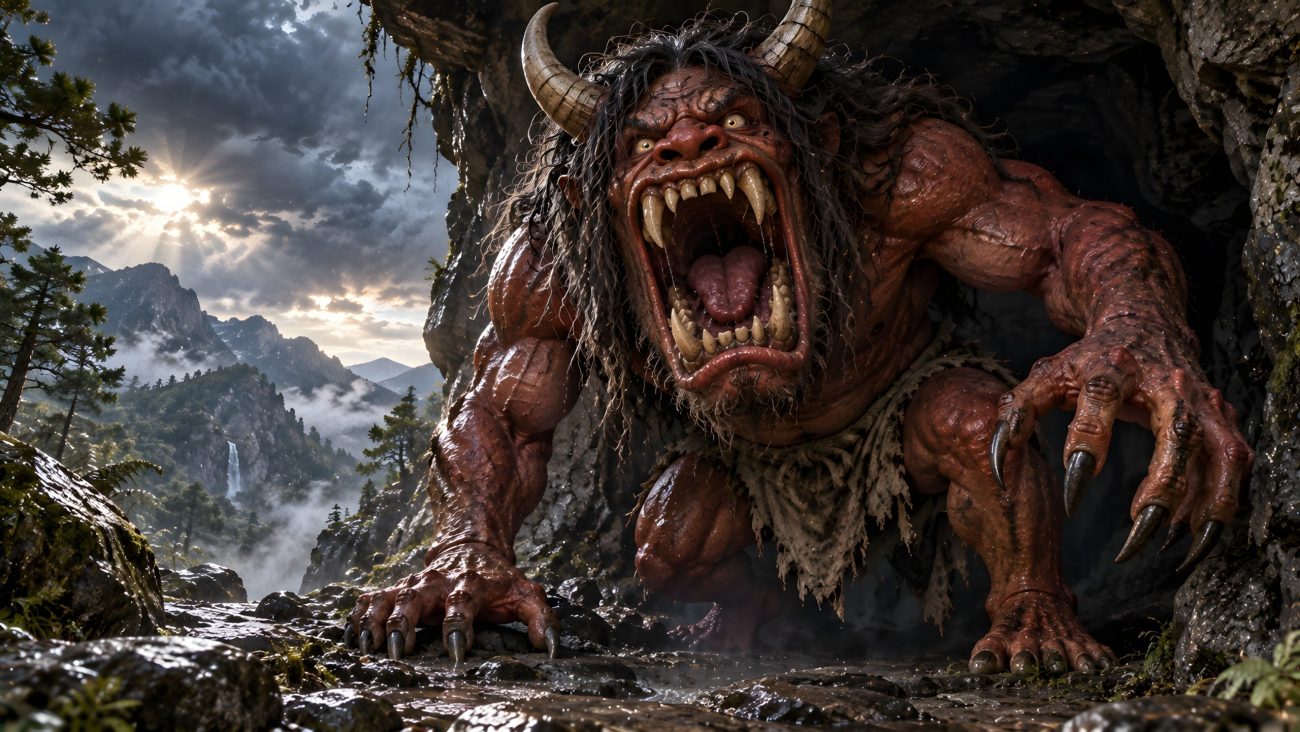
Oni hitokuchi describes an oni that devours a person in a single bite, leaving no trace of the victim behind. When someone disappears suddenly without leaving any evidence, such a disappearance may be attributed to evil spirits. A person carried away by spirits into the other world is said to have experienced kamikakushi, or being spirited away. Some victims eventually return, sometimes many years later and profoundly changed, while others never return at all because they were believed to have been eaten by an oni.

A famous example appears in the Heian-period story collection Ise monogatari. The poet and playboy Ariwara no Narihira desired a beautiful and high-ranking noblewoman named Fujiwara no Takaiko. Because of her social position, the two could not have a legitimate relationship and were forced to conduct their affair secretly.

One night, unhappy with their situation, Narihira secretly entered Takaiko’s room and kidnapped her. He fled with her into the wilderness, but a terrible storm suddenly struck. They found a cave and took shelter inside it. Takaiko remained deep in the cave while Narihira stood guard at the entrance with his bow and arrows.

When morning came and the storm had passed, Narihira went into the cave to retrieve Takaiko. She was gone. An oni living inside the cave had eaten her in a single bite, leaving not even a piece of her behind. Her screams during the night had been completely drowned out by the sound of the storm.


Sources

“Onihitokuchi.” Yokai.com: The Japanese Yokai Encyclopedia. Accessed September 12, 2026. https://yokai.com/onihitokuchi/


Amanojaku

Tradition: Japanese Mythology
Alternative Names: Amanojaku, Amajaku, 天邪鬼
Category: Demon


The Myth

Amanojaku are wicked supernatural beings described as evil kami, minor oni, or yōkai. They are mischievous and malicious, particularly known for provoking people into acting upon the wicked and impious desires hidden within their hearts. Wherever they go, they spread spiritual pollution.

Amanojaku are also associated with ancient Japanese myths of wicked deities. Amanozako, Amenosagume, and Amenowakahiko all possess characteristics resembling the undermining nature of the Amanojaku, and they are commonly regarded as possible origins of the spirit.

Despite their ancient origins, Amanojaku became closely associated with Buddhist imagery. They are sometimes depicted as the demons being crushed beneath the feet of the Four Heavenly Kings, symbolizing wickedness being defeated by righteousness. Demonic faces decorating the armor of Bishamonten are likewise identified with Amanojaku.

The best-known legend involving an Amanojaku is the story of Uriko-hime. An elderly childless couple discovered a baby girl inside a melon and raised her as their daughter, naming her Uriko-hime. She grew into a beautiful young woman, and eventually a marriage proposal arrived for her. Her parents went into town to prepare her dowry and warned her not to open the door to anyone while they were away.

Soon after they left, someone knocked at the door and called for Uriko-hime to let them in. She refused. The voice then asked her to open the window just a little. Uriko-hime reluctantly opened it a crack, whereupon a long, clawed finger entered through the opening and smashed the window apart.

An Amanojaku leaped inside and attacked her. Uriko-hime fought desperately, biting and kicking the demon, but she was unable to overpower it. The Amanojaku eventually snapped her neck and killed her.

The demon then flayed Uriko-hime’s skin from her body and wore it like clothing. Hiding beneath her clothes and using her skin as a disguise, it impersonated the girl so convincingly that her parents were deceived when they returned home.

When the wedding day arrived, the elderly couple brought the disguised Amanojaku to her future husband. A crow sitting in a nearby tree suddenly warned them that the bride was not what she appeared to be. The couple seized the supposed Uriko-hime and held her down. They washed her body until the flayed skin came away, revealing the Amanojaku underneath.

The demon fled, but the elderly couple pursued it. Villagers joined the chase until a large crowd was pursuing the Amanojaku through the village. Eventually they caught it and attacked it with sticks, stones, and tools, beating the demon until it was covered in blood and died.


Sources

“Amanojaku.” Yokai.com: The Japanese Yokai Encyclopedia. Accessed September 12, 2026. https://yokai.com/amanojaku/


Ryūtōki

Tradition: Japanese mythology
Alternative Names: Ryūtōki, Ryutoki, Dragon Lantern Demon
Category: Demon


The Myth

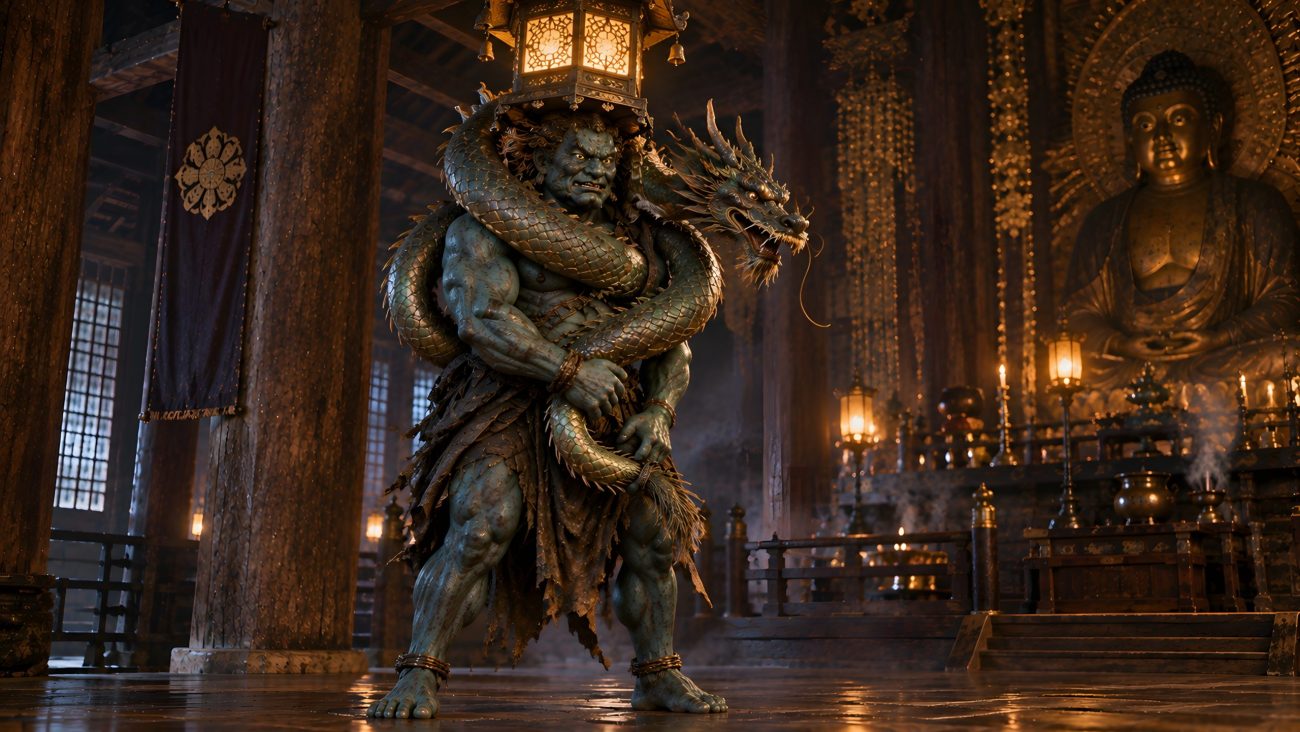
Ryūtōki is a muscular, verdigris-colored demon with a large lantern resting on its head. A dragon is wrapped around its upper body, and Ryūtōki grips the dragon by its tail. It is approximately 80 centimeters tall.

Ryūtōki was created to illuminate the area before the Buddha. Unlike the usual depiction of demons in Buddhist art as beings trampled beneath guardian deities such as the Nio and the Four Heavenly Kings, Ryūtōki is portrayed as an independent demon entrusted with carrying a lantern before the Buddha.

Ryūtōki was one of two demon figures associated with the West Golden Hall of Kōfuku-ji, together with Tentoki. The two demons form a deliberate contrast: Tentoki is red, has its mouth wide open, and is associated with the A-form, while Ryūtōki is blue, keeps its mouth tightly closed, and is associated with the Un-form. Their different postures are regarded as a contrast between movement and stillness.


Sources

Takahashi, Toshihiro. “龍燈鬼 [りゅうとうき] (Ryūtōki).” 新版TYZ 妖怪図鑑 (New TYZ Yokai Encyclopedia). October 21, 2025. https://tyz-yokai.blog.jp/archives/1085533967.html