Uso no Seirei is a yōkai depicted in the Bakemono Emaki (Monster Picture Scroll) preserved in the Kawasaki City Museum.
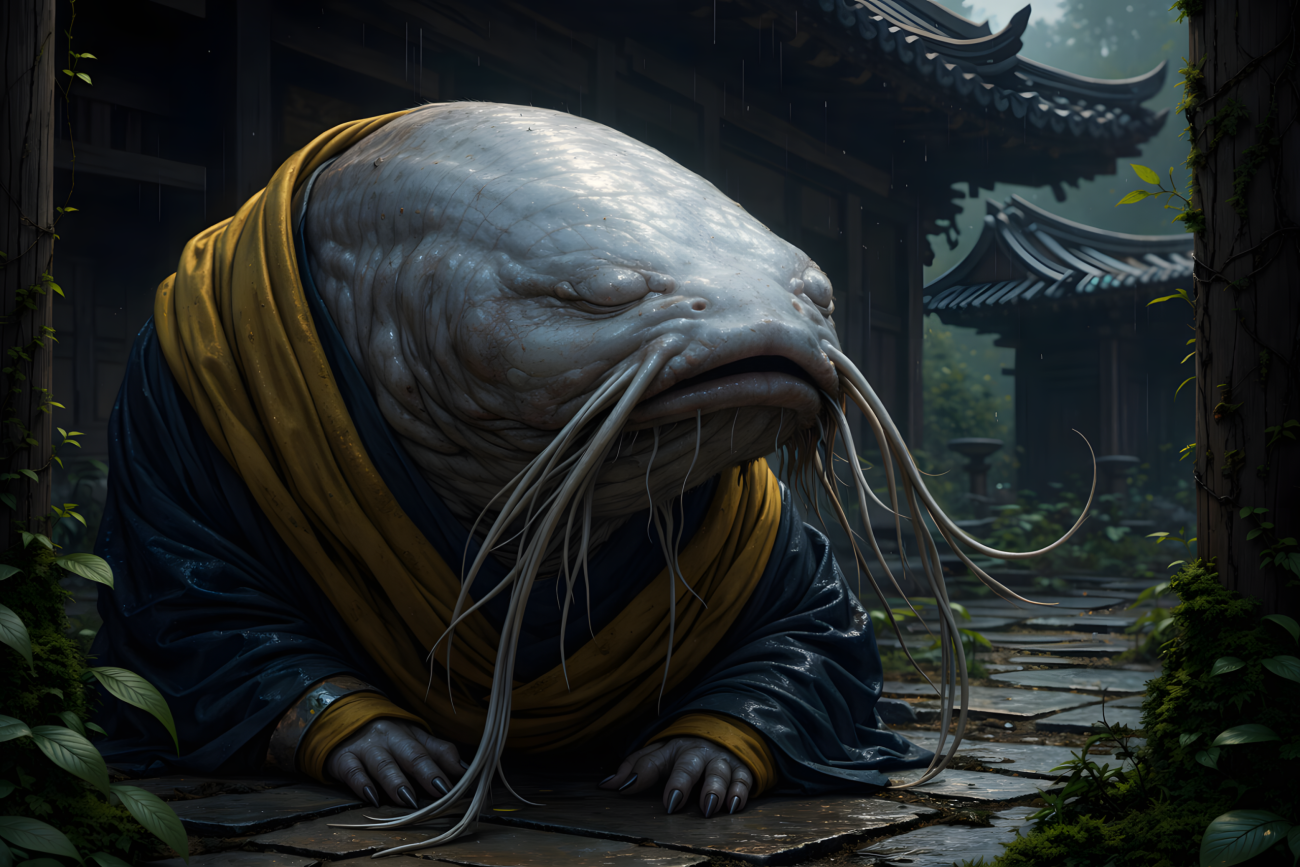
It appears in the form of a bald monk-like figure. Its face has no eyes, no nose, and no mouth. From where its face should be, long whiskers grow, resembling those of a catfish. The creature wears a kimono patterned with images believed to represent the uso, the bullfinch.
The spirit stands silently, without expression or speech. Its lack of facial features gives it an unsettling presence, as though it exists without identity or emotion. The bullfinch pattern upon its robes marks its nature, binding it to the idea of the uso itself.
Uso no Seirei does not act violently, nor does it chase or attack. It simply appears, featureless and mute, a quiet and uncanny figure among the monsters of the scroll.
Gallery
Sources
Tyz-Yokai Blog contributors. (n.d.). [Title of entry]. In TYZ-Yokai Blog, from https://tyz-yokai.blog.jp/archives/1010653494.html
Adhnúall, whose name means “Sweet of Sound,” was one of the hunting dogs of Fionn mac Cumhaill, leader of the Fianna. Unlike the more famous hounds, Adhnúall was remembered not for ferocity alone, but for a voice so beautiful and sorrowful that it could stir the heart.
Once, the dog was stolen by Arthur, the son of the king of Britain. The Fianna pursued the matter and reclaimed Adhnúall, restoring him to Fionn. From that time on, the hound remained closely bound to his master’s fate.
It was said that Adhnúall played a quiet but decisive role in love as well as in the hunt. Through the dog’s presence and guidance, Sadhbh was led into Fionn’s heart, beginning a bond that would shape both their lives.
In later days, a great battle was fought in Leinster, and many of the Fianna were slain. The loss weighed heavily upon Adhnúall. Stricken with grief, the hound ran the full circuit of Ireland three times, as though seeking every fallen companion and every memory of the Fianna.
When his strength was spent, Adhnúall returned to the battlefield. He went to a hill where three warriors of the Fianna and their lovers lay buried together. There, he lifted his head and gave three long howls, each filled with sorrow and farewell. When the last cry faded, Adhnúall lay down and died of grief.
Thus ended the life of the sweet-voiced hound, whose loyalty bound him to love, loss, and the fate of the Fianna themselves.
In the villages and marshlands of Hungary, people speak of the Lidérc, a restless and many-formed spirit that moves between fire, flesh, and shadow.
On some nights it appears as a shooting star or a wandering flame, streaking low across the sky or flickering over bogs and fields. Wherever it passes, sparks leap and fires may break out, barns and pens igniting without cause. In other places it takes the shape of a fiery rod, a blazing figure, or a marsh light that lures the unwary.
But the Lidérc is most feared for the form it takes among humans.
It seeks the lonely: widows, widowers, abandoned lovers, those whose beloveds are far away or dead. Slipping through the night, it enters their homes and assumes the exact appearance of the person they long for most. It speaks gently, knows their memories, and offers comfort, affection, and desire. Night after night it returns, lying beside its victim, feeding not on blood but on life itself. The victim grows pale and weak, dizzy and thin, until at last they waste away and die, loved to death. When its prey is spent, the Lidérc abandons the body and rises again into the sky as a star, seeking another heart to consume.
Yet the Lidérc is never perfect in its disguise. One of its legs always betrays it: a scaly goose foot, a chicken’s claw, or sometimes a horse’s iron-shod hoof. Those who scatter ashes at their threshold may see the tracks—one human footstep, one monstrous—and know what has crossed their door. Garlic, cords, and household charms can bar its entry, if the danger is recognized in time.
There is another kind of Lidérc as well, one born not from fire but from human greed. If the first egg laid by a black hen is hidden beneath a person’s armpit and warmed there, a strange, featherless creature will hatch. This Lidérc binds itself to its keeper, speaking with intelligence and obeying commands. It brings wealth, steals treasure, and works tirelessly, living on butter and favors. But it is never satisfied. If its master fails to give it constant tasks, it becomes restless and cruel, pestering day and night until it finally destroys the one who raised it.
The only escape is to give the Lidérc an impossible command: to carry water in a sieve, to squeeze through solid wood, to complete a task that cannot be done. Unable to endure failure, the creature will rage, weaken, and finally vanish.
Thus the Lidérc remains a warning whispered in Hungarian folklore: that desire, loneliness, and greed can summon something that looks like love or fortune—but feeds only on ruin.
From the deepest darkness before the world was formed, Abyzou came forth. She rose from the primeval waters, from the abyss that existed before heaven and earth were divided. In that endless sea she was born barren, and from her barrenness grew envy without limit.
Abyzou wandered the world without rest or sleep. She moved silently through night and shadow, drawn to the cries of women in labor and the breath of newborn children. She was said to feel no mercy, for what she desired most had been denied her forever. Because she could not give life, she sought to take it.
When a woman lay ready to give birth, Abyzou would draw near. If she was not driven away, she strangled infants in their cradles, stole them in the night, or brought sickness upon them so that they wasted away. She whispered illness into bodies, closing throats, blinding eyes, twisting minds, and filling flesh with pain. Wherever she passed, suffering followed.
Abyzou did not walk openly among mortals. Her form was half-seen: a greenish, gleaming face framed by writhing, serpent-like hair, while the rest of her body dissolved into darkness. Sometimes she appeared with the scales or tail of a fish or serpent, for she belonged to the ancient waters. She claimed to possess countless names and shapes, changing them constantly so that none might easily command her.
In ancient times, King Solomon encountered her while binding demons to build the Temple. When she was brought before him in chains, she confessed her deeds freely, boasting that she never slept and that each night she sought children to destroy. Solomon ordered her bound by her own hair and displayed before the Temple, so that all might see the demon who preyed upon mothers and infants.
Yet Abyzou could never be destroyed. She could only be driven away.
Thus people learned to defend themselves through sacred names, seals, and charms. Her name was written on amulets, spoken aloud in childbirth, carved into metal and stone. When she was named correctly, she was forced to flee. When the names of her enemies—angels, saints, or divine protectors—were invoked, she recoiled in fury and envy.
In Egypt she was known as Alabasandria. In Byzantium she was Gylou or Gello. In each land she took a new name, but her hunger remained the same. Riders trampled her beneath their horses in sacred images. She was whipped, bound, cursed, and cast out in spells, yet always returned when vigilance failed.
Only one thing could stop her: knowledge of her names. When a woman about to give birth wore an amulet bearing those names, Abyzou was powerless. Forced by oath, she would turn away and retreat to the dark waters from which she had come.
And so Abyzou still wanders the edges of night, driven by envy, searching for life she can never possess—an ancient shadow born from the abyss, feared wherever children are born.
Tradition / Region:Greek mythology Alternate Names: Afterthought, Late Counsel Category: Titan god
The Myth
Epimetheus was one of the Titan sons of Iapetos, brother to Prometheus, Atlas, and Menoitios. Where Prometheus was clever and foresighted, Epimetheus was slow to consider consequences, acting first and understanding only afterward. Because of this nature, the gods named him Afterthought.
When the time came for the mortal world to be filled with life, the gods entrusted Prometheus and Epimetheus with the task. Epimetheus asked that he be allowed to distribute the gifts of survival himself, while Prometheus would later inspect his work. Prometheus agreed.
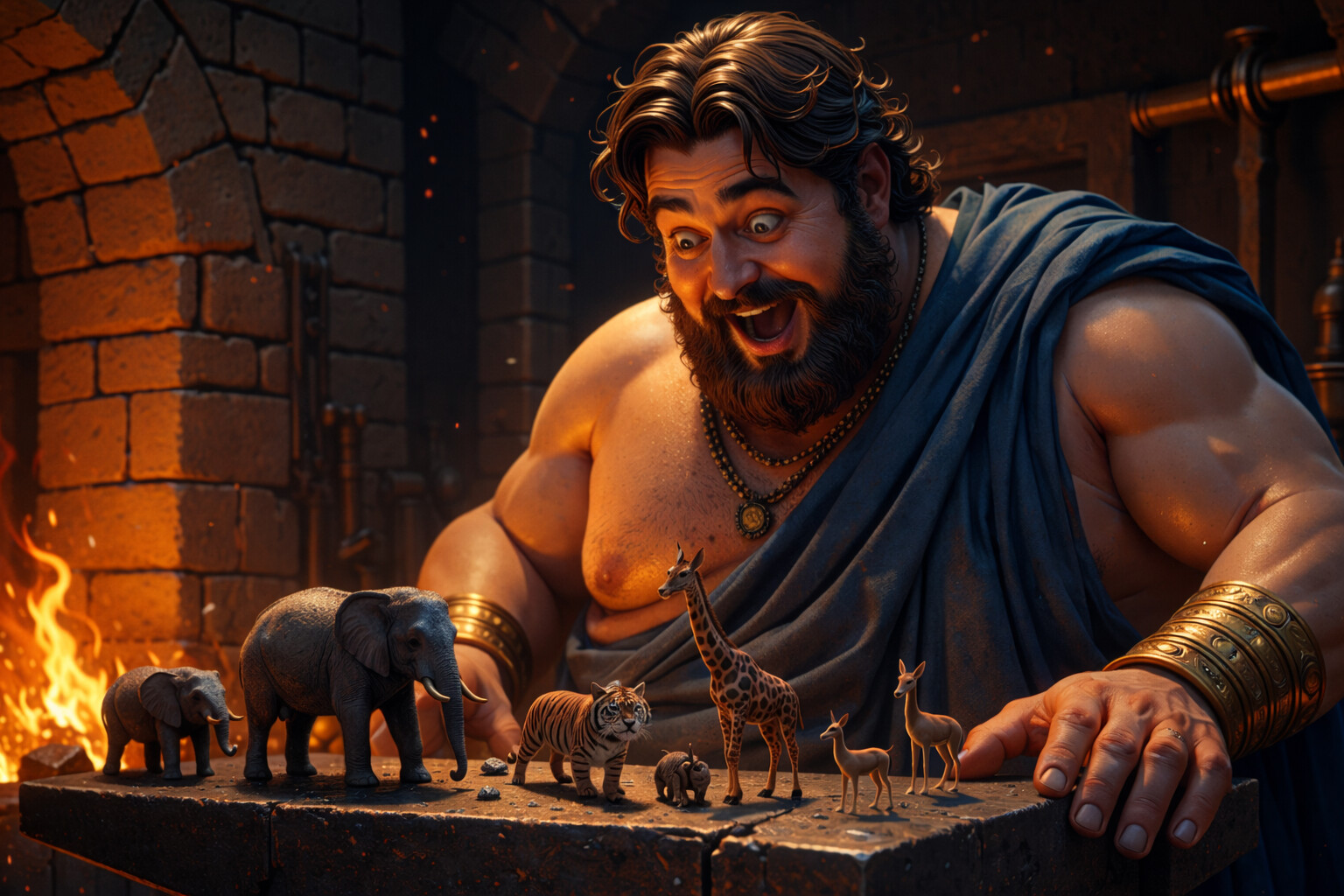
Epimetheus moved eagerly among the creatures of the earth. To some he gave great strength, to others speed. He armed some with claws, tusks, and horns, and gave thick hides and fur to those who would face cold and heat. Birds received wings, beasts received burrows, hooves, shells, or venom. To preserve balance, he ensured that prey multiplied quickly while predators were few. By the time he had finished, every animal was well equipped for life.
Only then did Epimetheus come to mankind.
And he found that he had nothing left.
Humans stood naked and unarmed, without claws or fur, without swiftness or strength, unable to defend themselves from beasts or the harshness of the world. Epimetheus was struck with terror at what he had done. He could not undo his mistake, and the appointed hour for humanity’s emergence had already arrived.
When Prometheus came to inspect the work, he saw at once the disaster. To save mankind, he climbed secretly into the workshops of the gods and stole fire, along with the arts of metalwork, craft, and skill. With these gifts, humans learned to build, to cook, to forge weapons, and to survive.
But Zeus saw the theft, and his anger was terrible.
As punishment, Zeus devised a slow and beautiful ruin for mankind. He commanded Hephaistos to shape a woman from earth, and Athena clothed her in fine garments and taught her weaving. Aphrodite gave her beauty and longing, Hermes placed cunning words and deception in her heart, and the other gods each bestowed a gift. Because of this, she was named Pandora, the All-Gifted.
Zeus sent Pandora to Epimetheus as a gift.
Prometheus warned his brother again and again: never accept gifts from Zeus. But Epimetheus did not heed him. Captivated by Pandora’s beauty, he welcomed her into his house and took her as his wife.
Pandora carried with her a sealed jar, entrusted to her by the gods. One day, moved by curiosity placed in her by divine design, she lifted the lid. From the jar burst sickness, pain, hunger, toil, madness, old age, and every misery that had never before existed. They spread across the earth and entered the lives of all mortals.
Only one thing remained inside the jar when Pandora closed it again.
Hope.
From that day onward, humans lived with suffering, yet were not entirely without comfort.
Epimetheus understood his error only after the evils had already escaped. He had failed mankind twice: first by leaving them helpless, and again by welcoming the instrument of their sorrow. Because of him, Prometheus was later chained and punished, and humanity inherited a world of labor and grief.
The poets said that Epimetheus was the father of Excuse, for he always understood too late. And so his name endured as a warning: wisdom that comes only afterward is no wisdom at all.
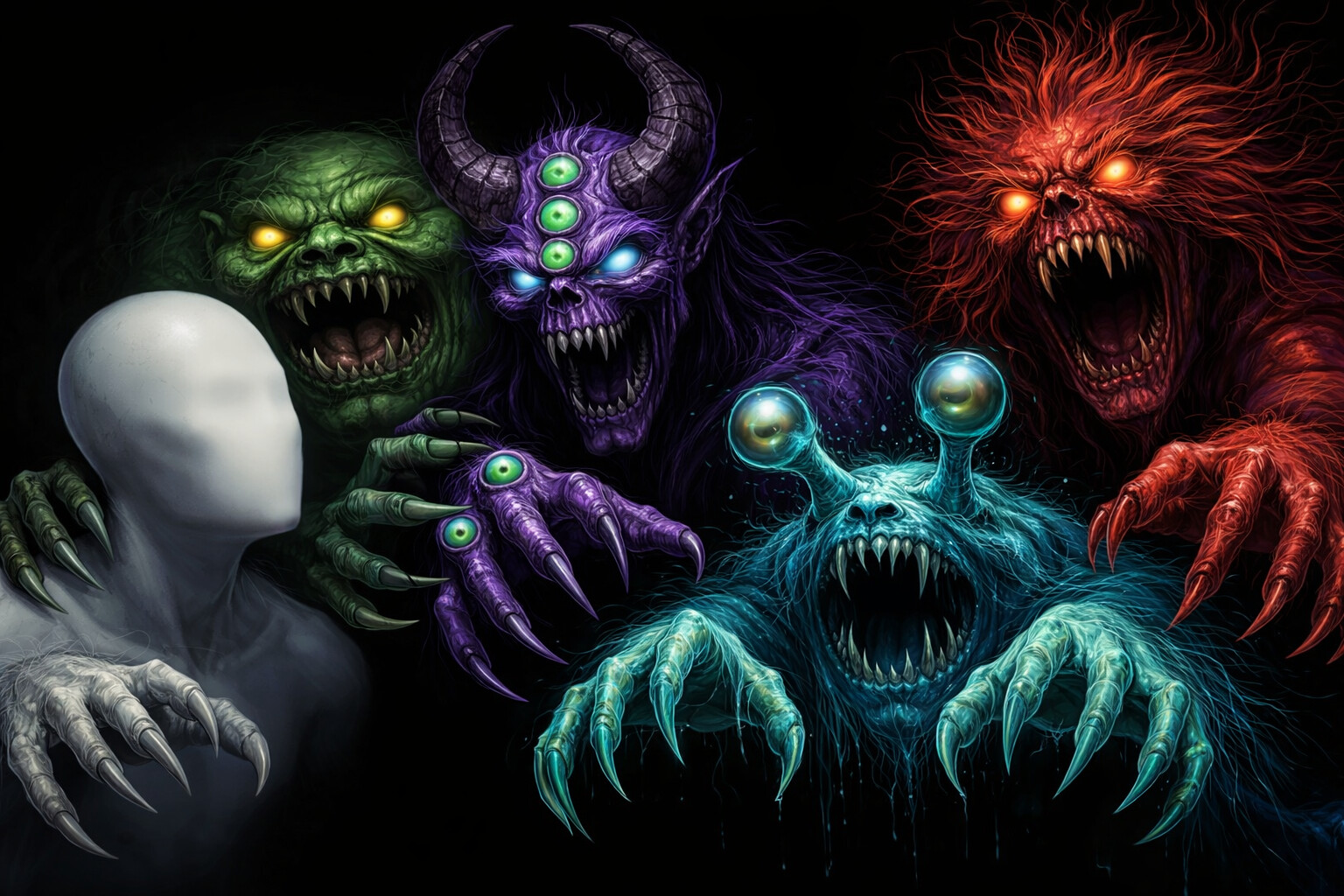
Asukokoko appears in an old depiction of the Night Parade of One Hundred Demons. It is not shown as a single body, but as a mass of many monster faces and grasping hands, all emerging from what looks like a drifting black cloud.
The faces leer and stare in different directions, while the hands reach outward as if the darkness itself were alive. There is no clear center to the creature, no fixed form that can be grasped or confronted.
Its name, Asukokoko, is understood to mean “here and there.” The monster is everywhere at once, scattered and unfixed, as though demons were appearing in many places at the same time.
Thus Asukokoko is not a single being that moves through the world, but a presence that manifests wherever fear gathers—faces and hands rising from darkness, here and there, without warning.
Tradition / Region: Dutch Mythology Alternate Names: Antje met het Wiel Category: Ghost
The Myth
Antsje mei it Tsjil is a spirit of the rye fields, feared as a child-snatching presence that lurks among tall grain. She is said to dwell within the fields themselves, unseen but never silent, bound to the growing rye and the dangers it hides.
Children were warned never to wander through ripe rye fields, for Antsje waits there. Those who stray too far are seized, crushed, and devoured, ground down as though by a mill. No trace is left behind, only flattened stalks and silence.
Antsje moves upon a wheel, rolling endlessly through the fields. Though she cannot be seen, her approach is always announced. Before she arrives, a soft rustling passes through the rye—not the sound of wind, but something heavier, deliberate, circling closer and closer.
Those who hear the sound know to flee at once. To remain is to risk being caught in her turning path, drawn into the grain and destroyed. Adults say the fields themselves seem to close behind her, hiding her passage and concealing her victims.
Antsje mei it Tsjil stands as a warning spirit, embodying the dangers of the harvest fields and the boundary between safety and wilderness. She reminds all who hear the rye whisper that not every rustle belongs to the wind, and that some fields are alive with hunger.
Tradition / Region: Indian Mythology Alternate Names: Hill Fairy; Bhūt; Hill Godling Category: Ghost / Child
The Myth
The Acheri is the restless spirit of a young girl, or sometimes a woman, who died a violent or untimely death. After death, her soul did not depart the world but lingered among the mountains, becoming a dangerous presence feared by the villages below.
By day, Acheri dwell on mountain peaks and high hilltops, unseen and silent. As dusk falls, they descend from the heights to hold revels in remote places. These gatherings are perilous. Anyone who stumbles upon an Acheri revel risks death or grave harm, and even visiting the site afterward is considered unsafe, as the land itself is believed to retain their influence.
Acheri are especially feared for their connection to disease. They are said to cast their shadow—known as chāyā—over children, afflicting them with sudden and incurable illnesses. The touch of their shadow alone is enough to weaken the body, and once marked, a child may never recover. Because of this, parents were warned to keep children away from lonely hillsides and twilight paths.
Though feared, the Acheri are not without boundaries. It is said that wearing a scarlet thread around the throat offers protection against certain illnesses associated with them, particularly colds and goitre. However, bright red clothing is dangerous, as the Acheri are believed to hate the color red and may be drawn to it in anger rather than repelled.
In some regions, strange sights on the mountains are attributed to the Acheri. Travelers speak of enormous moving shadows cast against the slopes—phantom processions of elephants, horses, and figures marching in silence. These illusions are said to appear without sound or substance, vanishing as suddenly as they arise.
The Acheri are remembered as spirits bound to the hills by unresolved death. Neither fully divine nor merely ghostly, they stand between village deities and wandering dead. Their presence turns mountains into places of beauty and danger alike, reminding those below that the heights are not empty, and that the spirits of the violently lost still walk at dusk.
Gallery
Sources
Bestiary.us contributors. (n.d.). Acheri. In Bestiary.us — Mythical Creatures of the World, from https://www.bestiary.us/acheri
Wikipedia contributors. (n.d.). Acheri. In Wikipedia, The Free Encyclopedia, from https://en.wikipedia.org/wiki/Acheri
Abja is a ghostly figure in Albanian folklore, appearing in the form of a woman wrapped in a rough shroud or a thick cloak made of coarse woolen fabric. The name Abja derives from abá or abája, referring to such a garment.
She is described simply as a female apparition distinguished by this heavy, coarse covering, which conceals her body and form. No further actions, speech, or narrative events are consistently recorded; her defining characteristic is her appearance as a shrouded female ghost.
Gallery
Sources
Elsie, R. (2001). A Dictionary of Albanian Religion, Mythology, and Folk Culture. p. 4.
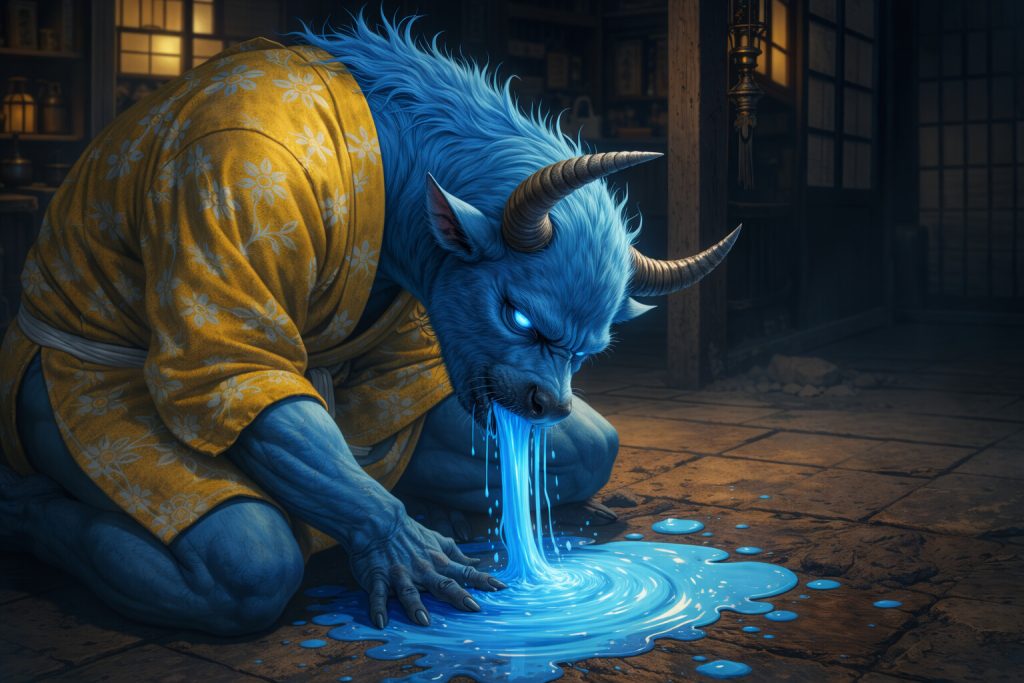
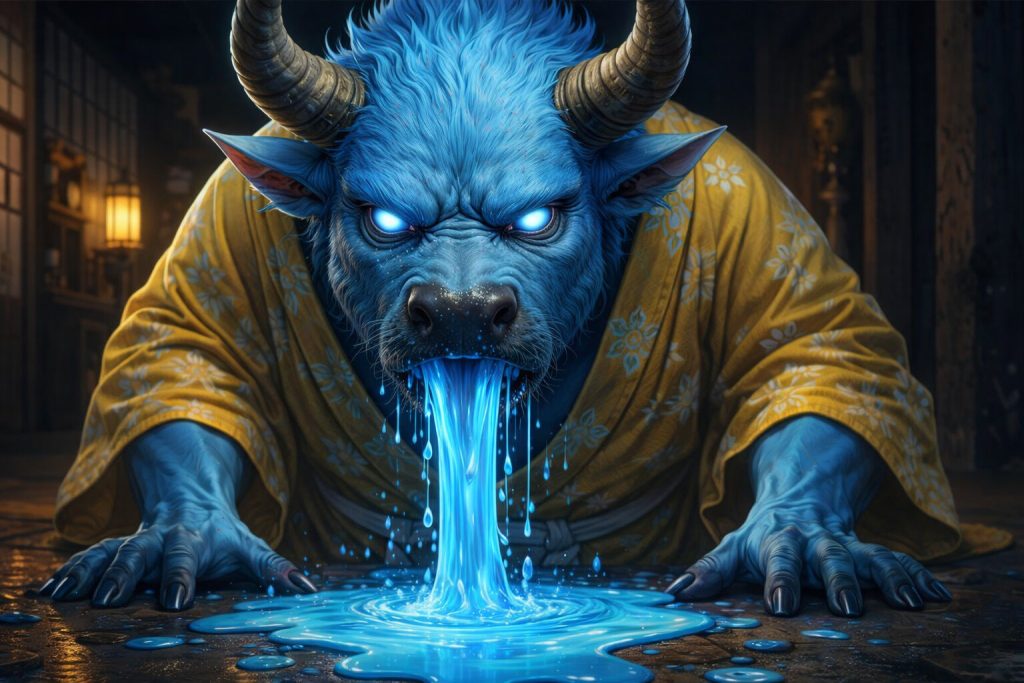
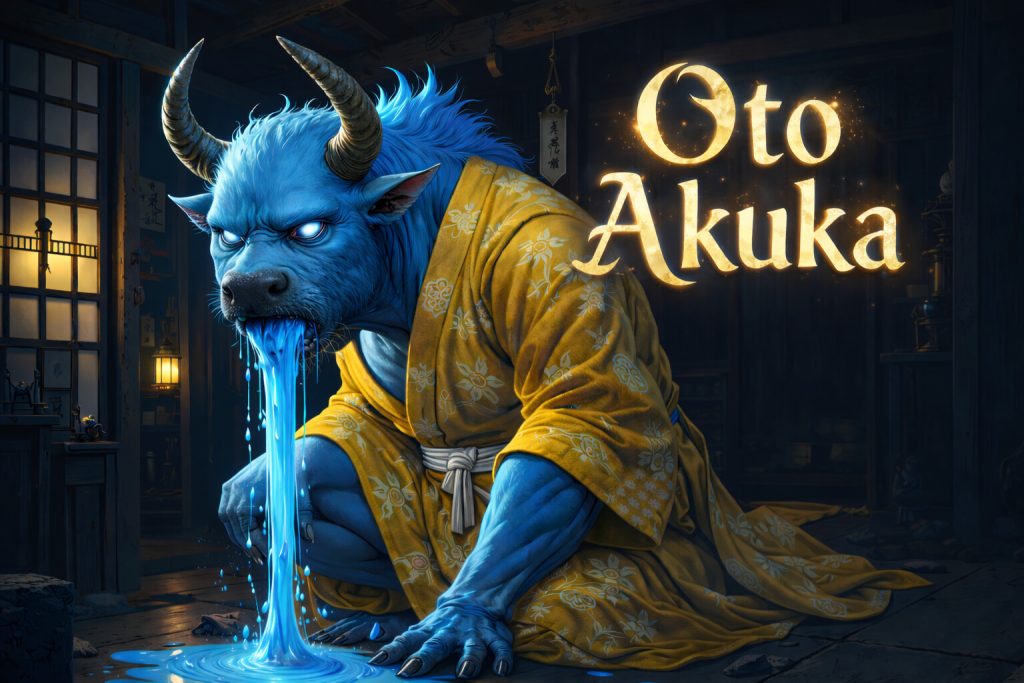
Oto Akuka is a demon recorded only once, in a single old Japanese scroll. Beyond this appearance, nothing more is known. There are no surviving stories, no extended legends, and no later mentions of the creature.
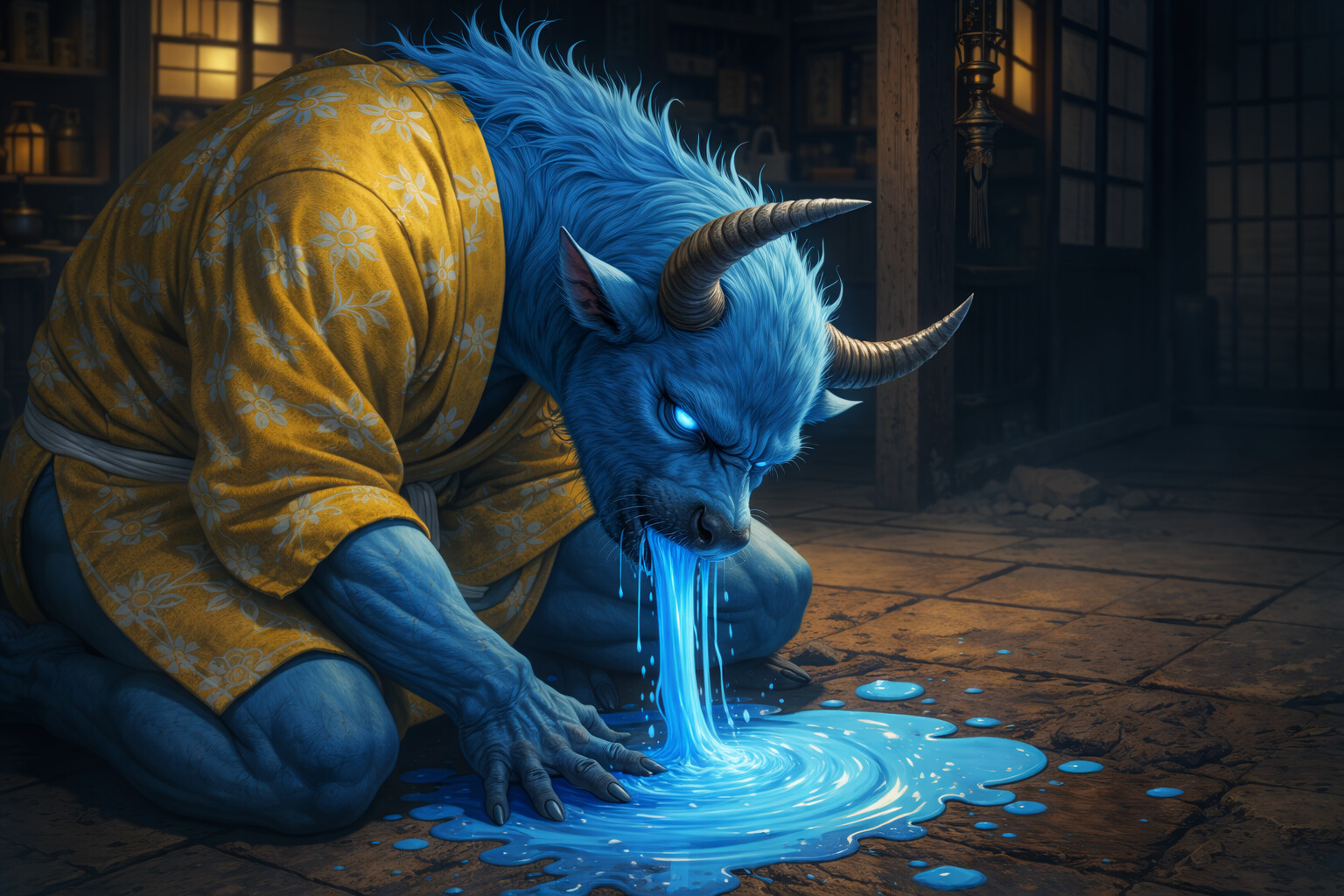
In the scroll, Oto Akuka is shown with blue skin and a beast-like face. Its head is bald and crowned with two horns, and its nose appears crushed, giving it the resemblance of a cow or a pig. The demon is depicted kneeling on the ground. One hand is pressed firmly against the floor, while the other supports its body as it vomits.
The image presents Oto Akuka not as a being that attacks others, but as one overcome by what rises within itself. The demon is shown in the moment of release, brought low and humiliated by its own condition. Its punishment is not delivered by an external force, but unfolds openly through its own body, in full view.
Oto Akuka remains an isolated figure in Japanese folklore—a single, unsettling image preserved in a scroll, offering no tale of origin or aftermath, only the enduring vision of a demon brought to shame.