
Medusa

Tradition / Region: Greek Mythology
Alternate Names: Gorgo, The Gorgon
Category: Snake


The Myth

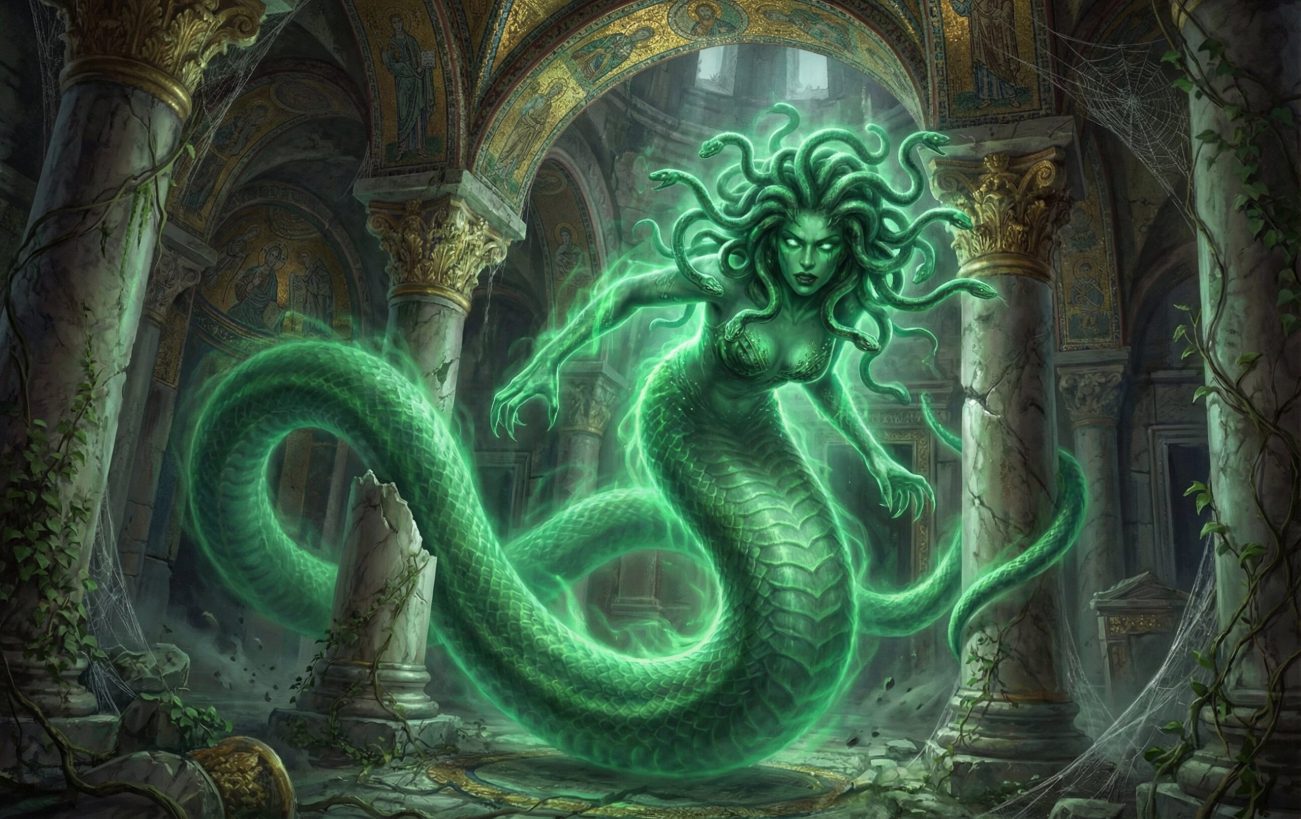
Medusa was one of the three Gorgons of Greek mythology alongside her sisters Stheno and Euryale. The Gorgons were usually described as daughters of the sea deities Phorcys and Ceto. Of the three sisters, Medusa alone was mortal.

She is most famously described as a terrifying woman with venomous snakes for hair whose gaze could turn any living being into stone. Ancient traditions often portrayed the Gorgons as monstrous winged creatures living far from the world of ordinary humans, in remote western lands associated by some writers with Libya.

The most famous myth involving Medusa centers on the Greek hero Perseus. King Polydectes ordered Perseus to bring back the head of Medusa, believing the task impossible. To aid him, the gods gave Perseus several magical items. Athena provided a polished shield, Hermes gave him winged sandals, Hephaestus supplied a sword, and Hades lent him the helm of invisibility.

Because looking directly at Medusa meant instant petrification, Perseus approached her while watching only her reflection in Athena’s shield. He found Medusa asleep and decapitated her with a single strike.

According to the myth, Medusa was pregnant by Poseidon at the moment of her death. From her severed body sprang Pegasus, the winged horse, and Chrysaor, a giant warrior associated with a golden sword.

Even after her death, Medusa’s head retained its petrifying power. Perseus used it as a weapon during several later adventures. On his journey home, he encountered the Titan Atlas and transformed him into stone with the Gorgon’s head, creating the Atlas Mountains according to later traditions. Perseus also rescued the princess Andromeda from a sea monster and eventually returned to the island of Seriphos, where he turned King Polydectes and his followers to stone for mistreating his mother.

In the end, Perseus presented the head of Medusa to Athena, who placed it upon her shield, the Aegis. The image of Medusa’s head later became a powerful protective symbol in Greek and Roman culture. Known as the Gorgoneion, it appeared on shields, armor, temples, and mosaics to ward off evil.

Different ancient traditions described Medusa differently. Early Greek art often portrayed her as a horrifying monster with tusks, bulging eyes, wings, and snakes. Later Greek and Roman writers increasingly depicted her as both beautiful and terrifying. In the Roman poet Ovid’s version of the myth, Medusa had once been a beautiful maiden before Athena transformed her hair into snakes after Poseidon violated her within Athena’s temple.

Over time, Medusa became one of the most recognizable figures in Greek mythology, remembered both as a deadly monster whose gaze turned mortals into stone and as a tragic figure whose severed head continued to wield terrible power even after death.


Sources

Wikipedia contributors. (n.d.). Medusa. In Wikipedia, from https://en.wikipedia.org/wiki/Medusa

Abyzou

Tradition / Region: Mesopotamian, Greek, Byzantine
Alternate Names: Abizou, Obizuth, Obyzouth, Byzou, Gylou, Gello, Alabasandria, Anabardalea, and countless others
Category: Demon, Snake, Hybrid


The Myth

From the deepest darkness before the world was formed, Abyzou came forth. She rose from the primeval waters, from the abyss that existed before heaven and earth were divided. In that endless sea she was born barren, and from her barrenness grew envy without limit.

Abyzou wandered the world without rest or sleep. She moved silently through night and shadow, drawn to the cries of women in labor and the breath of newborn children. She was said to feel no mercy, for what she desired most had been denied her forever. Because she could not give life, she sought to take it.

When a woman lay ready to give birth, Abyzou would draw near. If she was not driven away, she strangled infants in their cradles, stole them in the night, or brought sickness upon them so that they wasted away. She whispered illness into bodies, closing throats, blinding eyes, twisting minds, and filling flesh with pain. Wherever she passed, suffering followed.

Abyzou did not walk openly among mortals. Her form was half-seen: a greenish, gleaming face framed by writhing, serpent-like hair, while the rest of her body dissolved into darkness. Sometimes she appeared with the scales or tail of a fish or serpent, for she belonged to the ancient waters. She claimed to possess countless names and shapes, changing them constantly so that none might easily command her.

In ancient times, King Solomon encountered her while binding demons to build the Temple. When she was brought before him in chains, she confessed her deeds freely, boasting that she never slept and that each night she sought children to destroy. Solomon ordered her bound by her own hair and displayed before the Temple, so that all might see the demon who preyed upon mothers and infants.

Yet Abyzou could never be destroyed. She could only be driven away.

Thus people learned to defend themselves through sacred names, seals, and charms. Her name was written on amulets, spoken aloud in childbirth, carved into metal and stone. When she was named correctly, she was forced to flee. When the names of her enemies—angels, saints, or divine protectors—were invoked, she recoiled in fury and envy.

In Egypt she was known as Alabasandria. In Byzantium she was Gylou or Gello. In each land she took a new name, but her hunger remained the same. Riders trampled her beneath their horses in sacred images. She was whipped, bound, cursed, and cast out in spells, yet always returned when vigilance failed.

Only one thing could stop her: knowledge of her names. When a woman about to give birth wore an amulet bearing those names, Abyzou was powerless. Forced by oath, she would turn away and retreat to the dark waters from which she had come.

And so Abyzou still wanders the edges of night, driven by envy, searching for life she can never possess—an ancient shadow born from the abyss, feared wherever children are born.


Gallery


Sources

Wikipedia contributors. (n.d.). Abyzou. In Wikipedia, The Free Encyclopedia, from https://en.wikipedia.org/wiki/Abyzou


Interpretive Lenses

Religious Readings
  • Christian Ascetic Deep Dive
Philosophical Readings
  • Nietzschean Deep Dive
Psychological Readings
  • Jungian Deep Dive
Esoteric Deep Dive
  • Hermetic Deep Dive
Political / Social Readings
  • Marxist Deep Dive
Other
  • How to Invite The Abyzou