Tradition / Region: Japanese Mythology
Alternative names: One-Wheeled Monk / Flaming Wheel Monk
Category: Yokai, Flame
The Myth
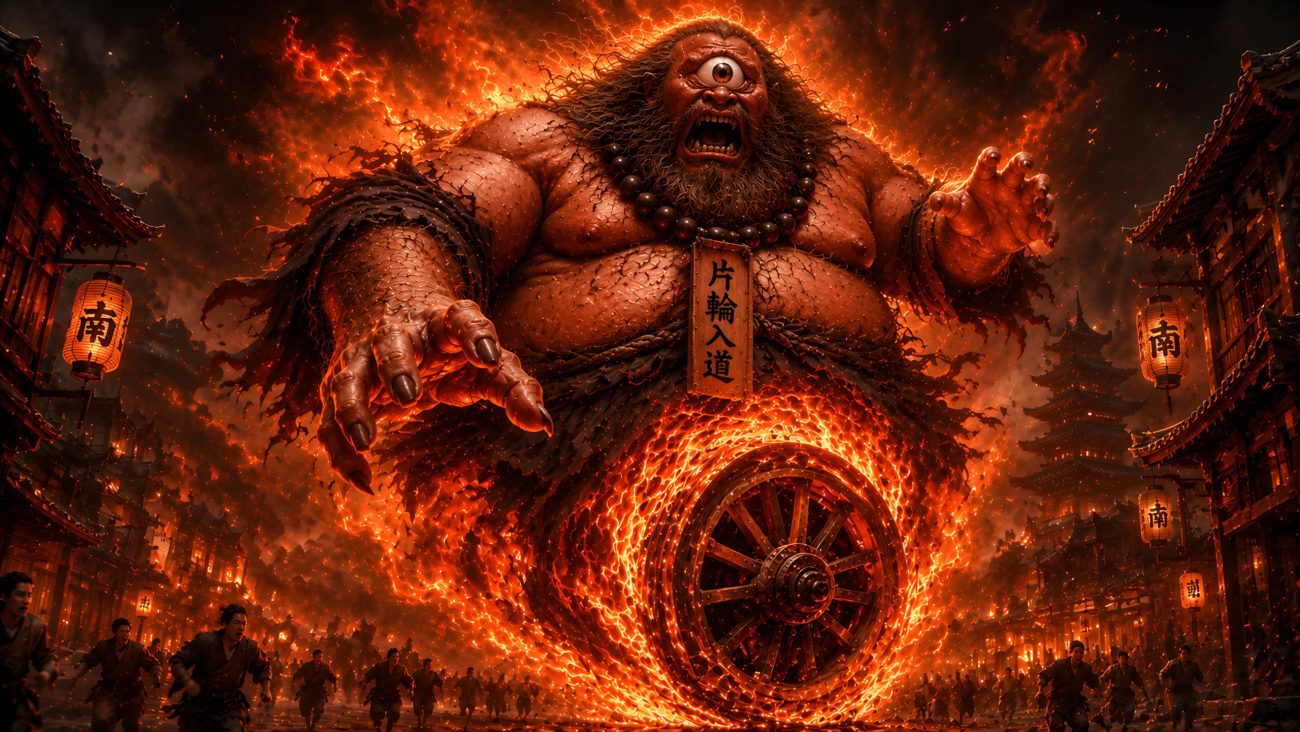
The Katawaguruma Nyūdō is a terrifying yokai that roams the streets of Kyoto at night. It appears as a gigantic hairy monk with a fierce face and enormous strength, riding upon a single wheel engulfed in flames. The burning wheel races through the darkness like a cart from hell, spreading fire and fear wherever it passes.
According to legend, the creature was once a powerful and wealthy monk who lived in the Rokuhara district of Kyoto. Cruel and arrogant, he delighted in the suffering of others and committed countless wicked deeds without fear of divine punishment. Although he enjoyed great prosperity during his life, his evil eventually caught up with him.
Divine punishment descended upon the monk, and he was consumed by supernatural flames. Transformed into a monstrous spirit, he became the Katawaguruma Nyūdō, forever condemned to wander Kyoto upon his fiery wheel.
One night, a woman living nearby put her three children to sleep and, through a knot hole in her door, secretly watched the terrible apparition pass by. The flaming monk noticed her gaze and shouted:
“Look to your children instead of looking at me!”
Terrified, the woman rushed to her children, but it was too late. The Katawaguruma Nyūdō seized all four members of the family and carried them away into the night, and they were never seen again.
Thus the One-Wheeled Monk became one of Kyoto’s most feared supernatural beings — a burning spirit born from greed and cruelty, whose fiery wheel still races through the darkness searching for those unfortunate enough to witness its passage.
Sources
TYZ. (n.d.). Katawaguruma Nyudo [片輪車入道]. In 新版TYZ 妖怪図鑑. Retrieved June 13, 2026, from https://tyz-yokai.blog.jp/archives/1079937229.html