Skarbnik

Tradition / Region: Polish Mythology, Ukranian Mythology, Belarusian Mythology
Alternate Names: Kladenets; Dzedka
Category: Cave dweller


The Myth

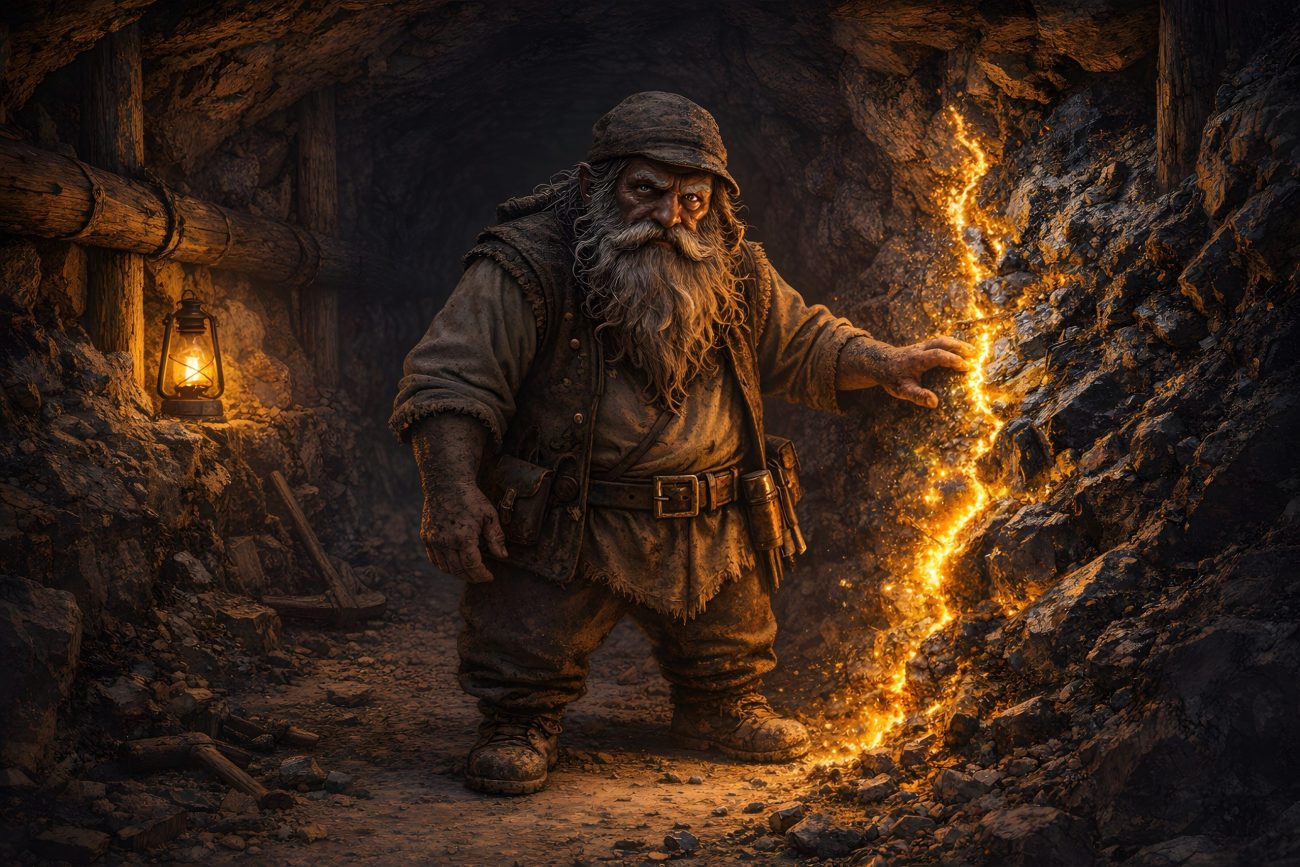
Deep beneath the earth, in the winding tunnels of mines and forgotten shafts, dwells the Skarbnik—the Treasurer of the underworld. He is the unseen guardian of gems, crystals, and precious metals, watching over the hidden wealth buried in stone.

Miners speak of him in hushed voices. To those who work honestly and show respect, Skarbnik is a silent protector. When tunnels groan and timbers strain, he may guide a worthy miner away from danger. When a man loses his path in the dark labyrinth underground, a whisper, a faint glow, or the echo of a step may lead him safely back. At times, Skarbnik rewards diligence by revealing a rich vein of ore, leading the faithful straight to silver, coal, or gold.

But Skarbnik is not gentle with the wicked.

Those who curse in the tunnels, mock the spirit, or treat the mine with arrogance soon feel his wrath. It is forbidden to whistle underground, to hurl stones in anger, or to cover one’s head in disrespect. Such acts insult the Treasurer. First comes a warning—a sudden shower of loose soil striking the offender, small clods thrown from unseen hands. If the warning is ignored, harsher punishment follows. Tunnels collapse without mercy. Dark chasms open beneath careless feet. Stones fall from above with deadly aim.

To the greedy and cruel, Skarbnik is a relentless judge. To the humble and respectful, he is a guardian and guide.

Thus the miners say that no one truly works alone beneath the earth. The Treasurer watches always, weighing the hearts of men as carefully as the ore they seek.


Sources

Wikipedia contributors. (n.d.). Karzełek. In Wikipedia, The Free Encyclopedia. Retrieved February 13, 2026, from https://en.wikipedia.org/wiki/Karze%C5%82ek
Puigmal

Tradition / Region: Catalan mythology, Spanish Mythology
Alternate Names: —
Category: Giant


The Myth

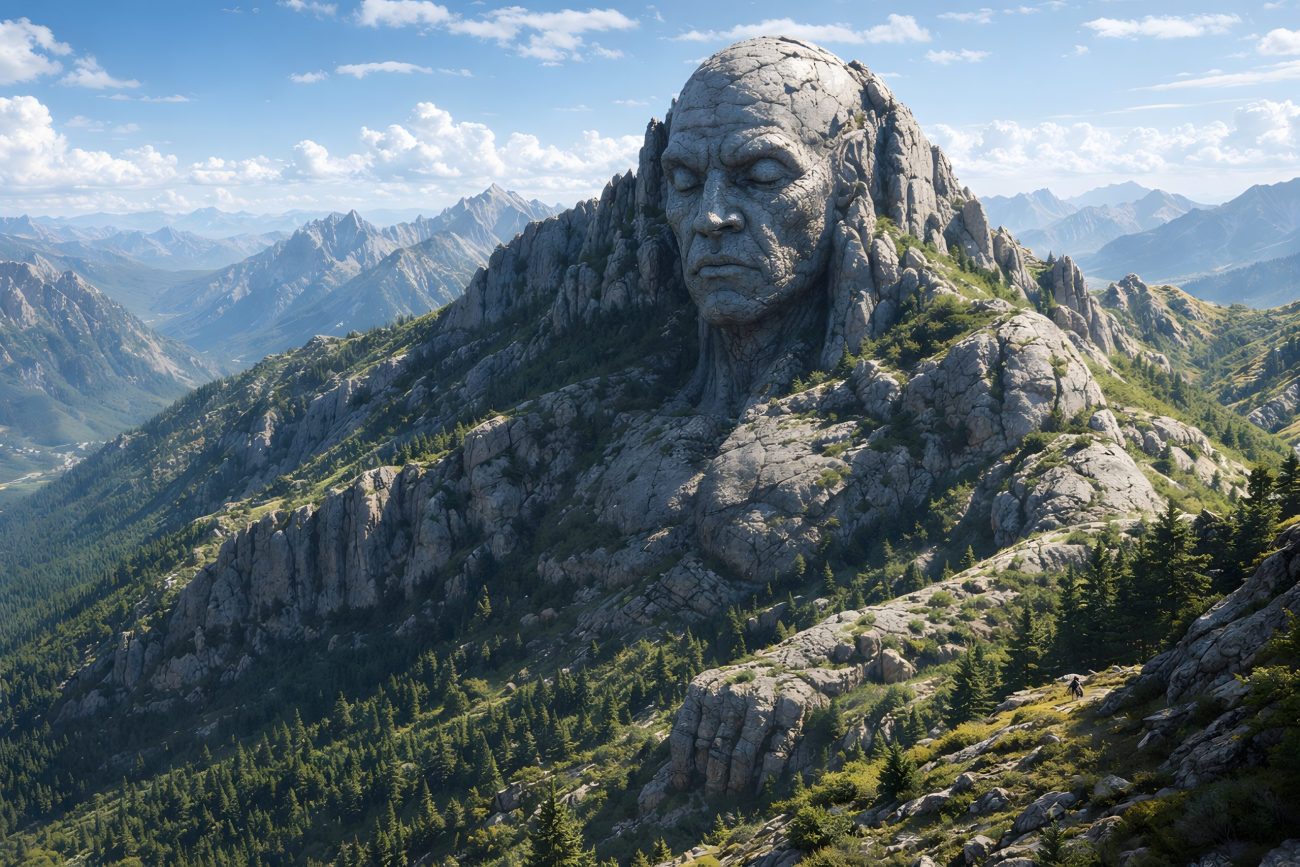
In the high mountains above the valley of Ribes there once lived a giant named Puigmal.

He towered above the forests and peaks, a mighty being who watched over the trees and the wild animals. No hunter could loose an arrow without feeling his presence. No woodcutter could strike a trunk without sensing the mountain’s silent warning. Puigmal guarded nature fiercely, defending it from careless human hands.

One day, as he wandered the slopes, he milked a wild doe and made cheese from her milk. He brought this cheese to a human and offered it as a gift. “As long as you do not eat it all,” he said, “it will grow again and again. You will never hunger, and you will not need to hunt the creatures of these mountains.”

The gift was a covenant: live with restraint, and the mountain would provide endlessly.

But the balance between humans and nature is fragile. In time, the giant was turned to stone, his immense body becoming the very mountain that now bears his name—Puigmal. His stony form rises above the valley still, silent and watchful.

They say he remains there as guardian still, the mountain itself standing as his petrified body, overlooking the forests and animals he once defended.


Sources

creatures-of-myth.fandom.com contributors. (n.d.). Puigmal. In creatures-of-myth.fandom.com, from https://creatures-of-myth.fandom.com/wiki/Puigmal


Cuegle

Tradition / Region: Cantabrian Mythology, Spanish Mythology
Alternate Names: —
Category: Mountain dweller


The Myth

In the mountains and wild lands of Cantabria there is said to roam a dreadful creature known as the cuegle.

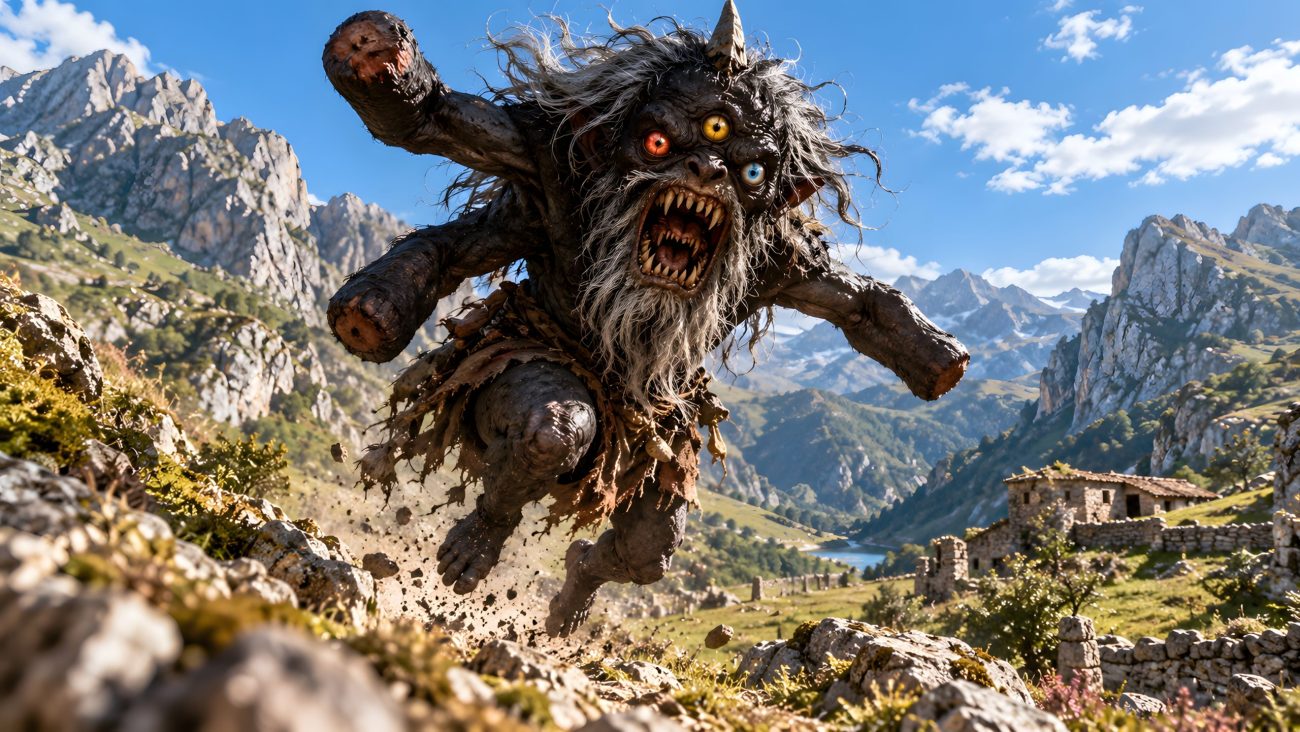
Though small in stature, it walks upright like a man. Its skin is black as soot, its beard long and tangled, its hair grey and unkempt. From its body sprout three arms—yet each ends bluntly, without hands or fingers. Upon its head sits a short, stunted horn, and in its face gleam three terrible eyes: one yellow, one red, and one blue. When it opens its mouth, five rows of teeth are revealed, layered deep within like the jaws of some monstrous trap.

Despite its size, the cuegle possesses enormous strength. It prowls at night, attacking travelers and livestock, dragging them down with ferocity. But most feared of all is its hunger for infants. The cuegle creeps silently into homes and steals babies from their cradles, vanishing into the darkness before anyone can stop it.

Families learned that the creature recoils from certain leaves. Oak and holly are hateful to it. So mothers would place fresh sprigs of oak or holly in the cradle beside their child. The sharp scent and sacred greenery drove the cuegle away, protecting the infant from its grasp.

Thus the people of Cantabria guarded their homes with leaves and vigilance, wary of the small, three-eyed horror that stalked the night.


Sources

Wikipedia contributors. (n.d.). Zana (mythology). In Wikipedia, The Free Encyclopedia. Retrieved February 13, 2026, from https://en.wikipedia.org/wiki/Cuegle


Kazou

Tradition / Region: Japanese Mythology
Alternate Names: —
Category: Mountain dweller


The Myth

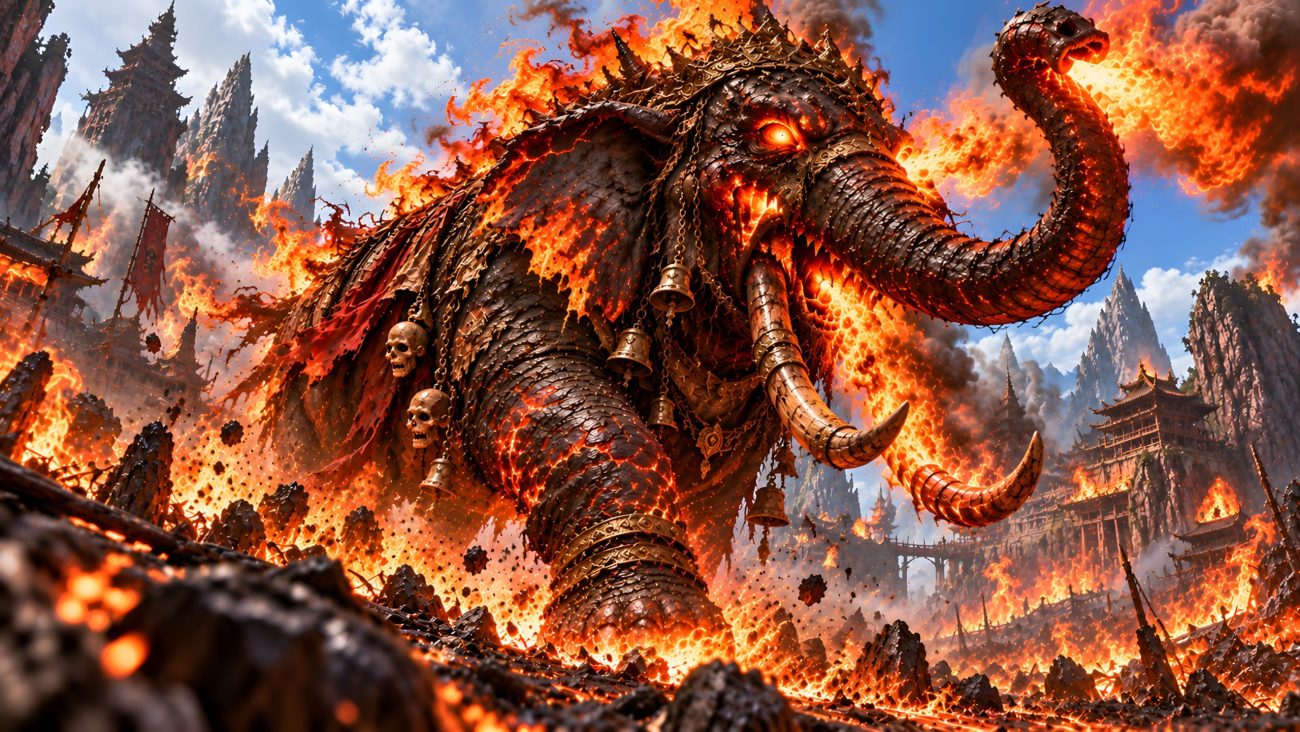
In the depths of the Buddhist cosmos, beyond the human world and far below the mountains that encircle Mount Sumeru, lies the Fire Elephant Hell. There dwells the terrible beast known as Kazou.

This hell is reserved not for the ignorant, but for those who once knew the Dharma. They had entered the Buddhist path, shaved their heads, donned robes, and received the pure precepts of the Tathagata. Yet despite their vows, they succumbed to lust and desecrated sacred images. Their betrayal of faith cast them down into this inferno.

Between the vast Iron Encircling Mountains—those final barriers at the edge of the world—the Fire Elephant Hell burns without end. There stands the great fire elephant, enormous and dreadful. Smoke pours from its mouth and eyes. Flames surge from its body as though its flesh were a furnace.

When the condemned monks are brought before it, they are struck motionless by terror at its overwhelming presence. Paralyzed by fear and the heat of its blazing form, they cannot flee. Horse-headed jailers seize them and hurl them onto the elephant’s back.

With a roar like thunder, the fire elephant charges forward. Its burning hide scorches the sinners. The monks fall from its back into the flames below, where their bodies are crushed beneath its massive feet. Some are trampled into ash. Others are seized in its blazing jaws and devoured.

Yet death offers no release. Day and night, a thousand times over, they die and are reborn in that same place, only to suffer again. The elephant’s flames never dim, and its fury never tires.

Thus the Kazou stands as the terror of the Fire Elephant Hell—an embodiment of burning remorse and unending punishment for those who betrayed their sacred vows.


Sources

tyz-yokai.blog.jp contributors. (n.d.). Kazou. In tyz-yokai.blog.jp, from https://tyz-yokai.blog.jp/archives/1010654402.html


Zana

Tradition / Region: Albanian mythology, Kosovo Mythology
Alternate Names: Zanë, Zërë, Xanë, Zâna, Zónja, Jashtësme
Category: Mountain dweller, Nymph


The Myth

High in the Albanian mountains, where cold springs run clear and forests cling to the slopes, dwell the Zana—wild and radiant maidens of the peaks. Each mountain is said to have its own Zana, who appears as a beautiful young woman with untamed hair and fearless eyes, often seen bathing in hidden streams or wandering among rocks and alpine flowers.

The Zana are guardians of nature—of forests, animals, springs, and the living strength that pulses through human beings. They walk accompanied by wild goats with golden horns, and the air grows tense with power wherever they pass. Though fair in form, they are fierce in spirit. Their courage is unmatched, and in Albanian speech it is said of a brave person: “He is as bold as a Zana.”

They favor warriors. In times of battle, a Zana may watch unseen from the mountainside. If she is pleased by a hero’s heart, she grants him strength beyond mortal limits. In the epic songs of the highlands, the young hero Muji was once found in the mountains by the Zana. They took pity on him and nursed him with their own milk. From that moment, Muji possessed the strength of many men, able to lift boulders and defeat giants. His power was the gift of the Zana.

Yet their favor is not lightly won, and their anger is dreadful. With a single glance, a Zana can paralyze a man, turning him stiff as stone. Those struck by such a gaze are said to be “touched by the Zana,” frozen in body and spirit.

In the northern highlands, the Zana also come by night in threes when a child is born. Like mysterious sisters of fate, they gather around the newborn and decide its destiny. One may grant fortune and health, another hardship and sorrow, and the third death itself. Their whispering shapes the path of a life before it has even begun.

Sometimes they reveal themselves to mortals. A soldier lost in the mountains may encounter a Zana at dusk. She may warn him of danger ahead—or lead him unknowingly toward it. In old tales, a captain once knelt before such a radiant being, believing her divine. She spoke to him gently, yet her words foretold tragedy, and fate unfolded as she had hinted.

The Zana are not bound by human law or morality. They belong to the mountains and to the older rhythms of the world. They can love, grieve, and rage. In epic song, when the maiden Tringa was slain, the Great Zana descended in fury, lifted her fallen companion, and called upon warriors to rise in vengeance. Her cry echoed through the valleys like a battle horn.

They are wild beauty and untamed force. Eternal maidens of the highlands, they move between tenderness and terror, between blessing and doom—spirits of the mountains who grant strength, shape destiny, and vanish like mist at dawn.


Sources

Wikipedia contributors. (n.d.). Zana (mythology). In Wikipedia, The Free Encyclopedia. Retrieved February 13, 2026, from https://en.wikipedia.org/wiki/Zana_(mythology)


Shishikori

Tradition / Region: Japanese Mythology
Alternate Names: —
Category: Mountain dweller


The Myth

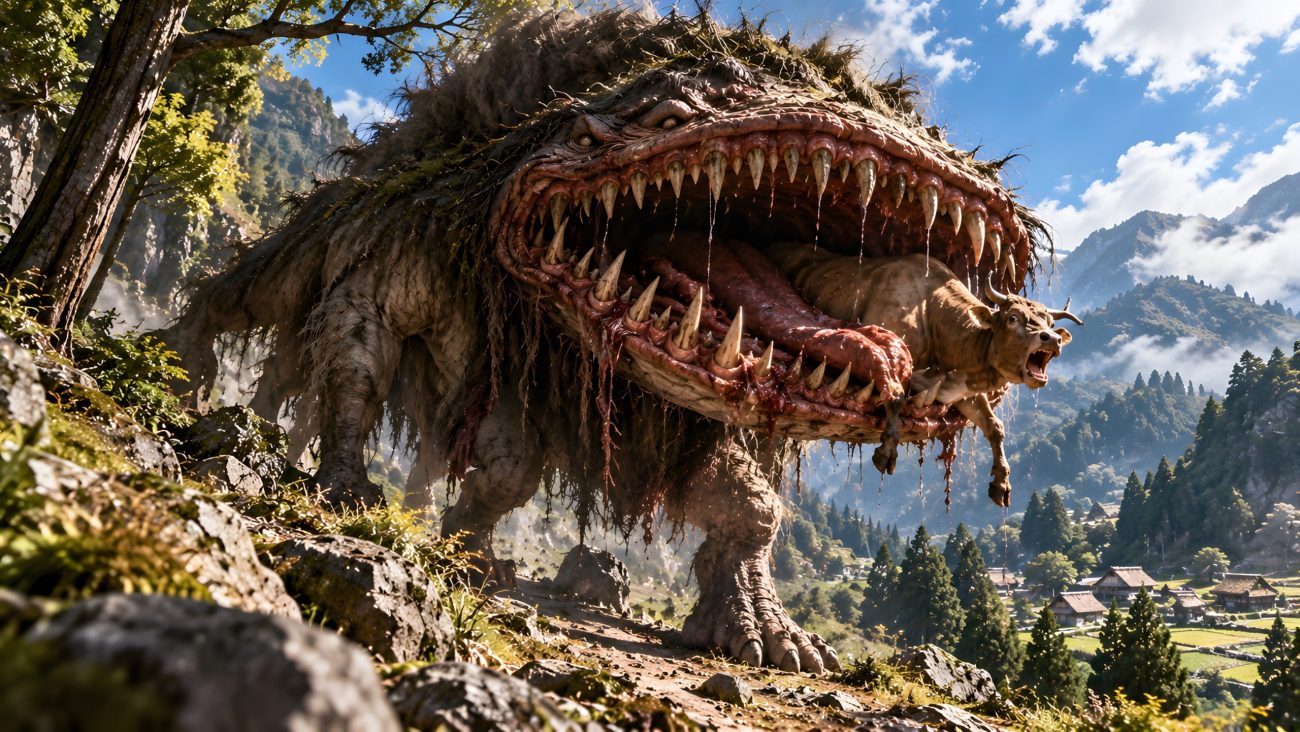
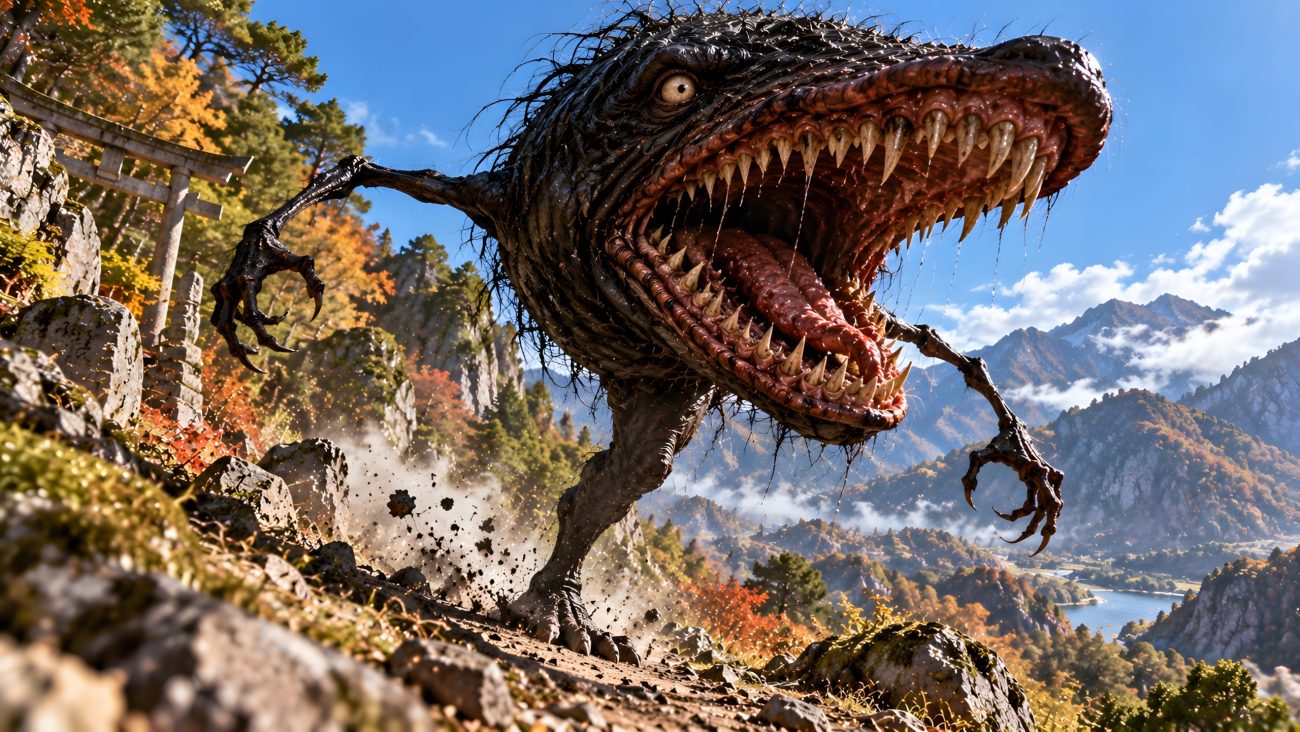
Shishikori is a terrifying monster said to lurk in the mountains of Japan. It has a monstrous appearance resembling other fearsome yōkai known as Otoroshi and Odoroodoro. According to an illustrated scroll depicting strange creatures, Shishikori was six shaku tall and possessed an enormous mouth measuring eleven jō across.

The creature became infamous in the village of Narabayashi in Buzen Province, where the cattle and horses belonging to local farmers began disappearing night after night. Every villager suffered losses except a man named Tōsuke. However, one night, a foul, fishy stench filled the air before the monster finally entered Tōsuke’s stable and swallowed one of his cows whole.

Terrified, Tōsuke fled and reported the incident to the village headman. The following day, the villagers organised a hunt through the surrounding mountains. Following the terrible stench, they discovered a rocky cave where the monster was hiding. Armed with bamboo spears, they attacked and killed the beast.

Afterward, an elderly villager identified the creature as a Shishikori. Its enormous mouth and habit of devouring livestock had made it a deadly threat to the surrounding countryside. The tale remembers Shishikori as a monstrous mountain-dweller whose hunger brought terror to an otherwise peaceful farming village


Sources

TYZ-Yokai Blog contributors. (n.d.). 獅子狩 (Shishikori). In TYZ-Yokai Blog, from https://tyz-yokai.blog.jp/archives/1010654244.html


Suiton

Tradition / Region: Japanese Mythology
Alternate Names: —
Category: Mountain dweller


The Myth

Suiton is a supernatural creature from the Hiruzen Highlands, a mountainous region on the border between Okayama and Tottori Prefectures in Japan. It is said to possess the ability to read people’s hearts, allowing it to recognise those who plot evil deeds or deliberately cause trouble for others.

When Suiton discovers a wicked person, it suddenly appears with a swift sui! and lands upright on a single leg with a sharp ton! It then tears its victim apart and devours them. Knowing that this creature can see through their intentions and punish their wrongdoing, the people of Hiruzen supposedly lived without evil-doers.

Unlike monsters that attack innocent travellers or hunt simply to satisfy their hunger, Suiton acts as a supernatural enforcer of justice. Its ability to read hearts means that hiding behind a respectable appearance is useless when one’s intentions are malicious.

Today, Suiton remains a local symbol of the Hiruzen Highlands. Sculptures resembling totem poles depicting the creature stand throughout the region, and Suiton-themed folk crafts are sold as souvenirs. Its legend continues to remind visitors that wicked actions may carry consequences, even when no human witness is present.


Sources

TYZ-Yokai Blog contributors. (n.d.). 水遁 (Suiton). In TYZ-Yokai Blog, from https://tyz-yokai.blog.jp/archives/1010653984.html


Yamawani

Tradition / Region: Japanese mythology
Alternate Names: Mountain crocodile
Category: Mountain dweller, yōkai, Crocodile


The Myth

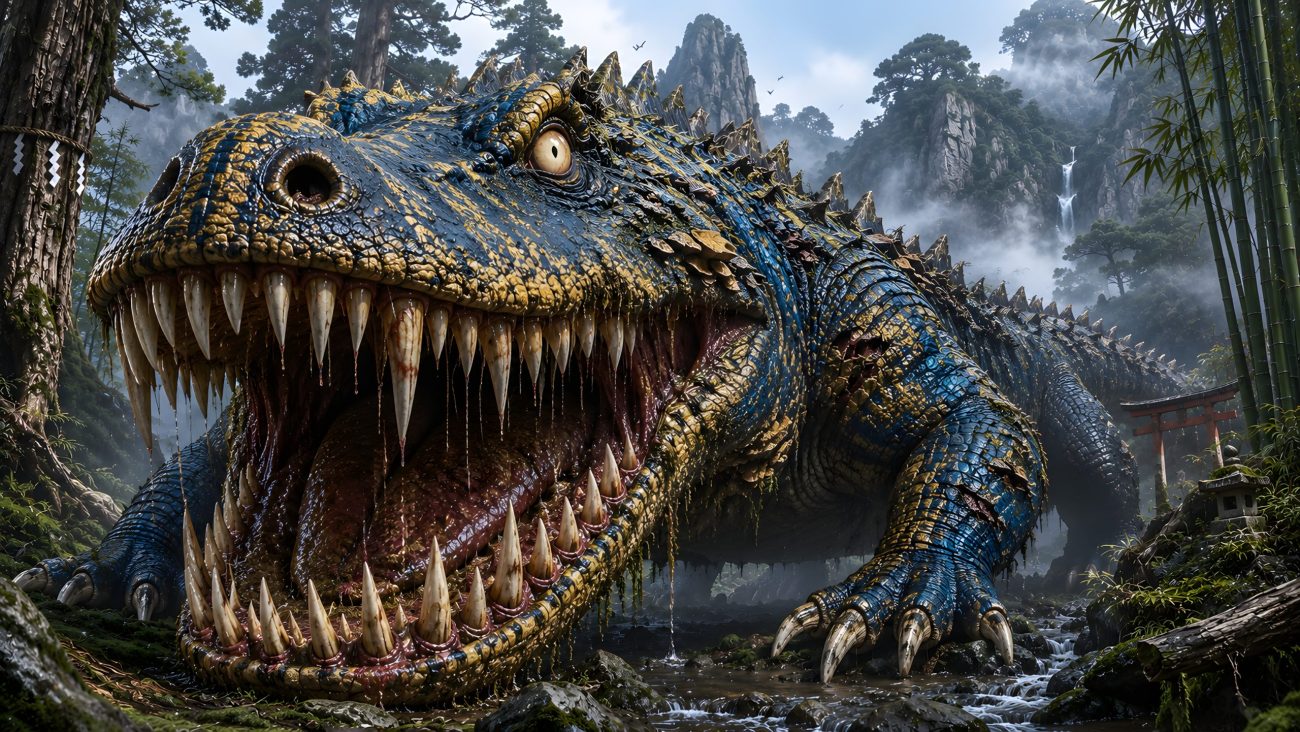
In the old illustrated scroll known as the Tosa Obake Zōshi, there appears a strange creature called the Yamawani—the Mountain Crocodile.

It is shown with a grotesquely large mouth, wide and thick-lipped, dominating its face. Its body is less clearly described than its jaws, for it is the mouth that defines it: heavy, fleshy, and capable of swallowing great things in a single gulp.

In the scroll, the Yamawani is said to speak of its kin. “My cousin lives in the sea,” it boasts, referring to the crocodile or shark of the waters. “He too is thick-mouthed and can lick up anything in one bite.” The creature claims a kind of family pride in its devouring nature. Even the crocodile carved or imagined at temples—known for their gaping jaws—is said to share this thick-mouthed likeness.

The Yamawani’s voice is described as making a peculiar sound—“tickle, tickle”—as though it mutters or chuckles through its massive jaws. Whether this is a threat, a laugh, or simply the grinding of its teeth is unclear.

It is not told that it hunts men, nor that it brings disaster like other mountain spirits. Instead, it lingers in the strange borderland between beast and caricature, a mountain echo of the sea’s crocodile, defined by its monstrous mouth and its unsettling presence in the wilderness.

Thus the Yamawani remains in the scrolls: a thick-mouthed being of the mountains, grinning in silence, its jaws large enough to swallow anything in a single bite.


Sources

TYZ-Yokai Blog contributors. (n.d.). 転倒お化け (Yamawani). In TYZ-Yokai Blog, from https://tyz-yokai.blog.jp/archives/1010653500.html


Nikusui

Tradition / Region: Japanese mythology (Mie–Wakayama mountain border)
Alternate Names: Meat sucker
Category: Vampire, yōkai, Montain dweller


The Myth

On the lonely mountain roads between Mie and Wakayama, travelers once feared to walk by lantern light. For in those dark passes, the nikusui prowled.

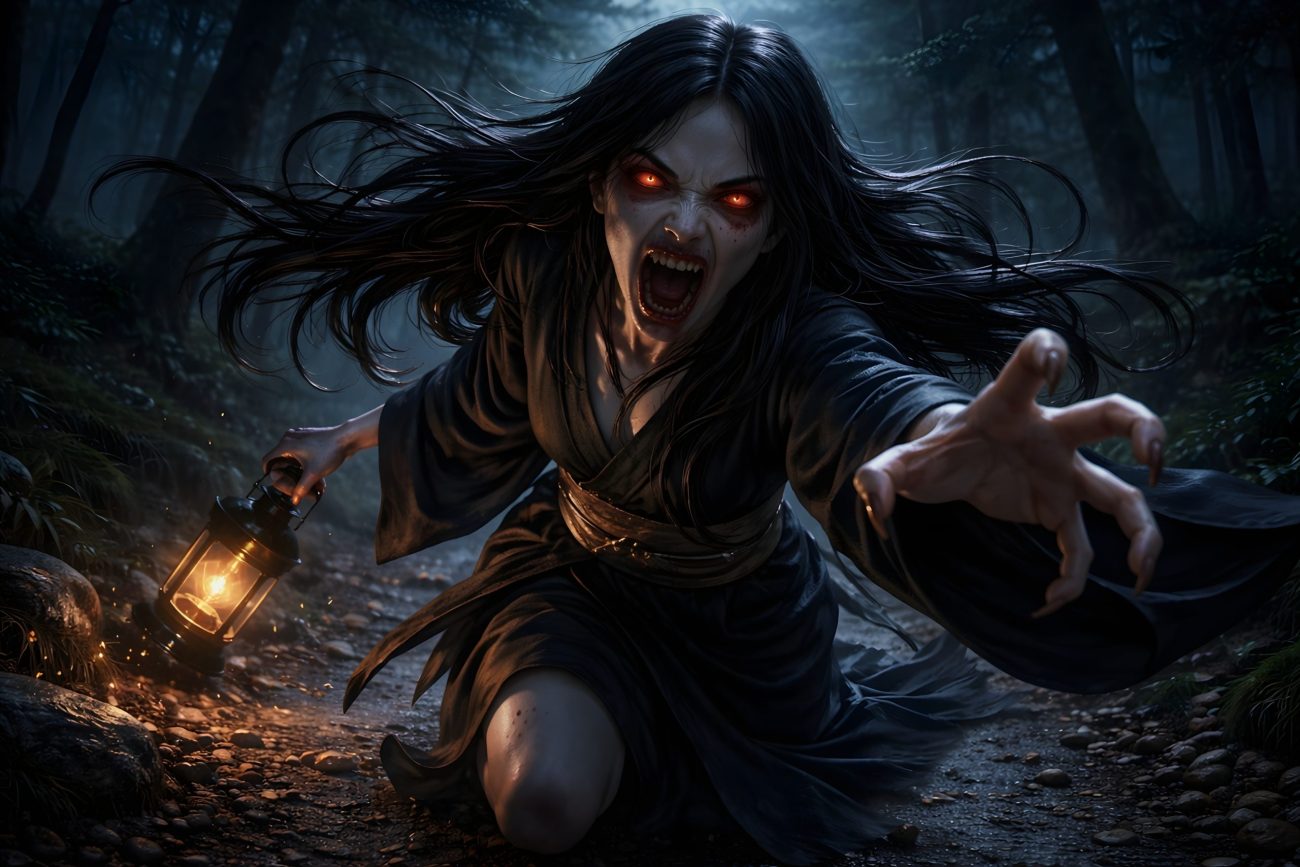
They appeared as young women, no more than eighteen or nineteen years old—beautiful, pale, and smiling softly in the night. They would step from the shadows as if they had been waiting, their laughter a faint “ho ho” that seemed to drift on the wind. Though it was pitch dark, they carried no lantern of their own.

When a young man traveling alone met such a woman, she would speak sweetly and draw closer. She might ask, shyly, to borrow his lantern. If he handed it over, she would snuff the flame at once. In the sudden darkness, before he could even cry out, she would seize him. Her teeth would sink into his body, and she would suck the meat from his bones. By morning, nothing remained but skin and skeleton, collapsed upon the road.

Sometimes the nikusui did not wait in the mountains. They slipped silently into bedrooms, approaching men who slept alone. They used tenderness and desire as their weapon. By seducing and exhausting their victims, they weakened them completely. Then, when the man was helpless, they fed at their leisure, draining his flesh until nothing but a hollow body remained.

Because of these horrors, villagers warned young men never to travel at night without extra light. Those who had no choice carried spare lanterns and burning coals. If a nikusui snatched their light, they could hurl hot embers into the darkness to drive her away.

One hunter named Genzō learned this lesson well. Late one night on Mount Hatenashi, a beautiful young woman appeared before him, laughing softly. She asked for his light. But Genzō felt unease stirring in his chest. He loaded his rifle with a blessed bullet inscribed with a prayer to Amida Buddha and leveled it at her. At once she fled into the dark.

Moments later, the earth shook as a monstrous shape—over six meters tall—charged from the shadows. Genzō fired. The sacred bullet struck true. The creature collapsed.

When he approached, he saw the truth of the nikusui’s form: a loose sack of pale skin draped over a bleached skeleton, empty of all flesh. There was no beauty left—only the hollow remains of what had once devoured others.

And so the mountain roads remained dangerous after dark, where beauty might be only a lantern’s breath away from death.


Gallery


Sources

Yokai.com contributors. (n.d.). Nikusui. In Yokai.com — The Japanese Mythology Database, from https://yokai.com/nikusui/


Interpretive Lenses

Religious Readings
  • Christian Ascetic Deep Dive
Philosophical Readings
  • Nietzschean Deep Dive
Psychological Readings
  • Jungian Deep Dive
Esoteric Deep Dive
  • Hermetic Deep Dive
Political / Social Readings
  • Marxist Deep Dive
Other
  • How to Invite The Nikusui

Igtuk

Tradition / Region: Inuit mythology, Greenlandic Mythology, Canadian Mythology
Alternate Names: The Boomer
Category: Mountain dweller


The Myth

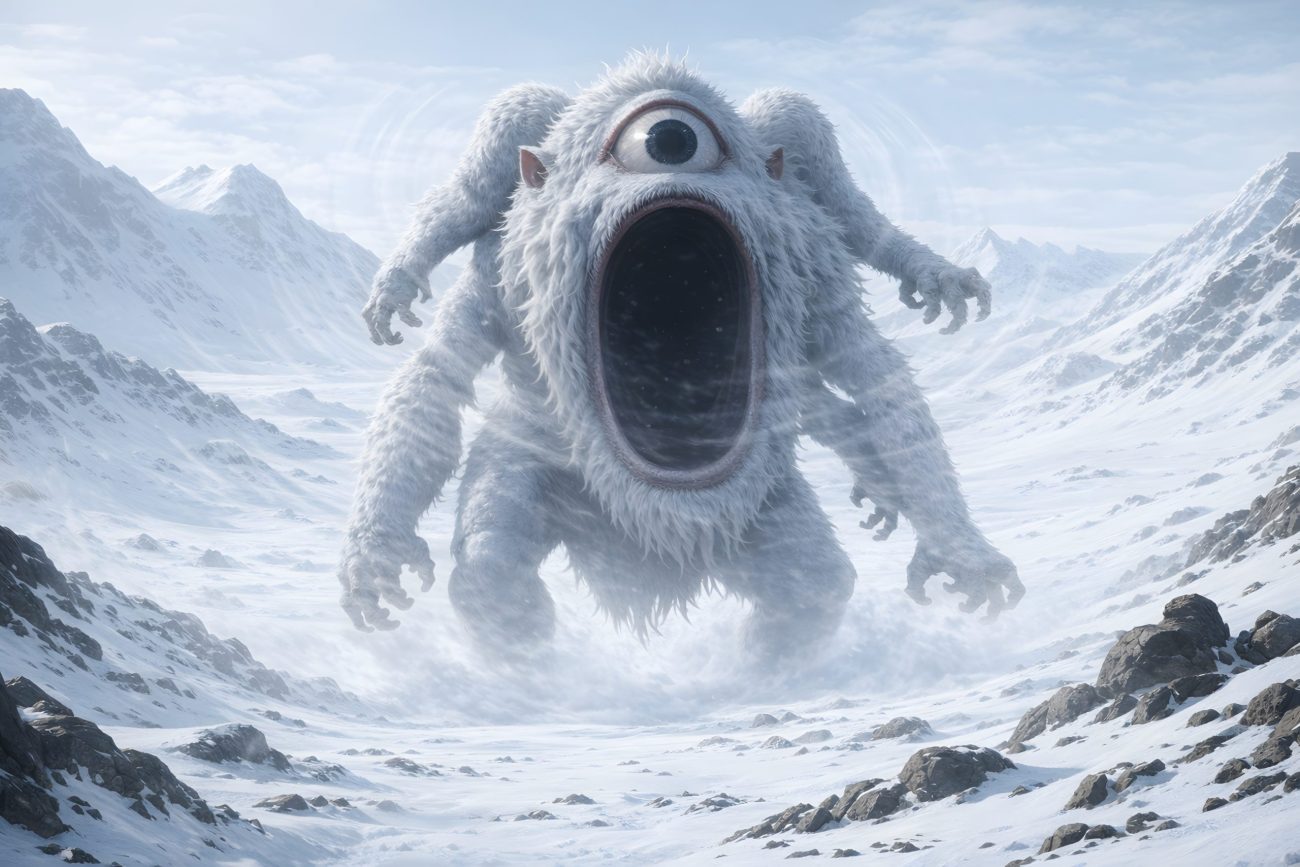
In the far northern lands, when the mountains echo with deep, hollow booming sounds, the Inuit say it is Igtuk who is moving. The sound rolls across the country without warning, rising from the rocks and valleys as if the land itself were breathing.

No one knows where Igtuk lives. He has no fixed dwelling and no trail that can be followed. He is said to be made unlike any other living thing. His arms and legs grow from the back of his body, twisted in a way no human or animal could endure. His great single eye sits level with his arms, staring outward, while his nose is hidden inside his mouth. Beneath his mouth, on his chin, hangs a thick tuft of hair, and his ears lie strangely aligned with his eye.

When Igtuk opens his mouth, it reveals not teeth or a tongue, but a dark, endless abyss. As his jaws move, the booming begins. The sound spreads across the mountains and tundra, shaking the silence and reminding those who hear it that something vast and unnatural is present, though unseen.

The Inuit do not hunt Igtuk, nor do they seek him out. He is not a creature to be challenged or approached. He is simply there—an unseen force whose voice rolls through the land. When the booming echoes across the mountains, people know it is Igtuk making himself known, even if no one will ever see where he stands.


Sources

Rasmussen, K. (1930). Intellectual culture of the Hudson Bay Eskimos.