Tradition / Region: Japanese religious folklore Alternate Names: Kuriekisu, Great Queen of Creation Category: Demon
The Myth
Zobutsu Daijoou is the highest-ranking of the twelve great demon kings described in a religious account of the demon realm. She is said to possess power one hundred times greater than that of an average god and is considered so terrifying that even powerful spiritual masters warned against approaching her. She has a white face, thin black eyebrows, yellow lips, and stands about three feet tall. Her hair rises two feet upward, bends backward, and divides into three sections that fall to her waist. She was said to have come into being when the accumulated shadows at the creation of the world condensed into evil energy.
Among the hundreds of demon leaders said to inhabit the demon realm, twelve hold the highest rank, and Zobutsu Daijoou stands above them all. Each of these demon kings rules a separate domain with their own followers and may bring disaster upon the human world. Alongside her in special distinction is the Queen of the Bottomless Sea, and together they are set apart from the rest.
On the night of July 19, 1880, a procession of these demon kings was said to pass across the sky. Their names were identified as they appeared, with Zobutsu Daijoou recognized as the foremost among them.
Gallery
Sources
TYZ Yokai Blog. (2018). 祖仏大王 (Zobutsu Daijōō). From https://tyz-yokai.blog.jp/archives/1034642738.html
Tradition / Region: Japanese Mythology Alternate Names: Inugami, Inuzuka, Loyal Dog Category: Dog
The Myth
Inugami Myojin refers to dogs worshipped after sacrificing themselves to save their masters from giant snakes. Stories of such loyal dogs exist throughout Japan, and shrines or mounds are often built to honor them.
Long ago, a hunter lived by the Shirajiya River in Goshu and kept a prized dog named Koshiromaru. One day, while hunting deep in the mountains, he took shelter under a rotten tree for the night. Late at night, Koshiromaru began barking repeatedly at him and would not stop. Enraged, the hunter drew his sword and cut off the dog’s head. The severed head leaped onto the rotten tree and bit into the throat of a giant snake that had been hiding there, ready to swallow the hunter. The dog’s head bit the snake to death and saved his master. Realizing the dog’s intention, the hunter mourned and built a shrine on the spot, worshipping the dog as a god. This shrine became known as Inugami no Myojin, and the area’s name was said to come from this event.
Another story tells of a hunter in Mutsu who kept many hunting dogs and spent a night in the mountains inside a hollow tree. Late at night, one dog suddenly woke and barked furiously, leaping toward him. Believing the dog meant to harm him, the man tried to kill it, but when he moved away from the hollow tree, the dog jumped inside and bit a giant snake hiding there. The man then killed the snake with his sword and returned home with the dog, realizing it had saved his life.
Stories of loyal dogs saving their masters from snakes are found in many places, and the dogs are worshipped under names such as Inugami or Inugami Myojin.
Tradition / Region: Japanese Mythology Alternate Names: — Category: Cat
The Myth
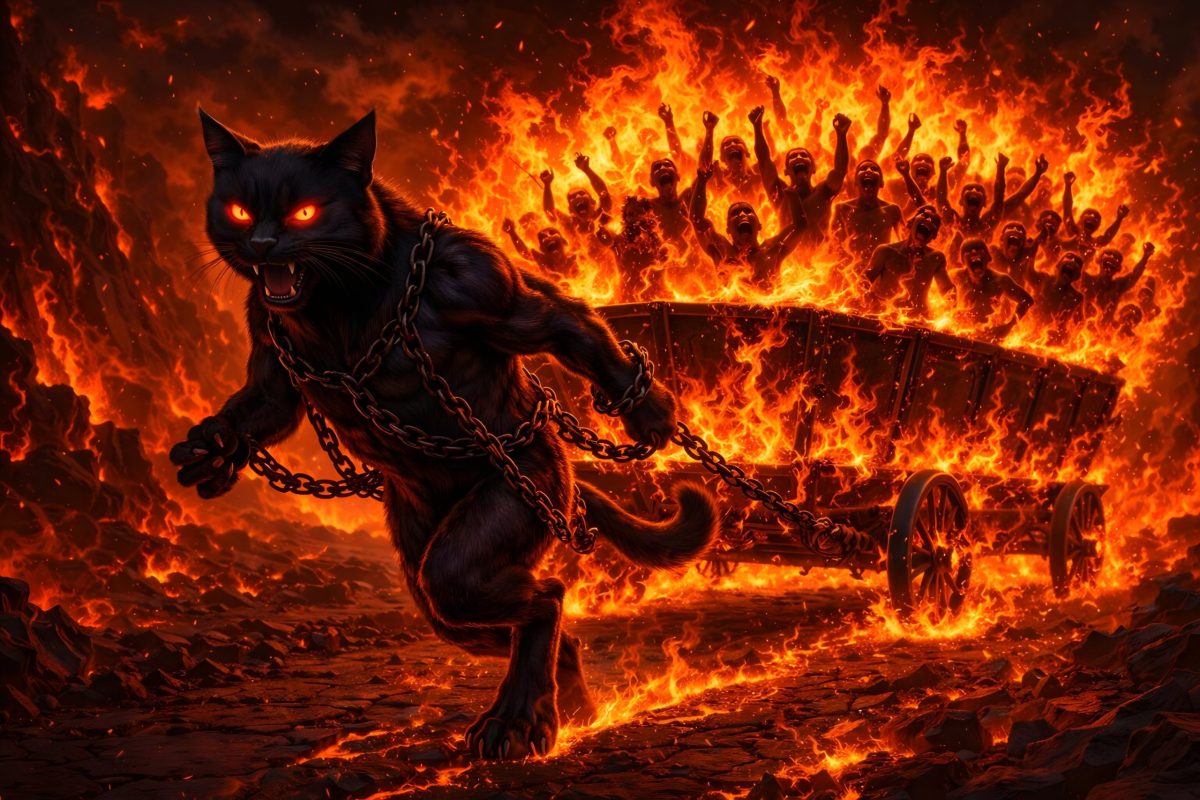
The Kasha is a cat-like yokai associated with death and the punishment of wrongdoers. It is said to carry away the corpses of those who committed crimes, and is often depicted grasping a body while connected to a flaming chariot or fire.
The Kasha appears when a person who has committed wrongdoing dies. It takes the corpse and carries it away, acting as an agent of karmic consequence rather than human judgment. It is portrayed as a cat-like being that may stand upright and seize the body, sometimes shown with a chariot of fire. Images of the Kasha appear in works such as death scrolls and mandalas, where it is shown taking the dead away. Its form varies by region, sometimes more monstrous and sometimes more cat-like, but it is consistently associated with the removal of sinful corpses and the inevitability of moral consequence.
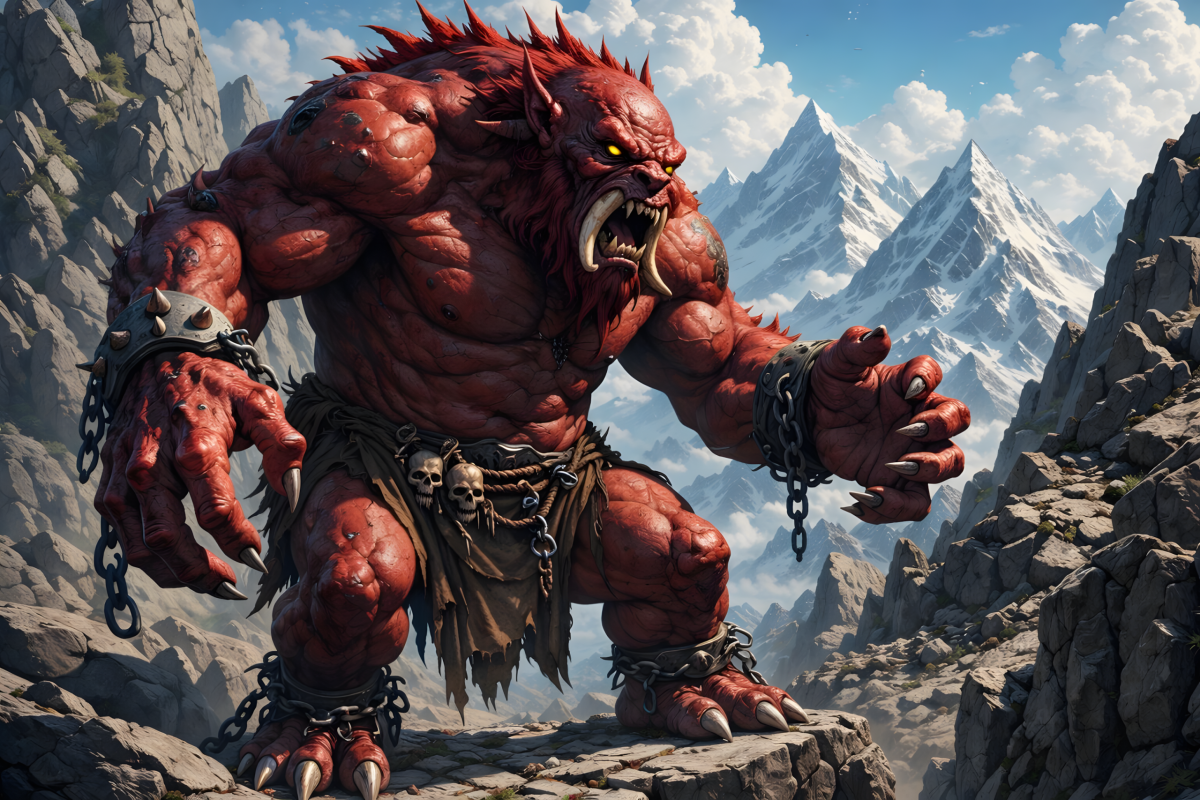
Yama-Otoroshi is a yokai said to inhabit Mount Tsurugi in the Tateyama mountain range. It is described as resembling an ogre with a red face and body and lacking iron bars. It was believed to wait on rocky outcrops and attack climbers.
It was said that before 1907, climbers failed to reach the summit of Mount Tsurugi because the Yama-Otoroshi waited on the rocks, seized them by the collar, and threw them to their deaths. After the Meiji period, the being was said to descend from the mountain and take up residence at temple gates such as Zenkoji Temple. There it grabbed non-believers by the collar and stopped them from passing through. In this form, it was also called simply Otoroshi. An illustration shows the red-faced, two-horned ogre throwing away a climber.
Tradition / Region: Japanse Mythology Alternate Names: Toramishi, Tiger Stone Category: Tiger, Stone
The Myth
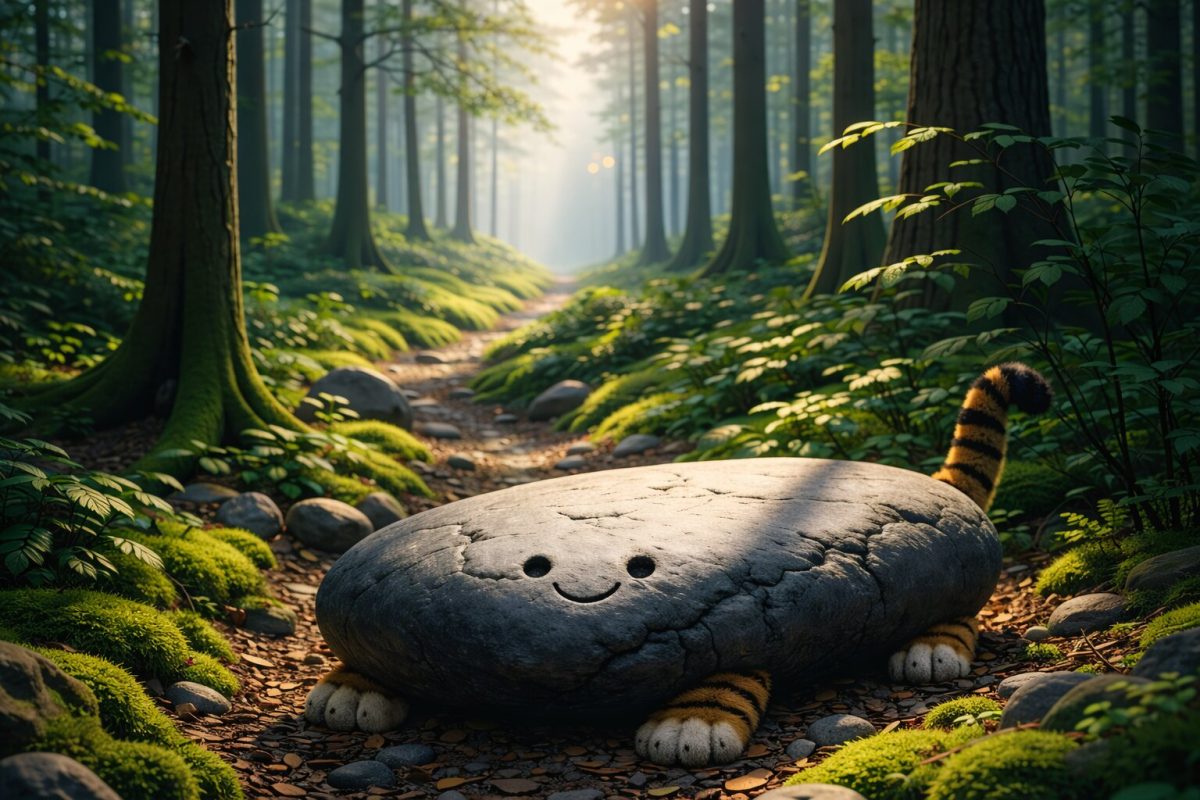
Torakoishi is a legendary stone associated with Tiger Gozen, a courtesan of Oiso-juku known from Soga Monogatari as the lover of Soga Juro Sukenari. A stone kept at Entaiji Temple in Oiso is said to have been given through the power of Benzaiten, and is believed to possess protective and miraculous qualities. It became known as a local curiosity and was publicly shown at certain times.
According to tradition, the stone was connected to a girl born on the Day of the Tiger who grew as she aged through Benzaiten’s power. When assassins sent by Kudo Suketsune attacked, the stone took the form of Soga Juro, blocking the arrows and saving them. The stone at Entaiji Temple is said to ward off evil, grant children, and fulfill wishes when touched, and it was displayed to the public each May. During the Edo period it was known as a roadside attraction and was said that only handsome men could lift it. An 1859 print by Utagawa Yoshikazu depicts the stone with tiger legs and a tail startling passersby, in the style of local monster caricatures.
Tradition / Region: Japanese Mythology Alternate Names: Sleeping Cow with a Broken Neck Category: Cow, Statue
The Myth
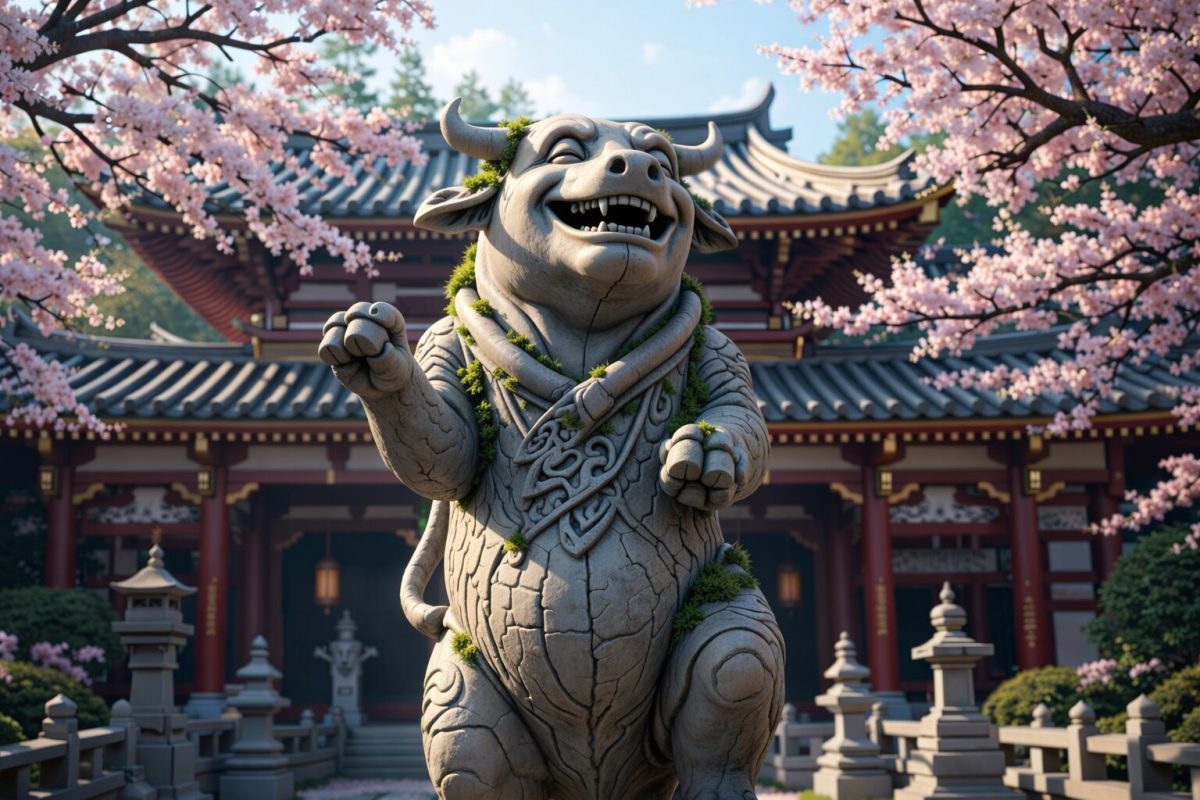
Kubiore Neushi is remembered as a stone cow statue connected to Takimiya Hachiman Shrine in Sanuki.
In the year 888, the land of Sanuki suffered a terrible drought. Rivers dried up, rice fields withered, and the villagers feared famine. Sugawara no Michizane, then governor of the province, fasted, purified himself, and climbed Mount Shiroyama to pray for rain.
At first, the heavens sent firestones and then pebbles, which frightened the people, but Michizane continued his devotions. On the final night of his ritual, the god of Mount Shiroyama appeared to him in a dream and told him that if he offered even a single drop of water to the heavens, a heavy rain would come.
Michizane threw his ink-soaked brush into the sky. At once, black clouds gathered, thunder rolled, and rain poured over the land. The dying crops revived and the villagers rejoiced. They gathered at Takimiya Hachiman Shrine and danced in celebration.
It is said that the joy of that day was so great that the stone cow statue before the shrine joined the dance. In its enthusiasm, the cow broke its neck and became known as the Sleeping Cow with a Broken Neck. The villagers preserved their celebration as the Takimiya Nembutsu Dance in memory of the rain and the event.
The Angalapona is a human-like being smaller than a grown person, only slightly larger than a child. It lives in water but is never wet, dwelling in a cave beneath the water into which no water enters. It moves through the water by a turning door and passes back and forth without becoming soaked. Its hair is very long, nearly reaching the ground when it stands. It is regarded as a director of divination and the foretelling of fortunate days, and diviners call upon it when working oracles.
A woman named Renisoarahanoro was once in an uninhabited place when the Angalapona called to her by a name pleasing to it. It led her toward its dwelling, and they passed through the water without becoming wet. When they reached the cave, she refused to go farther and stayed at the entrance. She would not eat its food, such as raw eels and crayfish, and because she remained by the doorway her clothes became covered in water-plants. The Angalapona and his wife decided to send her home, but first they granted her the power of divination. After that, people consulted her for this purpose.
Another person, Rainitsimanahy, said that while he was in an uninhabited place, an Angalapona came to him at night and wished him to be its husband. When he refused, it followed him continually.
Many people say they have seen this being, especially those afflicted with a disease called jila.
Gallery
Sources
Sibree, J. (1896). Madagascar before the conquest: The island, the country, and the people, with chapters on travel and topography, folk-lore, strange customs and superstitions, the animal life of the island, and mission work and progress among the inhabitants. New York: Macmillan; London: T. F. Unwin.
Tradition / Region: Latvian mythology Alternate Names: Putiene Category: Dragon
The Myth
Putis is a fire-breathing, many-headed dragon in Latvian folklore that lives in or near water. When tamed, it brings wealth to a household by stealing food and money from others at night and carrying them through the air while appearing as a flying flame. A domesticated putis lives in farm outbuildings, must be fed blood and given sacrifices, and can be killed with a silver bullet.
According to legend, a farm owner may obtain a putis by buying one or by selling their own soul, or the soul of someone close to them, to the devil or to the putis itself. Once bound to the household, the dragon steals goods from neighbors and brings them home to its master.
However, the price of keeping such a creature is severe. The master of a putis is said to die in agony and find no peace after death, unable to receive God’s blessing.
Laumė is a fairy-like woodland and sky spirit in Eastern Baltic mythology. She was originally a sky being but came to earth and is associated with clouds, rain, and natural places such as forests, lakes, and swamps. Laumės can shapeshift and appear as animals or as women with animal features. They are linked to weaving, spinning, weather, and fate. They may be dangerous, harming men and women, but they also help the needy, care for children, and act as guardians of orphans. In Latvian belief, Lauma assists at birth, protects children, and spins the cloth of life.
In Lithuanian belief, Laumės were considered among the oldest goddesses, possibly formed in very early times. They could appear as mares, goats, bears, or dogs, or in human-like form with bird claws, a goat’s head or lower body, or a single eye. They were said to have large breasts with stone nipples, which were associated with belemnite fossils found on the ground.
Laumės were feared by both men and women. If a Laumė lost her yarn, she could use women’s hair, veins, or entrails instead, killing them and grinding their bones. Toward men, Laumės felt desire, luring them, exhausting them, and then consuming their bodies. They were also believed to keep great cows whose remains were likewise linked to fossil stones, and they were said to fear iron tools.
Some traditions described Laumė as a cloud-dwelling goddess seated on a diamond throne. In some stories she was the wife of the thunder god Perkūnas; in others, the bride of Perkūnas was a Laumė named Vaiva, whose ribbon was the rainbow. Another tale tells of a Laumė who loved a mortal man and bore a son named Meilius. The highest god discovered the child, placed him among the stars, and cut off Laumė’s breasts, whose stone pieces were said to fall to earth.
Laumės were believed to descend from the sky and live near lakes, bath-houses, islands, forests, rivers, swamps, and meadows. They gathered especially during the new or full moon, danced, sang, and left rings in the grass. They were thought able to cause rain, hail, and storms through song, dance, or curses. Songs attributed to them were performed at weddings, sometimes in dances meant to bring rain. They were also connected with weaving and often appeared in groups of three.
They were said to love children, help the hardworking, and punish the lazy or those who mocked them.
One tale tells of a woman who forgot her sleeping child in a field. When she returned, a Laumė called out gently and returned the unharmed child, giving gifts to the mother because she worked hard. Another woman, jealous, abandoned her own child deliberately. When she returned, the Laumės said she had left the child in greed, and the child had been tortured and died.
Another belief held that Laumės foretold the fate of newborns by calling from outside the window, speaking of the child’s future depending on the hour of birth.
In Latvian tradition, Lauma was believed to assist during childbirth and ensure the well-being of mother and child. If the mother died or abandoned the child, Lauma became a spiritual foster mother. She spun the child’s life-cloth but mourned the fate woven into it. Over time, stories said her image declined, and she came to be seen as an old hag accused of stealing babies, though she longed to return to her former form.
Gallery
Sources
Wikipedia contributors. (n.d.). Lauma. In Wikipedia, from https://en.wikipedia.org/wiki/Lauma
Mythus Wiki contributors. (n.d.). Lauma. In Mythus Wiki, from https://mythus.fandom.com/wiki/Lauma
Encyclopaedia Britannica. (n.d.). Lauma. From https://www.britannica.com/topic/lauma
At the old Newgate Prison in London, there was once said to haunt a terrible creature known as the Black Dog of Newgate.
The story tells that during a time of famine, when hunger and misery gripped the land, a scholar was imprisoned there. He had a reputation as a sorcerer, a man said to have practiced dark arts. The prison conditions were so dreadful that the inmates, driven mad with starvation, killed and ate him.
Not long after this deed, something began to move through the prison in the night.
Prisoners reported seeing a monstrous black dog pacing the corridors and the cells. It appeared suddenly and vanished just as quickly, but its presence filled the place with dread. Those who had taken part in the killing believed the creature was the spirit of the murdered man, returned in a new form to avenge himself.
One by one, the prisoners who had been involved were said to die horribly, as though hunted down by the spectral beast. Fear spread through the prison until the survivors, half-mad with terror, broke out and fled.
But the story says the black dog did not stop there. It followed the escapees wherever they tried to hide, pursuing them until each had paid for the crime.
The tale was later told as a warning about cruelty, sin, and the brutal life within the prison walls. Some even doubted whether the beast was real at all, claiming the only “black dog” in the prison was a dark stone in the dungeon where condemned prisoners sometimes dashed out their brains in despair.
Yet the legend endured, and the image remained of a great black hound stalking the halls of Newgate — a spirit born from murder, hunger, and guilt, returning to claim the lives of those who had done wrong.